


.png?width=27&height=27&name=Group(1).png)

-1.svg)
-1.svg)


-2.svg)


%201-1.webp?width=148&height=74&name=our%20work%20(2)%201-1.webp)




.svg)





When an agentic AI implementation fails in production, teams almost arrive at the same question last: why did we choose this framework?
But- it should have been the first question asked.
Reason- most of those failures will not trace back to the wrong use case. They will trace back to the wrong agentic AI framework, chosen without sufficient evaluation and locked in before the real requirements surfaced.
Teams building agentic systems today have no shortage of options. What they lack is a clear lens for evaluating them against production realities.
 Generate
Key Takeaways
Generate
Key Takeaways

- Wrong framework choice surfaces as a scaling problem, not an early failure.
- Memory architecture is the most underrated agentic AI selection factor.
- LLM lock-in becomes costly when model benchmarks shift.
- Native observability directly reduces production debugging time.
- Governance requirements must drive framework selection, not follow it.
What Is an Agentic AI Framework
An agentic AI framework is the orchestration layer that enables autonomous AI agents to plan, select tools, manage memory, and execute multi-step workflows without constant human input. It is not an LLM wrapper. It is not a prompt chain.
Understanding how agentic AI works at the framework level defines the ceiling of what your agentic AI systems can do in production. Where a standard AI pipeline takes input and returns a single output, an agentic framework enables agents to decompose complex tasks, call external tools, coordinate with other agents, and maintain state across interactions.
The framework governs all of it, including error handling, state management, and how agents communicate in multi-agent setups. Building agentic AI systems on the wrong foundation is not a performance problem. It is a re-architecture problem.
Also Read: Top AI Agent Frameworks- Features, Comparisons & Use Case
The Landscape Is Fragmented by Design
Every agentic AI framework was built around a specific mental model of how intelligent systems should operate. Selecting one means inheriting those assumptions, including the ones that will conflict with your architecture at scale.
1. LangGraph structures agentic workflows as directed acyclic graphs, giving teams explicit control over state transitions in complex, stateful multi-step workflows.
2. AutoGen centers on multi-agent conversation patterns where autonomous agents negotiate tasks through natural language without constant human input.
3. CrewAI assigns specialized agents to defined roles within coordinated multi-agent setups, organizing task execution around role-based team structures.
4. Semantic Kernel targets enterprise environments running .NET or Python stacks, with modular components for plugin-based orchestration at enterprise scale.
5. Bedrock Agents integrates natively into AWS infrastructure, enabling teams to build agentic workflows within a managed cloud environment across multiple regions.
6. LlamaIndex Workflows suits event-driven, data-heavy agentic pipelines that rely heavily on vector databases and retrieval-augmented execution.
The mismatch between these embedded assumptions and your use case is where projects get expensive.
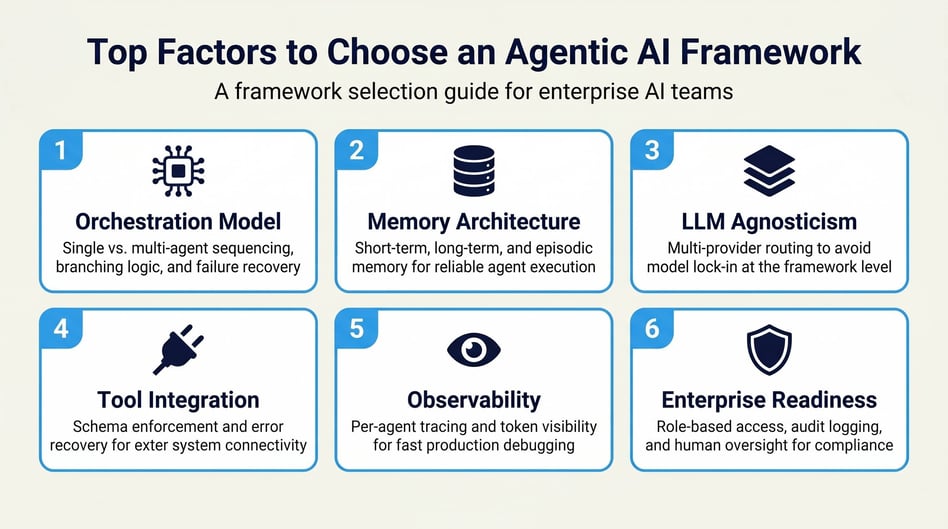
Factor 1: Orchestration Model
The orchestration model determines how the agentic AI framework sequences tasks, manages branching logic, and recovers from failures mid-execution. It is the most fundamental differentiator between different frameworks and the one most teams underweight during evaluation.
Single-agent architectures work well for isolated tasks with linear execution paths. Multi-agent orchestration becomes necessary when the problem requires parallel processing, with specialized agents handling specific subtasks and feedback loops running between agents. How the framework handles agent behavior, task decomposition, and communication with other agents governs how far the system scales before it breaks.
Key evaluation questions:
-
Does the framework support explicit control over state transitions, or does it rely on model-driven decisions with limited predictability?
-
Can the orchestration logic handle multi-agent coordination at enterprise scale without manual state management?
-
How does the framework handle failure in agentic workflows: retry, reroute, or surface for human oversight?
Factor 2: Memory Architecture
Memory is where most agentic AI implementations fail quietly. A framework must handle three types: short-term memory, which is in-context session state; long-term memory, persisted via vector databases or relational stores; and episodic memory, which records past agent interactions and outcomes across tasks.
Not all agentic frameworks handle all three natively. Some leave memory management entirely to the developer, requiring custom retrieval layers and session scoping from scratch.
In enterprise environments running long agentic workflows against high-quality data, memory bleed across sessions and context overflow are two of the most consistent production failure modes. The framework either prevents them by design or it does not.
Factor 3: LLM Agnosticism and Model Portability
Most agentic frameworks claim broad compatibility with large language models. Actual portability varies. Some are deeply optimized for one provider's function calling format and require significant rework to support other AI models.
What to verify before committing:
-
Does the framework support multiple LLM providers natively, or is one provider assumed throughout?
-
Can different agents within the same multi-agent setup use different AI models for different tasks?
-
How much rework does swapping the underlying generative AI model require in a live production environment?
In distributed systems with high query volumes, the ability to route between AI models based on cost, latency, or task type is a direct operational lever. Locking into one provider at the framework layer eliminates that option at the point it matters most.
|
Framework |
Orchestration |
Memory |
LLM Flexibility |
Best Fit |
|
LangGraph |
Stateful DAG |
External (customizable) |
High |
Complex stateful multi-step workflows |
|
AutoGen |
Multi-agent conversation |
Basic in-context |
High |
Collaborative multi-agent coordination |
|
CrewAI |
Role-based teams |
External |
Moderate |
Task-oriented crew deployments |
|
Semantic Kernel |
Plugin-based pipeline |
Native + external |
High |
Enterprise .NET/Python environments |
|
Bedrock Agents |
Managed cloud orchestration |
AWS-native |
AWS + external |
AWS-embedded enterprise stacks |
|
LlamaIndex Workflows |
Event-driven graph |
Native vector retrieval |
High |
Data-heavy retrieval pipelines |
Factor 4: Tool Integration and the MCP Standard
External tool integration gives autonomous AI agents their operational reach into enterprise systems. The framework must handle tool registration, schema enforcement, execution sequencing, and error recovery across every tool call. Poorly scoped tool integration forces agents to rely heavily on unvalidated responses, which is a direct path to tool call hallucination in multi-agent workflows.
The Model Context Protocol (MCP) is gaining adoption as a standard for how AI models connect to external tools and data sources. Frameworks that support MCP-compatible tool use reduce the overhead of maintaining custom connectors across external systems, enabling teams to automate tasks across complex enterprise environments without building bespoke integration layers for each one.
Factor 5: Observability and Debuggability
Agent behavior in production is non-deterministic. A workflow that ran correctly in development can fail live because a tool returned an unexpected schema, an AI model chose a different execution path, or a memory retrieval surfaced irrelevant context. Without native tracing, debugging requires reconstructing agent behavior from raw logs.
Watch for these gaps:
-
Does the framework provide per-agent execution traces or only aggregate output logs?
-
Is there visibility into tool call inputs and outputs, not just final agent responses?
-
Does the framework expose token usage at the per-agent and per-task level?
Operational reliability in agentic systems depends as much on visibility as on correctness. Frameworks that treat observability as optional make production debugging significantly more expensive.
Factor 6: Enterprise Readiness and Human Oversight
Enterprise deployment of agentic AI systems requires governance capabilities that go beyond functional correctness. These are selection criteria, not post-deployment configurations.
-
Audit logging: Every tool call, agent decision, and task execution requires a traceable record. In regulated industries this is a compliance requirement, not an operational preference.
-
Role-based access control: Agent-level access scoping is a baseline requirement in enterprise environments where multiple human agents and autonomous systems share the same infrastructure.
-
Human-in-the-loop controls: Specific agentic decisions, particularly those where agents are executing actions against live enterprise data, require explicit human approval checkpoints. Framework support for this varies widely.
Deployment flexibility: Private cloud and air-gapped support is non-negotiable for teams operating under data residency requirements across multiple regions.
Where Agentic Frameworks Fail in Production
The failure patterns across real deployments are consistent:
-
Infinite loops occur when multi-agent coordination lacks termination conditions. Without explicit exit logic in the orchestration layer, task execution continues and costs accumulate indefinitely.
-
Tool call hallucination happens when autonomous agents invoke functions using argument schemas that do not match registered tool definitions. A framework-level gap in schema enforcement during function calling.
-
Context overflow surfaces in long-running agentic workflows where memory management is inadequately scoped, causing agents to lose relevant context progressively over time.
-
Runaway token usage develops when task decomposition generates more subtasks than the orchestration logic can govern in complex environments.
These are not edge cases, but framework-level design decisions surfacing as runtime errors. They are selection criteria in disguise.
Conclusion
The right agentic AI framework is not the most popular one. It is the one whose orchestration model, memory architecture, tool integration depth, and governance features align with the actual requirements of your production environment.
Map the task graph first: single agent or multi-agent, stateful or stateless, cloud-native or privately deployed. The building blocks a framework provides should fit the problem naturally.
When teams find themselves writing workarounds to close the gap between the framework and the use case, the framework was the wrong choice to begin with.

Mangesh Gothankar


Ashwani Sharma
Achin Verma
Frequently Asked Questions
Have a question in mind? We are here to answer. If you don’t see your question here, drop us a line at our contact page.
What is an agentic AI framework and how does it work?

An agentic AI framework is an orchestration layer enabling autonomous AI agents to plan, use tools, manage memory, and execute multi-step workflows. It governs task decomposition, state management, and agent communication throughout the entire task lifecycle.
How does an agentic AI framework differ from a standard AI pipeline?
Standard pipelines return a single output per request. An agentic framework enables iterative execution where agents decompose complex tasks, call external tools, and coordinate with other agents across multiple decision-making cycles without constant human input.
Which agentic AI framework works best for multi-agent systems?
It depends on coordination requirements. LangGraph suits stateful complex workflows. AutoGen fits collaborative multi-agent coordination. CrewAI is built for role-based agent structures. Match the orchestration model to your task graph before selecting a framework.
What causes most agentic AI implementations to fail in production?
Common failure modes are infinite loops, tool call hallucination from schema mismatches, context overflow in long-running workflows, and runaway token usage. Most trace back to framework-level decisions made during initial selection.
Do agentic AI frameworks support human-in-the-loop controls for enterprise use?
Support varies widely. Some provide native checkpoints where agents pause for human approval before executing specific actions. Others require full custom implementation, adding significant complexity in regulated enterprise environments.






.png?width=352&name=What%20Is%20Autonomous%20AI%20and%20How%20Does%20It%20Work%20(1).png)