

.png?width=27&height=27&name=Group(1).png)

-1.svg)
-1.svg)


-2.svg)


%201-1.webp?width=148&height=74&name=our%20work%20(2)%201-1.webp)




.svg)





Most enterprises don't have one data problem. They have dozens of smaller ones living in transactional databases and SaaS tools. They even exist with event streams and IoT sensors, and in files nobody remembers creating.
By 2026, Gartner expects 60% of AI initiatives to be scrapped because the data behind them was never ready. Only 37% of data leaders say they actually trust their own data practices.
That fragmentation shows up everywhere downstream. Analytics slow to a crawl. Forecasting and automation hit a ceiling. A model can only be as reliable as the pipeline feeding it, and most pipelines right now are not built for that job.
Data engineering solutions are the answer to this problem. When they work, ad hoc extracts turn into governed, observable pipelines. Those pipelines move data from source systems out to the people who need it, and increasingly to the AI agents that need it too.
Fivetran's 2026 benchmark found that legacy, do-it-yourself pipelines fail 30-47% more often than managed platforms. That failure rate puts close to $3 million a month in downtime exposure on the table at large enterprises.
This guide walks through what data engineering solutions for enterprises actually involve. It covers the architecture, the pipeline types, and the practices that hold up at scale. It also covers where a dedicated data engineering services partner earns its budget.
 Generate
Key Takeaways
Generate
Key Takeaways

- Data engineering turns scattered information into meaningful information AI actually needs to run.
- Pipelines now handle ingestion and transformation while also running quality checks and monitoring.
- Batch and streaming, each shapes cost and latency, but reliability depends on the mix.
- Governance and DataOps practices lower compliance risk, and they build real trust in data.
What Are Data Engineering Solutions?
Data engineering solutions are the platforms, pipelines, and day-to-day practices that collect and move data. They're what connects source systems to the dashboards and applications people use, and to the AI models that increasingly need that same data too.
Traditional data engineering usually meant a single team, a single warehouse, and a handful of nightly batch jobs feeding a handful of reports. Enterprise data engineering is a different kind of problem. A large organization can run hundreds of source systems spread across dozens of business units, and the residency rules for where that data can even sit shift from one country to the next.
Accuracy, timeliness, and security are still the goal. Getting there is just harder now because there's so much more ground to cover, more systems, more teams, more rules to track all at once. That's the work data engineering services get paid to do, from architecture consulting and platform builds to the ongoing tuning that keeps a pipeline running well after launch rather than just on day one.
Data Sources > Ingestion > Processing > Storage > Analytics & AI
Every later decision in this guide sits somewhere on that line. This includes batch or streaming, warehouse or lakehouse, and build or buy.
Core Components of Enterprise Data Engineering Architecture
An enterprise data engineering architecture is the set of layers that decide how data moves. These layers include sources, ingestion, transformation, storage, and governance.
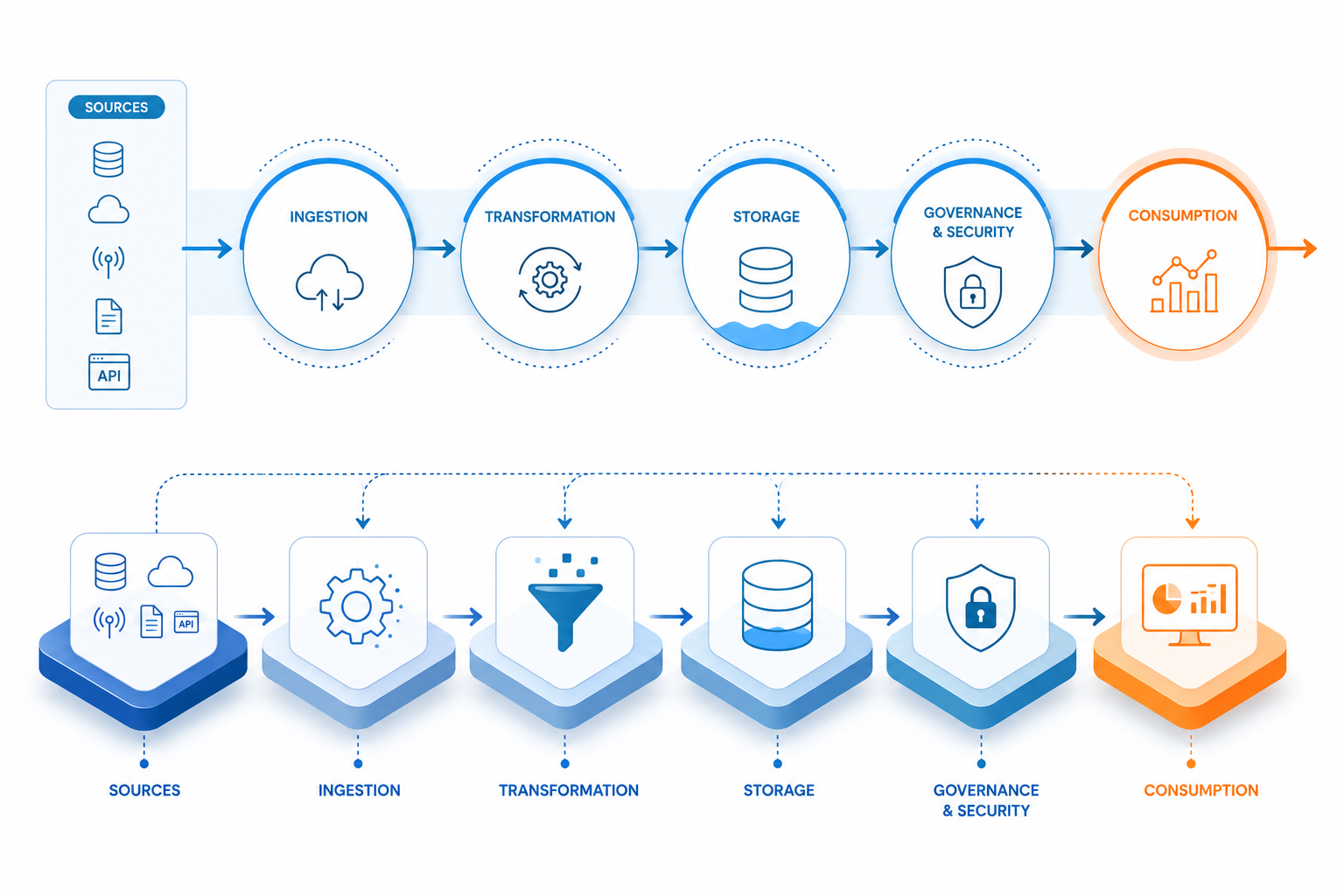
Sources, Ingestion, and the Batch vs. Streaming Call
Enterprise data typically comes from relational databases as well as SaaS platforms and event streams. When in use, IoT devices add another layer, and a long tail of flat files and APIs fills in the rest. Each source behaves differently. A Salesforce export changes shape without warning. A Kafka topic never stops. A legacy ERP table might not even have a reliable updated at column.
The ingestion layer has to absorb that variety. Batch ingestion still works well for finance close and historical reporting, or really anything where a few hours of latency is fine. Streaming ingestion runs on Kafka, Kinesis, or Pub/Sub. It is what fraud detection, personalization, and operational dashboards actually require.
Change data capture sits in between. Instead of re-scanning a whole table, it reads the database's change log and streams only what moved. This cuts load on production systems. Also, it shortens the gap between an event happening and the data team knowing about it.
-
Schema validation at ingestion: Every incoming record is checked against expected column names, data types, and null constraints. This is a standard process before it moves downstream. Also, the approach catches a broken upstream export before it reaches a dashboard.
-
Batch ingestion: It moves data on a schedule, hourly or nightly. It is simple to run and cheap to operate. Also, it fits any use case where a few hours of delay is acceptable.
-
Streaming ingestion: It moves events continuously as they occur, usually through Kafka, Kinesis, or Pub/Sub. It costs more to run but is the only option for fraud detection and live dashboards.
-
Change data capture (CDC): It reads a database's change log instead of re-scanning full tables. The process lowers load on production systems. Also, it reduces the delay between a change happening and the data team seeing it.
ETL vs. ELT: Choosing a Transformation Pattern
Both patterns move data from source to destination, but the order of operations differs. Data arriving raw is not useful yet. It has to be validated and deduplicated before it is joined against reference data. It helps to reshape the data for the systems that will consume it.
-
ETL (Extract, Transform, Load): Data is cleaned and shaped before it loads into the destination. This suits regulated pipelines where raw data cannot land untransformed.
-
ELT (Extract, Load, Transform): Raw data lands first, then transforms inside the warehouse or lakehouse using scalable compute. Most enterprises now default to this pattern, and it keeps an immutable copy of the original for audits.
Which to choose?
Pick ELT for cost and flexibility at scale. Pick ETL when compliance demands transformation before data lands anywhere.
Data Warehouse, Data Lake, or Lakehouse
Three storage patterns dominate enterprise data engineering solutions today. Which one fits depends less on trend and more on what your queries and AI workloads actually look like.
-
Data warehouse. Structured, fast, and predictable. Built for SQL queries that power BI dashboards and standard reporting.
-
Data lake. Cheap, flexible storage for structured and unstructured data. Well suited to machine learning and exploratory analysis.
-
Lakehouse. Combines warehouse performance with lake flexibility on a single copy of the data, instead of maintaining two.
How to choose?
Match the pattern to your queries, not to industry trends. A BI-heavy shop leans toward warehouse. An AI-heavy shop leans toward lakehouse.
Orchestration, Governance, and Security
Orchestration, governance, and security are three separate jobs that have to work together, or pipelines become both unreliable and unsafe.
-
Orchestration. Tools such as Airflow, Dagster, and Prefect manage dependencies between pipeline tasks, so a downstream job never runs against stale or half-loaded data.
-
Governance and access control. Role-based access control, encryption, and lineage tracking answer a key question on demand: where did this number come from, and who touched it.
Why does it matter now?
GDPR fines topped 1.2 billion euros in 2025 alone (Kiteworks, 2026), and India's DPDP Act is phasing in enforcement through 2027 (CDS Legal, 2026). Lineage and access control have become audit requirements, not nice-to-haves.
The Consumption Layer
Everything upstream exists to serve this layer. That includes BI dashboards, Machine Learning feature stores, AI agents, and operational applications that read data in real time.
-
Data contracts: Each consumer group needs a clear agreement on what they can access. This includes in what format and at what freshness. Otherwise, five teams build five different versions of monthly revenue.
Related Read: 10 Signs Your Business Is Ready for AI, and 5 Signs It's Not
Enterprise Data Pipelines: Types and Lifecycle
An enterprise data pipeline is the automated sequence that moves data from a source to a decision. It includes collection, validation, transformation, storage, monitoring, and consumption.
Most pipelines follow the same lifecycle regardless of architecture. Raw data is collected, validated against expected schema and ranges, then transformed into a usable shape. It is stored in the right tier, monitored for drift and failure, and finally consumed. What changes between pipeline types is how fast that loop turns.
| Pipeline Type | Best For | Typical Latency |
| Batch | Finance close, historical reporting, model training | Hours |
| Streaming | Fraud detection, personalization, live ops dashboards | Seconds |
| Hybrid | Analytics platforms needing fresh and historical views | Minutes to hours |
| Event-driven | Microservices, inventory updates, IoT triggers | Sub-second to seconds |
Do not default to streaming everywhere. Cost and operational complexity scale with it, and a nightly batch job is still the right answer for a monthly close. Match the architecture to the actual downstream SLA, not to whichever pattern is trending.
Best Practices for Building Enterprise Data Engineering Solutions
The practices below are operating habits, not tools, and they matter more than which vendor you pick.
- Design for scale before you need it: pick partition and cluster columns based on what your queries actually filter by, and update that choice as usage changes.
- Build modular, reusable pipelines: small steps you can test on their own are easier to fix than one giant script nobody wants to touch.
- Catch bad data at ingestion, not in the dashboard: check schema and nulls as soon as data comes in, so problems don't reach an executive's screen.
- Automate orchestration and deployment: keep pipeline code in version control, run it through CI/CD, and roll out changes in stages to catch most bugs early.
- Instrument for observability from day one: set up alerts for latency, throughput, and errors so you find problems before your data consumers do.
- Treat metadata and lineage as a product: a searchable catalog with clear ownership saves analysts from guessing what a column means.
- Adopt DataOps practices: idempotent writes and incremental loads make reprocessing safe and stop compute costs from growing as fast as your data does.
- Review cloud cost and architecture regularly: quarterly checks catch idle compute and forgotten pipelines before they turn into permanent waste.
Common Enterprise Data Engineering Challenges and Solutions
None of these are exotic problems. Fivetran's 2026 benchmark report found that enterprises running 328 pipelines lose roughly 60 hours a month to failures. Data leaders often say these failures have slowed an analytics or AI initiative.
Here are some issues you may encounter with the data engineering process and their respective solutions:
| Challenge | Recommended Solution |
| Data silos | Unified integration architecture with a single ingestion layer |
| Poor data quality | Automated validation rules enforced at ingestion |
| Pipeline failures | Continuous monitoring and observability with proactive alerting |
| Legacy systems | API-based or CDC integration instead of full-table exports |
| Governance gaps | A metadata catalog with enforced lineage tracking |
| Rising cloud costs | Resource autoscaling and scheduled architecture reviews |
The fixes above are not glamorous, but they separate a data team that ships from one that firefights.
Future Trends in Enterprise Data Engineering
Here is a short list of what is actually changing.
• AI-assisted data engineering. Copilots handle boilerplate transformation code and free engineers for architecture decisions.
• Data products. Teams publish governed, documented datasets the way software teams publish APIs.
• Lakehouse adoption. This is moving from early adopter to default for organizations running both BI and AI workloads.
• Data mesh. This decentralizes ownership to domain teams while keeping a shared governance layer.
• Real-time analytics. This is becoming table stakes for supply chain, fraud, and customer experience use cases.
• Intelligent observability. Anomaly detection replaces static, manually written data quality rules.
Automated governance. This includes the context layers Gartner highlighted at its 2026 Data & Analytics Summit. These layers connect raw data to the business meaning AI agents need.
How Data Engineering Services Accelerate Enterprise Transformation?
Building this internally from zero is possible. It is also slow, and most enterprises do not have twelve months to spare before an AI initiative needs reliable data. This is where data engineering services change the timeline.
An experienced partner typically enters at one of a few points. That includes architecture consulting, platform implementation on Snowflake, Databricks, or BigQuery, and cloud migration off legacy systems. It also covers pipeline modernization, governance framework design, and ongoing managed services after go-live. The value is not just speed. It comes from having already made the mistakes that cost other organizations a failed pilot.
Signity's Data Engineering Proficiency
Modern enterprise data platforms require more than technical implementation, they require architects who understand cloud-native infrastructure, governance, scalability, and AI readiness.
Signity helps organizations design and modernize enterprise data ecosystems using leading technologies including Databricks, Snowflake, AWS, Microsoft Azure, dbt, Apache Airflow, and Apache Kafka. Our teams have experience building scalable ETL/ELT pipelines, modern lakehouse architectures, real-time data platforms, and CDC-based integration solutions for data-intensive environments.
Whether you're modernizing a legacy data warehouse, migrating to the cloud, or preparing enterprise data for AI initiatives, our focus is on building secure, scalable, and production-ready data platforms that deliver long-term business value.
Conclusion
Modern data engineering solutions are not a back-office concern anymore. They are the foundation that analytics, automation, and AI get built on. Gartner predicts that six in ten AI projects will be abandoned through 2026 for lack of AI-ready data.
That is the cost of skipping this foundation. Investing in scalable architecture, well-designed pipelines, and real governance separates the winners from the rest. Those winners get measurable value from AI. The rest are still explaining why their pilot never shipped.
Signity's Data Engineering Services team has built and modernized this kind of infrastructure for enterprises across BFSI, healthcare, and retail. We are glad to walk through what that would look like for your environment.

Mangesh Gothankar


Ashwani Sharma
Achin Verma