


.png?width=27&height=27&name=Group(1).png)

-1.svg)
-1.svg)


-2.svg)


%201-1.webp?width=148&height=74&name=our%20work%20(2)%201-1.webp)




.svg)





Suppose you are on a hunt for a waterproof jacket for your next trip to Scotland, and you give ChatGPT a prompt and budget; however, there is no brand name and no defined category. Now, within seconds, the tool will offer you a handful of retailers, and the rest simply don’t exist for the shopper.
This isn't a future scenario anymore. As per the latest research, Adobe Analytics can seamlessly track more than a trillion visits to US retail stores. It was found that AI-driven traffic grew to around 393% year over year in Q1 2026 only. Moreover, the visitors converted at 42%, better than traffic from other sources.
Natural language processing in retail is what lets a system read the words a customer actually used. It works out what they meant, and does something useful with it, whether that's on a product page, in a support queue, or inside an assistant the retailer doesn't own. Most brands already have pieces of this running. Very few have it working end to end.
So here's what we'll get into: where NLP solutions are earning their keep in retail right now, where they quietly fall apart, and what a realistic rollout looks like for a team that doesn't have years to spend on it.
 Generate
Key Takeaways
Generate
Key Takeaways

- Fix search first. It understands what shoppers mean, not just what they typed.
- Containment is not resolution. Measure whether the problem actually got fixed.
- Your catalogue has two readers now: the shopper, and the agent shopping for them.
- Read your own support transcripts before you build anything.
What Natural Language Processing in Retail Actually Means in 2026
NLP is basically a layer that turns a human query into a structured signal, upon which a retail system can act. It powers AI-driven customer service, semantic search, and automated product recommendations, while extracting the intent from unstructured data. The data can be typed or spoken.
It reads intent, sentiment, product details, and urgency. Get those wrong and everything downstream breaks, from search results to refund approvals.
| Dimension | Then (2015–2020) | Now (2021–2025) | Next (2026 onward) |
| What it did | Matched keywords | Understood intent | Takes action |
| Customer types | "red running shoes" | "shoes for flat feet, long runs" | "reorder my usual, but a half size up" |
| The tech | Rules, keyword indexes | Transformers, embeddings, semantic search | LLMs plus tool access to your systems |
| Where it lived | Search bar, FAQ page | Chatbot, recommendation engine | Agents inside and outside your site |
| Who it served | Your website | Your customer | Your customer and the AI shopping for them |
Where NLP Is Actually Working in Retail Today
NLP shows up across the customer journey, and each use case lines up with a point where retailers currently lose people
1. Product Discovery Has Become a Conversation, Not a Search Box
The traditional search index could only match keywords. Suppose you type your query “black dress”, and in return you get all the dresses in black color. But there is a problem: suppose you type, “need something to wear to a beach wedding that does not crease in a suitcase”. In return, you get nothing useful. It may simply return "No products found. The search bars could not handle such queries traditionally.
Semantic search fixes that. Rather than searching for the matching keywords, it will map both query and catalog into a shared representation of meaning. It understands the query well and surfaces wrinkle-resistant dresses. This is the single highest-ROI place to apply NLP in retail, because on-site search is where high-intent shoppers go and where they quietly give up.
Three things are converging here:
-
Search became a conversation
Shoppers now describe, refine, and ask follow-ups. "Something warmer." "Does it come in petite?" Each turn carries context from the last one, which a keyword index has no way of holding.
-
Discovery moved off your site
Walmart pulls around 37% of its referral traffic from ChatGPT. It responded by putting its own assistant inside the platform rather than waiting for shoppers to come back. Target has moved the same way. Discovery is happening in places you don't own, and your products either show up there or they don't.
-
Search stopped being text-only
Customers photograph a chair they saw in a café, describe the fabric they want, and speak the query out loud while cooking. Multimodal search means all three inputs land in the same pipeline.
2. Hyper-Personalization: NLP for Customer Experience at the Individual Level
Most personalization in retail is just simple maths. You bought a tent, so the site shows you sleeping bags. It works well enough, but shoppers stopped finding it impressive years ago.
The more useful signal was never in the purchase history. It sits in what customers write and say. Reviews, return reasons, support tickets, chat transcripts, social posts, and all those free-text survey boxes nobody has opened in years. This is unstructured language, and it makes up most of the data a retailer holds. Until recently, it was too expensive to read at any real scale. That is the problem NLP solves.
Once you are able to read language, you can find out things that purchase logs would have refused to tell. The same jacket is spontaneously refused by the customers, not because the design was not good, but because the sleeves were short.
We saw this with TrendzStar, a fashion and lifestyle retailer. Their site served every shopper the same generic journey. We built agents that read individual behaviour and adjusted the experience in real time. Conversion rose 46%, and cart abandonment fell 35%. Read the case study.
This means the personalization changes in three ways:
-
Recommendations are Better
The model now understands why the product suits the need, rather than noticing that two items end up in the same basket. As per a report from McKinsey, it was stated that AI-generated product recommendations can convert 4.4x better than traditional search.
-
Timing Improves
Natural language processing in retail does not wait for the customer action and then react. It seamlessly looks at what the customer has said and where they are in their journey. After this, they can decide whether to offer them a size guide, assurance on return and refund, and more.
-
Messaging Fits the Person
Tone, language, and channel can be matched to the shopper instead of sent to one big list.
But personalization has limits. Shoppers are tired of it. When every email claims to be tailored, people stop opening them. Acting on a customer's mood can also backfire. A shopper who has just complained about a late delivery does not want an upsell email twenty minutes later, however confident the model is that they are ready to buy.
3. Post-Purchase Support: From Deflection to Autonomous Resolution
Most retail support queues are filled with the same handful of questions. Where is my order? How do I return this? Can I change the delivery address? There can be plenty of these queries and consume critical time of the AI agents who otherwise could have handled other complicated queries.
Chatbots were supposed to fix this. Most of them did not. The old ones matched keywords to canned answers, and when a customer phrased something unexpectedly, the bot fell back to a support link. Customers learned to skip past them and type "agent" straight away.
What has changed is that the system can now act, not just reply. An assistant with access to your order management and CRM systems can look up a real order, confirm the delay, offer a reroute, and process it. No handoff, no ticket. As per a Gartner report, it is supposed to solve around 80% of customer issues on its own. This helps cut down the operational costs by around 30%.
Two capabilities matter most here.
-
Sentiment routing
The model reads tone as well as content. A message that shows anger, or a customer on their third contact about the same problem, goes to a human agent immediately, and the agent gets a summary of what has already happened. Everything routine stays automated.
-
Autonomous resolution
The assistant completes the task rather than describing how the customer could complete it themselves. This is the line between a bot that deflects and one that actually helps.
That distinction is worth being strict about. Plenty of teams report high containment rates, meaning the bot handled the conversation without a human. Containment is easy to fake. A customer who gives up is contained. The number to track is resolution: did the customer's problem actually get fixed? If your support NLP solution reports 70% containment but your repeat-contact rate is climbing, you are not saving money. You are moving the cost somewhere you cannot see it.
Recommended Post: Cost-Effective AI Solutions for Your eCommerce Business
4. Omnichannel and In-Store: NLP Off the Screen
NLP in retail is not only an e-commerce project. Physical stores are quietly becoming one of the more practical places to deploy it.
One clear example is the AI assistant on the shop floor. Platforms like x-hoppers put a voice assistant on an associate's headset, so they can ask whether a size 8 is in the stockroom, or how to handle an unusual return, and get an answer back without leaving the customer or hunting for a terminal.
Stores can also use NLP to listen. Every contact center call and service desk conversation is language data. Speech analytics turns that audio into text you can actually search. You find out which products confuse people and which promotions nobody understands. Most retailers record these calls already and then never look at them again.
Where Retail NLP Solutions Break and How to Avoid It
Most NLP pilots do not fail on the model. They fail on everything around them. Here are a few things that generally come up.
The Assistant Makes Things Up
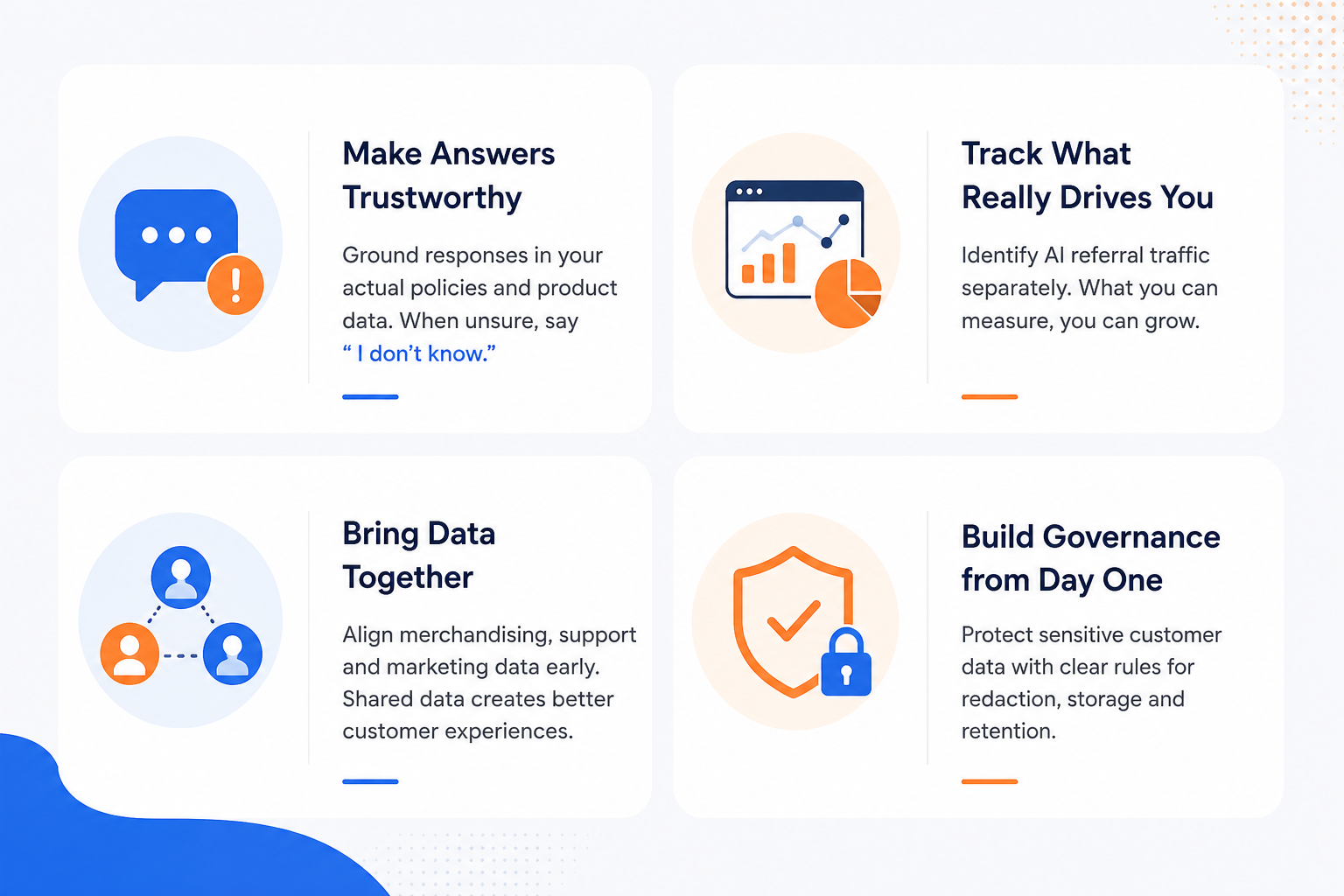
A language model asked about your returns window will answer even when it does not know. It will sound confident and be wrong, and the customer will hold you to it. The fix is to ground every answer in your actual policy documents and product data, and to make the system say it does not know rather than guess.
You Cannot See Where Your Traffic Came From
Most of the AI referrals are misread as direct traffic in standard GA4 setups. If your reporting cannot separate them, you will underinvest in the fastest-growing channel you have because it looks like nothing is happening.
Nobody Owns the Data
Product attributes sit with merchandising, support transcripts sit with the contact centre, and reviews sit with marketing. An NLP project needs all three, and the meeting where that gets agreed is usually the hardest part of the build.
Governance Gets Added Last
Support conversations contain names, addresses, and card details. Decide how that data is redacted, stored, and retained before you start, not after your first audit.
A 30-Day Roadmap to Deploy NLP Solutions in Retail
The team buys the chatbots, points it at a FAQ, prepares it, and then later finds out that they offer wrong answers. Here is a deliberate order to follow
Week 1: Read What You Already Have
Before building anything, run your existing support tickets, chat logs, and reviews through a model and cluster them. You will find out what customers actually contact you about, in what proportion, and in what words. The top five intents usually account for more of the volume than anyone expects, and at least one of them is a problem nobody knew existed. This step costs almost nothing, and it decides everything that follows.
Weeks 2 to 3: Help your agents before replacing them
Give the support team a copilot. It drafts replies, summarises the conversation history, and flags angry customers for priority handling. Nothing goes to a customer without a human approving it. You get a productivity gain immediately, and more importantly, you get a few weeks of watching where the model is right and where it is wrong, with a human catching every mistake.
Weeks 3 to 4: Automate one narrow, high-volume task
Now pick intents from step one, usually order status and returns, and let the assistant handle them completely. Connect it to your order management system so it can actually do the thing rather than explain how. Keep the scope tight. A bot that resolves two things reliably is worth more than one that attempts twenty.
Then: fix the catalogue
This runs alongside the rest. Audit your product data for missing attributes, standardise your taxonomy, generate the descriptions you never had time to write, and add structured markup. This is the work that decides whether AI assistants recommend you, and it takes longer than people think.
Throughout: Instrument Properly
Track resolution, not containment. Separate AI referral traffic from direct in your analytics. If you cannot measure whether it worked, you will not get a budget for the second phase.
Concluding Thoughts
You do not need a two-year programme to start. Take the conversations you already have and read them properly. Everything else follows from what you find there.
What has changed is the deadline. Discovery is moving into interfaces you do not own, and the shoppers who arrive from them convert better than anyone else. Retailers who sort out their language layer now get recommended. The rest find out that being invisible to an AI agent looks a lot like having no demand.
Signity Solutions builds NLP solutions for retail teams. That covers conversational assistants connected to your OMS and CRM, semantic search, sentiment analysis, and catalogue enrichment that makes your products readable to AI shopping agents. If you are not sure where to start, our two-week readiness audit will tell you what to build first.

Mangesh Gothankar


Ashwani Sharma
Achin Verma
Frequently Asked Questions
Have a question in mind? We are here to answer. If you don’t see your question here, drop us a line at our contact page.
How much does an NLP solution for retail cost?

Do we need our own data science team for this?
Will NLP in retail replace our support agents?
How do we know if we are ready for Natural Language Processing in retail?





.png?width=352&name=agentic-ai-strategy-for-enterprise-software%20(6).png)