


.png?width=27&height=27&name=Group(1).png)

-1.svg)
-1.svg)


-2.svg)


%201-1.webp?width=148&height=74&name=our%20work%20(2)%201-1.webp)




.svg)





Only one in five enterprises has a mature governance model for autonomous AI agents, according to Deloitte's 2026 State of AI in the Enterprise survey. Everyone else is running agents that can act, without a real system for controlling what those actions are allowed to be.
That's a different problem than the one most AI governance programs were built for. A model that answers a question is easy to reason about: you check the output, you catch the mistake, you move on. An agent that books a refund, updates a record, or calls another agent to finish a task has already acted by the time anyone reviews it. The mistake isn't a bad sentence anymore. It's a wire transfer, a deleted file, a decision made on your behalf while nobody was watching.
This is why enterprises scaling agentic AI need an actual agentic AI governance framework, not a patched-up version of the model governance checklist built for chatbots. In this piece, we'll walk through what real agentic AI governance looks like in practice: the controls that keep agents inside their lane, the compliance work that keeps regulators satisfied, and the part almost nobody is doing well yet: overseeing what happens when agents start working with other agents.
 Generate
Key Takeaways
Generate
Key Takeaways

- Traditional AI governance checks the outputs, and AI governance checks for the actions.
- Identity and human-in-the-loop thresholds are the foundation, not additional add-ons.
- Multi-agent chains break accountability, even if the agent is well governed.
- Kill switch and escalation path are only counted if they are tested before the incident.
Why Traditional AI Governance Falls Short for Agentic Systems
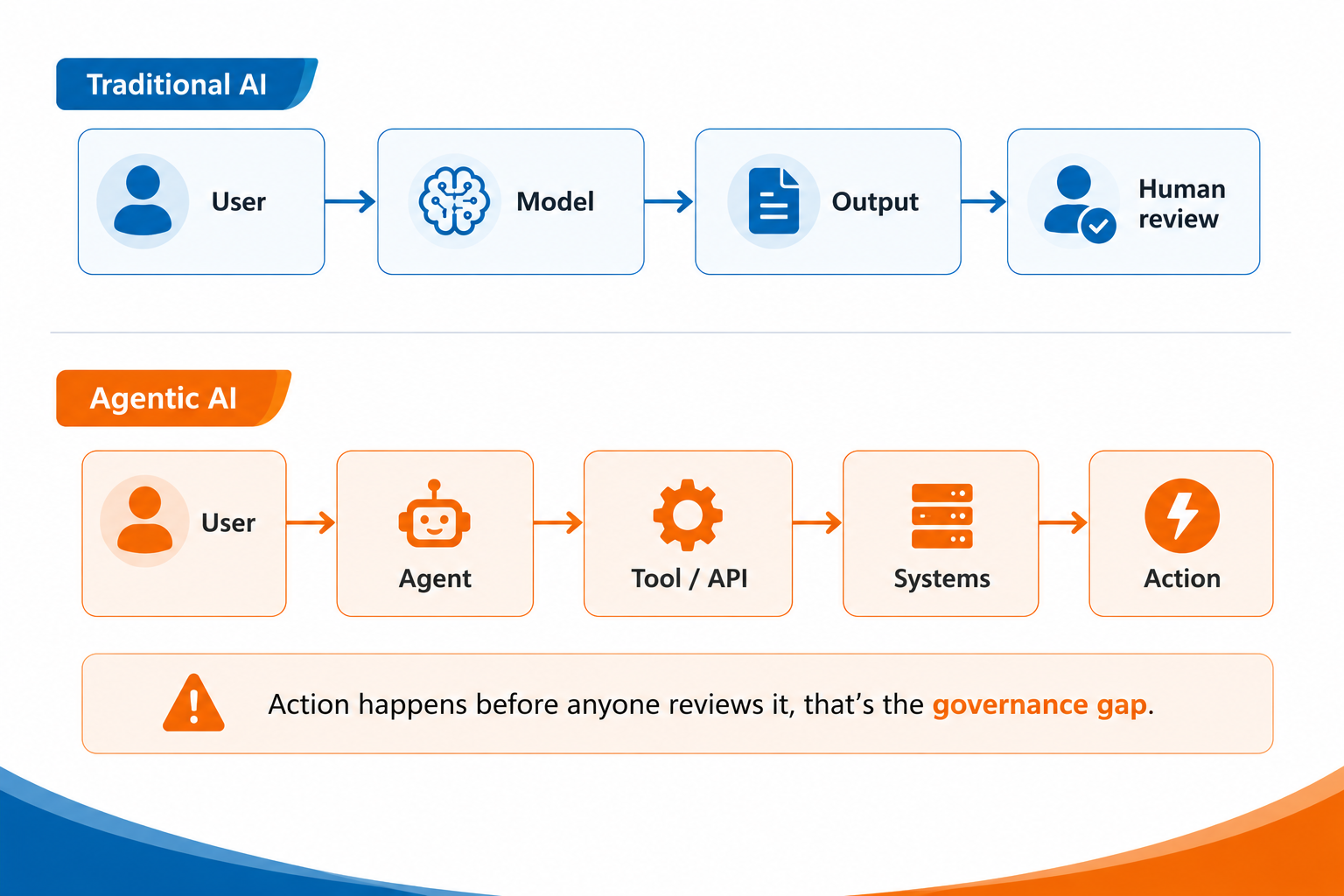
Traditional AI governance fails for agentic systems because it was designed for static and passive models. Their jobs simply end at the output, and they don’t bother about the outcomes. Someone asks a question, the model answers, and a human reads it. It only focuses on training data, bias audits, and stats approvals.
Agentic systems break that assumption. An AI agent does not only answer your query, but it also acts. It helps actively plan, use tools, call the APIs, and chain tasks accordingly. The question governance has to answer is no longer "was the output accurate?" It's "Was the agent allowed to do that, and can we prove it?"
That's the real gap traditional AI governance thinking misses. It was designed to catch a bad sentence, not stop a bad action, and by the time an agent's decision surfaces for review, the action it triggered has usually already happened. Closing that gap is the whole point of building agentic-specific oversight, and it's where most enterprise programs are still behind.
The Main Risks of AI Agents
Once the agent is able to act, there are plenty of things that can go wrong, and rather than looking like an AI model problem, it looks like a system problem. Here are all the risks that businesses across enterprises face:
-
Loss of execution control: an agent keeps running past the point where its actions still match its original intent
-
Unauthorized tool invocation: an agent calls an API or system it was never meant to touch
-
Privilege escalation: an agent inherits or accumulates more access than the task actually requires
-
Data misuse: an agent pulls sensitive data into a context it shouldn't be in, or passes it somewhere it shouldn't go
-
Emergent multi-agent effects: agents coordinating or negotiating in ways nobody explicitly designed
-
Accountability diffusion: when something breaks, no one can say exactly which agent, tool, or handoff caused it
-
Drift over time: an agent's behavior slowly moves away from its original scope, often without anyone noticing until it's already a problem.
The last two are worth sitting with, because they're the ones that don't show up in a single incident. A privilege escalation or a bad tool call usually announces itself. Accountability diffusion and drift show up as a slow erosion of trust in the system, and by the time it's visible, it's already happened across dozens of agent runs. That's also exactly where multi-agent systems make everything harder, which is what we'll get into next.
The Core Pillars of an Enterprise Agentic AI Governance Framework
Four things tend to separate the enterprises that scale agents safely from the ones cleaning up after them.
1. Identity and Access Boundaries
Give every agent its own identity, scoped permissions, and no shared admin logins. This is the one enterprises skip most often because they generally give a broad access to the AI agent to complete the work quickly and never narrow it down.
An agent handling refunds doesn't need write access to your CRM's customer notes field. Whitelist the specific tools it's allowed to call, an ERP, email, whatever the task actually needs, and block everything else by default.
2. Autonomy Thresholds and Human-in-the-loop
A customer agent is answering the FAQs, and AI agents approving the wire transfer should not actually follow the same approval process. AI agents can be classified based on the impact of a wrong decision. No matter whether it's financial or legal matters, the AI agents need to be classified according to their roles. High-risk agents need human approval before taking action.
Most businesses follow a practical approach that gives AI agents a simple job description. The document here defines what an agent does, what it is not supposed to do, and the limits it needs to follow. It may seem not very necessary at the beginning, but when the agent behaves differently, this document becomes useful and helps determine whether it was a system bug or the agent exceeded the assigned responsibilities.
Recommended Post: Understanding AI Governance: Key Strategies for Effective Oversight
3. Observability and Drift Detection
Log everything: the reasoning, the tool calls, the actual actions taken, in a format nobody can quietly edit after the fact. The harder problem isn't logging a single bad decision. It's catching an agent that's technically working fine today but has slowly wandered from what it was built to do six months ago. Nobody notices drift at the moment. You notice it in a postmortem, after it's already cost something.
4. Human Oversight and Incident Response
Every agent needs a kill switch that actually works, tested before an incident, not during one. Pair it with clear escalation paths so edge cases go to a person instead of getting handled by an agent guessing its way through something outside its training. And this shouldn't live with one team.
Get IT, security, and compliance in the same room reviewing high-stakes agents before launch. A regulation and governance policy written entirely by engineers misses the risks that only legal or compliance would catch.
Multi-Agent Oversight: The Gap Most Frameworks Miss
Most of you must be assuming there is a single agent working and carrying out all these processes. However, this is not the scenario. This assumption breaks when agents begin talking to each other.
Where the Chain Breaks Down
Suppose a procurement agent calls a finance agent to check the budget. The finance agent calls a vendor-verification agent. That one pulls from a data agent nobody remembers configuring. Each agent can be well-governed on its own, with scoped identity, logged actions, a human checkpoint for anything risky, and the chain as a whole can still do something nobody actually approved. An agent working exactly within its own permissions can still be one link in a sequence that goes sideways.
Why Accountability gets Hard to Pin Down
If a wrong refund goes out, was it the agent that approved the amount, the one that verified the customer, or the one that pulled stale pricing data three steps upstream? In a single-agent system, that question has one answer. In a multi-agent system, it can have four plausible answers, especially if the logs were never designed to capture handoffs as their own event. This is accountability diffusion stopping being a theory and becoming Monday morning's incident review.
The Coordination Problem
Agents built to negotiate, delegate, or compete for shared resources, budget, compute, or priority can settle into patterns nobody explicitly programmed. None of it looks like a bug from inside any one agent's logs. It only looks wrong once you zoom out to how the agents are interacting, and most governance frameworks still audit agents individually rather than the conversations between them.
What Actually Helps
A few practices close most of this gap. There needs to be a traceable ID given to every agent that can follow the task via the full chain. So the whole sequence can be reconstructed instead of a single piece. Set a limit on how many agents can be chained together for one task. If a task suddenly needs five agents instead of two, that should trigger a review, not happen automatically. And keep an eye on how agents interact with each other, not just on what each one does individually. That's usually where problems actually start.
A Practical Implementation Roadmap
Knowing the pillars is one thing. Actually rolling this out across an enterprise is another. Here's the order that tends to work, based on how the pieces above fit together.
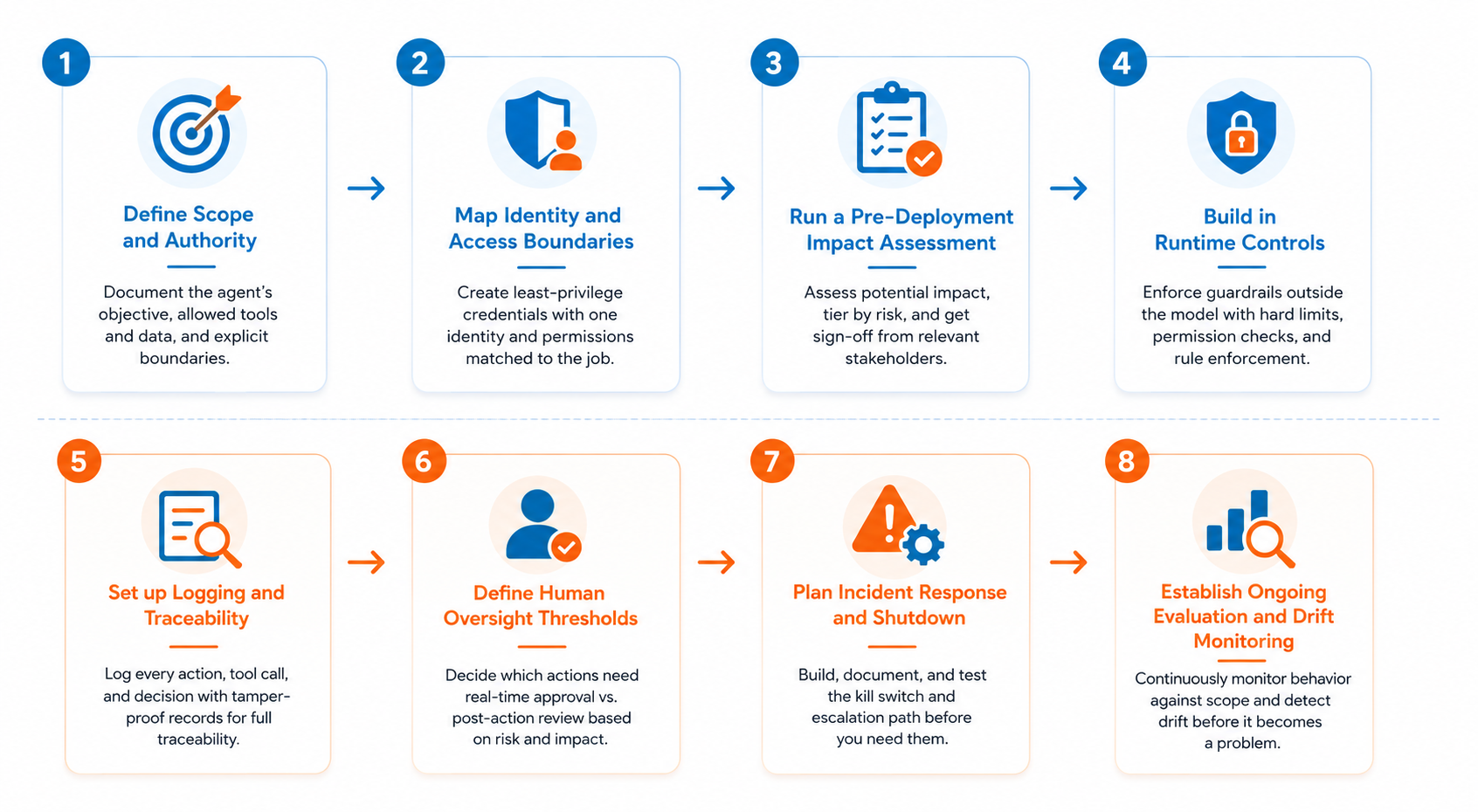
1. Define Scope and Authority
Before anything else, write down what the agent is actually for. What's its objective, what tools and data is it allowed to touch, and just as important, what's explicitly off-limits. This document becomes the reference point for everything that follows.
2. Map Identity and Access Boundaries
Set up least-privilege credentials tied to that defined scope. This is where the identity and access work from earlier gets put into practice: one agent, one identity, one set of permissions matched to the job.
3. Run a Pre-Deployment Impact Assessment
Before launch, figure out how much damage a wrong decision could actually cause. Tier the agent by risk- financial, legal, reputational- and get sign-off from the relevant teams, not just engineering, for anything in the higher tiers.
4. Build in Runtime Controls
Don't rely on the agent's own reasoning to stop it from doing something risky. That's not a safeguard; it's a guess. Guardrails need to live outside the model itself: hard-coded limits, permission checks, and rules that fire regardless of what the agent decides are fine. If a check can be talked out of by the agent's own logic, it isn't really a check.
5. Set up Logging and Traceability
Every action, tool call, and decision needs a record that can't be quietly edited later. This is the same observability work covered earlier, applied at rollout instead of as an afterthought.
6. Define Human Oversight Thresholds
Not every decision needs a person standing in the way before it happens. Some just need a person watching after the fact, catching problems on review rather than blocking every action upfront. The work here is deciding which is which ahead of time; refunds under a certain amount might only need a spot-check later, while anything touching money above a threshold or customer data should wait for a yes before it goes through.
7. Plan Incident Response and Shutdown
Build the kill switch and the escalation path before you need either one. Test them. An off switch nobody has tried is just a theory.
8. Establish Ongoing Evaluation and Drift Monitoring
This is the step most teams skip once an agent is live and working. Keep checking the agent's behavior against its original scope, not just its output quality. Drift usually looks like an agent quietly expanding what it does, not an agent doing its job worse.
How Signity Solutions Helps
Most businesses don’t have the bandwidth to design the AI governance framework from scratch while also running their existing MLOps and security stack. At Siginity, we have been setting up identity, access control, wiring observability into monitoring tools, and helping organizations build runtime guardrails that don’t rely on agent policing only.
Agentic AI adoption has moved fast; governance hasn't kept up the same pace. Unscoped access, missing kill switches, and accountability that falls apart the moment two agents are involved aren't exotic failure modes; they're what happens when chatbot-era governance gets stretched to cover systems that act.
The enterprises that get this right won't be the ones with the most advanced agents. They'll be the ones who can explain what their agents did and prove it when someone asks. Talk to our AI development company regarding building a governance framework to see where your agents actually stand.

Mangesh Gothankar


Ashwani Sharma
Achin Verma
Frequently Asked Questions
Have a question in mind? We are here to answer. If you don’t see your question here, drop us a line at our contact page.
Is an Agentic AI Governance Framework a legal requirement, or just best practice?

How is agentic AI governance different from MLOps or AI security?
Who should own agentic AI governance inside an enterprise?
How long does it take to build an enterprise AI governance framework?





.png?width=352&name=agentic-ai-strategy-for-enterprise-software%20(7).png)
.png?width=352&name=agentic-ai-strategy-for-enterprise-software%20(4).png)