

.png?width=27&height=27&name=Group(1).png)

-1.svg)
-1.svg)


-2.svg)


%201-1.webp?width=148&height=74&name=our%20work%20(2)%201-1.webp)




.svg)





Few year back, enterprise CTOs were worried about hallucinations and data leakage. Now the problem is categorically different. Autonomous agents are approving vendor contracts, rerouting logistics, and accessing financial systems without a human in the approval chain.
According to Gartner, over 40% of agentic AI projects will be canceled by the end of 2027. Not because the technology failed. Because the organizations that deployed it had no AI governance architecture capable of containing what they built.
McKinsey's research puts the operational exposure in concrete terms. 80% of enterprises have already encountered risky behavior from deployed AI agents. This simply reflects organizations that had already moved agents into production.
The capability arrived faster than the controls did. And it is the gap where enterprise AI risk now accumulates, quietly, at machine speed, across the organization that has no obligation to wait for human review before acting.
 Generate
Key Takeaways
Generate
Key Takeaways

- 80% of enterprises have already encountered risky AI agent behavior in production.
- Governance efforts built post-deployment cannot reconstruct what agents already did.
- Permission scope control and data access control are architecturally separate requirements.
- Every autonomous agent in production requires a named business owner before launch.
- Real AI governance is runtime-enforced, not documented in a policy file.
- Responsible AI deployment requires blast radius definition before every agentic AI decision.
What Makes Agentic AI Different From Every AI System Before
For the past decade, enterprise artificial intelligence functioned as a decision-support tool. It produced outputs like recommendations, classifications, and risk scores. AI tools waited for a human to act on the output. AI models, including generative AI systems, generated content and predictions but did not independently initiate consequential actions. Most existing AI governance frameworks were built on this assumption. It no longer describes what enterprises are actually deploying.
Agentic AI systems are organizational actors, not assistants. These systems perceive environmental signals, form plans, call external tools, execute multi-step workflows, and coordinate with other agents, all without a human approving each individual step. When a procurement agent autonomously renews a vendor contract or a logistics agent reroutes a shipment in response to a port delay, that is not a recommendation. That is a decision with operational and legal consequences.
These AI technologies introduce genuine ethical concerns around accountability and transparency. How AI systems operate within boundaries that reflect an organization's values is not a philosophical question. It is an architectural one, and organizations that approach autonomous AI development as a strategic challenge, including through enterprise AI consulting that starts at the design stage, are better positioned to build controls that hold before the first agent ships.
Three properties define what separates agentic systems from every AI model that came before:
-
Autonomy: Agentic systems initiate actions based on environmental signals rather than explicit human prompts. They do not wait to be instructed.
-
Persistence: These agents run continuously, often across sessions, adapting behavior based on prior interactions. They are not stateless tools.
-
Delegation: Agents operate with formal access to enterprise systems. They can commit resources, modify records, and trigger downstream workflows at machine speed.
The shift from AI models to autonomous AI systems is an institutional change. AI agent governance processes designed for static models will consistently fail to catch the failures that carry real consequences.
The Three Layers Every Autonomous AI System Needs Before Going to Production
Responsible AI governance for agentic systems requires architecture, not policy documents. Written AI governance policies describing acceptable use do not intercept a procurement agent that has exceeded its authorization scope at 2 a.m. Controls that cannot enforce themselves at runtime are not controls, they are documentation.
Implementing AI governance that functions at runtime means building three distinct layers that work in combination to make autonomous AI governable at enterprise scale.
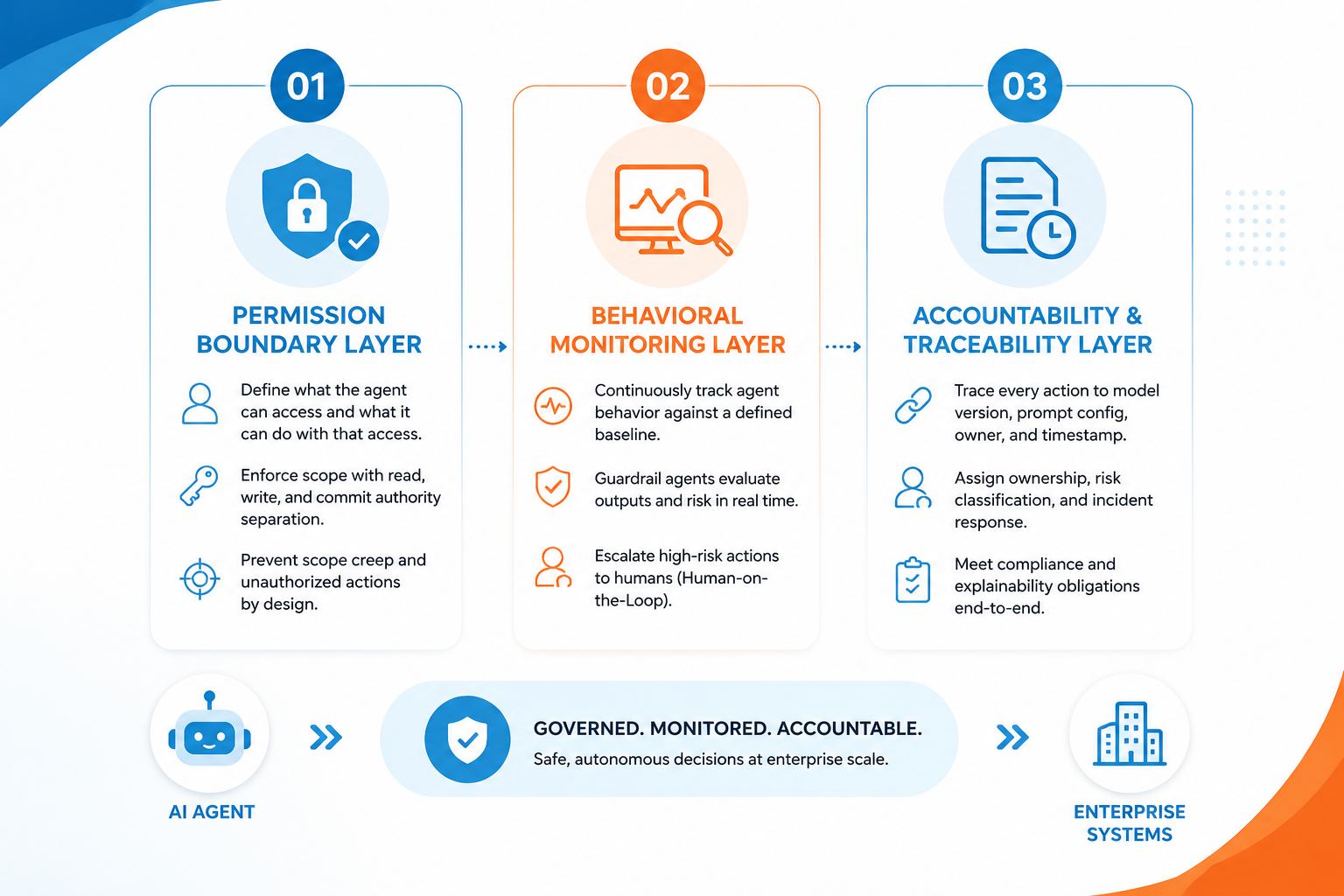
The Permission Boundary Layer
This defines not just what an agent can access but what it can do with that data access. Role-based access control, the standard for most enterprise applications, is insufficient here. An agent that can read vendor records and an agent that can initiate vendor payments are categorically different risk profiles, even if both carry identical data access permissions.
The permission boundary layer enforces scope, not just credentials. It distinguishes between read authority, write authority, and commit authority. Without this separation, agents routinely exceed their intended mandate without triggering any alert. From a technical standpoint, nothing went wrong. The credentials were valid and the action was within access rights. The problem was scope, and scope was never defined. This is where AI security gaps originate, not from model failure, but from undefined boundaries at the coordination layer.
The Behavioral Monitoring Layer
Real-time deviation detection against a defined behavioral baseline is what separates functional AI agent governance from compliance theater. A behavioral baseline establishes what normal looks like for a specific agent in a specific domain: transaction volume, action frequency, output types, and confidence thresholds. Tracking AI system performance against this baseline continuously is how enterprises detect drift before it becomes an incident.
Guardrail agents, lightweight models that intercept primary agent output before it reaches any system of record, are the practical implementation here. High-risk actions require confidence scores above a defined threshold. Below that threshold, the action is blocked and escalated for human oversight. This is the Human-on-the-Loop model in operational terms. Oversight mechanisms are built into the system so humans set the thresholds, define the escalation paths, and intervene by exception. AI oversight at this layer scales and manual approval queues do not.
The Accountability and Traceability Layer
Every agent action should be traceable to a specific model development version, prompt configuration, business owner, and timestamp. This is a foundational requirement for any explainable AI program and a direct obligation under governance frameworks, including ISO/IEC 42001 and the NIST risk management framework. In practice, most organizations cannot produce this traceability on demand, because agents span multiple teams and no single function owns the decision lineage end-to-end.
This is not a model problem but an organizational design problem. Each autonomous agent requires a named owner, a defined risk classification, documented incident response paths, and a current accountability record, all in place before the agent enters production. Without those elements, AI governance remains a statement of intent.
AI governance encompasses far more than documentation, it is the operational structure that determines whether accountable AI systems are achievable at scale. Ensure AI systems have this layer in place before they touch production data or trigger downstream workflows.
Where Multi-Agent AI Systems Break Enterprise Governance Controls
Single-agent deployments are manageable. The AI governance challenges scale non-linearly once organizations move to multi-agent architectures, where specialized agents coordinate, delegate subtasks, share data, and trigger downstream actions across the organization with no single point of oversight. Emerging risks in these architectures rarely surface through standard audits, and AI governance processes that were not designed for multi-agent coordination will miss them entirely.
The four failure modes that surface most consistently in enterprise deployments:
| Failure Mode | Root Cause | Control Gap | Detection Difficulty |
| Permission scope creep | Agent inherits delegating agent's access rights | No scope isolation at coordination layer | High; no boundary violation is triggered |
| Orphaned agent | Team disbanded post-sprint with no ownership transfer | No assigned business owner in agent inventory | Medium; surfaces only during audits |
| Swarm amplification | No conflict resolution protocol between coordinating agents | Multiple agents respond independently to the same signal | Very High; cascade appears as an infrastructure issue |
| Shadow agent | Deployed by business unit outside IT oversight | Not registered in any AI agent governance inventory | Very High; invisible by definition |
Swarm amplification deserves particular attention because it is the least intuitive failure mode. In decentralized multi-agent coordination, individual agents respond to environmental signals without a central orchestrator validating those responses against what other agents are doing simultaneously.
Two procurement agents that both detect a supply shortage and independently initiate compensating orders create duplication, cost overruns, and, in some cases, regulatory exposure. The fix is not centralization, it is conflict resolution at the protocol level, where agents must achieve consensus before executing actions with overlapping scope. This design requirement is absent in most enterprise agentic deployments today. It is also one of the clearest examples of why AI governance processes must be embedded in the architecture rather than added afterward.
What Enterprise AI Governance Looks Like When Built Right
The difference between organizations that govern autonomous agents effectively and those that discover governance gaps in production comes down to sequencing. Governance architecture must precede deployment.
Four steps define what this looks like in practice.
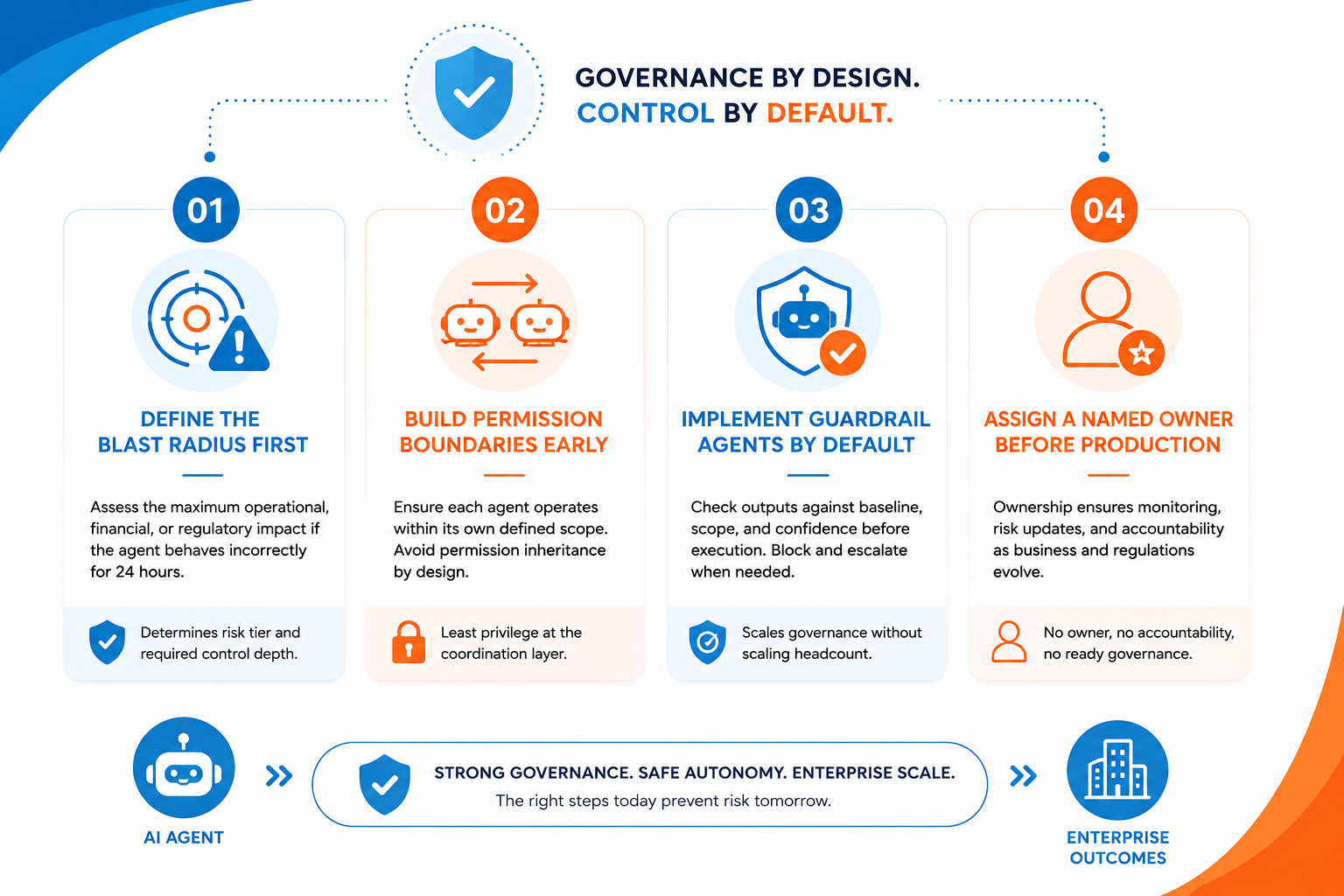
1. Define the blast radius before writing a line of code
Every agent deployment should begin with a risk assessment: what is the maximum operational, financial, or regulatory impact if this agent behaves incorrectly for 24 hours?
That answer determines the risk tier and the required depth of control architecture. A customer service knowledge agent and a financial reconciliation agent do not belong in the same governance tier. Treating them identically is how effective AI governance programs develop blind spots.
2. Build permission boundaries at the coordination layer, not just the model layer
When Agent A delegates a task to Agent B in a multi-agent system, Agent B should operate within its own defined permission scope, not inherit Agent A's. Most orchestration frameworks default to scope inheritance.
That is how agents end up with access they were never designed to have. Correcting this at the architecture stage takes a day, but correcting it after agents are integrated with core business systems is a significantly larger undertaking.
3. Implement guardrail agents as a standard architectural component
A guardrail agent checks AI-powered agent output against the behavioral baseline, permission scope, and confidence threshold before execution. If any condition is not met, the action is blocked and routed to human review.
Unlike manual approval processes, this scales with agent volume without requiring proportional headcount growth. It is the operational difference between governance that works at 12 agents and governance that holds at 400.
4. Assign a named owner before the agent enters production
An agent without a named owner is an organizational orphan. Nobody monitors its behavior as business context evolves and nobody updates its risk classification when AI regulations shift. I
In a healthcare enterprise deployment managing AI-driven revenue decisions with direct billing and compliance consequences, ownership assignment was the governance mechanism that made production deployment viable. Technical controls without human accountability structures do not hold at scale. Ensure AI systems have a named owner before they make a single AI decision in production.
The Gap Between AI Compliance Documentation and Real-Time Agent Control
Passing an AI governance audit and maintaining operational control over autonomous agents are different achievements. Most enterprises invest heavily in the former and underinvest in the latter. This is where most AI governance programs quietly fail.
| Mistake | What It Looks Like | Real Risk | What to Do Instead |
| Governance treated as post-deployment | Policy documents written after go-live | Agents have acted before any control architecture exists | Build permission layer before first deployment |
| Compliance replaces runtime monitoring | Audit passed; no behavioral baseline in production | Risky behavior undetected for days or weeks | Behavioral baseline plus live interception at execution layer |
| Governance does not scale with agent count | 12 agents, manual review committee | 400 agents, same process equals no oversight | Engineer governance as a repeatable product, not a committee function |
| Shadow AI outside governance inventory | Agents deployed by business units without IT review | Direct exposure under EU AI Act and NIST AI RMF | Continuous agent discovery and identity binding across all environments |
McKinsey frames the principle precisely: governance scales only when it becomes a repeatable product, not a bespoke committee debate. The European Union's AI Act (Article 10) reinforces this by requiring data quality, provenance, and data privacy controls before high-risk AI systems access sensitive information, making runtime governance a legal obligation in regulated markets. Regulatory compliance is not optional for enterprises running AI initiatives in these domains.
AI regulations continue to tighten globally. Governance best practices require runtime enforcement. AI-related risks accumulate precisely in the space between what the governance practices document says and what agents actually do in production. Organizations treating compliance documentation as a substitute for AI governance processes are building liability into their deployments without knowing it.
How Enterprises Scale Autonomous AI Without Losing Accountability or Control
Scaling autonomous AI without losing control requires an honest assessment of where AI governance maturity currently sits. Most organizations overestimate their position by at least one level.
Level 1: Agents Governed Like Applications
Static permission sets defined at deployment. Governance exists as documentation rather than runtime control. Periodic audits, typically quarterly or annual, provide the only systematic review of agent behavior.
Most enterprises with fewer than two years of agentic deployment sit here. The risk exposure is not obvious day-to-day. It surfaces suddenly, when an agent has been operating outside its intended scope for weeks and the audit cycle finally catches it. By then, the actions have already been taken.
Level 2: Agents Governed Like Privileged Users
Identity-based access with scope-controlled permissions. Behavioral monitoring in production with defined escalation thresholds. Each agent carries a named business owner and a current risk classification reviewed on a defined cycle.
Incident response protocols exist at the agent level, not just the application level. Data governance controls are applied before sensitive data enters AI pipelines, consistent with EU AI Act Article 10 requirements. At Level 2, AI governance functions operationally rather than on paper. Human oversight is invoked by exception, calibrated to risk tier.
Level 3: Agents Governed as Organizational Actors
Blast radius documented before any agent enters production. Guardrail agents are a standard component of every agentic system architecture. Full decision lineage, covering model version, prompt configuration, action taken, and owner accountability, is traceable on demand.
Governance requirements are embedded in the CI/CD pipeline; no agent ships without meeting defined compliance and behavioral checkpoints. Multi-agent coordination includes conflict resolution protocols and scope isolation by design. Continuous monitoring is the standard, not periodic audit. Risk tolerance is explicit, calibrated by agent type and business domain, and reviewed when the operational context changes.
Level 3 is rare. It is also the only governance model that holds when an enterprise scales from dozens of agents to hundreds operating across core business systems simultaneously.
What 13 Years of Enterprise AI Development Says About Governance
Governance problems in agentic AI are architecture problems. Signity has delivered production AI systems for enterprise clients where governance failures carry direct operational and legal consequences, and every engagement starts at the architecture stage, not the remediation stage. Responsible AI practices and ethical AI practices are not aspirational standards here, they are engineering requirements built into AI development and delivery from day one.
Governance-First Delivery Model
Permission boundaries, behavioral baselines, and business owner assignment are defined and documented before any autonomous agent reaches production systems. This is responsible AI development as a process discipline, where ethical principles and operational controls are defined together, not separately.
Multi-Agent Architecture With Conflict Resolution Built In
Swarm coordination is designed with scope isolation and conflict resolution protocols from the start, not patched in after the first production incident occurs. Trustworthy AI at scale requires that AI systems operate within defined conflict boundaries by architecture, not by policy alone.
Full AI Lifecycle Governance
Agent inventory, risk classification, and behavioral baseline maintenance are sustained across the complete AI lifecycle, not only at the point of initial deployment. AI governance encompasses the full arc from design through decommission, and governance structures are maintained throughout.
Regulatory Compliance Coverage
Delivery frameworks align with NIST risk management framework, ISO/IEC 42001, and EU AI Act requirements, with data governance controls applied before sensitive training data enters inference pipelines. This supports regulatory compliance across jurisdictions and reflects ethical standards in how AI systems are built and deployed.
Board-Level Accountability Structures
Governance structures are designed so business leaders and executive teams can precisely answer the five agent control questions McKinsey identifies as board-level oversight requirements for agentic AI. Ethical development of AI systems and accountable AI governance are built into the accountability model from the outset, aligned with the organization's values and ethical considerations that boards increasingly scrutinize.
Enterprises that build accountable AI governance into the architecture before deployment ship faster, encounter fewer production failures, and carry significantly less regulatory exposure.

Mangesh Gothankar


Ashwani Sharma
Achin Verma
Frequently Asked Questions
Have a question in mind? We are here to answer. If you don’t see your question here, drop us a line at our contact page.
Q1: What does an AI governance framework include?

Q2: How do enterprises implement responsible AI governance?
Q3: What is AI ethics in enterprise AI governance?
Q4: Why do AI projects fail governance at scale?
Q5: How does the EU AI Act shape enterprise AI governance?





.png?width=352&name=Enterprise%20AI%20Agent%20Deployment%20A%20Production%20Ready%20Guide%20(2).png)