


.png?width=27&height=27&name=Group(1).png)

-1.svg)
-1.svg)


-2.svg)


%201-1.webp?width=148&height=74&name=our%20work%20(2)%201-1.webp)




.svg)





.png?width=670&height=445&name=How%20Much%20Does%20AI%20Development%20Cost%20(1).png)
You ask different vendors about how much it costs to develop an AI product. Trust me, everyone will have a different quote, and they will barely overlap. The idea is the same, but the quotation is different, and the gap remains difficult to justify.
That gap is the whole reason this guide exists.
AI software development costs in 2026 can range from around $10,000 for a simple bot to around $1.5 million for an agentic platform. The price difference is real, as AI development can simply mean integrating an API to building an entire custom model on your data.
Gartner predicts the total AI spending to reach $2.59 trillion in 2026, a 47% jump over last year. 2026 for AI remains an inflection year where businesses finally begin spending at scale. But the higher spending brings along higher risk. Around 60% of AI projects exceed their budget by 30% to 50% because there are hidden costs involved that no one included in the proposal.
So before you sign anything, it pays to know where the AI development cost actually goes. This guide breaks it down by project type, the factors that move the number, the hidden costs that catch teams off guard, and how to budget without overpaying.
 Generate
Key Takeaways
Generate
Key Takeaways

- Cost varies widely: simple chatbots start low, enterprise platforms run into the millions.
- The build is only half the bill: inference, maintenance, and data prep add up.
- Team location matters: offshore talent cuts cost without cutting quality.
- Start small: a proof of concept beats betting your whole budget upfront.
How Much Does it Cost to Develop an AI?
The quickest way to get an answer on how much it costs to develop an AI is to stop treating AI as a thing and match your idea to the type of project. Each tier covers the actual build work: architecture, data engineering, model setup, integration, testing, and first deployment. What it leaves out is the cost of running the system once it's live, which we'll come back to later.
| Project type | Typical build cost | Timeline | What it involves |
| Proof of concept | $5,000 – $60,000 | 2–6 weeks | One question answered: can AI solve this at acceptable accuracy, on sample data? No production hardening. |
| Basic AI integration/chatbot | $10,000 – $80,000 | 1–3 months | Off-the-shelf models that offer support and text generation; can be customized. |
| Machine learning/predictive systems | $50,000 – $200,000 | 3–6 months | Data engineering and custom model training for fraud detection or recommendations. |
| Generative AI/custom applications | $100,000 – $500,000 | 6–12 months | RAG tied to internal databases, fine-tuning, guardrails, and production scaling. |
| Enterprise agentic AI platform | $300,000 – $1,500,000+ | 12–24 months | Multi-agent orchestration across systems, HIPAA or SOC 2 compliance |
These ranges assume a professional team, proper testing, and real post-launch support. Cut any of those to hit a lower number, and you usually pay for it later, with interest.
Recommended Post: A Comprehensive Guide To Mobile App Development Costs
The Factors that Decide Your Cost
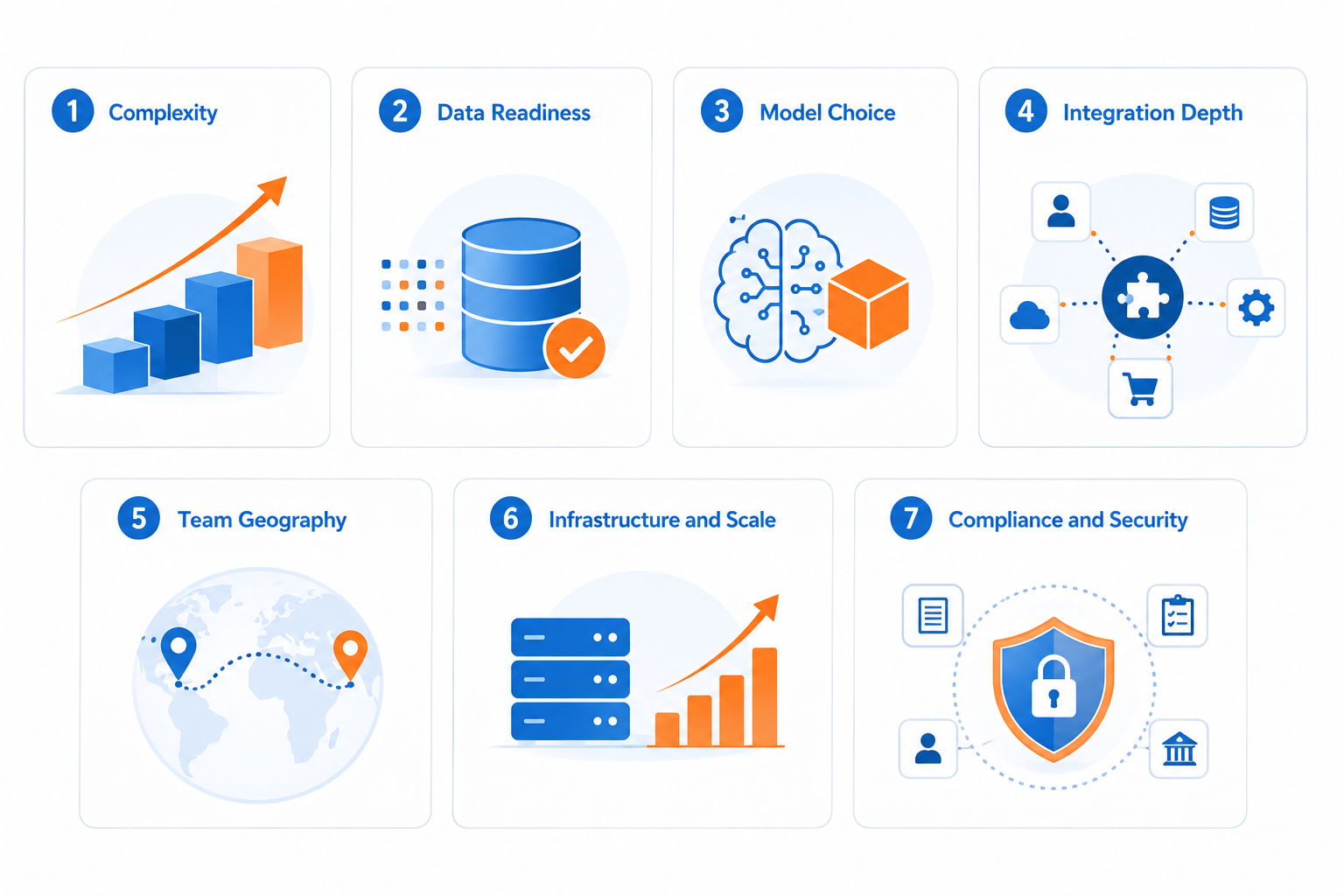
Two honest vendors can look at the same project and quote very different numbers. It usually comes down to six things. Once you know them, you can read any quote and understand why it says what it says.
1. Complexity
The complexity of the project is one of the biggest and most important factors that impact its cost. As per a survey from GoodFirms, more than 95% of respondents reported that project complexity was the top cost driver. Building a rule-based FAQ bot can be more cost-efficient than a large language model support tool or CRM in integration, which is comparatively higher. Every step up in complexity, from simple rules to machine learning to full agentic systems, can double or quadruple the effort.
2. Data Readiness
If your data is clean, labeled, and organized, you save real money. If it isn't, this is where the bill grows. Data preparation alone often eats 20% to 40% of an AI budget. One recent survey found that data scientists spend around 60% of their time cleaning data and organizing it, before the modeling begins. Messy or unstructured data is another critical reason the quote rises.
3. Model Choice
For most business cases in 2026, training a model from scratch makes no sense. Foundation models have cut baseline model costs by 40% to 60% compared to 2023, so fine-tuning or plugging into an existing model through an API usually wins on both price and speed. Building your own foundation model is a $500,000-and-up decision, and only a handful of companies have a real reason to do it.
4. Integration Depth
AI never works alone. It has to communicate and pull data from different sources like CRM, ERP, customer-facing apps, and keep everything moving. Wiring up each connection may cost around $5,000 to $25,000. A typical setup for an enterprise AI may touch four to twelve systems. Integration can take another half of the budget, and this becomes one of the most critical reasons a project budget drifts.
5. Team Geography
This is the cost driver you have the most control over, and the one most companies barely think about. The same build can cost three or four times more depending on nothing but where the team sits. A senior AI engineer in the US now runs past $200,000 a year, while a developer of the same caliber in India or Eastern Europe costs a fraction of that for identical work. The engineering is the same. The invoice is not.
6. Infrastructure and Scale
A system handling a few hundred requests a day costs almost nothing to run. One handling tens of thousands of requests a day at low latency is a different problem, and it can multiply your compute spend several times over. High volume, real-time responses, and on-premise setups in regulated industries all push the AI development cost up.
7. Compliance and Security
For a lot of companies, this isn't optional, but vital. If you handle health data, payment data, or anything under GDPR, your AI has to be built to prove it's safe, not just work. This means it needs proper access control, audit trails, and more. It requires HIPAA compliance and more, which add another dollar to audit costs alone.
Team Geography: The Biggest Cost Lever
The same AI product can cost three or four times more depending on where your team is located. Let us discuss them based on the geographies.
| Region | Blended AI team rate (2026) | Fully loaded team of 6/year |
| USA/Western Europe | $100 – $200 / hour | $1.2M – $2.5M |
| Eastern Europe | $50 – $110 / hour | $600K – $1.1M |
| India (offshore) | $30 – $70 / hour | $400K – $900K |
A senior AI engineer in the US can cost over $200,000 a year. A team of six can easily cost $1 million to $2.5 million annually before any code is written. The same work done by a strong engineering team in India may cost around $400,000 to $900,000.
Cost-efficient is not always better. Plenty of vendors will hand you something broken, and you'll pay twice to fix it. The real point is narrower than "offshore saves money." Most AI work just doesn't require a San Francisco salary attached to it. Your data pipelines, model integration, testing, MLOps—all of it gets built to the same standard by good engineers regardless of their postcode.
What works is matching the geography to the job. The parts that truly need to sit close to your business, keep close. Everything else, a capable offshore or hybrid team can handle. Get that split right and you end up with serious engineering without a serious-city payroll, which tends to be the biggest single way to pull your AI development cost down without giving up quality.
Why the Model is No Longer where the Money Goes
A few years ago, most of an AI budget went into the model itself. Now the model is close to a commodity, and the real cost has moved to everything built around it. Here's what that shift for real cost evaluation looks like.
What got more affordable
- Access to frontier models. You can now rent a top-tier model through an API for cents per request, instead of paying to build one.
- Baseline model costs. Foundation models have cut these by roughly half compared to previous years.
- Upfront build price. With the intelligence available off the shelf, the cost to get a first version working has dropped with it.
Where the cost actually went
The spend didn't disappear. It shifted into the layer that makes a model usable in production:
- Data pipelines that feed the model clean, structured information.
- Integration with your own documents, databases, and tools.
- Guardrails that keep it from going off-script in front of a customer.
- Monitoring that catches problems before they spread.
- Orchestration, which multiplies all of the above once you move into agentic, multi-step systems.
What this means for your quote
- When a vendor quotes $300,000 for a tool that "just calls GPT," the model isn't the line item you're paying for.
- You're paying to make it reliable, secure, and genuinely connected to how your business runs.
- In 2026, this surrounding work is where most of your AI development cost sits.
Beyond the Build: What AI Actually Costs to Own
The build price is only the down payment. Most of the numbers that blow up a project show up after launch, and they rarely make it into the original quote. This is why around 60% of AI projects run over budget. Here's where the surprises hide.
Inference: the Bill that Never Stops
Every request your AI answers costs money in API or cloud fees, which makes a live system a running cost rather than a one-time purchase. The part that catches people out is how much this varies. Two builds with an identical price tag can end up with very different monthly bills, purely based on how heavily they get used. A lightly used internal tool stays inexpensive to run. A customer-facing system handling high volume can cost far more to operate each month than teams expect. Model this before you sign, not after.
Infrastructure and Compute: The Technical Line Items
This is where a generic estimate meets reality. The systems that actually run modern AI carry their own recurring bills:
- GPU costs. Training and serving models lean on GPUs, which are expensive and often in short supply. Whether you rent cloud GPU time or reserve dedicated instances, this is one of the largest recurring bills for anything running its own models.
- Vector databases. Any RAG system needs a vector database such as Pinecone, Weaviate, or pgvector to store and search embeddings. Costs scale with how much data you index and how often you query it.
- LLM API pricing. If you build on OpenAI, Anthropic, or similar providers, you pay per token, both in and out. High-volume or long-context calls add up quickly, and pricing shifts as providers release new models.
- AI monitoring. Production AI needs observability, tracking accuracy, latency, drift, and hallucinations. Tools for this are a standing subscription, not a one-off.
- Model upgrades. Foundation models get replaced constantly. Moving to a newer one means re-testing prompts, re-tuning, and sometimes re-architecting, so treat upgrades as a regular event rather than a surprise.
Maintenance: Budget for it Every Year
AI software continues to drift, and the world your model learned from changes too with time. So the answers it gives may be outdated unless someone keeps tuning and patching it. That work costs a chunk of the build price every single year. Skip it, and you don't save the money; you just defer a bigger bill, because a neglected system degrades until someone has to rescue it.
Data preparation: The most Underestimated Line
This is the line almost everyone underestimates. So, before the model does anything useful, the data must be cleaned and structured. Teams may assume that their data is in perfect condition. But when it isn't, a quote that looked fair on Monday can look very different by the time anyone's actually dug into the data.
Compliance: Bigger in 2026 Than Ever
If you operate in a regulated space, compliance stops being optional. Handling health or other regulated software data includes encryption, audit trails, access controls, and often formal certification like HIPAA or SOC 2. However, these are not free. And the rules are tightening. The EU AI Act reaches full effect in August 2026, so anyone touching the EU market now has a fresh set of obligations to design around.
How AI-Assisted Development is Cutting Build Costs
The same AI that costs money to run every month also makes software cost-efficient to build. Coding assistants are standard kit now, and it shows up in the price of a build.
Where the Savings are Real
Around 90% of developers now work with AI tools, according to Google's DORA research, and most say they're faster for it. In practice,e that means a smaller senior team can ship what used to take a bigger one, and the routine setup work that once ate weeks gets done in days. Builds that carried a certain price two years ago often come in lower today.
The Catch
AI amplifies whatever a team already is. Give it to strong engineers with good testing, and it turns into real speed. Give it to a weak team, and you get broken code faster. The actual gains are also smaller than the marketing claims, because writing code was never the slow part. Review and debugging were. A prototype AI rushed out with no structure underneath isn't a saving. It's a rebuild with a delay on it.
What to Ask a Vendor
Ask how many of their engineers use AI tools daily, then ask how they keep quality up while moving faster. A team that's built these tools into a disciplined process delivers the same product for less.
5 Mistakes that Inflate Cost
Most blown AI budgets don't come from bad luck. They come from the same handful of avoidable errors. Here are the five that do the most damage, and what to do instead.
| The mistake | Why it costs you | What to do instead |
| Skipping the proof of concept | You commit six figures before knowing whether AI can actually solve the problem, then pay again when it can't. | Run a small PoC first to prove or kill the idea cheaply. |
| Lowballing data prep | Budgeting a fraction of what cleaning and labeling really takes is the fastest way to blow past your estimate. | Assume your data is messier than it looks and build in a real buffer. |
| Ignoring what it costs to run | A modest build with heavy usage turns into an expensive first year once the monthly bills land. | Model the running cost before you sign, not after launch. |
| Over-building version one | Multi-region setups and custom-trained models burn budget if no one is using it. | Ship a lean first version, then scale only what people actually use. |
| Chasing speed without discipline | A fast, cheap prototype with no architecture or tests is the priciest kind of cheap. | Pick a team whose process keeps quality up as it moves faster. |
The Bottom Line
Whenever someone asks how much does it cost to develop an AI, the real answer is a range, and this guide gave you the one that fits your project. It depends on what you're building, how clean your data is, and who you hire to build it. A simple chatbot and an enterprise platform aren't the same project, and any quote that ignores running costs, data prep, and maintenance is telling you only half the story.
The smartest thing you can do before spending anything is get clear on the problem you're solving and the total cost of owning the solution, not just building it.
If you want a straight answer on what your specific idea would cost, that's a conversation worth having with a team that will scope it honestly. At Signity Solutions, we help companies do exactly that, from first estimate to a system that keeps working long after launch. Tell us what you're trying to build, and we'll give you a real number to plan around.

Mangesh Gothankar


Ashwani Sharma
Achin Verma
Frequently Asked Questions
Have a question in mind? We are here to answer. If you don’t see your question here, drop us a line at our contact page.
What's the minimum budget to start an AI project in 2026?

How can I reduce AI software development cost without cutting quality?
Is AI development billed as a fixed price or by the hour?
How long does it take for an AI project to pay for itself?