

.png?width=27&height=27&name=Group(1).png)

-1.svg)
-1.svg)


-2.svg)


%201-1.webp?width=148&height=74&name=our%20work%20(2)%201-1.webp)




.svg)





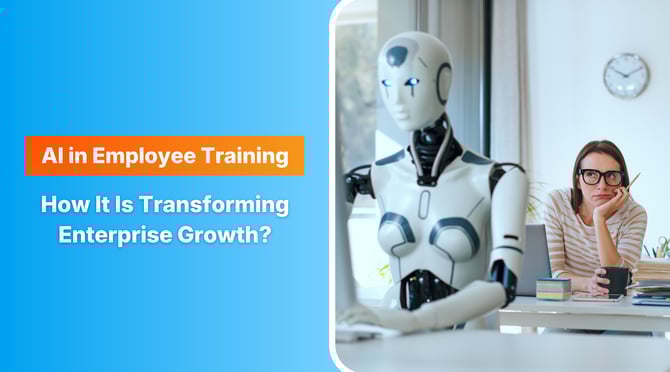
AI adoption is accelerating. But workforce readiness is still behind.
In 2026, 82% of enterprise leaders say their organization provides some form of AI training. And yet, 59% report an AI skills gap. The gap directly impacts decision-making and ROI from AI investments.
On one hand, we have traditional training models that are too slow and generic to keep up with advanced tech. At the same time, 45 percent of managers say that the use of AI has improved the work of their teams as much as they expected, with measurable efficiency gains.
The big challenge is not access to AI tools. It is the lack of role-based training programs that integrate into workflows.
This blog focuses on how generative AI for employee training can address the gap. Further, we will explore how enterprises can effectively implement AI to enhance business performance.
 Generate
Key Takeaways
Generate
Key Takeaways

- Generative AI is transforming employee training through adaptive learning.
- Enterprises must grow AI literacy and create structured learning programs.
- Data literacy and ethics are essential factors for responsible AI use.
- When implemented correctly, AI training accelerates decision-making and ROI.
Understanding the AI Training Problem for Mid-Market Enterprises
AI investments are increasing across mid-market enterprises. However, training remains a bottleneck. Most organizations have access to AI tools yet struggle to translate that productivity into workforce performance.
The issue is how employees are trained to use AI in business contexts. The lack of training causes:
- The AI process brings outcomes that are not tied to KPIs.
- Skills are delayed in application, making it longer to reach productivity.
- Training programs are not aligned with use cases.
- Low engagement due to a missing personalization.
- Limited visibility into training effectiveness.
But why does traditional training fail?
Static Learning Models: Traditional programs operate using predefined modules that do not adapt to changing requirements.
Lack of Adaptability: No real-time feedback loop to adjust training.
Disconnection from Workflows: Training exists outside the actual systems. It means no actual knowledge of real-time application.
Low Tool Adoption: Without contextual understanding, employees are likely to underutilize the available AI tools.
What Enterprises Need To Work On Instead?
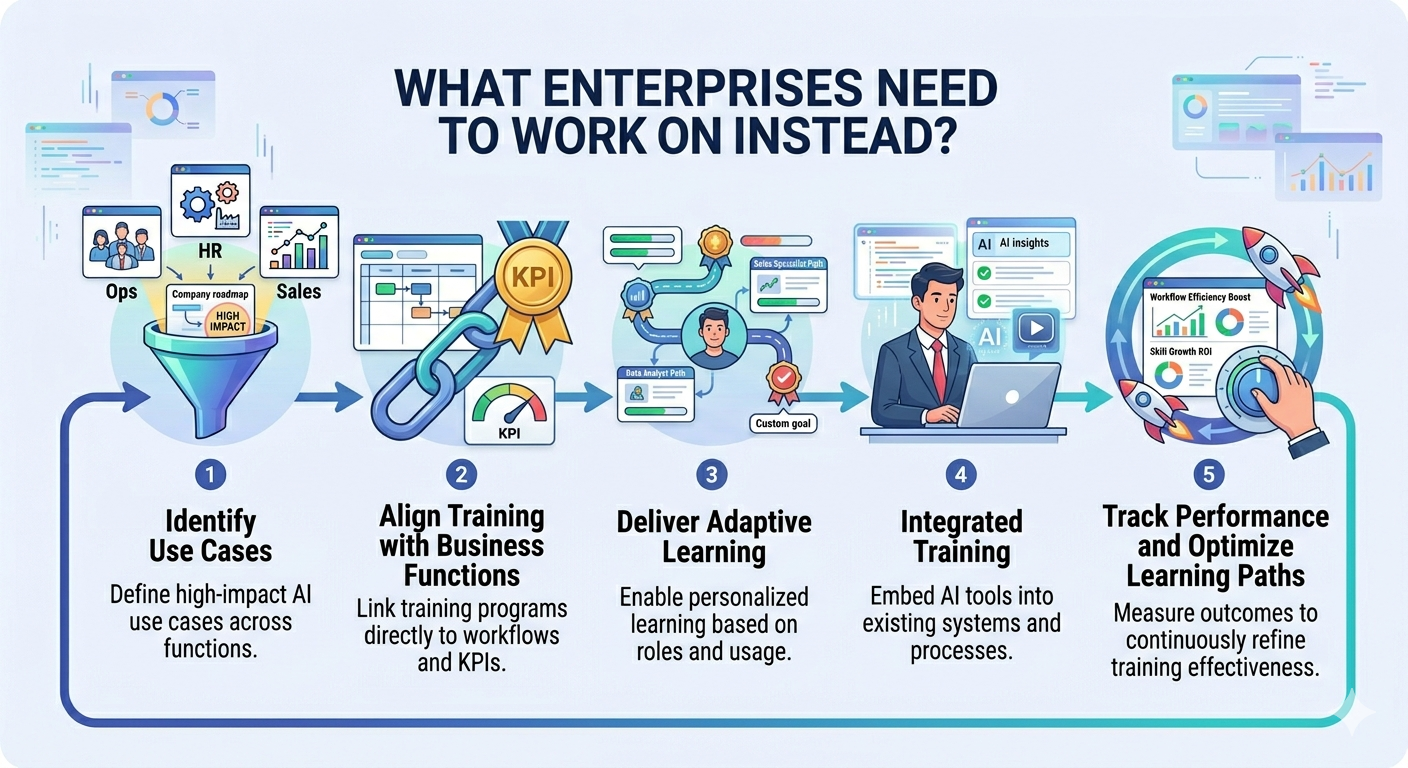
Step 1: Identify Use Cases:
Define high-impact AI use cases across functions.
Step 2: Align Training with Business Functions:
Link training programs directly to workflows and KPIs.
Step 3: Deliver Adaptive Learning:
Enable personalized learning based on roles and usage.
Step 4: Integrated Training:
Embed AI tools into existing systems and processes.
Step 5: Track Performance and Optimize Learning Paths:
Measure outcomes to continuously refine training effectiveness.
The above-defined approach ensures reduced time-to-competency and direct alignment towards business performance, meeting the goals to gain competitive advantage.
How Generative AI impacts Employee Training?
Instead of relying on static content, organizations are working on Gen AI systems that adapt in real time. The shift is what enables training to move from a support function to a performance driver.
From Static Training to Adaptive Learning Systems
Traditional training programs were built around fixed modules and predefined paths. They assumed all employees learn at the same pace and require the same content. However, the integration of gen AI changed the approach to work on evolving business requirements.
Generative AI introduces adaptive learning systems that evolve based on how employees interact with tools. It uses usage patterns and role context to recommend what an employee should learn next.
Instead of separating generative AI for employee training from work, learning can be embedded within workflows. It enables employees to receive guidance when executing tasks, reducing the gap between learning and application.
Solving the Skills Gap Across the Workforce
The skills gap is all about the speed at which new skills are required compared to the pace at which organizations can train their teams. Generative AI solutions help address the situation by enabling continuous upskilling. It identifies scope for skill development using employee data so that training can be aligned with specific organizational needs.
Business Impact of AI Training
The impact of AI-driven training is visible in operational metrics. Employees reach productivity faster because they learn from context. It makes the onboarding cycles shorter, without any major supervision requirements.
Productivity improves as repetitive tasks are automated with employees focusing on high-value work. Overall, such strategic initiatives benefit teams to be better equipped to execute complex projects in a short time.
Components of an AI Training Program
An effective AI training program requires a structured approach to build the foundational knowledge. It should offer practical application and alignment with real business workflows.
Here are the components that play a specific role in moving employees from awareness to execution:
|
Component |
Description |
AI Layer |
|
AI Literacy Foundation |
Basics of AI, ML, NLP |
Awareness |
|
Tool Training |
Hands-on use of generative AI tools |
Practical |
|
Data Literacy |
Understanding internal data |
Analytical |
|
Ethics Training |
Data privacy, bias, and responsible AI |
Governance |
|
Workflow Integration |
AI embedded into work processes |
Applied |
Component Breakdown
AI Literacy Foundation
For any AI training program, employees need an understanding of artificial intelligence, machine learning, and the latest tech stack. The goal is to stay competitive by gaining knowledge to implement AI without friction.
Tool Training
Once the understanding is developed, the employees need to learn to use generative AI tools for prompt design, data handling, and task automation. Generative AI for employee training at this stage should be aligned with real use cases across different roles.
Data Literacy
AI systems rely on data, which is why employees must understand how to interpret it. Data literacy enables teams to identify inconsistent outputs and make informed decisions. Without this layer, AI usage becomes reactive.
Ethics Training
As AI adoption grows, so do the risks related to bias. It means employees must be trained for skill development to understand responsible AI usage around sensitive data. Organizations investing in ethical training ensure that AI-driven decisions remain aligned with regulatory requirements.
Workflow Integration
Real-time workflows are where training delivers real value. AI is embedded into day-to-day processes, including reporting and analysis. Employees should not switch between learning and working. Instead, training should enable them to gain technical skills and apply AI directly within their existing workflows.
A well-structured training program connects the above-defined components into a continuous learning cycle. It ensures that employees move beyond basic understanding and apply AI to improve overall performance.
Employee AI Training Stages
AI training delivers value only when employees move beyond awareness to real application. The learning progression happens in three stages.
1. AI Literacy (Awareness Stage)
Employees understand AI concepts and capabilities. It builds confidence.
2. AI Fluency (Application Stage)
Employees use AI tools in day to day work. These can relate to reporting or in-team communication, and AI helps improve productivity and execution speed.
3. AI Expertise (Optimization Stage)
Employees optimize processes and identify new use cases to yield long-term value. Therefore, enterprises must design training programs that align teams from literacy towards expertise.
4. Data Literacy for AI Competency
AI systems are only as effective as the data they get. Without strong data literacy, employees may fail to make informed decisions. Since AI effectiveness depends on the relevance of data, employees must understand how to interpret and validate results.
Since over-reliance on AI outputs is prone to errors, employees must question results and avoid misinterpretation of insights. Also, teams must have clear guidelines for handling data, ensuring compliance with requirements.
Effective Training for AI Adoption: Quick Guide
Adopting AI tools depends on structured training that aligns with how teams actually work. This is why the process needs to check for certain benchmarks:
1. Adoption Barriers
Some of the common challenges associated with AI adoption in the mid-market industry include resistance to change. The constant lack of structured programs and difficulty integrating AI tools into existing systems make teams resist AI. These issues must be addressed to avoid underutilized AI investments.
2. Practical Phased Rollout
Once adoption barriers are removed, teams must start by identifying role-based use cases. The process begins with the introduction of relevant AI tools, followed by guided training. Such approach unlocks the opportunity to integrate AI into daily workflows and continuously refine training based on feedback.
3. Measuring Effectiveness
Post-rollout, teams need to track the adoption rates of AI tools. There must be checks on time saved on routine tasks using specific tools while focusing on improvements in output quality. Working with such an approach allows teams to measure real impact and work in the right direction.
Automating Tasks: How AI Training Drives ROI?
Teams that invest in AI training tend to gain the immediate benefits of AI training. AI training brings the ability to screen routine tasks that can be automated to save human effort.
When employees are trained to use AI tools effectively, automation becomes part of everyday workflows, leading to measurable growth:
1. Automation Opportunities
The primary advantage AI training delivers is the ability to identify repetitive tasks across functions such as operations, HR, etc. AI helps to simplify reporting, documentation, and basic analysis of the available information. Since these tasks are rule-based, they are most suitable for AI-driven automation.
2. Workflow Integrations
Automation can only be of advantage when AI tools are embedded into workflows. Employees need training that shows how to apply AI within existing workflows and not as a separate activity. In such a way, a mid-market enterprise can ensure higher adoption with consistent usage.
3. Measuring Productivity Gains
The impact can be measured through reduced manual effort and faster task execution. These improvements directly improve resource utilization and overall operational efficiency.
How Companies Use AI to Improve Decision-Making?
AI supports decision-making by turning internal data into actionable insights. Instead of relying only on intuition or static reports, AI can be trained to analyze data and work on decisions that generate value.
Organizations apply AI across functions to process large volumes of internal data. Here, predictive analytics can be harnessed to anticipate outcomes with scenario-based personalized recommendations to help employees in evaluating options before taking action.
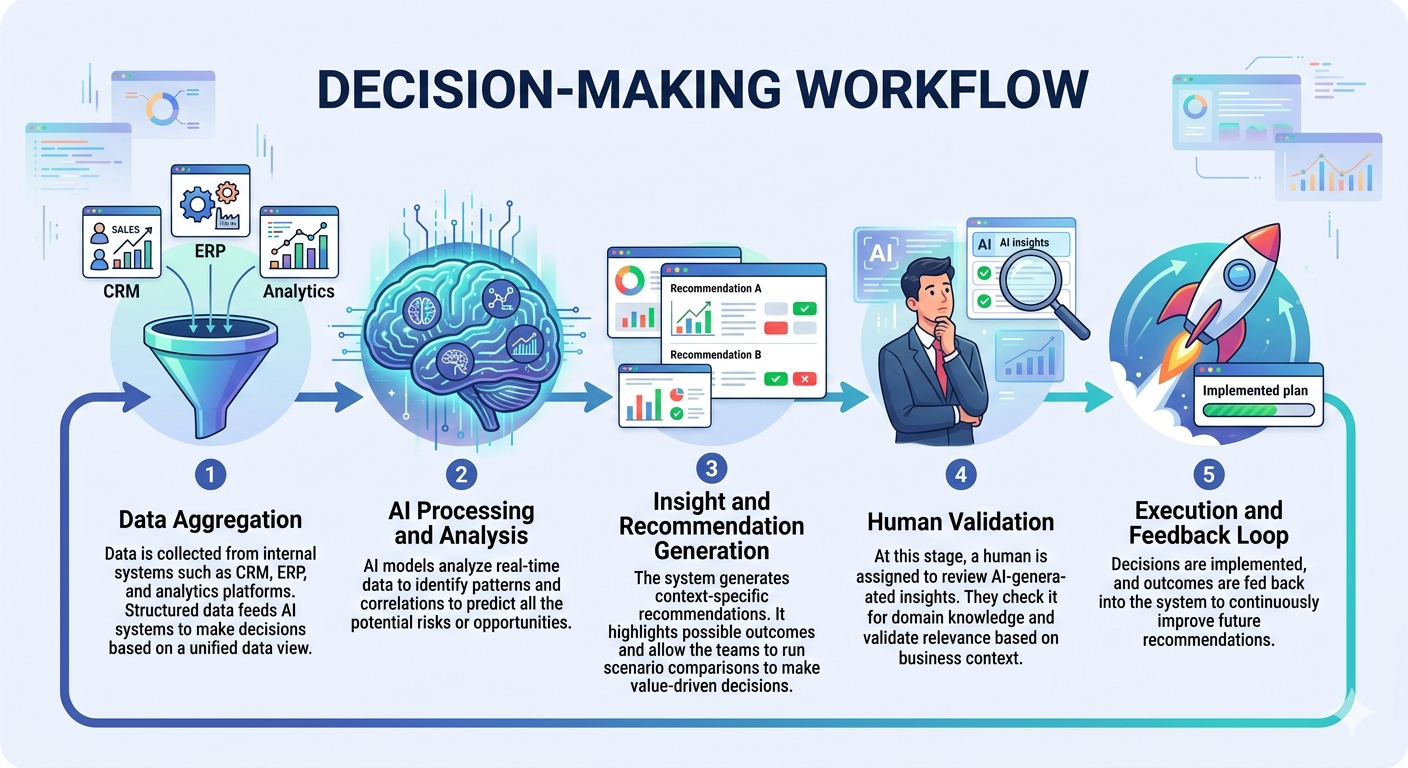
Step 1: Data Aggregation
Data is collected from internal systems such as CRM, ERP, and analytics platforms. When you feed structured data to AI systems, it helps to make decisions based on a unified data view.
Step 2: AI Processing and Analysis
AI models analyze real-time data to identify patterns and correlations to predict all the potential risks or opportunities.
Step 3: Insight and Recommendation Generation
The system generates context-specific recommendations. It highlights possible outcomes and allow the teams to run scenario comparisons to make value-driven decisions.
Step 4: Human Validation
At this stage, a human is assigned to review AI-generated insights. They check it for domain knowledge and validate relevance based on business context.
Step 5: Execution and Feedback Loop
Decisions are implemented, and outcomes are fed back into the system to continuously improve future recommendations.
Such a structured workflow ensures that AI enhances decision-making without replacing human judgment while ensuring the efforts are directed toward highly productive outcomes.
Ethics and Responsible AI: What Every Employee Should Know
As AI adoption increases, ethical usage becomes critical to ensure trust, compliance, and reliable outcomes. Employees must understand not just how to use AI, but how to use it responsibly within business environments.
1. Bias Awareness
AI models can reflect biases present in training data. Employees need to recognize potential bias in outputs and avoid making decisions without validation. This is essential for maintaining fairness and accuracy.
2. Data Privacy and Compliance
Using AI often involves handling sensitive internal data. Employees must follow data protection policies, ensure secure usage, and stay aligned with regulatory requirements to avoid risks.
3. Accountability in AI Usage
AI should support decisions, not replace responsibility. Employees must validate outputs, take ownership of actions, and ensure decisions align with business context and organizational policies.
Technical Architecture of AI Training Systems
AI training systems in enterprises are built on layered architectures that enable model processing and real-time interaction within existing environments. A well-structured architecture ensures seamless integration for consistent learning experiences.
Table: Architecture Layers
|
Layer |
Description |
|
Data Layer |
Internal data, LMS, HRMS systems |
|
AI Layer |
Machine learning, NLP, large language models |
|
Application Layer |
AI coaches, dashboards |
|
Integration Layer |
APIs and cloud infrastructure |
How These Layers Work Together
1. Data Layer
This layer aggregates structured and unstructured data from systems such as LMS, HRMS, and enterprise platforms. It provides the foundation for personalized insights.
2. AI Layer
Machine learning models, natural language processing, and large language models process the data to generate recommendations, training content, and real-time guidance.
3. Application Layer
This is where users interact with the system. AI coaches, dashboards, and training interfaces deliver personalized learning experiences and track progress.
4. Integration Layer
APIs and cloud infrastructure connect the AI system with existing enterprise tools. This ensures training is embedded within workflows rather than operating as a separate system.
This architecture enables organizations to deliver workflow-integrated AI training that aligns with real business processes.
Future of AI in Employee Training
AI in employee training is evolving from structured programs to continuous, intelligence-driven systems that adapt in real time. The focus is shifting toward embedding learning directly into work environments and enabling employees to build skills as they execute.
AI coaches and assistants are becoming more common, providing real-time feedback and recommendations during tasks. It reduces dependency on formal training sessions and improves on-the-job learning. Continuous learning systems are also gaining traction, dynamically updating training based on role changes and new technologies.
Emerging technologies such as advanced large language models and automation platforms will further expand training capabilities. At the same time, workforce roles are evolving, with a growing emphasis on AI fluency and cross-functional expertise.
Conclusion
AI training is no longer a support function. It is a core driver of workforce development and business performance. As AI adoption increases, organizations must move beyond static learning models and invest in adaptive, role-based training systems that align with real workflows.
The focus should be on structured adoption. This includes identifying use cases, enabling hands-on learning, and continuously improving training based on performance data. Without this approach, AI investments will remain underutilized.
When implemented effectively, AI training helps employees automate routine tasks, improve decision-making, and work more efficiently. Over time, this leads to measurable gains in productivity, faster execution of strategic initiatives, and better resource utilization.
From Signity’s perspective, successful AI training is built on strong alignment between technology, data, and business goals. Enterprises need tailored AI consulting, scalable architectures, and workflow-integrated solutions to ensure long-term impact. The goal is not just adoption, but sustained performance and continuous innovation.

Mangesh Gothankar


Ashwani Sharma
Achin Verma
Frequently Asked Questions
Have a question in mind? We are here to answer. If you don’t see your question here, drop us a line at our contact page.
What are the key components of an employee AI training program?

A structured program includes AI literacy, role-based tool training, data literacy, ethics, and workflow integration. Together, these ensure employees can apply AI in real business scenarios and not just understand concepts.
How to train employees to use AI tools effectively?
Focus on role-specific use cases, enable hands-on learning, embed AI into existing workflows, and track adoption through usage and performance metrics. Training must be continuous, not one-time.
What should AI ethics training include?
It should address data privacy, bias detection, responsible usage, and compliance. Employees must also understand accountability when acting on AI-generated outputs.
How do companies use AI to improve decision-making?
AI analyzes internal data, identifies patterns, and generates predictive insights. Employees use these recommendations to make faster, more accurate, and consistent decisions.
What is the role of data literacy in AI training?
Data literacy enables employees to interpret outputs and avoid blind reliance on AI, which is critical for decision quality.
How to build an AI training program for employees?
Start with business goals, map skill gaps, align tools with use cases, integrate training into workflows, and continuously optimize based on outcomes.
What is the difference between AI literacy and AI fluency?
Literacy is understanding AI concepts. Fluency is the ability to apply AI tools effectively within real workflows to improve outcomes.
How does AI training help automate routine tasks?
It equips employees to use AI for repetitive processes like reporting and analysis, reducing manual effort and freeing time for higher-value work.