


.png?width=27&height=27&name=Group(1).png)

-1.svg)
-1.svg)


-2.svg)


%201-1.webp?width=148&height=74&name=our%20work%20(2)%201-1.webp)




.svg)





Most EdTech platforms face the same challenge: learners sign up, but many never finish the course.
Low engagement and poor completion rates continue to affect online learning platforms, especially when they try to scale. The bigger the learner base, the harder it becomes to offer personalized support without increasing instructional costs.
And, this is where the AI tutoring system comes into play and changes how the modern education system works. It is powered by adaptive and machine learning capabilities that allow intelligent tutoring systems to personalize learning lessons, help students understand lessons at their own pace, clear concepts, and ultimately retain knowledge for a longer time.
Research indicates that global AI tutors market is expected to reach USD 17.72 billion by 2033, at a CAGR of 30.5%. This clearly highlights its rapid adoption across schools, universities, and other edtech platforms.
Whether it's personalized learning, clearing doubts on the go, or predictive learning analytics, the AI tutor platform redefines how students learn and engage. In this blog, we will explore how AI tutoring systems are achieving better knowledge retention and transforming the future of AI for student learning.
 Generate
Key Takeaways
Generate
Key Takeaways

- AI tutoring systems personalize learning based on student behavior and performance.
- Real-time feedback and adaptive learning boost knowledge retention and engagement.
- Intelligent tutoring systems help EdTech businesses scale personalized education.
- AI-powered education works best when combined with human mentorship and guidance.
What is an AI Tutoring System?
An AI tutoring system refers to an intelligent learning platform that uses AI to offer personalized experiences to students. It is far different from the traditional model and understands every student's learning pace and adjusts lessons according to their understanding.
Students learn via personalized lessons, online assessments, and guidance in real-time. Intelligent AI tutoring systems seamlessly collect and analyze the students' data, and based on their performance, adjust questions, recommend revisions, and offer improvement.
The system is used in language learning apps, STEM education platforms, and for corporate training. Schools and universities also continue to adopt AI that streamlines the learning process and improves engagement for students.
How AI Tutoring Systems Improve Knowledge Retention
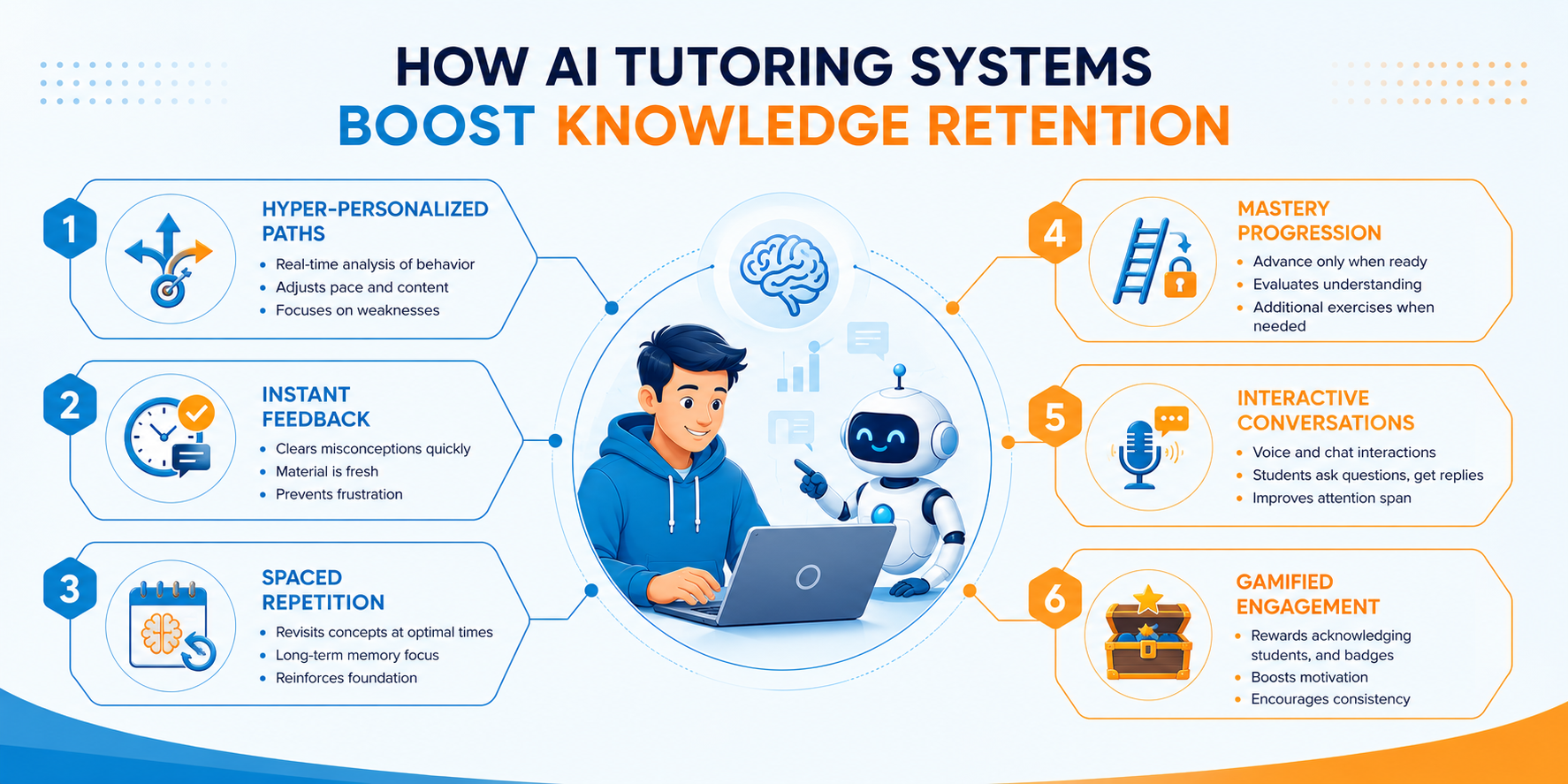
AI tutors can help students learn more effectively as they offer personalization, help reinforce learning, and keep the learners engaged. Here is how AI tutoring systems help:
1. Hyper-Personalized Learning Paths
Every student has a different learning pace and mindset, and the traditional one-size-fits-all model does not understand this. However, the AI tutors understand and analyze the behavior of users in real-time, adjust the pace, and create personalized learning paths for them. The learning paths are created based on the students' weaknesses, strengths, and learning pace. This ultimately allows them to focus on areas where they actually need improvement, rather than simply following a fixed schedule.
2. Instant Feedback and Real-Time Corrections
Students generally lose interest in the topic if the feedback is delayed. Thanks to the AI tutor platform that offers instant feedback and allows students to clear the misconceptions quickly. While the students are still in a learning stage, the material is fresh, and they get rid of the frustration that causes students to give up. This also allows students and other learners to fix their mistakes quickly in real-time and prevent confusion.
3. Spaced Repetition and Mastery Learning
AI-powered education platforms rely on spaced repetition techniques and improve long-term memory. The algorithms help revisit the concepts at the right time and interval so that students can retain the information for a much longer time, rather than forgetting it during the exam period. For learners who want to apply this technique independently, using the best spaced repetition app can make it easier to schedule reviews and reinforce concepts consistently. It also helps identify learners who need reinforcement of which concepts and ensures the foundational topics are clear before moving on to advanced ones.
4. Mastery-Based Progression Models
We are well aware that in the traditional learning model, students were simply given lessons without any clarity on whether they were able to understand the material. AI tutoring systems follow a mastery-based approach. That means learners move to the next session once they have a clear understanding of the previous concept. The system evaluates the students' performance via assessments and learning behavior. However, if the student still struggles, they can be further assigned additional exercises.
5. Interactive and Conversational Learning Experiences
Modern AI for student learning is making education more interactive. It uses conversational AI and voice-based interactions that keep students engaged in the learning process. For example, students can ask their queries to the system and receive quick replies. It works similarly to a human tutor. As the learning experiences are interactive, there is an improved attention span, and more student participation, ultimately leading to more engagement and retention.
6. Gamification and Engagement-Driven Learning
Student motivation is one of the most critical challenges the education sector faces. To sort this out, the AI tutor platform encourages gamification features like giving rewards, acknowledging students, and badges that keep the learners' motivation alive. The features offer more engaging and enjoyable learning experiences. Higher engagement levels often result in improved concentration, better consistency, and stronger knowledge retention over time.
Recommended Post: Role of AI in Education: Use Cases and Examples
Key Features of an Intelligent Tutoring System
Here are the critical features of an intelligent tutoring system that help students leverage engaging learning experiences.
Personalized Dashboards and Learner Analytics
An AI tutoring system offers a personalized dashboard that seamlessly displays the learning process of every individual separately. These personalized dashboards are assigned according to the students' weaknesses, goals, and strengths. The dashboards help students and teachers to understand the learning patterns and make better decisions.
Interactive Simulations & Gamification
AI tutors, to be interactive, offer smart assessments and gamification features. Here, the assessments can be adjusted according to the difficulty level of the individual. Rather than static tests, the personalized gamifications and assessments offer learners rewards and points, that encourages them to participate and allow them to practice more effectively.
Natural Language Conversational Tutoring
Using natural language processing (NLP), an intelligent tutoring system can interact with tutors conversationally. It allows learners to naturally ask questions and receive step-by-step explanations. It also helps clear their doubts on the go, and there is no need for manual teacher support.
Progress Tracking and Performance Insights
With AI-powered education support, schools can encourage continuous monitoring of their students, their activities, and engagement levels. When the insights are right, the learners who are unable to cope with the pace are identified at an earlier stage. This offers a more targeted support, and there is no scope for performance decline.
Integration With LMS and EdTech Ecosystems
The AI tutoring system often includes learning management systems, virtual classrooms, and other edtech ecosystems. This creates a connected digital learning environment that has seamless data-sharing capabilities and offers centralized learning management.
AI Tutoring Systems vs Human Tutors
Both AI tutors and human tutors play a critical role in educating. While AI offers more scalability and personalization, humans bring emotional intelligence and can not be completely replaced.
| Factor | AI Tutoring Systems | Human Tutors |
| Cost & Scalability | More affordable and highly scalable for large numbers of students | Expensive and limited by tutor availability |
| Availability & Response Time | Available round the clock to offer support | Limited to scheduled sessions |
| Personalization | Rely on real-time data to adapt learning pace | Personalization depends on the tutor's experience |
| Teaching Consistency | Delivers consistent explanations, assessments, and evaluations | Teaching quality may vary from tutor to tutor |
| Engagement Methods | Uses gamification and adaptive learning tools | Builds engagement via personalized communication |
| Emotional Intelligence | Limited emotional understanding and lacks empathy | Strong emotional support and encouragement |
| Assessment & Tracking | Tracks performance continuously using data analytics | Manual tracking with limited real-time insights |
| Learning Flexibility | Students can learn anytime and from anywhere | Often dependent on fixed schedules |
| Best Use Cases | Repetitive practice, test preparation, concept reinforcement | Critical thinking and mentorship |
| Scalability for Institutions | Easily supports thousands of learners simultaneously | Difficult to scale across large student groups |
Business Benefits of AI Tutoring System Development
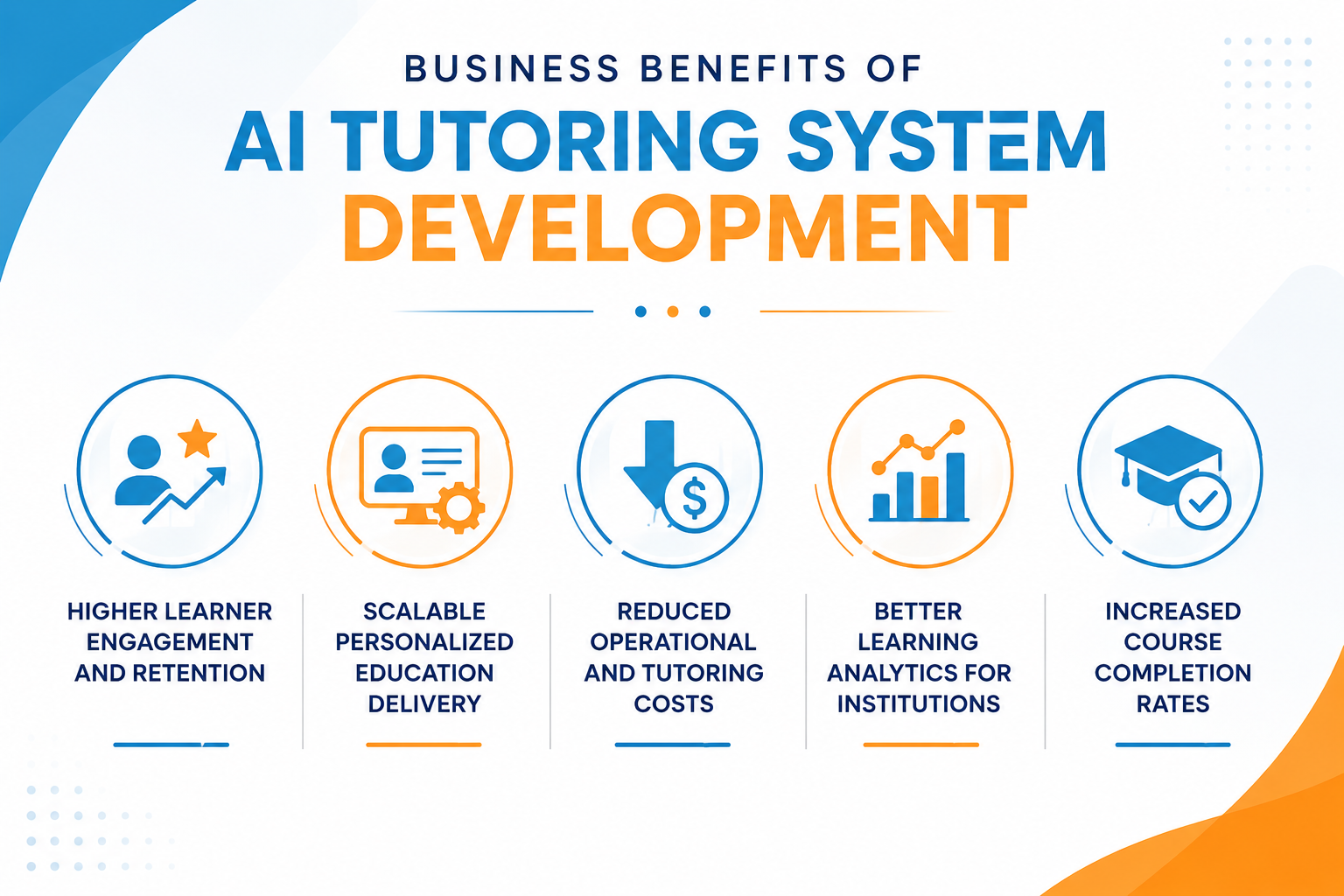
As the demand for more personalization and digital learning increases, EdTech companies have begun investing in AI tutoring systems so that students' outcomes can be improved, and scaling becomes much easier. Apart from automation, the systems also help create a better learning experience. Let us discuss all the benefits it offers in more detail:
Higher Learner Engagement and Retention
When the learning process becomes repetitive and boring, students generally lose interest. Thanks to AI tutors who keep the learners motivated and engaged with interactive sessions, quick feedback, and personalized recommendations. When the students are engaged, they continue to learn, take more interest, and complete their courses well on time.
Scalable Personalized Education Delivery
Delivering personalized support to each student can be a daunting task to do. Thanks to intelligent tutoring systems that can seamlessly solve these challenges. It personalizes the lessons for every student at scale, and this allows edtech businesses to target a large set of people altogether. Guess what, students don’t have to compromise on the quality as well.
Reduced Operational and Tutoring Costs
Hiring and managing a large team of teachers raises the operational costs and the tutoring costs as well. AI-powered educational platforms offer automated learning support with pre-recorded sessions that automate repetitive tasks. A few of these tasks include creating assessments, resolving doubts, tracking progress, and more. This ensures that businesses can reduce the cost and still maintain consistent learning support.
Better Learning Analytics for Institutions
AI tutoring systems continue to collect data like student performance, their level of engagement, work completion rates, and areas of improvement. With these insights, both institutions and edtech companies can make well-informed decisions and improve the quality of courses over time.
Increased Course Completion Rates
Most online learning platforms struggle with low course completion rates. AI helps improve course completion rates and keeps students motivated. It also offers personalized guidance and gamification throughout their learning journey.
Challenges and Ethical Concerns in AI Tutoring Systems
While AI tutoring systems offer significant advantages, they also come with challenges that educational institutions and EdTech businesses must address carefully.
| Challenge | Impact on Education |
| Over-Dependency on AI Learning | Reduced independent thinking Lower problem-solving ability Less critical reasoning |
| Data Privacy and Security Concerns | Risk of data misuse Student information exposure Compliance challenges |
| Bias in AI Algorithms and Training Data | Unfair learning outcomes Inaccurate recommendations Limited personalization |
| Accessibility in Under-Resourced Regions | Limited platform access Connectivity issues Infrastructure gaps |
| Limited Emotional Understanding | No emotional support Difficulty understanding stress Limited human empathy |
| Balancing Automation With Human Interaction | Less teacher involvement Reduced personal guidance Need for hybrid learning |
| High Development and Integration Costs | Higher initial investment Complex integrations Ongoing maintenance costs |
Future Trends in AI-Powered Education
AI is helping education platforms deliver more adaptive, personalized, and data-driven learning experiences. As AI adoption continues to grow, EdTech platforms are becoming more intelligent, scalable, and responsive to student needs. Here are some key trends shaping the future of AI-powered education.
Generative AI Tutors and Conversational Learning
The scenario has changed drastically, and instead of relying on long lectures, students prefer learning via generative AI in edtech. Relying on such technologies allows modern AI tutors to quickly answer questions, explain simple topics, and guide the learners. This makes the process of learning much easier and stress-free for the students.
AI-Powered Virtual Classrooms
Virtual classrooms continue to become more advanced with AI. It allows teachers to track the participation of students, create assessments, and monitor the progress of learning. It offers much faster support during online learning.
Emotion-Aware AI Learning Systems
Some AI systems are now being designed to understand student behavior. They can detect confusion, frustration, or low attention levels during lessons. This helps the platform adjust the learning experience when needed.
AR/VR Integration in Intelligent Tutoring Systems
AR and VR are making learning more practical. Students can explore virtual labs, interact with 3D objects, and practice simulations in real time. These experiences make lessons easier to understand and remember.
Conclusion
AI tutoring systems are changing how students learn, practice, and retain knowledge. From personalized learning paths to real-time feedback and adaptive lessons, these platforms are making education more engaging and effective.
As the demand for smarter and more flexible learning experiences grows, AI-powered education will continue to play a major role across schools, universities, and EdTech platforms. Businesses investing in intelligent tutoring system development today are building the future of digital learning.
At Signity Solutions, we help EdTech businesses build scalable AI tutoring systems tailored to their learning goals. With hands-on experience in building custom education platforms, AI integrations, and intelligent learning workflows, we help businesses launch future-ready solutions that fit their users, content model, and scale requirements. Planning to build an AI tutoring system for your platform? Get a free consultation today!

Mangesh Gothankar


Ashwani Sharma
Achin Verma
Frequently Asked Questions
Have a question in mind? We are here to answer. If you don’t see your question here, drop us a line at our contact page.
What industries can benefit from AI tutoring system development?

AI tutoring systems are widely used in education, corporate training, healthcare learning, language training, and professional certification platforms.
Can an AI tutor platform support multiple learning styles?
Yes. An AI tutor platform can adapt content for visual, audio, text-based, and interactive learning preferences based on student behavior.
How secure is student data in AI-powered education platforms?
Most modern AI-powered education platforms use encryption, secure cloud storage, and access controls to protect student data and learning records.
Is AI for student learning suitable for small educational institutions?





.png?width=352&name=AI%20Solutions%20in%20Education%20A%20CXO%20Guide%20to%20Scalable%20ROI%20(1).png)