

.png?width=27&height=27&name=Group(1).png)

-1.svg)
-1.svg)


-2.svg)


%201-1.webp?width=148&height=74&name=our%20work%20(2)%201-1.webp)




.svg)





Only 27% of executives say they have a comprehensive AI strategy in place. Just one in five believe their workforce is truly AI-ready, says the Gartner survey of nearly 200 CxOs and senior business leaders.
The gap between confidence and reality is exactly where accountability problems start. It shows up first in systems nobody can fully explain to a regulator, a board, or a customer who just got denied a loan.
AI accountability is the practice that closes that gap. It means assigning who owns an AI decision, documenting how that decision got made, and building the controls that let an organization prove it when someone asks.
That "someone asks" part isn't hypothetical anymore. The EU AI Act's high-risk obligations are phasing in through December 2027. U.S. states including California, Colorado, and Texas have their own AI transparency laws landing in 2026. Insurers, meanwhile, are underwriting AI governance maturity directly into cyber policies.
This guide walks through what an AI accountability policy actually contains, and which controls turn that policy into something enforceable. This guide also covers AI governance best practices that help organizations defend their AI decisions rather than simply hoping they won't be questioned.
 Generate
Key Takeaways
Generate
Key Takeaways

- Accountability means naming who owns an AI decision before deployment. It does not mean explaining failures after the fact.
- Policies without enforcement controls are just aspirations. RACI matrices and audit trails are what make accountability real.
- The EU AI Act, NIST RMF, and ISO 42001 converge on the same core ideas of transparency, oversight, and traceability.
- Risk-tier classification, lifecycle checkpoints, and continuous monitoring matter for a reason. They turn governance from theory into daily practice.
What is an AI Accountability Framework?
An AI accountability framework is a documented set of policies, roles, and controls. It assigns responsibility for an AI system's behavior across its lifecycle. That lifecycle runs from data collection through retirement.
The U.S. Government Accountability Office built one of the earliest widely cited versions of this idea in 2021. It was meant to organize around four principles:
- Governance means setting clear goals and naming who's accountable before a system goes live.
- Data means checking that training data is representative and lawfully sourced.
- Performance means testing the system against its stated purpose.
- Monitoring means watching the system after deployment.
That four-part structure still holds up. What's changed in 2026 is the stakes. Back then, accountability was mostly an audit concern inside federal agencies. Now it's a board-level question for any company running AI. It is because a model that can't explain its own decision is a model that can't survive a regulator's request for documentation.
The practical difference between an AI accountability framework and a broader AI governance framework is scope. Governance covers the full operating system. It includes ethics, security, data management, and risk. Accountability is the sharper question sitting inside it. It works at the question who answers for it, when something goes wrong.
Why AI Accountability Matters in 2026
The market itself is confirming the urgency. Gartner projects global spending on dedicated AI governance platforms will reach $492 million in 2026 and surpass $1 billion by 2030, as AI-specific regulation expands to cover roughly three-quarters of the world's economies.
The same analysis found a clear performance gap. Organizations running a dedicated AI governance platform are 3.4 times more likely to reach high governance effectiveness.
Regulators have stopped waiting for that gap to close on its own. The EU AI Act began enforcing its prohibited-practice rules in February 2025. Penalties for the most serious violations reach €35 million or 7% of global turnover.
High-risk system obligations were originally due in August 2026. Regulation (EU) 2026/1744, the Digital Omnibus on AI, entered into force on July 27, 2026. It pushed that deadline to December 2, 2027.
In the U.S., California, Colorado, and Texas have all introduced AI transparency and governance laws taking effect in 2026. The Federal Reserve's SR-26-2 guidance, issued in April 2026, also reshaped how banks holding over $30 billion in assets must treat AI-adjacent model risk.
Three frameworks anchor most enterprise programs today. They are built to layer on top of each other rather than compete:
| Framework | Status | Core Focus | Certifiable |
| NIST AI RMF | Voluntary (U.S | Govern, Map, Measure, Manage functions | No |
| ISO/IEC 42001 | Voluntary, international | AI management system (Plan-Do-Check-Act) | Yes |
| EU AI Act | Binding law | Risk-tiered obligations, unacceptable to minimal | N/A — legal compliance |
A common and workable pattern has emerged. Organizations use the NIST AI RMF for initial risk assessment and governance planning. They layer ISO 42001 on top for a certifiable management structure. Then they map EU AI Act obligations against any system that touches European users or data.
Core AI Accountability Policies
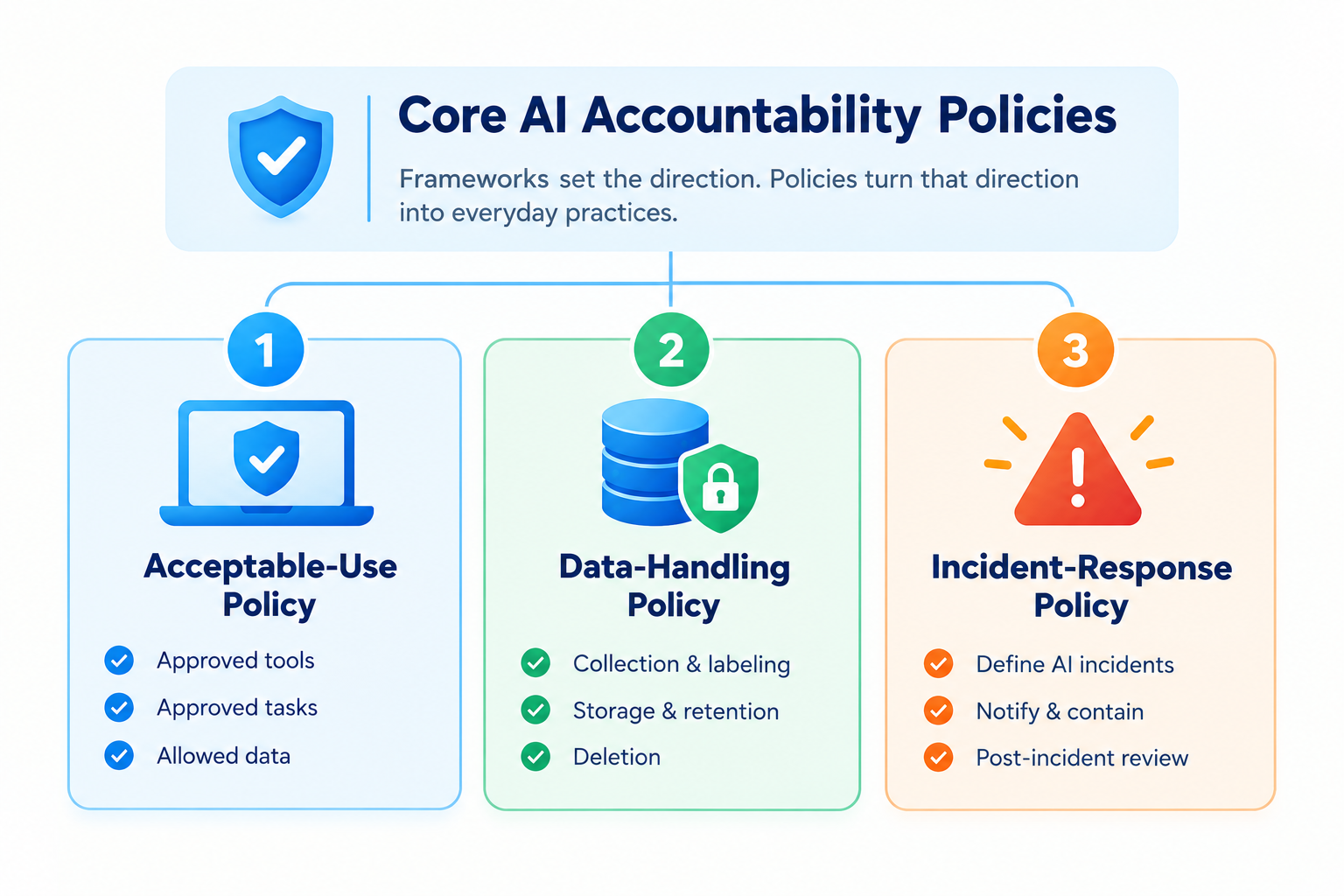
Frameworks establish the direction. Policies translate that direction into practices employees can follow day to day. There are three documents that form the operational backbone of any AI accountability policy. Omitting any one of them leaves a gap that regulators and auditors will eventually identify.
Acceptable-Use Policy
An AI acceptable-use policy sets clear limits: which AI tools employees may use, what tasks those tools are approved for, and what data can go into them. Without that document, a developer might paste proprietary code into a public chatbot without a second thought. An HR specialist might upload candidate files to a tool nobody on the security team has ever reviewed.
Without one, shadow AI fills the gap on its own. A Gartner Global Labor Market Survey of more than 12,000 employees across 40 countries found that 88% of employees with enterprise AI access also use personal AI tools for business tasks, often just to save time.
Data-Handling Policy
A data-handling policy governs the AI data lifecycle. It covers how training data gets collected, labeled, stored, retained, and eventually deleted. The policy has to reconcile two forces pulling in opposite directions. Models need large volumes of data to perform well. Regulations such as GDPR require organizations to collect only what's strictly necessary.
Every AI initiative should run a data protection impact assessment before collection starts. That assessment maps the legal basis for processing. It also maps the re-identification risk if the data ever leaks.
Incident-Response Policy
An AI-specific incident-response policy starts by defining what counts as an AI incident in the first place. That definition typically includes model drift past a set threshold. It also includes biased outputs, data leakage through inference, and deepfakes used for impersonation.
The policy then lays out who gets notified, how the system gets contained, and what the post-incident review has to cover. Traditional cybersecurity incident response wasn't built for this. A model that quietly produces biased loan decisions for six months doesn't trip the same alarms as a ransomware attack, but the cumulative damage can be worse.
Related Read: The AI Governance Framework Guide
AI Accountability Controls That Make Policy Enforceable
Policies establish the rules. Controls are what make sure the rules actually get followed.
RACI and Named Ownership
A policy that fails to name a person responsible is, in practice, a wish list rather than a working document. The corrective mechanism is a RACI matrix. It assigns Responsible, Accountable, Consulted, and Informed roles across every stage of the AI lifecycle. That lifecycle includes data acquisition and model development. It includes bias testing and deployment approval. It also includes production monitoring, incident response, and audit.
The rule that actually matters is that exactly one Accountable owner exists per activity. Split accountability sounds collaborative, but in practice it works out to nobody owning the outcome when something breaks.
Every high-risk system needs three roles. A model owner is accountable for the system's behavior in production, though that isn't necessarily the person who built it. A data steward is accountable for where the training data came from. A compliance lead signs off before go-live on anything touching regulatory obligations.
Continuous Monitoring and Audit Trails
Controls only work if someone is watching after deployment. That means tracking three things: model drift, fairness metrics such as demographic parity delta across protected groups, and accuracy degradation over time. The Population Stability Index is the common metric for drift, a standard statistical convention where anything above 0.25 signals a real distribution shift.
Immutable audit logs matter as much as the metrics themselves. When a regulator asks what happened and why, "we think" isn't an answer. Automated logging tools cut the documentation burden, but a human still has to check that the business rationale got captured accurately, not just the technical output.
Human Oversight Mechanisms
Human oversight isn't one setting. Oversight splits into three distinct modes. A mature accountability framework specifies which mode applies to each system. Human-in-the-loop means a person reviews and approves every output before it takes effect. This mode fits something like a clinical decision-support tool.
Human-on-the-loop also refers to the system that runs autonomously while a person monitors in real time with override authority. This is the model used for fraud detection or algorithmic trading. Human-in-command means a person sets the constraints the system operates within, with the ability to intervene at the edges. Getting the mode wrong is its own accountability failure, whether that means too much friction on a low-risk chatbot or too little oversight on a lending model.
Best Practices for Implementing an AI Accountability Framework
Controls tell you whether accountability is working today. Best practices are what keep it working as the organization's AI footprint grows.
Start With Risk-Tier Classification
Not every AI system deserves the same scrutiny. A three-tier classification keeps governance resources pointed at what matters. High, medium, and low risk each get a different level of attention instead of spreading resources thin across a hundred low-stakes internal tools. Where a system lands depends on what it decides and who it affects.
- High risk: hiring, credit, healthcare, and legal-rights decisions
- Medium risk: customer-facing tools where errors damage trust but not legal standing
- Low risk: internal productivity tools that still need basic logging
Build Lifecycle Checkpoints, Not One-Time Reviews
A lifecycle control map puts a governance gate at intake, data acquisition, model development, pre-deployment, production, and retirement. Each gate either produces a documentation artifact or references one already on file, which is what turns a control map from a diagram on a slide into something an auditor can actually follow.
Choose Governance Technology Deliberately
Most organizations shouldn't build governance tooling from scratch. McKinsey's May 2026 Enterprise AI FinOps survey found 93% of enterprises exceeded their AI budgets over the past year, and internal platform builds are especially prone to that same overrun as regulations shift underneath them mid-project.
Buying purpose-built governance software is usually the faster, cheaper path. Look for a platform that maps to ISO 42001, NIST AI RMF, and EU AI Act requirements out of the box. That gets most mid-market and enterprise teams to a working program faster, and at lower total cost, than building in-house.
Related Read: Understanding AI Governance
Signity's Approach to Accountable AI
Getting all three pieces right- policy, controls, and best-practice implementation- is usually where internal teams run out of bandwidth. Building the policy is the easy part. Mapping it against three different regulatory regimes while your engineering team is still shipping features is where most internal efforts stall.
Signity works with enterprise teams on the pieces that tend to get skipped. That includes:
- Drafting AI accountability policies that hold up under audit
- Building RACI matrices that assign one real owner per lifecycle stage instead of a committee
- Mapping existing AI systems against EU AI Act risk tiers, ISO/IEC 42001's management-system clauses, and the NIST AI RMF's four functions, side by side rather than as three separate projects
The goal isn't a policy binder nobody reads. It's a working accountability structure your compliance team can defend on short notice, and your engineering team can actually operate inside without governance becoming the thing that slows every deployment down.
Conclusion
AI accountability isn't a document you write once and file away. It's closer to a discipline, one that has to survive the gap between what a policy says on paper and what a production system actually does when nobody's watching.
The organizations that get this right aren't the ones with the most polished ethics statement. They're the ones who can name an owner, produce an audit trail, and explain a decision on forty-eight hours' notice instead of forty-eight days. With EU AI Act enforcement deepening and U.S. state laws landing through 2026, the gap between "we have a policy" and "we can prove it" is exactly where the real risk sits.

Mangesh Gothankar


Ashwani Sharma
Achin Verma
Frequently Asked Questions
Have a question in mind? We are here to answer. If you don’t see your question here, drop us a line at our contact page.
How do federal agencies assign and map accountability when deploying AI systems?

What regulatory requirements and industry standards govern AI accountability in the US?
Who can be held accountable when machine learning models or AI models cause harm?
How do organizations demonstrate compliance and ensure accountability across stakeholders?
What role do data science and AI experts play in accountability questions?