

.png?width=27&height=27&name=Group(1).png)

-1.svg)
-1.svg)


-2.svg)


%201-1.webp?width=148&height=74&name=our%20work%20(2)%201-1.webp)




.svg)





Financial institutions manage more sensitive financial data than almost any other industry. Transaction histories, credit files, regulatory filings, and market reports pile up faster than compliance teams and financial professionals can review them by hand.
Generative AI promised to help, then ran into a hard limit: a model only knows what it was trained on, and that knowledge goes stale fast in a market that moves every day. Retrieval augmented generation changes that equation. RAG in Finance pairs a language model with a retrieval system built on your own data sources, so every answer comes from relevant documents instead of a model’s frozen training data.
For banks, investment firms, and fintechs, this distinction determines whether generative AI creates compliance risks or a genuine competitive edge for financial services organizations. This guide explains how retrieval augmented generation services actually work, where they deliver measurable ROI, and what regulatory compliance now requires before a system reaches production inside a regulated financial environment.
 Generate
Key Takeaways
Generate
Key Takeaways

-
RAG systems ground every answer in real financial data, cutting hallucinations in regulated workflows.
-
Structured document retrieval nearly doubles retrieval accuracy over naive text extraction, per CFA Institute testing.
-
EU AI Act and DORA make regulatory compliance mandatory for RAG models used in credit risk assessment.
-
Fraud detection, credit scoring, and compliance reporting deliver the fastest, most measurable returns.
Understanding RAG in Financial Services
RAG in Finance, short for Retrieval-Augmented Generation, pairs two key components: a retrieval engine and a large language model. Large language models are powerful on their own. Even so, they can only draw on what they were trained on, and that training data goes stale the moment new filings, prices, or policies appear.
A retrieval engine’s only job is to retrieve relevant information fast and hand it to the model. Ask a question, and the system searches your document stores for relevant documents, pulls out the relevant information, and passes it to the language model to write an answer grounded in your actual records instead of memorized training data. That is retrieval-augmented generation, RAG, working exactly as intended: retrieval first, generation second.
This is a real shift from how data retrieval used to work at most financial institutions. Traditional keyword-based search returns documents containing the exact words in a query, so analysts still had to read through multiple documents to find the real answer. Document retrieval through RAG works differently. It ranks results by meaning, not exact wording, so a question about loan defaults also surfaces relevant documents filed under non-performing loans or credit scoring models.
RAG in Financial Services also protects data ownership. Because the retrieval engine only searches documents your organization controls, sensitive financial data never leaves your environment to train a public model. That is what separates a proper RAG system from a general-purpose chatbot: every answer traces back to a specific regulatory filing or record that a compliance team can verify.
RAG vs. Fine-Tuning: Which One Does Your Institution Need?
The two approaches solve different problems, and most financial services organizations end up needing RAG first. Fine-tuning adjusts a model’s internal weights on a custom dataset, which works well for teaching a fixed style or format. RAG keeps the model as-is and instead controls what it reads at answer time, which is what regulated, fast-changing financial data actually requires.
| Factor | RAG | Fine-Tuning |
| How it works | Retrieves relevant documents at query time and feeds them to the model | Retrains the model’s internal parameters on a custom dataset |
| Data freshness | Updates the moment source documents change | Requires a new training run to reflect new information |
| Auditability | Every answer traces back to a source document | Answers come from adjusted model weights, harder to trace |
| Best fit for finance | Fast-changing financial data and compliance-heavy workflows | Stable, narrow tasks like tone, format, or terminology matching |
Related Read: Mastering RAG Implementation: Covering All the Basics
Why Are Financial Institutions Adopting RAG Now?
Adoption across the financial sector has moved well past the pilot stage. According to the Cambridge Centre for Alternative Finance’s 2026 Global AI in Financial Services Report, 81 percent of financial services organizations now use AI models in some form, though only 14 percent describe their deployment as fully transformational. That gap between using AI and using it well is where RAG for financial services makes the biggest difference.
McKinsey’s 2026 Global Banking Annual Review estimates that AI could unlock up to 340 billion dollars in annual value across the banking sector. Much of that value comes from faster financial document processing, sharper economic forecasts, and less manual compliance work. Banks that combined cloud migration with AI deployment reported a 29 percent increase in pre-tax profit and a 7.7 percent drop in operating expenses compared with peers that had not made the same investment.
The pattern holds across investment firms and among portfolio managers as well. Institutions that treat retrieval augmented generation as core infrastructure, rather than an experiment attached to a chatbot, are the ones converting AI spend into data-driven insights across the finance sector. NVIDIA’s 2026 State of AI in Financial Services report backs this up directly: 65 percent of financial institutions now use AI in production, up from 45 percent a year earlier, and fraud detection has become the single most common AI use case in the industry.
Related Read: 25+ Best Open Source RAG Frameworks
RAG Architecture and How It Works
Inside the Pipeline
A RAG pipeline follows three steps in practice. A user query comes in. The retrieval engine searches a vector database for the passages that best match that input query, using semantic search to rank results by meaning instead of exact wording.
The generative model reads that retrieved content, made up of the most relevant chunks out of thousands of candidates, and writes a response that cites where the information came from. A system capable of handling financial context this way will say a source could not be found rather than invent an answer.
Document Structure and Retrieval Performance
Document structure matters more than most teams expect. Financial filings mix narrative text, tables, and footnotes, and how well that structure survives ingestion has a direct effect on retrieval performance. Some financial RAG pipelines now use vision language models to read scanned filings and image-based tables, extending retrieval accuracy to documents that plain text extraction would otherwise miss entirely.
| Feature | RAG-Enhanced Language Model | Pure Generative Model |
| Data source | Live, proprietary financial data | Frozen training data only |
| Accuracy on new information | High, traceable to a source document | Prone to outdated or invented answers |
| Regulatory compliance fit | Auditable, source cited | Hard to justify to regulators |
| Customization | Tuned to your data sources and workflows | Generic across all users |
Retrieval accuracy still depends heavily on how source data is prepared, and that is worth stating plainly rather than overselling it. In a 2026 case study, CFA Institute Research and Policy Center tested a RAG pipeline against real corporate filings and found that structured, header-based chunking produced 62 percent overall accuracy on complex extraction tasks, compared with 32 percent for a naive text splitting approach.
Qualitative information, such as governance language, scored higher than numeric extraction, such as compensation calculations. Most financial RAG deployments now pair retrieval with a calculation or agent layer to close that particular gap.
Related Read: Understanding RAG: Architecture, Techniques & Development
High-Impact Use Cases in Banking and Financial Services
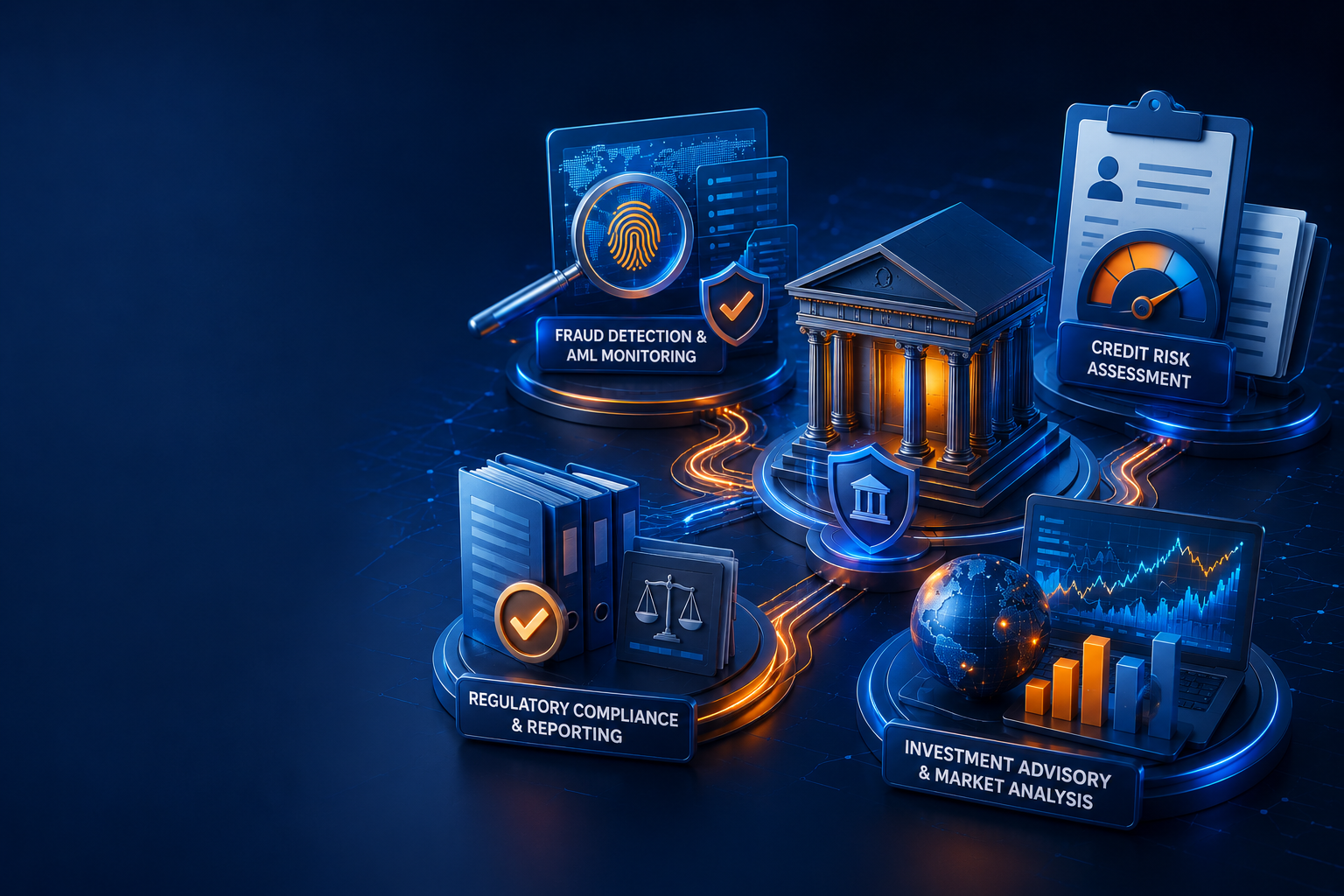
Fraud Detection and AML Monitoring
RAG systems enable real-time data cross-referencing of transaction patterns against historical fraud cases, sanctions lists, and regulatory guidelines. Instead of a rules engine flagging every anomaly for manual review, a RAG pipeline retrieves the specific precedent or policy that explains why a transaction looks suspicious. That context cuts false positives and gives investigators a documented reason to act, which matters when compliance teams are already buried in alert queues.
Credit Risk Assessment
Credit risk assessment depends on combining structured data with unstructured financial reports, bank statements, and employment letters. RAG retrieves and synthesizes both in a single pass, giving underwriters a consistent, evidence-backed risk picture instead of a black box score. It also makes it straightforward to show regulators exactly which relevant data drove a lending decision, a requirement under most credit scoring models and fair lending frameworks.
Regulatory Compliance and Reporting
Compliance teams spend enormous time manually cross-checking new regulatory guidelines against internal policy. RAG shortens that cycle by retrieving current regulatory filings and flagging exactly where internal documentation is out of step with fast-changing financial regulations, whether that involves a DORA ICT requirement or a MiFID II disclosure rule. It will not replace a compliance officer’s judgment. It does remove most of the manual searching that eats up their week.
Investment Advisory and Market Analysis
Financial professionals use RAG to pull relevant research, client history, and real-time market analysis into one grounded answer instead of assembling it by hand before every client call. RAG also speeds up how advisors respond to customer queries during volatile markets. Morgan Stanley’s wealth management division has publicly discussed building its advisor assistant on this pattern, retrieving from its internal research library to deliver precise, sourced answers that improve customer satisfaction instead of generic AI output.
Staying Compliant: RAG Under the EU AI Act, DORA, and GDPR
Regulatory compliance is no longer a footnote at the end of an AI project. For EU regulated financial institutions, it is a fixed deadline. The EU AI Act classifies AI used for credit risk assessment and insurance pricing as high risk under Annex III, and the transparency, traceability, and human oversight requirements for those systems become enforceable on August 2, 2026.
Any RAG pipeline touching lending or underwriting decisions needs to meet that standard now, not after an audit exposes the gap. Unmanaged deployments like these create compliance risks that are far more expensive to unwind later than to design correctly from the start.
DORA adds a second layer. It folds AI models, including RAG systems and the language models behind them, into existing ICT risk management practice rather than creating a separate track: model monitoring, access control, resilience testing, and a documented register of every AI vendor and dependency.
It also requires financial entities to protect sensitive information across the full pipeline, not only at the point of storage. A RAG pipeline built on a third-party API without that documentation counts as an unmanaged ICT risk under DORA. The stakes are rising alongside adoption: IBM’s 2026 Cost of a Data Breach Report recorded a 56 percent year-over-year rise in AI-driven cyberattacks, which is exactly the kind of risk DORA’s resilience testing requirement is designed to catch before it reaches production.
MiFID II adds a third layer. Chatbots, robo-advisors, and any AI-generated investment strategies fall under existing suitability and record-keeping rules. Every RAG-generated answer touching investment advice needs a timestamped, auditable log rather than a confident-sounding response.
Standard practice still applies on top of these frameworks. GDPR requires anonymization and data minimization controls on any personal data inside your retrieval engine, along with clear data ownership boundaries between your organization and any AI vendor. Access control and encryption remain baseline requirements, not differentiators. Meeting these compliance requirements early costs far less than retrofitting them after deployment, which is why most institutions bring in AI governance consulting before a RAG system reaches production.
Best Practices for Secure RAG Implementation
Data Governance and Quality
Implementing RAG well starts with the data behind it. Run regular audits and validation checks, keep market reports and economic data sources current, and reconcile records across systems so the retrieval engine is not pulling from three versions of the same document. Deloitte’s 2026 Banking and Capital Markets Outlook puts it plainly: data readiness is not a preliminary step; it is the foundation the rest of an AI program depends on.
Access Control and Encryption
Apply role-based access control so retrieval results respect the same permissions your staff already have, and encrypt data in transit and at rest. Sensitive information, including client identifiers, account numbers, and internal risk models, should never be retrievable by a user without the right clearance, regardless of how a query is phrased.
Audit and Monitoring
Log every query, every retrieved source, and every generated answer. Automated alerts for unusual usage patterns catch both security incidents and compliance drift before they surface in an examination. This kind of audit quality is also what DORA and the EU AI Act now expect by default.
Deployment Timeline for RAG in Finance
A RAG implementation in financial services typically moves through four phases. Discovery and scoping identify the use case, data sources, and compliance requirements, usually within two to three weeks. Architecture and integration set up the vector database, retrieval methods, and secure API connections to core systems, and this is usually the longest phase, often six to ten weeks depending on how fragmented the existing data is.
Pilot testing validates retrieval performance against real user queries, with a human reviewer checking outputs before anything reaches production, typically three to four weeks. Full deployment adds monitoring, audit logging, and user training, then scales gradually.
Total timeline runs three to five months for a well-scoped use case. Vendors promising a production-ready RAG pipeline in two weeks are usually skipping the validation work that makes a system trustworthy inside a regulated financial context.
Signity's Proficiency in RAG Services
Building a compliant RAG system for financial services takes a specific mix of skills. ML engineers need to understand vector databases and retrieval methods. Backend developers need to secure API integrations without exposing sensitive financial data. QA teams need to know what audit-ready actually means before a compliance review sends a project back.
This is where Signity’s dedicated offshore delivery model fits in. Our team has shipped RAG pipelines and large language model integrations across regulated industries, so the team already understands encryption standards, access control design, and seamless integration with core banking systems before the first sprint starts.
Clients get a dedicated pod of AI engineers, data engineers, and QA specialists working across domain-specific data for financial workflows, at a fraction of the cost of building the same team locally, with the option to scale into a full Global Capability Centre as the roadmap grows. It is built for financial services organizations that need RAG done right the first time, not rebuilt after launch.
Key Considerations Before Deployment
Before signing off on a RAG build, enterprise buyers should be able to answer the following questions. Each one maps to a phase of the deployment timeline above, and each one is far cheaper to resolve on paper than after launch.
- Data readiness: Are financial documents structured well enough for accurate retrieval, or do they need cleanup first?
- Compliance mapping: Which EU AI Act, DORA, or MiFID II requirements apply to this specific use case
- Access control design: Does the retrieval layer respect existing user permissions, or does it need a new model?
- Data location: Where does sensitive financial data live during retrieval, and who can see it at each step?
- Accuracy threshold: What level of retrieval accuracy is acceptable for this use case, and how will it be measured?
- Partner track record: Does the implementation partner have documented experience delivering RAG inside a regulated environment?
- Audit plan: Who reviews flagged answers, and how often are logs checked for compliance drift after go-live?
Conclusion
RAG in Finance is no longer an experiment. It is becoming standard infrastructure for any institution serious about using generative AI in fraud detection, credit decisions, or regulatory compliance. The technology is proven, the retrieval accuracy numbers are documented, and the regulatory deadlines, especially the EU AI Act’s August 2026 enforcement date, are fixed.
What separates a successful RAG deployment from a stalled pilot usually is not the model. It is data readiness, compliance planning done early, and a delivery team that has already shipped a working RAG pipeline inside a regulated financial context. Get those three right, and RAG in Banking and Financial Services becomes one of the highest ROI AI investments available to your institution this year.

Mangesh Gothankar


Ashwani Sharma
Achin Verma
Frequently Asked Questions
Have a question in mind? We are here to answer. If you don’t see your question here, drop us a line at our contact page.
How does RAG Improve compliance in Financial Services?

What are the Primary use Cases of RAG in Financial Services?
Key use cases include credit risk assessment, anti-money laundering (AML) processes, investment advisory, portfolio management, and operational efficiency improvements through data-driven insights.
How does RAG handle Real-time data in Financial Operations?
RAG uses advanced retrieval engines and real-time data integration capabilities to provide up-to-date insights, enabling quicker and more informed decision-making.
What technical Components are Involved in RAG Implementation?
RAG implementation involves technologies such as embedding and vector databases, NLP-driven query analysis, secure API-based integrations, and generative language models for high-dimensional data handling and contextual similarity.