

.png?width=27&height=27&name=Group(1).png)

-1.svg)
-1.svg)


-2.svg)


%201-1.webp?width=148&height=74&name=our%20work%20(2)%201-1.webp)




.svg)





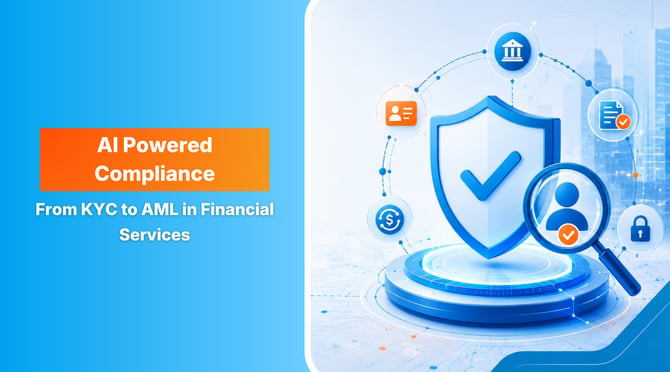
AI in fintech has left the pilot stage. Compliance is where you can see it clearest. Banks and lenders have to verify customers faster, keep monitoring running around the clock, and pass audits, all without drowning their teams in review queues. The manual processes built for this were designed for a slower pace. Fraud patterns shift faster than those processes can follow, and the regulatory checklist keeps growing.
With deepfakes turning out to be a potential threat, 35% organizations cite AI-generated impersonation as a major concern, nearing document fraud. That's the part that should worry people. The same AI pressure hitting the rest of the business has now reached the part of the business meant to catch fraud.
Better automation helps here, mostly by cutting repetitive work and making sure the right cases get a human's attention. It tightens the line between what a system flags and what someone actually decides to do about it. For organizations adopting AI in finance, this isn't one problem. It's a regulatory one, an operational-risk one, and an audit-readiness one, all running at the same time.
Let us dive into more depth to understand how AI can contribute to automating regulatory compliance.
 Generate
Key Takeaways
Generate
Key Takeaways

- Automation takes over the repetitive parts of compliance work, so reviews stop varying.
- For KYC specifically, that means faster identity checks and onboarding, with the harder, higher-risk cases actually getting a closer look instead of getting rubber-stamped.
- On the AML side, it's mostly about catching more at scale: transaction monitoring and sanctions screening that doesn't fall behind as volume grows.
- The payoff shows up as lower costs, sure, but the bigger win is having less to explain when an auditor comes asking.
Why Financial Institutions Are Moving Toward Compliance Automation?
The old model depends on people moving through queues. That works until volume spikes, regulations change, or fraud becomes more adaptive. In financial services, those events are no longer edge cases; they are the operating environment.
That's pushing teams toward automation-led compliance. Instead of customer identities, transactions, watchlists, case notes, and past behavior sitting in five different systems, AI can pull them into one place where an actual decision gets made.
The payoff is better triage as routine cases clear faster. The genuinely complicated ones get flagged early instead of sitting in someone's queue. And analysts stop burning hours re-checking things that a machine has already checked. Give a system enough history, past KYC outcomes, prior interactions, prior risk calls, and it starts catching patterns a purely manual process would miss, mostly because no person has time to look at everything.
The onboarding process also gets cleaner because automated workflows shorten the distance between application, verification, and final approval. Recent KPMG research reported by TechRadar found that 51% of the financial sector say AI is reshaping their business, which helps explain why compliance leaders are reworking operating models now.
Manual compliance is still the bottleneck
Manual processes create friction exactly where banks can least afford it. They slow down onboarding, throw off more false positives than they should, and make it hard to keep policy consistent once you're running multiple products in multiple markets.
Continuous monitoring changes the operating model
Periodic checks just aren't built for how risk actually moves now. With continuous monitoring, teams can watch transactions as they happen, catch a trend before it becomes a pattern, and react when a customer's behavior changes, instead of waiting for next quarter's scheduled review.
Automation only works with people still in the loop
AI in fintech isn't about taking people out of compliance. It's about giving the team better signals, a clearer sense of what to look at first, and more time for the calls that actually need a human's judgment.
That matters most for the people doing the job day to day, who are constantly weighing regulatory compliance against risk and the integrity of the institution, all inside rules that don't leave much room to improvise.
Related Read: AI in Accounting and Finance: A Complete Guide for Business Leaders
How AI Improves KYC and Customer Onboarding?
Once the operating model starts to shift, onboarding is usually the first workflow that gets attention, and KYC is where the pain shows up first. Slow verification stalls onboarding. Inconsistent review lets risk through.
AI helps here by extracting data from ID documents, checking it against trusted sources, and flagging mismatches for a human to look at. That cuts a lot of manual work without removing the controls that actually matter. The payoff for fintechs: people convert instead of dropping off mid-onboarding, fraud gets caught earlier, and customers trust the process more.
Well-run AI-powered KYC workflows also reduce human error, help compliance teams process large volumes of cases, and create automated workflows that are easier to defend during audits.
The benefits include:
Identity verification becomes faster and cleaner: Automated identity verification uses OCR, document validation, and liveness checks to handle routine cases quickly. The value is consistency as much as speed.
Risk scoring makes the queue smarter: Machine learning models can score risk using signals like document quality, device behavior, geography, prior activity, and entity verification results. That helps the highest-risk customers rise to the top instead of getting buried in a first-in, first-out queue.
The better versions also support risk assessments for high-risk customers without forcing every file through the same manual review path.
Manual review stays where it should: AI handles repetitive lifting. Analysts still own enhanced due diligence, uncertain cases, and decisions that require context. That balance matters in regulated environments where explainability and accountability are non-negotiable.
KYC now doubles as fraud prevention: The same workflow that verifies a customer can also surface synthetic identity fraud, manipulated documents, and unusual customer behavior. KYC is now part of the fraud detection stack as much as the compliance stack.
That is why automated identity verification sits so closely with fraud prevention, customer due diligence, and enhanced due diligence in modern KYC workflows.
| KYC stage | Manual approach | AI-assisted approach | What changes |
| Identity check | document-by-document review | automated identity verification | faster onboarding |
| Risk review | static checklist | machine learning risk scoring | better prioritization |
| Exception handling | manual escalation | workflow-based routing | less bottlenecking |
| Record keeping | scattered notes | structured audit trails | easier audit readiness |
How AI Strengthens AML Monitoring and Risk Detection?
Once onboarding gets faster, the next control layer to modernize is monitoring.
AML AI compliance matters more each year because transaction volume keeps rising while criminal behavior keeps adapting. Rule engines still matter, but they rarely provide enough context on their own, which is why they can create alert fatigue, bury analysts in false positives, and miss patterns that only appear when data is viewed together.
AI helps by keeping watch on transactions continuously and comparing activity across internal and external signals. It also makes sanctions screening, adverse media review, and suspicious activity detection more scalable than manual review alone.
In anti-money laundering programs, this means compliance teams can process large volumes of customer interactions, analyze behaviors, and identify trends before suspicious transactions spread across accounts.
That is the practical value of analyzing vast amounts of data without asking compliance professionals to do every step by hand, and it is one of the clearest benefits of AI-powered AML workflows. The additional benefits include:
Smarter Transaction Monitoring
Good monitoring is not only about unusual transfers. It is about whether the behavior fits the customer profile, business context, and historical pattern. AI helps teams analyze that context. It also helps teams analyze data from related entities and recurring payment paths, which is where many financial crime cases begin.
More Accurate Sanctions Screening
Better matching logic matters. AI can reduce false positives by comparing names, aliases, geography, and surrounding signals more intelligently than a simple fuzzy match.
Faster Analysis of Unstructured Risk Signals
Natural language processing is useful when compliance teams need to summarize cases, scan adverse media, or pull meaning from large text-heavy datasets. It saves time without replacing the analyst.
When AI pre-populates parts of the case narrative, compliance professionals can focus on judgment and validation rather than drafting every line from scratch. That usually makes audit-ready reports more consistent.
It saves manual effort when teams need to report suspicious transactions under tight regulatory requirements.
Stronger Detection Through Layered Controls
The strongest programs combine transaction monitoring, customer due diligence, entity verification, watchlist data, open-source intelligence, and internal history. That broader view helps teams escalate suspicious activity earlier. It also gives them better evidence.
Layering these controls also helps reduce non-compliance exposure and supports more reliable financial crime investigations.
The Architecture We Recommend at Signity
With KYC and AML mapped, the real question becomes how to connect them safely inside existing systems.
In practice, technical design matters as much as the use case. If a compliance platform cannot connect to existing systems, explain its decisions, or preserve audit trails, it will create more work than it removes.
The most practical path is an API-first architecture. Add AI models where they bring the most value. Keep human review tied tightly to the workflow. That lets financial institutions modernize in stages instead of forcing a full reset.
It means the stack should combine AI algorithms, machine learning algorithms, and data analytics. The setup lets teams process large volumes of records without losing traceability inside existing systems.
That is where AI technologies move from theory into day-to-day compliance operations.
What the stack should include
| Layer | Purpose | Why it matters |
| Data layer | collects and normalizes signals | clean inputs for risk scoring |
| Model layer | classifies, scores, and flags | better prioritization and detection |
| Workflow layer | routes, reviews, and escalations | faster handling of exceptions |
| Control layer | preserves governance and audit trails | defensible decisions |
Integration is not optional
Most financial institutions already have core banking tools, case systems, and cloud infrastructure in place. AI should fit into that environment. It should not fight it. Seamless integration turns an idea into something the compliance team can actually use.
That also makes room for security enhancements, access controls, and safer handoffs between compliance operations and technology teams.
Governance has to be visible
Policy management, model monitoring, approval history, and human-in-the-loop controls are not extras. They are the difference between a useful compliance system and a risky one. This is also where SOC 2 AI compliance becomes part of the buying conversation for many teams.
That concern is not abstract, because Nexas.AI research reported by TechRadar found that 43% of large financial firms lack AI risk frameworks even as adoption rises.
Data quality decides how far AI can go
If customer data is inconsistent, the model will be too. If records are fragmented, the workflow will be too. Better architecture starts with cleaner data, clearer ownership, and a tighter link between systems.
That is why data discipline shows up so often in AI programs. KPMG research reported by TechRadar found that 72% of financial firms are concerned about data quality, and that concern maps directly to compliance performance.
Without that discipline, even well-designed AI systems struggle to analyze data, identify patterns, or support meaningful risk scoring.
The Business Impact of Compliance Automation
Once the architecture is clear, the business case becomes easier to quantify.
Compliance automation ROI rarely shows up as one dramatic leap; it usually comes from many smaller gains, such as shorter onboarding time, fewer false positives, lower manual effort, and less cleanup during audits.
The implementation cost can vary depending on integration effort, data quality, model governance, and how many workflows you want to automate. That is why the best choice is not always the flashiest platform. It is the one that matches the operating model.
For many firms, the real return is lower operational costs, stronger audit trails, and a cleaner path to financial integrity across compliance operations.
The same logic that supports investment strategies elsewhere in the business can improve compliance investment decisions here, especially when leaders want clear proof of value.
The Main ROI Drivers
| ROI driver | What it improves |
| Manual effort reduction | Less time spent on repetitive review |
| Faster onboarding | Higher conversion and lower abandonment |
| Lower false positives | Better analyst productivity |
| Better audit readiness | Less remediation effort |
| Continuous monitoring | Earlier detection of potential risks |
| Stronger governance | Lower non-compliance exposure |
How should I implement? - Build, Buy, or Both
Buy the standard stuff. KYC checks, document parsing, the things every fintech needs and nobody gets credit for building themselves.
Build the parts where your compliance logic is the actual product. Most regulated teams land somewhere in between: they keep policy and data ownership in-house and buy speed for everything else. It's less a strategy than a survival tactic, but it works.
Who should help implement?
Who you pick to build with matters as much as the decision itself. A real partner can talk about regulation, the machine learning underneath it, and how a compliance team's day actually goes, in the same conversation. If they get cagey the moment you bring up audit trails or your existing systems, walk away.
They also need to understand that this market doesn't hold still. A partner who treats compliance like a one-and-done build hasn't actually worked in fintech.
How Signity Helps Financial Institutions Automate Compliance?
This is where the strategy comes together: controls, delivery, and measurable value.
Signity’s view is that compliance technology should make the team faster, not busier. The best systems fit the business and fit the controls. They also survive audits, exceptions, and regulatory change without constant rework.
That is why Signity focuses on the full picture with AI KYC automation and AML AI compliance, offering seamless integration, constant human oversight, and audit trails that can stand up to scrutiny. We also pay close attention to implementation cost and architecture decisions. Those choices usually determine whether a compliance program scales or stalls.
That same delivery mindset is what we bring to RegTech AI solutions and SOC 2 AI compliance work, especially when buyers need a clear view of implementation, governance, and delivery risk.
For financial institutions, that means building around what already exists rather than forcing a full reset. It means choosing systems that process large volumes of data, support transaction monitoring, reduce manual effort, and still keep the compliance team in control.
What do we care about in practice?
- Faster onboarding without weakening identity verification or compliance control.
- Lower alert fatigue without hiding real risk in the queue.
- Better risk scoring without opaque decisioning or extra analyst rework.
- Clear audit trails without adding administrative burden to compliance teams.
- Measurable ROI without waiting too long for value to show up.
That is the difference between compliance automation that looks good in a demo and automation that actually works in production.
Conclusion
Put together, the story is consistent: automate the repetitive work, keep humans on judgment calls, and build the controls that make both KYC and AML defensible.
AI is changing compliance in financial services from a manual support function into a more adaptive operating model. In KYC, it makes identity verification and onboarding more efficient. In AML, it improves transaction monitoring, sanctions screening, and suspicious transaction detection. Across both, it reduces manual work and gives teams better control over risk.
The strongest programs will not try to automate everything. They will use AI where it creates leverage, keep human oversight where judgment matters, and build architecture that can evolve with regulatory requirements. That is how financial institutions improve audit readiness, protect financial integrity, and get real value from compliance automation.

Mangesh Gothankar


Ashwani Sharma
Achin Verma
Frequently Asked Questions
Have a question in mind? We are here to answer. If you don’t see your question here, drop us a line at our contact page.
What is AI in fintech compliance?

How does AI improve KYC workflows?
Can AI reduce false positives in AML monitoring?
What should a RegTech AI solution include?
How do financial institutions measure compliance automation ROI?