


.png?width=27&height=27&name=Group(1).png)

-1.svg)
-1.svg)


-2.svg)


%201-1.webp?width=148&height=74&name=our%20work%20(2)%201-1.webp)




.svg)





Most banks and insurers have already started using AI. Far fewer can say it is paying off. Gartner's 2026 Hype Cycle for Artificial Intelligence in Banking puts it plainly. Adoption is surging. But only 38% of organizations report real financial gains from it.
The Cambridge Centre for Alternative Finance found something similar. Its 2026 Global AI in Financial Services Report shows 81% of financial services firms adopting AI at some level. Yet only 40% have reached the advanced stages of scaling or transforming their operations.
The gap between trying AI and running it in production is where most roadmaps fall apart. This guide sets out a practical, step-by-step approach for financial services firms building an AI implementation roadmap in 2026.
Our guide aims to cover leadership alignment and data readiness. It also explores use case selection, architecture, governance, and how to scale AI in fintech without tripping over compliance.
 Generate
Key Takeaways
Generate
Key Takeaways

- AI adoption is common across financial services. Proven financial payoff still lags well behind.
- Deloitte finds bank AI projects often stay stuck as pilots. They remain disconnected and weakly governed.
- A governed roadmap moves AI into production safely. Another tool purchase will not.
- Leadership alignment, data readiness, and governance matter most. The AI vendor matters less.
What Is an AI Implementation Roadmap for Financial Services?
An AI implementation roadmap is a phased plan. It sets out which AI use cases a financial services firm will pursue and in what order. It also defines the data foundation, the technical foundation, and the governance behind each one.
It is not a shopping list of tools. It is the sequencing and accountability that turns a pilot into a production system.
For a bank, insurer, or asset manager, the roadmap needs to answer five questions before any model reaches production.
- Where does AI create measurable value?
- Which use cases go first?
- What data and systems have to be ready?
- Who is accountable for the outcome?
- How do compliance and risk teams sign off?
Miss any one of these and a pilot tends to stay a pilot indefinitely. It stays well funded but never deployed.
Deloitte's 2026 Banking and Capital Markets Outlook found three problems standing in the way of most banks: fragmented data, mounting compliance demands, and outdated legacy systems. Together, these keep most bank AI efforts stuck as disconnected pilots.
Deloitte's review of large US banks found something else. Their AI programs were mostly reactive and siloed. That produced inconsistent value.
Why Financial Services Firms Need a Roadmap in 2026
Adoption is no longer the obstacle. Agentic AI is where the momentum is now. Statista's 2026 figures show 52% of financial institutions piloting agentic AI or further along by early 2026. Of those, 23% had already reached the scaling or transforming stage.
What is missing is proof that any of this pays off. Gartner's 2026 research shows adoption is surging. Real financial gains still lag behind for most organizations. That gap between activity and value is exactly what an AI adoption roadmap is meant to close. It forces a firm to define the business case first. Only then should data and governance decisions follow. Without that order, resources go into pilots that never leave the lab.
McKinsey's 2026 Global Banking Annual Review notes that generative AI adoption has moved faster than any prior banking technology. It took roughly two years for 45% of the US working age population to adopt gen AI tools. Digital banking needed 15 years to reach that same level of reach. Firms waiting for the technology to settle are, in effect, waiting for a moving target.
The Step-by-Step AI Implementation Roadmap for 2026
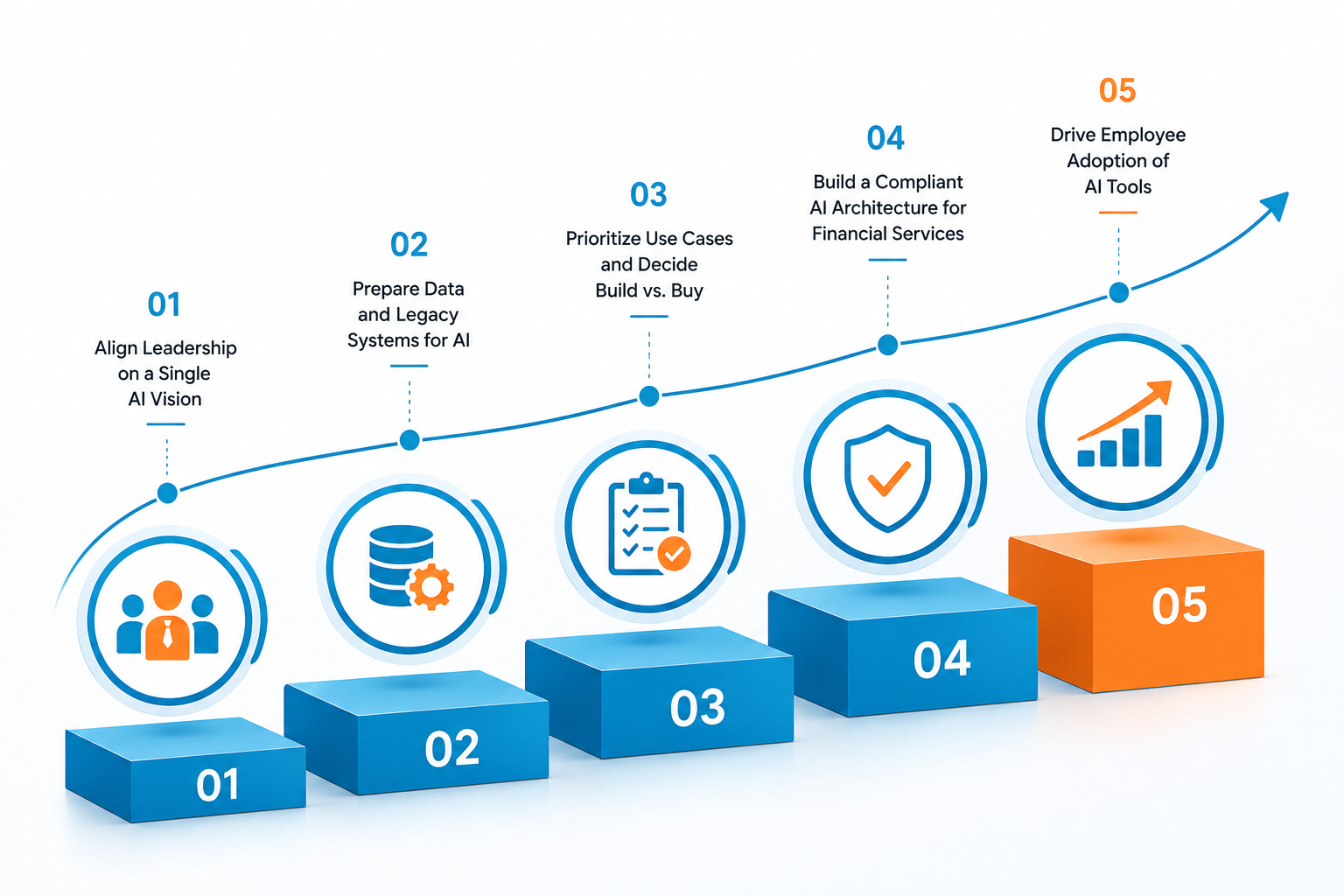
Step 1: Align Leadership on a Single AI Vision
Firms that has successfully industrialized AI started the same way: with agreement at the top on what AI is actually for. Most banks have taken a patchy, function-by-function approach to generative AI. Only a handful have written down a single firmwide strategy tied to one clear goal, whether that is efficiency, growth, or risk reduction.
Practically, this means getting the CEO, CRO, compliance head, and business unit leaders to agree on outcomes and funding. It also means agreeing on the 30-day, quarter-one, and year-one horizon before any tool gets shortlisted. Without that agreement, one team buys a chatbot. Another builds a fraud model. Nobody can measure whether AI is working across the firm.
Step 2: Prepare Data and Legacy Systems for AI
Deloitte's 2026 research lays out four pillars financial firms need before AI can scale. Data has to be accurate and traceable. It has to arrive fast enough to be useful. It needs to be broad enough in format and context to ground a model properly. And it has to be governed and secure by design. Weak performance on any one pillar tends to expose weaknesses in the others.
Ownership matters as much as the data itself. Deloitte's research found that firms making real progress usually anchor this in a joint data and risk ownership model. IT should not own it alone. An AI adoption roadmap should assign that ownership explicitly before use case selection starts, not after a pilot stalls for lack of clean data.
Step 3: Prioritize Use Cases and Decide Build vs. Buy
With leadership aligned and data readiness underway, the next step is picking where to start with the enterprise AI strategy.
Shortlist candidates across functions such as onboarding, fraud detection, claims handling, and portfolio research. Then score each one on business impact, data readiness, technical feasibility, and regulatory complexity.
Deloitte's 2026 outlook flags the build-versus-buy decision as harder for generative AI than for traditional machine learning. Many banks now buy the foundation model layer and build the proprietary layers themselves, including data connectors, guardrails, and domain-specific logic. That is usually where real differentiation sits. Smaller firms, with tighter budgets and less specialized talent, tend toward this hybrid approach by default.
Step 4: Build a Compliant AI Architecture for Financial Services
This is where the roadmap becomes an engineering plan, not just a strategy document. A workable architecture for regulated financial services generally needs six layers.
- Data pipelines connect core banking, policy administration, or CRM systems. Lineage and access logs get built in from day one.
- A model layer gets chosen on data sensitivity and latency needs. It should not default to whichever large model is trending.
- A retrieval layer, commonly retrieval-augmented generation, grounds model output in the firm's own documents and filings. That makes answers traceable rather than invented.
- An orchestration layer sequences multi-step tasks: pulling data, drafting a response, routing it for review. It does not rely on a single prompt.
- Security controls cover encryption, role-based access, and audit trails. They also set a clear position on whether any vendor can train on client data.
- A monitoring layer tracks model drift, output quality, and bias over time. Human review gets defined before anything reaches production.
Deloitte's 2026 report points to smaller, purpose-built language models as a growing alternative to general-purpose ones. They can be cheaper to run and easier to govern inside a bank's own infrastructure.
Step 5: Drive Employee Adoption of AI Tools
Once a pilot proves out, expand it in phases rather than flipping a switch enterprise-wide. Deloitte's 2026 outlook recommends a hub-and-spoke governance model. A central AI center of excellence sets standards, reference architecture, and MLOps practices. Business units keep ownership of their own use cases.
ROI measurement deserves the same discipline. Deloitte's analysis found that vague claims like "AI helps employees work faster" are common. They are rarely tied to a financial outcome. That makes it hard for firms to prove AI is paying off, even when it is.
An AI adoption roadmap should require every use case to report against a defined, firmwide metric category: cost, revenue, risk, or customer experience. Results should be checked centrally to avoid double counting.
What Are the Biggest Risks in Financial Services AI Implementation?
Deloitte's review of large US banks found the same failure patterns turning up again and again. The table below maps each one to what a roadmap should do about it.
| Hurdle | Why It Happens | How to Address It |
| Isolated pilots | Teams launch AI projects without a shared strategy or funding model | Tie every use case to one firmwide vision before pilots start (Step 1) |
| Fragmented data | Legacy systems and siloed compliance data were never built for AI access | Assess against the four data readiness pillars before scaling (Step 2) |
| Governance gaps | No single owner for model risk, bias review, or output accountability | Stand up a hub-and-spoke AI center of excellence (Step 5) |
| Unclear ROI | Benefits get described in vague terms with no financial baseline | Require quantified, firmwide ROI categories checked centrally (Step 5) |
| Build vs. buy indecision | Teams debate proprietary models versus vendor tools case by case | Set a standing build-versus-buy policy at the roadmap stage (Step 3) |
What Compliance Rules Apply to AI in Financial Services?
Regulation should shape the roadmap from the outset for the entire enterprise AI strategy. It should not arrive as a final review before launch.
Depending on where a firm operates, that means accounting for several frameworks. The EU AI Act sets risk tiers for high-risk financial use cases. The EU's DORA framework sets operational resilience obligations. GDPR sets data residency rules. Model risk management expectations, similar to the Federal Reserve's SR 11-7 guidance in the US, apply as well.
Deloitte's 2026 outlook also stresses embedding compliance directly into AI agents themselves. That includes permissions, audit trails, and human checkpoints, rather than bolting governance on afterward. It means documenting where every training record came from. It also means tracking how a model processed it and how it influenced an output. Regulators increasingly expect that level of traceability during examinations.
Human accountability still matters most. Define who reviews AI output and how exceptions get escalated. That way, AI supports judgment rather than replacing it.
Signity's AI Implementation Expertise
Building the roadmap is one challenge. Getting a bank, insurer, or capital markets firm from that roadmap to a live, audited system is the harder one. That's usually where an engagement with Signity begins, and it tends to come down to a handful of specific things:
- Legacy modernization: Most stalled pilots trace back to a core banking or policy administration system that was never built to expose clean data to a model. Signity modernizes that layer first, so the model has something reliable to read from.
- Security and compliance: Bolting governance on after a pilot already works in a sandbox usually means rebuilding it before the first real audit. Signity designs for that audit from the first line of code.
- End-to-end implementation: Strategy, architecture, build, and post-launch monitoring stay with one team instead of getting split across vendors, which cuts the handoff gaps where accountability usually disappears.
- AI-first architecture: Agentic AI and retrieval-augmented generation systems are built to ground every output in a firm's own documents and data, making results traceable instead of invented.
- A track record in regulated environments: With 17 years of software engineering and AI-first approach, Signity has delivered over 1,000 projects with a 98% client satisfaction rate. The team includes 150 plus specialists who understand AI strategy and consultation, agentic AI and RAG development, secure and private LLM implementation, AI governance consulting, and MLOps.
What matters in the end isn't the service list. It's whether a firm can point to a specific use case, in production, that a regulator has already reviewed and signed off on. Signity's teams stay past the handoff through data integration, security hardening, and post-launch monitoring, because a system that survives a demo and a system that survives a real audit six months later are proven in different ways.
Case Study: From Manual Onboarding to an AI-First Platform
- The problem: New resident onboarding took 5 to 9 days. The team handled all email and physical paperwork manually. Besides, there was no unified data layer connecting leasing, maintenance, and accounting tools.
- What Signity did: Built an automated onboarding pipeline (Node.js, BullMQ, DocuSign, Twilio) with Claude 3.5 Sonnet reviewing documents and flagging missing items before staff sign-off, inside a unified AI operating layer for the full portfolio.
- The result: Onboarding dropped to under 2 days for 91% of residents.Teams now save 18 hours weekly and $94K annually.
Read Full Case Study: AI-Powered Property Management
Conclusion
Most financial services firms are not short on AI ambition. Research from the Cambridge Centre for Alternative Finance and Gartner both point to the same pattern: adoption is common, proven financial return is not.
The gap is due to a sequencing problem. Leadership alignment comes first. Data readiness comes next, followed by prioritized use cases, sound architecture, and real governance. Firms that follow that order are the ones running AI in production. Firms that skip it are still funding pilots that never ship.
2026 is not the year to wait for the market to settle. Firms that build the roadmap now, and pick the right partner to execute it, are the ones setting the pace everyone else will spend the next few years trying to match.

Mangesh Gothankar


Ashwani Sharma
Achin Verma
Frequently Asked Questions
Have a question in mind? We are here to answer. If you don’t see your question here, drop us a line at our contact page.
What is an AI implementation roadmap for financial services?

How long does AI implementation take for a bank or insurer?
What are the biggest risks in AI implementation for financial services?
Should financial firms build AI in-house or work with a partner?
What compliance regulations affect AI implementation in financial services?
How do firms measure ROI on AI investment?






.png?width=352&name=Why%20Enterprise%20AI%20Pilots%20Fail%20And%20How%20to%20Fix%20Them%20(1).png)