

.png?width=27&height=27&name=Group(1).png)

-1.svg)
-1.svg)


-2.svg)


%201-1.webp?width=148&height=74&name=our%20work%20(2)%201-1.webp)




.svg)





.png?width=670&height=445&name=Why%20Enterprise%20AI%20Pilots%20Fail%20And%20How%20to%20Fix%20Them%20(1).png)
Enterprise AI pilots have a secret: most of them never survive contact with the real world.
A pilot succeeds in testing. Leadership signs off. Budgets get unlocked. And then, somewhere between the controlled environment and actual business operations, things fall apart.
According to a widely cited report, most enterprises are stuck in the same trap. They are endlessly running AI pilots that look great on paper, but around 95% of these corporate AI initiatives show zero return, and never scale into production systems that deliver real value.
The problem isn't the AI. It's how enterprises deploy it.
This blog breaks down exactly why enterprise AI deployment fails, and lays out a proven 7- step fix to show you how to scale enterprise AI into something that actually works.
 Generate
Key Takeaways
Generate
Key Takeaways

- Most enterprise AI-powered pilot failures come down to poor deployment planning, not the technology itself.
- Legacy systems, dirty data, and team learning gaps are the three biggest blockers when scaling an AI pilot.
- Agentic AI systems need clear governance boundaries before they touch any critical business operations.
- Knowing how to scale enterprise AI successfully requires the right process, the right people, and the right partner.
The AI Pilot Illusion: Why "It Worked in Testing" Isn't Enough
For AI pilots to succeed, there are many reasons, and the same reasons are why AI pilots fail when businesses prefer to scale.
Pilots are built to succeed because you get the clean data, and the team is handpicked. The conditions in the pilot project are controlled, and basically, it acts as a science experiment that runs in a lab, not a business running in a real-world environment.
However, the enterprise environments may get messy as the business units have different workflows. The data that looked perfect in the testing environment turns out to be a fraction of the huge amount of data the AI systems need to perform at scale.
And that's where the AI implementation mistake starts, not in the technology but in assuming that a successful pilot is equal to a scalable solution. The skill may be there, but the environment changes everything.
Generative AI tools, machine learning models, deep learning, artificial neural network, and even advanced agentic AI systems are no different. They need to be built and tested for the environment they'll actually operate in, not the one that makes them look good on a demo.
The Real Reasons Why AI Pilots Fail
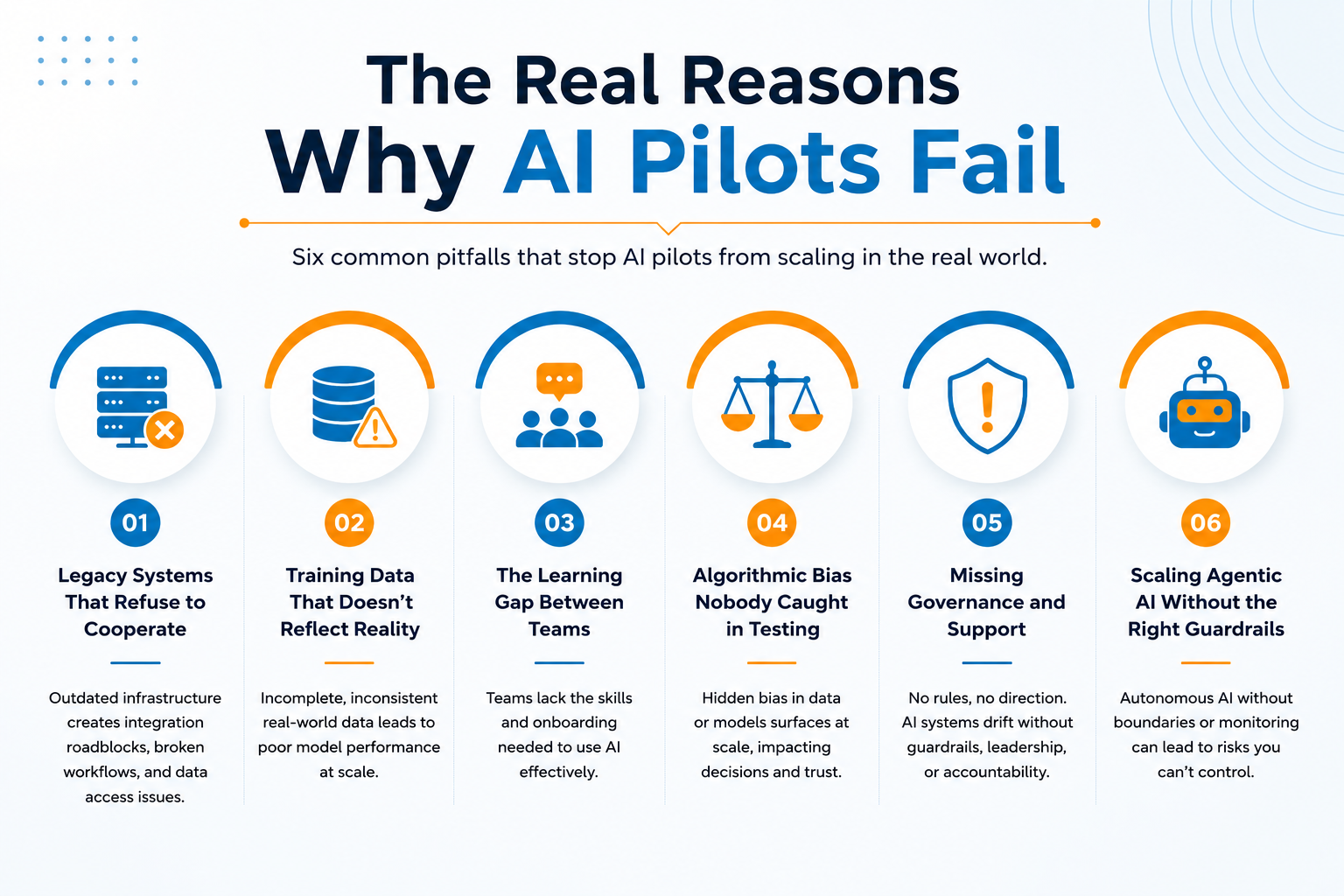
Most enterprise AI deployment challenges don't show up during the pilot. They show up the moment you want to scale. Here are the six reasons it goes wrong, and why they're more common than most organizations want to admit.
1. Legacy Systems That Refuse to Cooperate
Understanding the root causes of enterprise AI pilot failure is the first step toward making sure your deployment doesn't become another cautionary tale. Most of the enterprises run on legacy systems. Those traditional systems were built quite a while before AI was part of the conversation. So, when the AI pilot moves into production, it has to integrate with the already existing infrastructure that was not designed that way to share data freely. And the result is broken workflows, bottlenecks, and tools that are unable to access the information they need to function properly.
2. Training Data That Does not Reflect Reality
An AI pilot runs on carefully prepared data; the production does not. In the real world, data is incomplete, inconsistent, and spread across multiple business units. Machine learning models trained on clean, narrow datasets struggle when exposed to the vast amounts of messy, real-world data that enterprise environments generate daily. Enterprises must continuously analyze data across business units to identify inconsistencies, gaps, and quality issues before scaling AI systems.
3. The Learning Gap Between Teams
AI adoption challenges enterprises are rarely technical; they are most likely to be human brain. So, the business units that were not involved in building an AI pilot are not aware of how to work with AI tools, AI agents, and systems in their daily workflows. If there is no structured onboarding, even the most powerful AI programs can be misused.
Recommended Post: Agentic AI: Key Concepts and Real-World Applications
4. Algorithmic Bias Nobody Caught in Testing
What looks good and controlled during the pilot stage can cause serious blunders during the scale-up. When the AI systems began to influence the hiring decisions and customer-facing interactions, the hidden bias in the training data or AI algorithm surfaced with real consequences for the reputation of the brand.
5. Missing Governance and Support
AI deployment without a governance framework is like handing someone the car keys, and there are no traffic rules in place. Businesses that generally skip the governance structure find the AI systems drifting apart in directions that are unpredictable. Also, if there is no leadership support and defined guardrails, even the well-built AI programs lose direction and trust across the organization.
6. Scaling Agentic AI Without the Right Guardrails
Modern Agentic AI systems work independently, execute repetitive tasks autonomously, and make decisions, even when the workflow is complex. That is such a relief for the development teams. However, it can be risky without proper governance. Businesses that scale Agentic AI faster without clear boundaries and monitoring often create a system that is not controllable when things go wrong.
What Successful Enterprise AI Deployment Actually Looks Like
Not every business AI story ends in disappointment and failed deployment in production. Some of the businesses actually get it right, and the difference between them and the one that fails is not about budget, or sophistication of their AI models, or team size. Rather, it is about the mindset.
Companies that scale AI do not treat an AI pilot as a standalone project. They treat it as a foundation for large business transformation.
Now, this means businesses think about the legacy systems before the actual deployment and involve business units early so that learning gaps can not become a blocker here. Also, businesses need to build governance around agentic AI systems before the systems start making decisions that can affect real customers and operations.
Take virtual assistants as a classic example. The ones that work seamlessly today across banking, healthcare, and other sectors didn't get there through a perfect pilot. They reached the stage via continuous iteration, rigorous testing, and businesses that invest in the complete journey.
Real-world applications don't succeed because the AI technology is amazing. They succeed because the enterprise around them is ready.
That readiness doesn't happen by accident. It follows a clear, repeatable process, which brings us to the 7-step fix.
The 7-Step Fix to Scale Enterprise AI Successfully
Scaling an AI pilot isn't about doing more; it's about doing the right things in the right order.
Audit Your Data Infrastructure Before You Scale
Before anything else, dig into your actual production data, not the clean dataset your pilot ran on. Run data profiling across every source, check for schema inconsistencies, and measure how far your training data drifts from what the model will see at scale. Skipping this step means building on a foundation that will crack the moment real-world data hits it.
What to track: Data completeness rate, schema consistency, and feature drift between pilot and production.
Design for Enterprise Environments, Not Lab Conditions
Stress-test your AI against production-like conditions: variable load, legacy API failures, and edge-case inputs. This is where MLOps frameworks like MLflow or Kubeflow earn their value, giving you the infrastructure to move from experimental to production-grade without rebuilding from scratch every time.
Ask the hard questions early: what happens when the data is messy, the system slows down, or user behavior doesn't match what you anticipated?
Close the Learning Gap With Structured AI Adoption Programs
Business units that weren't involved in building the pilot don't understand its logic, its limits, or when to step in. Structured adoption programs need to cover three things: how the AI makes decisions, what it can and cannot do, and when humans need to take over.
For high-stakes workflows, hiring decisions, financial approvals, clinical recommendations, explainability isn't optional. It's a compliance requirement.
Build Governance Around Agentic AI Systems
A practical governance framework for agentic AI covers four areas: decision boundaries, audit trails, rollback protocols, and compliance alignment.
We helped a leading e-commerce brand deploy autonomous pricing agents that adjusted prices across competitor sources every 15 minutes, all within governance boundaries that protected brand margins. The result was an improvement in gross margin with zero manual approvals needed. That outcome only happens when the governance layer is solid enough to trust the system.
Embed AI Into Business Operations: Not Around Them
Map existing workflows before deployment. Identify where AI removes friction, then redesign the process around it; don't just plug AI into a broken workflow and expect results.
We built Fraud Shield for a financial services client where AI was embedded directly into the transaction pipeline, scoring every transaction in under 50 milliseconds. Because it was part of the operation, not sitting beside it, fraud exposure dropped from 6.2 hours to 28 minutes.
Monitor Model Performance Continuously
Models drift. Track three things in production: data drift, concept drift, and business metric drift. Set alert thresholds tied to business outcomes, not just technical benchmarks.
A fraud detection model producing more false positives isn't just a technical problem; it's a customer experience problem and an operational cost problem.
Key metrics: Feature drift score, false positive/negative rates, prediction confidence distribution, business KPI correlation.
Partner With the Right AI Implementation Team
Scaling enterprise AI demands a rare mix: data engineering, ML infrastructure, domain expertise, and enterprise systems integration. That combination rarely exists fully in-house.
The right partner shortens your path from pilot to production because they've already worked through the problems you'd otherwise spend months figuring out alone.
The Role of Generative AI in Bridging the Gap
Enterprise AI lived mostly in headlines and science fiction: machines that understand human language, systems that could think for themselves. Something is always just around the corner but never quite here.
That corner has been turned.
Businesses are using generative AI tools today to draft contracts, dig through data, respond to customers, and pull out insights that would have kept entire teams busy for weeks. Deep neural networks are running computer vision checks on factory lines faster than human intelligence. Agentic AI isn't a research paper topic anymore; it's running live inside real enterprise environments.
Here's the thing, though, the tools are not what's holding enterprises back. Generative AI is more accessible and capable than it has ever been. What trips up AI development companies is the deployment, making it fit the actual business, connecting it to existing systems, and keeping it running as things grow. That's where experience matters more than technology.
Concluding Thoughts
AI pilots are not the problem. The problem is treating them like the destination rather than the starting point.
Every enterprise that has successfully scaled AI has reached a moment where it stopped asking if the pilot project worked. and started asking, "Are we actually ready to take this further?" That shift in thinking, from testing AI to committing to it, is what separates the enterprises seeing real returns from the ones cycling through pilots.
At Signity Solutions, we have helped enterprises move past the pilot stage and build AI systems that work in the real world, not just in the demo room. If you are sitting on a pilot that showed promise but never went anywhere, or planning one and want to get it right from the start, let's talk.

Mangesh Gothankar


Ashwani Sharma
Achin Verma
Frequently Asked Questions
Have a question in mind? We are here to answer. If you don’t see your question here, drop us a line at our contact page.
1. How long does it typically take to scale an Artificial Intelligence pilot into full enterprise deployment?

It varies depending on your legacy systems, data quality, and how many teams are involved. That said, companies that walk in prepared consistently move faster than those treating deployment as an afterthought.
2. What is the difference between traditional AI systems and agentic AI models in an enterprise setting?
3. How do you address AI challenges like algorithmic bias before it becomes a real business problem?
4. Can small and mid-sized enterprises benefit from enterprise AI agents, or is it only viable for large corporations?






.png?width=352&name=Enterprise%20Agentic%20AI%20Architecture%20A%20Guide%20for%20Autonomous%20AI%20at%20Scale%20(1).png)