


.png?width=27&height=27&name=Group(1).png)

-1.svg)
-1.svg)


-2.svg)


%201-1.webp?width=148&height=74&name=our%20work%20(2)%201-1.webp)




.svg)





Supply chain disruption has become a persistent risk. With events lasting longer than 1 month occurring every 3.7 years on average, and nearly 80% of organizations experiencing at least 1 disruption in the past year.
The numbers cover lost freight, spoiled inventory, and SLA breach penalties. Most importantly, the logistics operators reading that figure have felt it personally.
Port backlogs, carrier capacity crunches, and demand spikes are not surprises. They appear in data feeds hours or days before they become expensive. The problem has never been visibility. It has been that acting on a signal fast enough, while also managing everything else in the operation, requires more processing capacity than a human team can realistically sustain.
AI in logistics solves that specific problem.
An agentic system monitoring carrier feeds catches a delay, evaluates alternatives against live SLA and cost data, and triggers a rebooking in the TMS.
The architecture behind that capability, where it generates the clearest returns in 2026, and how implementations actually get built, is covered in the sections below.
 Generate
Key Takeaways
Generate
Key Takeaways

- Agentic AI reduces freight handling time significantly.
- AI-driven demand forecasting cuts inventory overstock and reduces stockouts.
- Route optimization using live carrier and traffic data drives measurable improvements in fuel costs and delivery times.
- Logistics AI pilots fail most often at integration, not the model layer.
What AI in Logistics Actually Does?
AI in logistics applies machine learning, computer vision, and autonomous decision-making systems to freight management, warehousing, last-mile delivery, and supply chain planning. The systems automate decisions and surface predictions in operational time, not batch-processing time.
A working logistics AI system has three interdependent layers. How well they connect to each other determines whether the deployment pays off or produces recommendations no one acts on.
- Perception handles data intake. IoT sensors on containers, GPS feeds from trucks, computer vision in warehouses, carrier API updates, and port system events all feed into this layer. Stale or incomplete data here degrades every model above it, regardless of how well those models are trained.
- Intelligence is where models run: demand forecasting engines, route optimization systems, and the LLM cores used in agentic workflows. This layer converts the incoming data into a prediction or a decision.
- Execution is where a decision becomes an action. A TMS rebooking, a WMS slot reassignment, an ERP inventory update, and an automated customer message. Deployments stuck in read-only mode, where the model produces a recommendation and waits for a human to act on it, miss most of the operational benefit.
67% of Tier 1 logistics providers had at least one AI system in production in 2026. While 40% have reported deploying AI beyond pilots, as per BCG research.
It means that most logistics AI investments to date have produced something that works in one corner of an operation. Cross-functional integration, where the same intelligence layer serves freight, warehouse, and last-mile simultaneously, is where significant cost reduction actually comes from. Getting there is an integration project as much as a modeling project.
Related Read: AI in Logistics: How Does It Truly Transform The Field?
Agentic AI in Logistics: How Autonomous Decision-Making Works?
Agentic AI in logistics describes systems that work through multi-step tasks without waiting for human approval at each stage. A rules-based system runs a fixed trigger. An agentic system reads context, selects from available tools, sequences actions, and adjusts when conditions change mid-process.
Rules-based logistics automation handles anticipated scenarios reliably. If warehouse inventory for a given SKU drops below a threshold, the system raises a purchase order. That works until reality produces a situation the rule author did not write for.
Consider a concurrent disruption: a port authority announces a 36-hour closure, a carrier's capacity API shows no available lanes for the affected route, and a key account's procurement team moves their delivery window forward by 48 hours.
A rules engine has no path through that. An agentic system with access to carrier APIs, WMS slot data, cost models, and SLA records works through the options and executes the least-cost compliant response.
Four layers make up the architecture in practice:
| Layer | Function | Logistics Example |
| Perception | Real-time ingestion from IoT, ERP, carrier APIs, and traffic systems | Port closure detected via authority feed |
| Reasoning | LLM core evaluates context, costs, constraints, and available options | Three rebooking paths modeled against cost and SLA |
| Planning | Multi-step action sequence built across connected tools | Carrier availability checked, warehouse slot queried, SLA window confirmed |
| Execution | TMS and WMS actions triggered without manual approval | Rebooking placed, customer notified, ERP updated |
The time savings are the measurable output. Equally relevant is what the system catches that a manual process would miss: a disruption detected at 2 am, an SLA window calculated across 40 shipments simultaneously, or a carrier substitution evaluated before a dispatcher starts their shift.
Where Intelligent Logistics Automation Delivers Measurable ROI?
Intelligent logistics automation refers to Agentic AI systems that learn from operational outcomes and adjust their parameters over time. Accuracy improves as the system runs, unlike rules-based automation, where the logic stays static until a human changes it.
Research from IDC, McKinsey, and other market research platforms consistently identifies five areas where logistics AI deployments return measurable value fastest. The benchmarks in the table below come from those studies, with direct citations per row.
| Use Case | What does the AI do? |
| Demand Forecasting | ML models predict SKU-level demand 12 weeks out, updated daily |
| Route Optimisation | Agentic AI recalculates routes using live traffic, weather, and capacity |
| Warehouse Slotting | AI optimizes pick paths and SKU placement based on velocity data |
| Freight Procurement | AI matches carrier rates to historical benchmarks and market signals |
| Last-Mile Delivery | Computer vision and route AI cut failed attempts and driver exceptions |
Demand forecasting and route optimization tend to produce early results because the input data, sales history, carrier feeds, and traffic data are already being collected by most operations. The engineering work centers on connecting existing datasets to the model rather than building new data collection infrastructure.
Warehouse slotting and freight procurement involve deeper integration with WMS and ERP systems. Those integrations take longer partly because of technical complexity and partly because those systems often carry duplicated or inconsistent records accumulated over the years. Data remediation is an expected part of the project, not an obstacle that signals something went wrong.
Last-mile AI depends heavily on address data accuracy. Operators whose address records carry significant error rates should treat data remediation as a prerequisite rather than a parallel workstream. A model trained on bad addresses produces confident, wrong answers.
What AI Logistics Implementation Actually Looks Like?
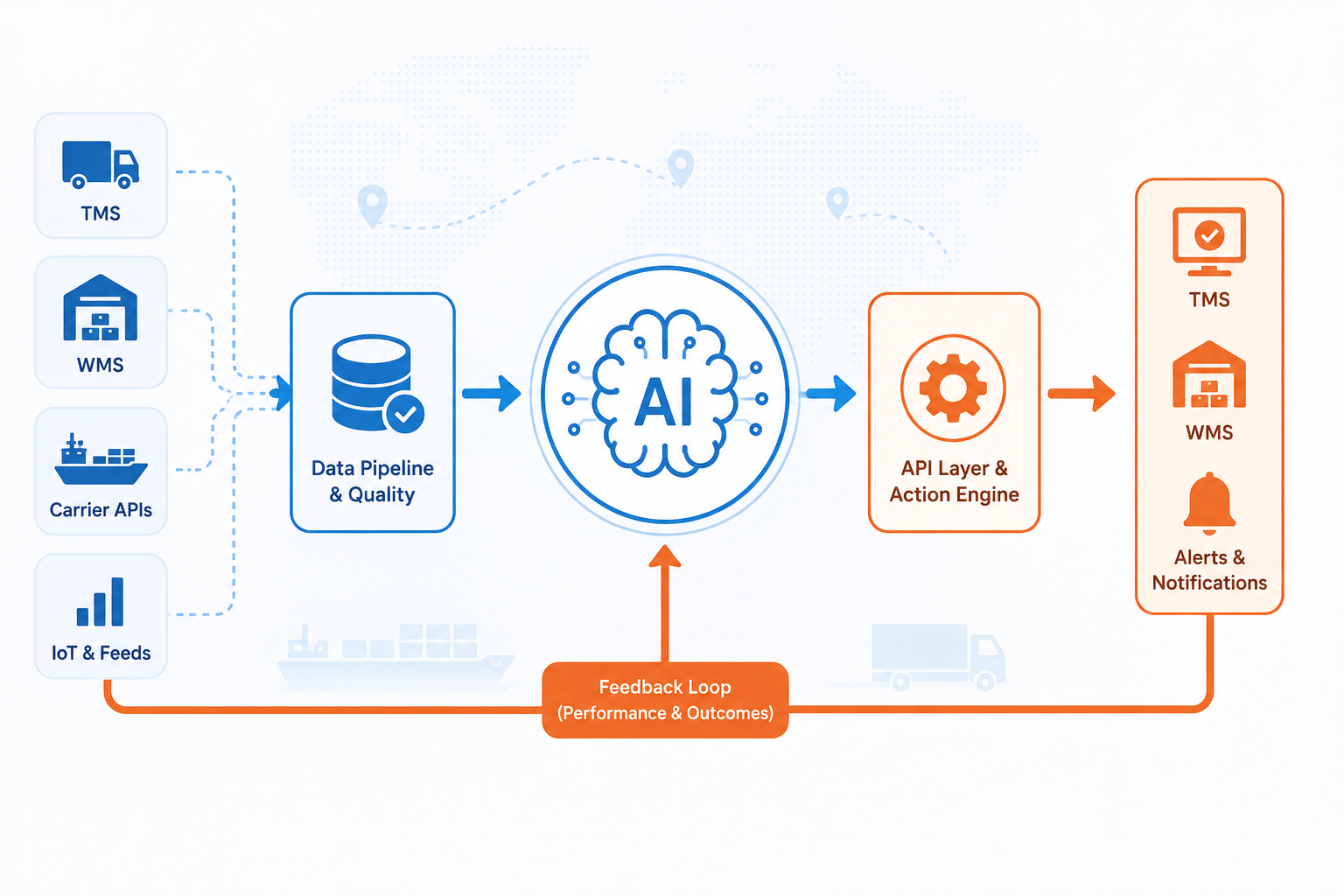
Logistics AI implementations that stall usually share a common profile: the model performed well in testing, but the live TMS fed it stale data, the API layer lacked permissions to trigger actions, and no feedback mechanism existed to improve accuracy after deployment.
Model selection is a relatively small part of the project. The work that determines success happens earlier: auditing data pipelines, establishing API contracts between the AI engine and operational systems, and designing a feedback loop so the model learns from production outcomes rather than sitting on static training data indefinitely.
The Data Layer Problem
Most logistics IT infrastructure runs on batch processing cycles. These include Nightly ERP reconciliations, weekly carrier invoice processing, and monthly inventory counts.
An AI engine trying to make real-time decisions on batch-cycle data produces recommendations that are hours out of date. Operations teams override those recommendations quickly, the model trust collapses, and the deployment stalls.
Bridging batch-cycle infrastructure to a real-time AI system requires either a data mesh setup, where each operational domain owns and publishes its own live feed, or an event streaming layer (Kafka and Kinesis are the two most common implementations) that normalizes data from existing systems before the model sees it. Both require dedicated engineering time that is separate from the model build itself.
Phased Implementation: The 90-Day Model
Freight exception management is a good starting workflow because the cost signal is clear, and operations teams see the results every day. Run one workflow in production for 30 days before expanding the scope. Broad early automation increases the chance of a visible error that causes ops teams to pull back the AI's authority and slows the wider rollout.
| Phase | Timeline | Scope | Success Metric |
| 1 - Pilot | Days 1-30 | Data audit, integration architecture, single workflow scoped | Data quality >=85%; API contracts signed off |
| 2 - Build | Days 31-70 | Model development, TMS/WMS integration, internal testing | Accuracy at target threshold on held-out validation data |
| 3 - Live | Days 71-90 | Production deployment, monitoring, and exception review process | Autonomous decisions logged; override rate tracked |
| 4 - Scale | Month 4+ | Additional workflows, cross-system integration, and a retraining cycle | ROI vs. baseline; manual intervention rate over time |
Four Implementation Gaps That May Delay Returns
-
No single authoritative data source for shipment records. When the AI recommendation contradicts what a dispatcher sees on their screen, they override it. Override rates above 30% in the first month usually point to a data integrity issue, not a model quality issue.
-
Read-only deployment. A model running in advisory mode, where it surfaces suggestions but lacks API access to trigger system actions, helps build early trust but must gain execution access within the first 60 days or adoption stalls.
-
No retraining schedule. Carrier lane costs, warehouse velocity patterns, and customer SLA profiles all shift across seasons and market conditions. Without a scheduled retraining cycle, model accuracy degrades gradually and often goes unnoticed until ops teams have already stopped relying on it.
-
The scope is too wide in Phase 1. A single high-profile error early in the deployment gives skeptical ops teams a reason to reduce AI authority. Narrow scope early, demonstrate accuracy, then expand.
Choosing an AI Development Partner for Logistics
Logistics AI partner selection is more consequential than in most software engagements because the integration surface is wide and the domain is specific. A team with general ML experience but no logistics background tends to underestimate both the integration complexity and the operational constraints that shape model design.
Three questions separate capable partners from those who will struggle with the specific demands of logistics AI:
- Can they describe a real TMS integration, including what broke during testing and how it was resolved? Not a generalized process description, but a specific technical account of a live deployment.
- How do they detect model drift after go-live, and what triggers a retraining event? Partners who cannot answer this specifically have not managed a logistics model in production.
- Who owns the feedback loop? If data engineering, model development, and post-launch monitoring are split across subcontractors, no single team owns the performance trajectory of the model.
Cost varies by integration complexity, primarily driven by the state of the TMS and WMS the AI engine needs to connect with. Modern cloud-native systems cost significantly less to integrate than legacy stacks without native API access. Request an integration audit before agreeing to any fixed-price scope.
How Signity Solutions Can Help with AI in Logistics Implementation?
Logistics enterprises bring us in when an earlier vendor stalls, when a pilot never made it to production, or when they want the integration work done the first time properly. Our team of AI developers works exclusively on AI builds with a logistics or supply chain context.
End-to-end ownership of the build
Data pipeline setup, model development, TMS/WMS integration, and post-launch MLOps are handled by one team rather than handed across vendors.
Logistics-specific engineering
Our engineers have worked directly with freight operators, 3PLs, and warehouse management teams on live deployments.
We start where your data is
If your TMS runs on a legacy stack, we work with that stack rather than asking you to modernize before the engagement starts.
Architecture review before any code is written
We audit your data layer and integration surface first, so scope and cost are grounded in what your systems actually look like.
Production focus over pilot delivery
The goal of every engagement is a system that operates in production, not a proof-of-concept that needs a second project to become real.
Post-launch model monitoring by default
Models degrade when supply chain patterns shift. Retraining schedules and drift detection are built into every engagement from the start.
What Comes Next?
By 2026, route optimization and demand forecasting will no longer be experimental investments at Tier 1 logistics providers, since they are running in production.
The competitive pressure is now coming from cross-functional integration, where intelligence built for freight operations begins to inform warehouse and last-mile decisions within the same system.
Where you start depends on your stack and your data. A legacy TMS without native APIs changes the integration sequencing. A clean warehouse management system with modern APIs opens up different early options. Both paths lead to the same place over 12 to 18 months.
The readiness assessment and ROI calculator above are a practical starting point for scoping the first phase without committing to a full discovery engagement upfront.
Frequently Asked Questions
Have a question in mind? We are here to answer. If you don’t see your question here, drop us a line at our contact page.
What is AI in logistics, and how does it work?

What is agentic AI in logistics?
What is intelligent logistics automation?
How long does AI logistics implementation take?







.png?width=352&name=agentic-ai-strategy-for-enterprise-software%20(9).png)