

.png?width=27&height=27&name=Group(1).png)

-1.svg)
-1.svg)


-2.svg)


%201-1.webp?width=148&height=74&name=our%20work%20(2)%201-1.webp)




.svg)





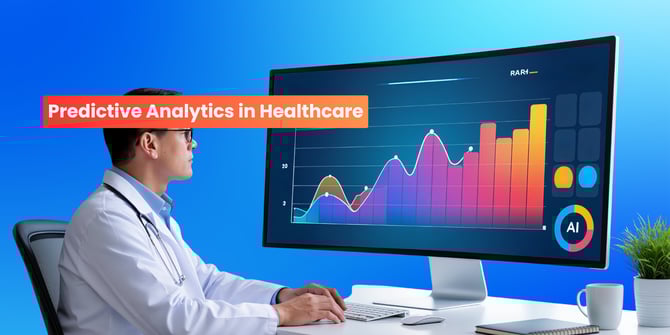
Healthcare organizations are evolving rapidly as tools such as Artificial Intelligence and Machine Learning are being adopted, transforming how care is delivered. The tools are allowing healthcare specialists to move beyond reactive decision-making and adopt a smarter and data-driven approach across the clinical workflows.
One of the AI applications is predictive analytics in healthcare, which analyzes the historical data in real-time and makes accurate predictions. It helps make predictions about unknown future events or activities, helping make accurate predictions.
The global healthcare predictive analytics market size is USD 22.49 billion in 2025 and is expected to reach around USD 156.36 billion by 2034, at a CAGR of 24.04%.
As healthcare organizations continue to embrace predictive analytics, it becomes vital to understand its practical applications. Here is an article that covers the ways predictive analytics in healthcare helps save time and money, along with predictive analytics examples that drive success.
 Generate
Key Takeaways
Generate
Key Takeaways

- Predictive analytics identifies high-risk patients and prevents costly complications.
- AI-driven insights improve clinical decision-making and operational efficiency.
- Personalized treatment and precision medicine reduce reliance on trial-and-error.
- Streamlined administrative processes, like billing and claims, cut costs and save time.
What Exactly is Predictive Analysis in Healthcare?
Unlike the traditional approach that relies on processed information from the past, predictive analytics uses real-time and operational data to forecast future events and trends for patient care. The approach combines different data sources, including Electronic health records, medical imaging, patient demographics, wearables, remote monitoring devices, and more.
Predictive analytics patterns analyze the patterns across these datasets and generate actionable insights, like identifying high-risk patient data, hospital readmissions, preventing costly medical errors, and more.
Integrating AI in healthcare services, predictive analysis becomes even stronger. AI algorithms can seamlessly process a large volume of complex healthcare data and provide clinicians with data-driven recommendations for informed decision-making.
7 Ways Predictive Analytics in Healthcare Saves Time and Money
Predictive analytics in healthcare is transforming patient care and healthcare operations. With AI, healthcare organizations can proactively manage risks, optimize workflows, and cut down costs. Here are the most efficient ways predictive analytics is helping make an impact:
1. Early Detection and Prevention of Diseases
Chronic diseases like diabetes and hypertension are leading causes of death worldwide. In the United States, chronic diseases make up 8 of the 10 top causes of death. Predictive analytics plays a critical role here, as it allows healthcare experts to identify patients with a high risk before the conditions worsen. It also allows healthcare providers to intervene proactively.
Using a combination of electronic health records, imaging data, and demographics of the patient and other lifestyle factors influences healthcare experts to assess risk profiles of patients. AI algorithms then detect the right patterns and trends that may be visible otherwise.
Benefits include:
- Reduces Hospitalizations: Identifying patients at risk allows for prior physician intervention and reduced hospitalization.
- Cost Savings: Preventing disease progression avoids expensive treatments, hospitalizations, and long-term care costs.
- Improved Patient Outcomes: Early interventions, such as lifestyle changes, medication adjustments, and targeted monitoring, improve quality of life for patients.
A healthcare system called Mount Sinai implemented predictive analysis to detect patients at risk of a condition called Sepsis. It helped them analyze vital signs, lab results, and patient historical data to flag the patients with a higher risk. This prior detection helped physicians to intervene, reducing hospitalizations and improving the survival rates.
Related Read: AI in Healthcare Use Cases
2. Enhancing Clinical Decision Support
Clinical decision support can be complex as it involves multiple patient factors, diagnostic tests, and treatment options. Building AI systems for healthcare consists of designing algorithms that can support clinicians with risk predictions, treatment recommendations, and real-time decision support. It can help analyze a broad range of data like patient history, lab results, and treatment response. The models identify patterns, flag patients with high risk, and suggest optimal treatment opportunities.
Benefits Include:
- Reduces Diagnostic Errors: Early identification of potential complications improves patient safety.
- Improves Treatment Effectiveness: Personalized recommendations help select therapies with the likelihood of success.
- Saves Clinician Time: Automated insights and alerts allow clinicians to focus on patient care rather than manual data analysis.
IBM Watson implemented predictive analytics that support oncology care. From analyzing clinical trial data to patient records and more, Watson offered oncologists with evidence-based treatment options, customized as per the patient’s profile.
3. Reducing Hospital Readmissions
Hospital readmissions are very costly for the patients and also indicate a potential gap in patient care. It is vital to avoid such expensive readmissions, and predictive analytics in healthcare help achieve this goal. Predictive analytics identifies patient data, medical history, lab results, medications, and more that ultimately help identify patients with a higher risk of readmissions. The model generates a risk score for every patient during discharge, which enables teams to follow up and reduce hospital readmissions.
Benefits Include:
- Reduces Cost: The average readmission cost for the hospital in the US is around 15% to 20%, depending on patient population and condition. With predictive analytics, it can be controlled.
- Improves Patient Outcomes: Patients with a higher risk are given post-discharge care, which reduces further complications, readmissions, and recovery rate ultimately.
- Improved Compliance and Reporting: It helps hospitals and other stakeholders to avoid penalties from the insurance providers and government programs, as hospitals can meet the regulatory requirements.
UnityPoint Health, a healthcare system in the U.S., implemented predictive analytics to identify patients at high risk for readmission. By implementing tailored follow-up care plans, home visits, and telehealth check-ins, the hospital reduced readmissions by 40%.
4. Optimizing Staffing and Resource Allocation
Efficient staffing and resource allocation are quite a challenge for the healthcare industry. Overstaffing leads to an increase in operational cost, while understaffing can compromise patient care and bring chaos for the staff. Predictive analytics can address all these issues as it can forecast patient volume and resource needs. From patient admissions to local outbreaks and procedure volumes, it anticipates the demand easily. Machine learning algorithms can generate a forecast that allows administrators to plan proactively.
Benefits Include:
- Reduced Operational Costs: By aligning staff schedules and resource allocation with predicted demand, hospitals can avoid unnecessary overtime
- Improved Patient Care: Patients can receive timely attention with predictive analytics, reducing wait times and improving patient care outcomes.
- Enhanced Resource Utilization: Predictive analytics allocate medical equipment and operating rooms, minimizing waste and bottlenecks.
Many of the emergency departments in hospitals use predictive analytics to understand the surge of patients based on historical patterns. This way, emergency departments can adjust staff and ensure the right number of nurses, physicians, and other support staff are available.
5. Forecasting Appointment No-Shows and Patient Behavior
Missed appointments may be a hidden cost to the healthcare system, but they have a serious impact that could even lead to revenue loss and delayed care. With predictive analytics in healthcare, providers can anticipate patient behavior and take proactive measures to reduce no-shows and improve clinical efficiency. Machine learning algorithms assign a risk score to patients and highlight the probability of missing an appointment.
Benefits Include:
- Reduces Operational Inefficiencies: Minimizes gaps in scheduling, which allows for better resource usage
- Improves Revenue: Fewer missed appointments directly lead to increased billing and service delivery.
- Enhances Patient Engagement: Personalized reminders and proactive communication improve adherence to care plans.
Kaiser Permanente uses predictive analytics to identify patients who may miss appointments and sends targeted reminders via email, SMS, or phone calls. This strategy has significantly reduced no-show rates.
Related Read: AI in Healthcare Market Size
6. Personalized Treatment Plans and Precision Medicine
Traditional methods of treatment often rely on standard treatment protocols that may not fully reflect each patient's unique needs. Thanks to predictive analytics, which offers a personalized treatment approach for every patient. It leverages data-driven insights to tailor treatment plans based on the characteristics of the patients. AI helps identify patterns that predict how a patient responds to a specific treatment, while helping physicians choose the right approach.
Benefits include:
- Improved Treatment Outcomes: Personalized therapies increase the probability of positive responses and faster recovery.
- Reduced Trial-and-Error: Predictive insights help avoid ineffective treatments, reducing costs and patient discomfort.
- Optimized Use of Resources: By focusing on treatments with the highest success rates, healthcare providers reduce unnecessary procedures and hospital visits.
It is widely used in oncology, where physicians can match cancer patients with targeted therapies based on the genetic markers and previous response to treatment. The approach helps improve the survival rate and reduce the cost of ineffective treatments.
7. Streamlining Insurance, Billing, and Claims Processing
Processes like billing, insurance claims, and other administrative tasks are time-consuming and may lead to errors. Predictive analytics, in collaboration with Natural Language Processing algorithms, automates the workflows and reduces operational costs and delays. Predictive analytics examines the previous claim data, billing patterns, and denial trends of the patient to forecast potential issues before filing the claims. AI-driven documents enable early corrections in the process.
Benefits Include:
- Faster Reimbursements: Clean claims reduce processing time and accelerate cash flow.
- Lower Administrative Costs: Automation minimizes manual effort and repetitive tasks.
- Reduced Claim Denials: Early detection of errors improves first-pass claim acceptance rates.
Hospitals leveraging AI-driven revenue cycle management solutions have reported significant reductions in claim denials and days in accounts receivable (A/R).
Final Thoughts
While traditional methods of healthcare rely on standard protocols that cannot satisfy the patient’s needs, predictive analytics in healthcare turns out to be a game-changer. It enables a more personalized and data-driven approach as per the patient's needs. Predictive analytics examines the patient history, genetic data, and other lifestyle factors to identify which therapies are most likely to work for a specific patient.
Powered by AI in healthcare, the collaborative insights help clinicians eliminate the hit-and-trial method and move towards precision-based care, saving both time and money. This way, healthcare organizations can improve the treatment outcomes and reduce adverse effects and costs. As a result, healthcare providers deliver targeted interventions and optimize clinical resources.
Partner with an expert AI development company to implement the most effective solutions for your healthcare organization.
Frequently Asked Questions
Have a question in mind? We are here to answer. If you don’t see your question here, drop us a line at our contact page.
What types of Healthcare Organizations can benefit most from Predictive Analytics?

Predictive analytics is not limited to large hospitals alone. It delivers value across health systems, specialty clinics, diagnostic labs, telehealth providers, and health insurers. Any healthcare organization that works with large volumes of patient, operational, or claims data can use predictive analytics to improve efficiency and reduce costs.
What data quality challenges affect predictive Analytics in Healthcare?
The accuracy of predictive analytics depends on data quality. Common challenges include incomplete patient records, data silos across departments, inconsistent data formats, and outdated information. Addressing these issues through data integration, standardization, and governance is essential to ensure reliable predictions and trustworthy insights.
How does Predictive Analytics support value-based care Models?
It identifies high-risk patient populations, predicts outcomes, and measures care effectiveness over time. These insights enable providers to focus on preventive care, reduce avoidable hospitalizations, and improve long-term outcomes.
Are there ethical or regulatory considerations when using predictive analytics in healthcare?
Yes, healthcare organizations must ensure predictive analytics solutions comply with data privacy regulations such as GDPR AND HIPAA, and maintain transparency in how AI models make decisions.