


.png?width=27&height=27&name=Group(1).png)

-1.svg)
-1.svg)


-2.svg)


%201-1.webp?width=148&height=74&name=our%20work%20(2)%201-1.webp)




.svg)





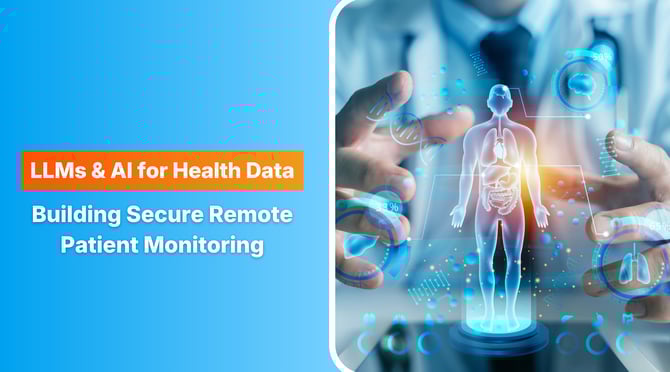
Remote patient monitoring (RPM) systems are no longer an optional tool in modern healthcare.
Healthcare organizations are using these technologies to track vital signs, continuously assess symptoms, and support doctors in managing acute and chronic conditions outside the hospital.
Around 80 million patients globally are expected to be monitored remotely, showing how deeply these systems have integrated into clinical settings. This growth also brings fresh challenges because patient data now flows across device networks and care teams in ways never seen before.
Protecting this data is about more than compliance. When health records or monitoring streams are exposed, healthcare systems lose trust and risk harm to patients. Recent breaches have shown that weak security can undermine the very promise of remote care.
Also, artificial intelligence and natural language processing enable new levels of insight. The technologies can detect anomalies to reduce false alarms, enabling clinicians to treat faster.
Understanding how AI and LLMs fit into secure remote monitoring is now essential for any provider focused on patient outcomes and data protection.
 Generate
Key Takeaways
Generate
Key Takeaways

- AI tools strengthen remote patient monitoring by detecting threats to sensitive health information.
- LLMs improve access control and secure queries within electronic health records, supporting clinical decision-making.
- Secure RPM systems reduce false alarms, supporting clinicians. They even enhance patient outcomes, reducing overall healthcare costs.
- Privacy-first AI design builds trust, protects data, and enables broader adoption across healthcare systems.
How AI and LLMs Protect Patient Data Across Distributed Healthcare Systems?
Remote patient monitoring (RPM) systems connect devices, cloud platforms, and electronic health records across healthcare systems. The distributed environment improves access to care but increases exposure to risk.
However, artificial intelligence now protects patient data at multiple layers of the architecture.
AI models analyze behavior patterns. For instance, if login attempts deviate from normal practice, or if medical data moves in unusual volumes, the system flags the activity.
In 2025, healthcare cybersecurity findings show that organizations using AI-driven detection reduced breach response time by nearly 40 percent. A faster response time improved safety and limited financial damage.
Besides, large language models add contextual intelligence to the security process. Using natural language processing, they evaluate whether a request inside electronic health records aligns with clinical workflows and treatment decisions.
If the request lacks a valid context, access can be restricted or escalated. The process protects sensitive information without slowing clinicians.
How AI Strengthens Security in Distributed RPM Systems?
|
Security Function |
Without AI |
With AI and LLMs |
Result for Healthcare Providers |
|
Access Control |
Static role permissions |
Context-aware evaluation of user intent |
Reduced unauthorized access |
|
Threat Detection |
Periodic log reviews |
Continuous anomaly detection |
Faster breach containment |
|
Alert Management |
High volume false alarms |
Intelligent filtering of critical alerts |
Improved clinical focus |
|
Compliance Tracking |
Manual audits |
Automated audit generation |
Stronger regulatory readiness |
Together, these capabilities create a resilient foundation for secure remote patient monitoring across distributed healthcare environments.
Why is security-first AI essential in remote patient monitoring RPM systems?
Remote patient monitoring(RPM) systems are now part of daily healthcare practice. They help clinicians monitor patients outside hospitals and manage acute and chronic health conditions more quickly.
As adoption grows, patient data moves across devices, platforms, and electronic health records. The expansion improves care but also increases risk. Security must be built into the system from the beginning:
- RPM systems collect continuous data on vital signs and treatments across healthcare systems.
- Each connected device creates another entry point for attackers that needs to be protected.
- In 2025, healthcare breach reports show that medical data is a top target for cyberattacks.
- When patient data is exposed, trust is directly affected.
- Security first AI embeds encryption, anomaly detection, and access control into the core architecture.
- AI models monitor both clinical signals and unusual system behavior in real time.
- Strong protection reduces financial risk and strengthens regulatory readiness.
- Secure infrastructure allows healthcare organizations to improve monitoring.
Reducing false alarms and strengthening clinical workflows
Remote patient monitoring (RPM) systems generate constant streams of updates for vital signs and symptoms. While it improves visibility, it can overwhelm clinicians with frequent alerts. Here, false alarms reduce a clinician’s focus and slow response time.
In high-pressure clinical settings, alert fatigue becomes a serious safety concern.
Artificial intelligence helps to solve such issues by analyzing patterns in medical data, not just isolated readings.
Instead of triggering alerts for every fluctuation, the system evaluates context. It determines whether a change signals a real health risk or a normal variation. Such a distinction improves accuracy to protect clinical focus.
Fewer false alarms allow healthcare providers to prioritize patients who need immediate attention. Besides, AI analysis works to:
- Highlights early signs of disease progression
- Organizes patient data into clear summaries within electronic health records
- Supports faster diagnosis and treatment decisions
- It delivers crucial information without disrupting existing practice.
By reducing noise, AI enables secure, intelligent monitoring of clinician systems. Therefore, creating a balanced system in which safety and precision work together.
Securing Clinical Workflows While Enabling Faster Diagnosis and Treatment Decisions
Remote patient monitoring (RPM) systems must support clinicians. Therefore, your security measures should protect patient data without disrupting workflows.
You can put AI models to secure access in real time while they organize medical data into meaningful insights. Moreover, when clinicians open electronic health records, LLMs can be used to evaluate user context with appropriate access.
Such an approach protects sensitive information without affecting the speed.
AI also supports faster diagnosis by analyzing vital signs and symptom patterns together. Instead of reviewing scattered reports, doctors receive structured summaries. It allows quicker treatment decisions and better health outcomes without compromising safety.
Integrating Securely with Electronic Health Records and Existing Healthcare Infrastructure
Remote patient data must integrate smoothly with electronic health records.
Since poor integration creates security gaps, AI platforms use APIs and encrypted data exchange to connect monitoring systems with hospital infrastructure.
Moreover, AI continuously evaluates access control through NLP and behavior analysis. It ensures healthcare providers have access to accurate data at the right moment without exposing the entire system.
Secure integration practices also help organizations maintain compliance with HIPAA and other norms when transferring protected health information on systems.
Balancing Automation, Human Oversight, and Regulatory Compliance
Automation improves speed but healthcare needs human judgment.
AI supports clinicians by providing analysis but not replacing the decision-making. It means doctors remain responsible for diagnosis and treatment decisions.
Security frameworks must also align with FDA guidelines and global standards. This is why regulators continue to emphasize auditability and patient safety in AI-driven healthcare systems.
Balanced design protects patients while allowing innovation to progress responsibly.
Designing Privacy-First AI Platforms for Long-Term Healthcare Adoption
Building a secure AI platform for remote patient monitoring (RPM) systems requires a structured approach. Therefore, each layer should reinforce privacy into performance without affecting the clinical reliability.
Step 1: Establish Privacy by Design
Always begin with encryption for data at rest and in transit. In healthcare, the focus must be on protecting vital signs, symptoms, and treatment records from the moment they are captured.
Make sure you always limit data collection to what is clinically necessary.
Step 2: Implement Intelligent Access Control
Always use artificial intelligence to evaluate user behavior and context before granting access to electronic health records. It is important to move beyond static role-based permissions.
Besides, you must ensure that only authorized clinicians and healthcare providers have access to sensitive medical data.
Step 3: Build Secure and Flexible Infrastructure
The team should aim at designing a cloud architecture that integrates safely with existing healthcare systems. The process should use secure APIs and continuous monitoring to prevent unauthorized data movement.
Step 4: Enable Real-Time Threat Detection
Teams must work at deploying AI models that monitor anomalies in system behavior. Remember, early detection reduces the impact of breaches and strengthens operational resilience.
Step 5: Plan for Scalable Performance
You must ensure the AI platform can process growing volumes of remote patient data without slowing clinical workflows. After all, stability is vital to nurturing better patient outcomes.
Step 6: Maintain Continuous Compliance
Align the system with FDA guidance and global standards. It will help you automate audit tracking while working on long-term regulatory readiness.
All in all, scalable privacy-first platforms protect patients and enable sustainable healthcare innovation.
How Signity Leads with a Security First Approach in Healthcare AI?
At Signity, security is embedded into the foundation of every healthcare platform we build.
Our engineering teams design remote patient monitoring systems and AI-driven healthcare solutions with privacy in mind. We aim to infuse encryption and controlled access into the architecture from the start.
The approach helps healthcare organizations protect sensitive patient data while aligning with regulatory frameworks such as HIPAA, HITECH, SOC2, etc.
Also, by combining strong engineering practices with responsible AI development, Signity enables healthcare providers to maintain compliance as well as patient safety.
Conclusion: Securing the Future of Remote Care
Remote patient monitoring (RPM) systems are redefining how healthcare systems manage health conditions.
Since care is no longer limited to hospitals and travels with the patient, the shift creates opportunities but also responsibilities.
Artificial intelligence and large language models are shaping the next chapter of healthcare. They analyze vital signs, support diagnosis, and guide treatment decisions. At the same time, they guard patient data across distributed environments. The real transformation lies in combining intelligence with protection.
The question is no longer whether healthcare will scale through digital monitoring. It already is. The real question is whether organizations will build systems that patients trust. Security first AI is not a feature. It is the foundation of sustainable healthcare innovation.
Healthcare leaders who invest in privacy-centered architecture today will define the standard of care tomorrow. Those who delay may struggle to regain trust in an increasingly connected world.

Mangesh Gothankar


Ashwani Sharma
Achin Verma
Frequently Asked Questions
Have a question in mind? We are here to answer. If you don’t see your question here, drop us a line at our contact page.
How does artificial intelligence improve security in remote patient monitoring (RPM) systems?

Artificial intelligence monitors system behavior in real time and detects unusual activity before it escalates.
Usually, AI models analyze access patterns, device communication, and data movement across healthcare systems. It helps to protect patient data while allowing clinicians to work without disruption.
What role do large language models play in protecting electronic health records?
Large language models use NLP (natural language processing) to evaluate user intent inside electronic health records.
They determine whether a data request aligns with clinical process. Such checks strengthen contextual access control and reduce unauthorized exposure of data.
How can remote patient monitoring reduce false alarms without affecting patient safety?
AI models analyze trends in vital signs. It can reduce unnecessary alerts and enable clinicians to receive meaningful notifications that can support rapid diagnosis.
Are AI-driven remote monitoring systems compliant with FDA and global healthcare standards?
Security-focused AI platforms are designed to align with FDA guidance and global regulatory standards. They include encryption, audit tracking, controlled access, and continuous monitoring.
Besides, the compliance depends on proper system design and ongoing governance by healthcare organizations.
How do secure RPM systems improve long-term healthcare outcomes?
Secure systems build patient trust, which can help with wider adoption of the remote care options.
When patient data remains protected, healthcare providers can confidently monitor chronic conditions.
Therefore, RPM systems can help detect early signs of disease progression and keep patient data confidential. Ultimately, it leads to stronger health outcomes with added privacy.





.png?width=352&name=top-ai-tools-financial-services%20(3).png)