


.png?width=27&height=27&name=Group(1).png)

-1.svg)
-1.svg)


-2.svg)


%201-1.webp?width=148&height=74&name=our%20work%20(2)%201-1.webp)




.svg)





With rising patient volumes, operational costs, and greater administrative burden, traditional systems are no longer reliable. They struggle to keep up with the modern healthcare demands and therefore shift towards artificial intelligence in healthcare.
Adoption of AI in hospitals is a transformative force that improves patient care, streamlines operations, and supports stakeholders. According to the latest report, the global AI in the healthcare market is expected to reach $110.61 billion by 2030, which means growth from $21.66 billion at a CAGR of 38.6%.
It has also been stated that the healthcare systems using AI tools, machine learning, and analytics see measurable improvements in their diagnostic accuracy and ensure patient safety. From detecting cancer at an early stage to stroke indicators and detecting patient history, integrating AI performs better than humans and allows diagnosis at an earlier stage.
The World Health Organization has also recognized the potential of AI, as it helps revolutionize healthcare and enables better patient care with reduced labor and resources. Most hospitals today rely on using predictive models, generative AI, and machine learning algorithms to streamline healthcare operations and personalize patient care. From predictive patient discharge AI to clinical decision support systems, AI reshapes how care is delivered.
In this blog, we will explore the high-impact use cases of AI in hospitals that help transform patient care and redefine the future of healthcare.
 Generate
Key Takeaways
Generate
Key Takeaways

- AI enables hospitals to predict patient needs and optimize resources and workflows.
- Generative AI and conversational AI reduce admin workload, allowing clinicians to focus on patient care.
- Predictive and personalized AI solutions improve early disease detection and patient experience.
- Implementing AI successfully requires responsible AI governance for hospitals to ensure safety and regulatory compliance.
Why AI Adoption Is Growing in Hospitals
It is vital for hospitals to deliver quality care to their patients while managing their operational costs and burden on the administrative staff. The hospitals have to deal with plenty of medical data, patient records, and a lot more. Also, there is a shortage of skilled clinical staff and expertise that makes it difficult to maintain efficiency. Therefore, hospitals have begun AI adoption.
Rising Administrative Tasks & Operational Costs
Hospital staff have to deal with patient records, data, their history, billing, and other tasks. These activities consume their valuable time and also raise the operational costs, as now more staff have to get involved in managing the tasks. Thanks to AI in healthcare, which automates repetitive business tasks and reduces monotonous human tasks, freeing the staff to focus on patient care. With this automation, efficiency is improved, and costs are lowered.
Need for Predictive Models and Advanced Analytics
As already discussed, hospitals generate a massive amount of data, such as patient records and lab tests. With predictive models and advanced analytics, healthcare providers can analyze the data and forecast their patient needs, optimize if beds are available, and anticipate exactly how much staff is needed. For example, predictive patient discharge AI can help hospitals plan for bed shortages while ensuring timely admission and discharge.
Shortage of Technical Expertise and Staff
Most hospitals struggle because there is a shortage of clinical staff and experts who manage the complex data-driven systems. With AI technologies, businesses can automate their routine workflows, provide decision support, and generate actionable insights from the datasets in real-time. This allows hospitals to maintain their care standards even when resources are limited.
Increased Medical Data and Patient Records
The healthcare industry experiences a surge in critical medical records and data. Analyzing the data manually can be slow, monotonous, and can also lead to errors. AI in healthcare processes this large volume of data seamlessly and detects patterns that allow physicians to create a more effective and customized treatment plan as per the patient's needs. This capability ensures AI-based patient care and better healthcare outcomes.
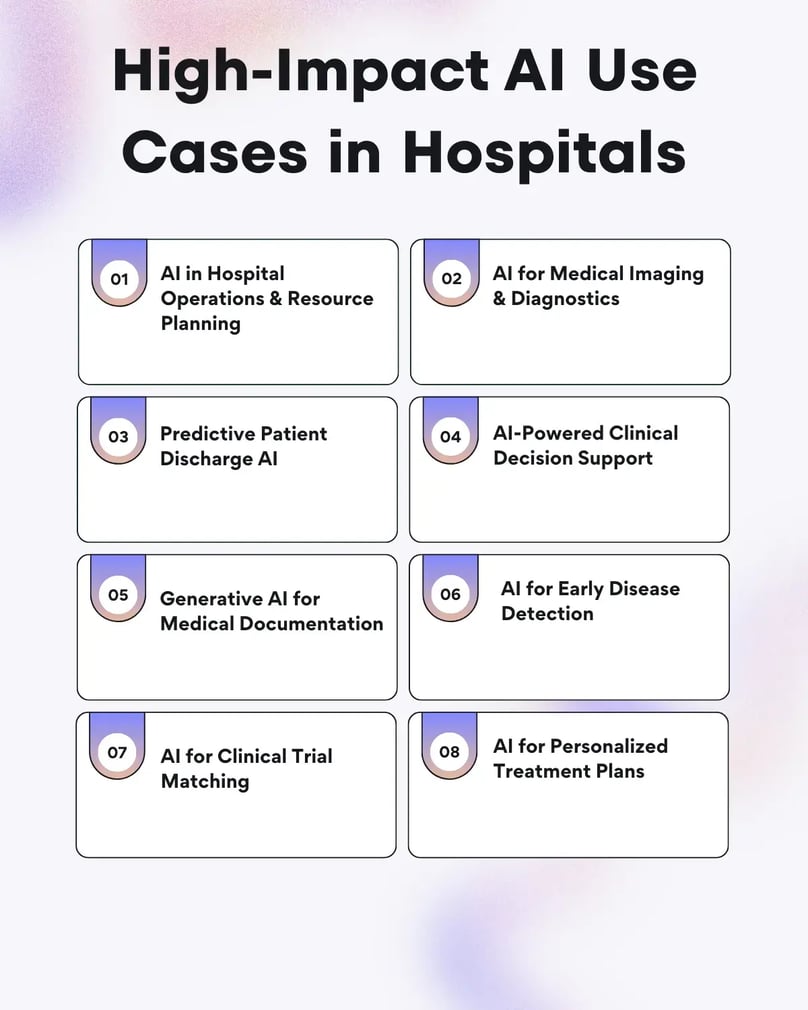
High-Impact AI Use Cases in Hospitals
Hospitals today leverage AI solutions that help improve patient care, outcomes, and more. Below are the most important use cases of AI in hospitals, along with the examples that help make a real difference.
1. AI in Hospital Operations & Resource Planning
When operations are carried out efficiently, the quality of patient care rises, and the cost is controlled, too. Integrating AI in hospital operations allows them to predict the volume of patients, optimize staffing, manage resources, and more. It relies on predictive analytics and machine learning models to predict the outcomes. This way, organizations can pre-plan the forecast demands, equipment needed, and more, allowing them to streamline operations. This improves the workflow efficiency and reduces staff burnout so that they can focus on patient care.
At Signity, we implemented AI-driven predictive analytics to manage revenue and operations for one of our clients. We integrated AI and helped them analyze claims, patient volume, and workflows across the departments. This helped them prioritize critical tasks, reduce staffing inefficiencies, and streamline operations. This resulted in reduced delays and bottlenecks and improved operational efficiency, accuracy, and more.
Related Post : Cost of Implementing AI in Healthcare
2. AI for Medical Imaging & Diagnostics
AI revolutionizes medical imaging as it provides a much faster and more accurate diagnosis of X-rays, MRIs, and other imaging data. It uses machine learning algorithms and advanced pattern recognition to recognize patterns and offer a diagnosis. In traditional times, diagnostics was a time-consuming and expensive process, as a large volume of data had to be handled manually, which was a difficult task. It can also lead to errors. AI models are trained on processes like medical images and can detect patterns that are generally missed by a physician and the human eye.
Apart from speed, AI systems can also standardize diagnostics and improve patient safety. Hospitals that rely on AI tools can offer earlier detection of conditions and enable doctors to act accordingly.
3. Predictive Patient Discharge AI
Managing the patient flow is another challenge for the hospitals. If the bed availability is limited, the volume of patients is much higher, and a shortage of staff or no proper patient discharge planning can lead to delays and longer patient wait times. Predictive patient discharge AI relies on machine learning algorithms and patient historical data to depict the discharge dates, identify delays, and keep a check on hospital beds.
According to research, hospitals that implement predictive discharge AI reported 33% reduction in ER wait times, 15% faster discharge process, and better patient satisfaction. Analyzing the patient records and treatment plans allows AI models to ensure patient care is coordinated efficiently, and everything remains on track. It allows clinicians to make informed decisions about patient discharge and maintain high-quality care.
4. AI-Powered Clinical Decision Support
AI-powered clinical decision support (CDS) allows doctors to make faster and more accurate decisions. Analyzing the patient’s medical history, records, lab results, and imaging data allows for more actionable recommendations to support treatment planning, risk assessment, and more.
Integrating AI in healthcare can alert physicians to potential drug interactions, detect conditions with a high risk, and reduce medical errors.
5. Generative AI for Medical Documentation
Clinicians spend a lot of their time on the documentation process and administrative reports, which may divert their attention and reduce the time available for direct patient care. Generative AI is a game-changer that helps healthcare organizations automatically create accurate medical records from the treatment notes.
The AI tools rely on large language models to summarize the patient data, generate reports, and suggest follow-ups. Automating the documentation process allows hospitals to reduce errors and improve data consistency.
Signity helped one of its clients to deploy a conversational AI platform that supports patient communication and administrative tasks. The assistants could handle the common patient queries across digital channels and offer accurate responses. It resulted in a reduced call volume in the hospital, faster response time for patient queries, and more.
6. AI for Early Disease Detection
Early disease detection is vital for improving the patient's condition, reducing the cost of treatment, and ultimately ensuring there are no complications. AI uses predictive models and machine learning algorithms to analyze the patient data, history, and lab results and identify patterns that indicate the potential issue they face.
With early warning signs of the disease like stroke, cancer, and others, healthcare providers can intervene earlier and allow for a more effective monitoring of patients with a higher risk.
7. AI for Clinical Trial Matching
Choosing the patients for a clinical trial that involves a particular disease can be a complex task. Most of the trials fail due to a lack of the right patients for the trial, which delays the research work and treatment. AI in clinical trial matching is a boon that has the patient history and lab results to identify the patient eligible for the treatment accurately.
As AI can help analyze large datasets, it can detect patients who meet the criteria and reduce manual review time for clinical staff. This ensures the promising therapies reach patients who actually need them. As per research from Mayo Clinic, implementing an AI-powered clinical trial matching system increased enrollment in breast cancer clinical trials by about 80% within 11 months.
8. AI for Personalized Treatment Plans
Every patient responds to the treatment in a different way, and that makes personalization a key in healthcare to deliver the best outcomes. AI in healthcare analyzes the medical history of patients, genetic data, imaging scans, and more to recommend a personalized treatment plan and strategies. This simply helps clinicians to minimize the trial-and-error approach, ultimately helping improve the patient’s recovery.
Personalized treatment and recommendations are vital in sectors like chronic disease management and cardiology, where a minor variation in the patient data can impact the effectiveness. AI suggests optimized plans for medication while ensuring that care is customized to every patient’s needs.
One example is of MDPI, which used AI to design personalized cancer treatment plans, resulting in higher response rates and fewer side effects.
Challenges of AI Adoption in Hospitals
Hospitals using AI offer a plethora of benefits to improve efficiency and patient care; the adoption comes with challenges, too. Here are the critical challenges that hospitals usually face in adopting AI.
|
Challenge |
Description |
Impact on Hospitals |
|
Regulatory Compliance |
It is vital for hospitals to comply with strict regulations followed in healthcare, like HIPAA, GDPR, and more. AI systems need to meet clinical safety standards before deployment. |
It delays the AI implementation and the need for validation |
|
Patient Privacy Concerns |
AI relies on sensitive patient data and medical records. Therefore, patient privacy concerns rise in the domain.
|
Hospitals should implement robust frameworks for security so that sensitive data and information are protected. |
|
Integration with Existing Hospital Systems |
Most of the hospitals using AI rely on legacy IT infrastructure and EHR that may not integrate with modern AI tools. |
Integration challenges can increase implementation time and require additional technical resources. |
|
Lack of Technical Expertise |
Healthcare organizations may lack professionals with expertise in AI, machine learning, and more to deploy and manage AI systems effectively. |
Hospitals may need to collaborate with technology providers or invest in workforce training. |
|
Data Quality Issues |
To deliver accurate results, an AI model relies on high-quality, structured medical data. Incomplete patient records affect the accuracy and reliability of AI insights.
|
When the quality of data is poor, it leads to incorrect predictions and reduced AI effectiveness |
The Future of AI in Hospitals
Future AI systems will rely on frameworks for responsible AI governance for hospitals to ensure safe, transparent, and patient-centered implementation. Here are a few healthcare technologies that will advance AI, boost patient outcomes, and improve patient care quality. Here are some of the vital trends that will redefine the future of AI in healthcare.
Generative AI in Healthcare
It is the most powerful tool that helps healthcare providers automate tasks like clinical documentation, communication, and more. Using LLMs to process patient information provides structured insights into complex patient data, helping clinicians make faster decisions.
Autonomous AI Assistants for Doctors
Hospitals have now begun using AI-powered virtual assistants to support clinicians. From retrieving the patient history to the results of lab and more, doctors can access whatever information they need for the consultations. It reduces the cognitive workload and allows professionals to work more efficiently.
AI-Driven Predictive Health Systems
Predictive AI systems analyze large volumes of patient data, medical history, and clinical patterns to identify potential health risks before they become serious conditions. These systems help healthcare providers detect early signs of diseases and recommend preventive interventions.
Conclusion
AI is actively helping businesses to transform the healthcare system. Whether it is predictive patient discharge AI for disease detection or generative AI for documentation, hospitals that leverage AI in healthcare help achieve improved patient outcomes and care quality. AI solutions in healthcare allow hospitals to make informed, data-driven decisions and reduce administrative burden.
Wish to discover how hospitals can leverage AI to drive innovation. Learn how AI in healthcare can help you implement tailored strategies to maximize its impact.

Mangesh Gothankar


Ashwani Sharma
Achin Verma
Frequently Asked Questions
Have a question in mind? We are here to answer. If you don’t see your question here, drop us a line at our contact page.
How is AI improving Patient Engagement in Hospitals?

AI is improving patient care by using tools like virtual assistants, chatbots, and more that offer a streamlined communication between the patient and physician. They offer a response in real-time and ultimately improve the patient experience and satisfaction without having to put any extra effort.
Can AI help Hospitals Reduce Medical Errors?
Yes. AI in healthcare can analyze large datasets from patient records, lab results, and imaging to detect anomalies or potential risks early. By providing clinical decision support and automated alerts, hospitals can minimize misdiagnoses, medication errors, and treatment delays, ensuring safer patient care.
What types of Hospital Departments benefit most from AI?
While AI can impact nearly every department, radiology, oncology, ICU, and administrative operations often see the most immediate benefits. AI tools enhance diagnostics, predictive planning, and workflow optimization, helping these critical departments deliver faster, more accurate, and cost-efficient care.
How do Hospitals ensure AI systems are Ethical and Secure?
Hospitals adopt Responsible AI Governance frameworks to ensure AI models comply with regulations, protect patient privacy, and maintain transparency. Data encryption, secure storage, and continuous monitoring are essential for ensuring that AI in hospitals is both ethical and safe for patient use.





.png?width=352&name=choose%20Agentic%20AI%20Framework%20(1).png)
.png?width=352&name=agentic-ai-infrastructure-trends%20(1).png)