


.png?width=27&height=27&name=Group(1).png)

-1.svg)
-1.svg)


-2.svg)


%201-1.webp?width=148&height=74&name=our%20work%20(2)%201-1.webp)




.svg)





Legal teams have been running the same contract review process for years. A document arrives, someone reads it cover to cover, flags issues in a Word file or email, and eventually it gets signed, revised, or escalated. The process was designed for a contract volume that most organizations no longer have.
According to CLOC's State of the Industry Report, 83% of legal departments are now managing more work than they were a year ago, with headcount staying flat. Vendor agreements, software licensing contracts, and commercial deals are arriving faster than manual review can cleanly absorb. That pressure is what is driving faster adoption of AI for legal documents, not a desire to replace attorneys but a practical need to handle more volume without proportionally more staff.Where AI fits into this picture varies by organization. Some legal departments have already deployed tools for high-volume, lower-risk review: NDAs, standard vendor terms, and software licensing agreements. Others are still mapping existing workflows before selecting anything. The range of AI for legal services has matured considerably, and the use cases being implemented today are quite different from the narrow pilots of two or three years ago.
 Generate
Key Takeaways
Generate
Key Takeaways

What Is AI for Legal Documents and How Does It Work?
The term covers more than most businesses expect. At one end, tools that review a contract and highlight clauses deviating from standard positions. At the other, full contract lifecycle management systems using AI at multiple stages, from initial legal drafting through negotiation, execution, obligation tracking, and renewal.
The part most legal teams care about first is contract review, and it is where NLP does the heavy lifting. The system reads a document, identifies what kind of clause each section contains, extracts parties, dates, monetary amounts, and obligations, and flags anything outside a defined set of acceptable terms. A well-configured system completes this in minutes for an agreement that would take an attorney two to four hours manually.
The key difference between legal AI and a basic keyword search is that NLP understands the context of legal language, not just the words. Indemnification clauses have recognizable structures. Limitation of liability provisions follow established patterns. Models trained on large volumes of legal documents, like LegalBERT, learn these patterns at a level that general language models do not reach. A general model applied to a master services agreement will miss clause interactions that a legal-specific model handles correctly.
Processing works in sequence:
-
Complex documents arrive as PDFs, Word files, or scanned paper
-
OCR converts them to machine-readable text
-
A pipeline of clause segmentation, entity extraction, and classification then produces structured output that reviewers work from, rather than reading from scratch.
Key Applications of AI in Legal Document Management
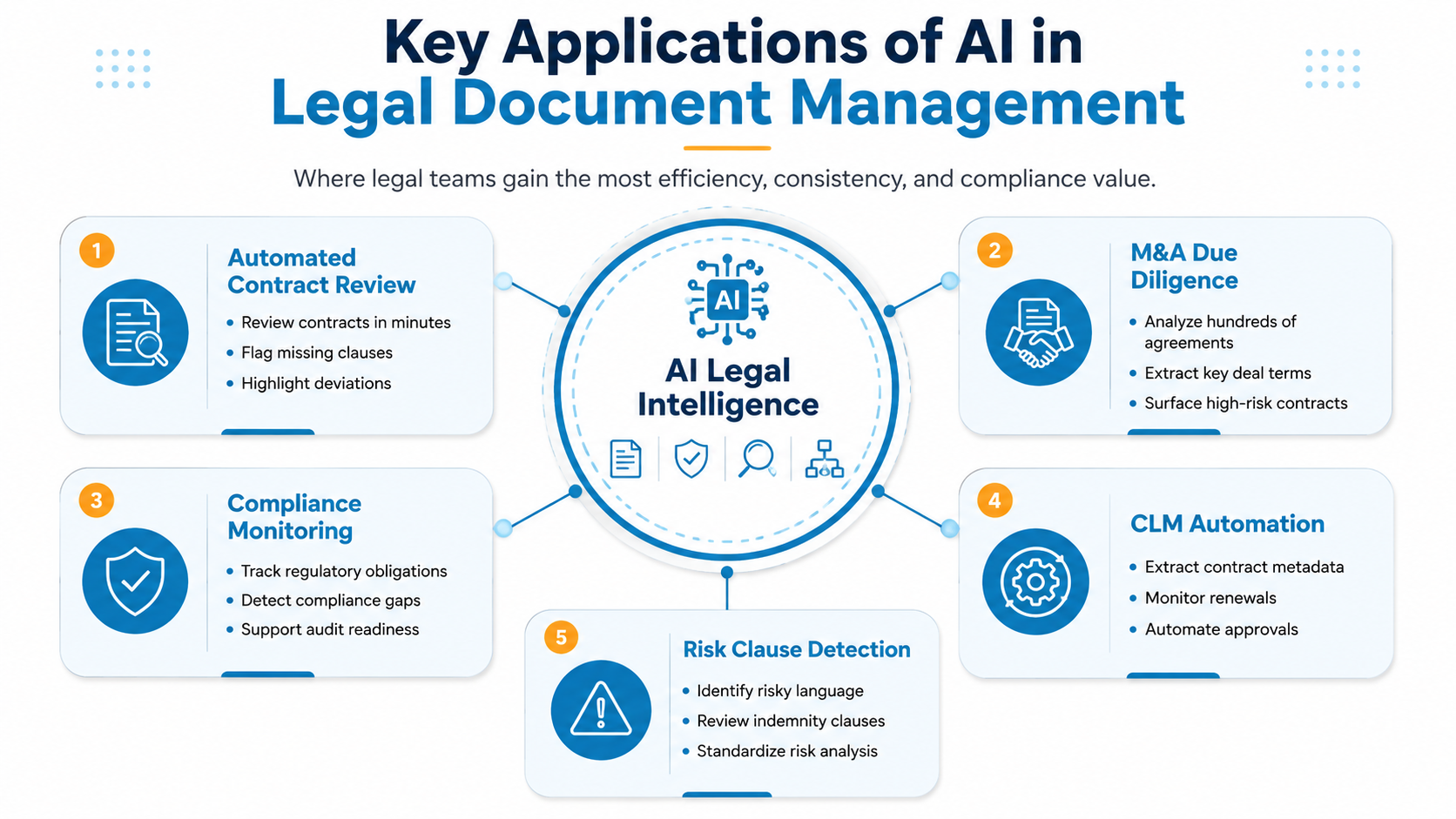
The areas where AI for legal documents delivers consistent, repeatable value share a common thread: high volume, defined structure, and rules that can be systematically applied. Here is where legal teams are seeing it work.
Automated Contract Review
AI reads commercial contracts, vendor agreements, and NDAs against a predefined playbook of preferred and fallback positions. It flags deviations and missing provisions before a human opens the document.
For in-house legal teams managing dozens or hundreds of agreements each month, this changes the economics of first-pass review entirely. The attorney who previously spent four hours on a vendor MSA is now spending thirty minutes on the exceptions the AI surfaced.
AI Legal Contract Analysis in M&A Due Diligence
M&A transactions involve reviewing large volumes of agreements under significant time pressure. Change-of-control provisions, IP ownership language, and assignment restrictions buried across hundreds of contracts all carry deal risk.
AI contract analysis tools extract these data points consistently across the full document set and surface which agreements need senior attorney attention, rather than requiring associates to read everything at once.
Regulatory Compliance Monitoring
Contractual obligations do not exist in isolation from the regulatory environment. As requirements like GDPR, DORA, or sector-specific data security standards evolve, existing contracts may carry obligations that need to be revisited.
AI tools that monitor contractual language against current regulatory requirements give legal teams an early signal rather than a compliance gap discovered during an audit.
Contract Lifecycle Management Automation
CLM platforms handle the workflow layer of contract management, but AI improves what those platforms can do. Automated metadata extraction, renewal date alerts, obligation tracking, and approval routing all become more reliable when AI is doing the extraction rather than manual data entry. Non-legal stakeholders get visibility into contract status without needing to involve legal at every stage.
Risk Clause Identification Across Contract Volume
High-risk language in indemnification provisions, liability caps, and termination-for-convenience clauses can appear in low-priority vendor contracts just as easily as high-value commercial agreements.
AI reviews every document at the same standard regardless of volume, and flags anything outside acceptable parameters. This is especially useful for organizations that receive large amounts of third-party paper where counterparty standards vary widely.
Manual vs. AI-Powered Contract Review
| Dimension | Manual Review | AI Contract Review |
| Review speed | 2 to 10 hours per contract | Minutes per document |
| Accuracy rate | ~80% | ~95% |
| Scalability | Constrained by team size | Handles high contract volume |
| Consistency | Varies across reviewers | Consistent clause-level output |
| Risk identification | Depends on reviewer experience | Systematic flagging against playbook |
| Human oversight required | Full review on every document | Exception-based escalation |
Contract Review Automation ROI: What the Numbers Show
Organizations that have moved beyond AI contract review pilots are reporting measurable returns. A Deloitte study of more than 1,100 senior leaders across six countries found that organizations using AI-powered agreement workflows achieve an average 36% efficiency gain, while 72% report improvements in agreement accuracy, including better clause consistency and compliance.
Similarly, Thomson Reuters' Future of Professionals Report found that legal professionals expect to save 240 hours annually per attorney through AI adoption—equivalent to roughly $19,000 in productivity value per lawyer.
The ROI comes from several areas:
- Faster first-pass contract reviews
- Automated metadata extraction
- Improved obligation tracking
- Reduced administrative workload
- Greater consistency in risk and clause analysis
Organizations with primarily in-house legal teams typically realize efficiency gains, while those that rely heavily on outside counsel often benefit from both efficiency improvements and direct cost savings.
One example is an AI-powered legal workflow we’ve built. It reduced contract review cycles and provided structured visibility into contract obligations. Beyond speed, the solution improved review consistency and operational control across a growing contract portfolio. Explore the complete case study here.
How NLP Contract Review Works
Natural language processing is what allows AI to read a contract rather than just search it. The distinction matters and keyword search finds terms. NLP understands the clause those terms appear in, what that clause means relative to standard legal language, and whether the language deviates from an acceptable range.
In a working NLP contract review pipeline, document text goes through several processing stages. Clause segmentation breaks the document into its component provisions. Classification assigns each clause to a legal category, indemnification, limitation of liability, governing law, confidentiality, and so on. Entity extraction pulls parties, dates, amounts, and jurisdictions. Deviation detection then compares extracted language against a trained clause library to identify where the document departs from preferred or acceptable positions.
A few specific NLP functions directly determine the quality of AI contract review output:
- Named Entity Recognition (NER): It handles identification of parties, effective dates, notice periods, and dollar thresholds. Poor NER is one of the most common sources of errors in AI contract review, particularly in documents with complex party structures or defined terms that modify standard meanings.
- Clause Classification Accuracy: This depends heavily on training data. A model that has seen thousands of indemnification clauses in US commercial contracts will classify them reliably. Applied to key clauses in cross-border agreements, the same model may misclassify or miss them.
- Obligation Extraction: It maps what each party is required to do, by when, and under what conditions. This is what enables downstream contract lifecycle management: the system knows what obligations exist and who owns them.
What AI for Legal Documents Gets Wrong
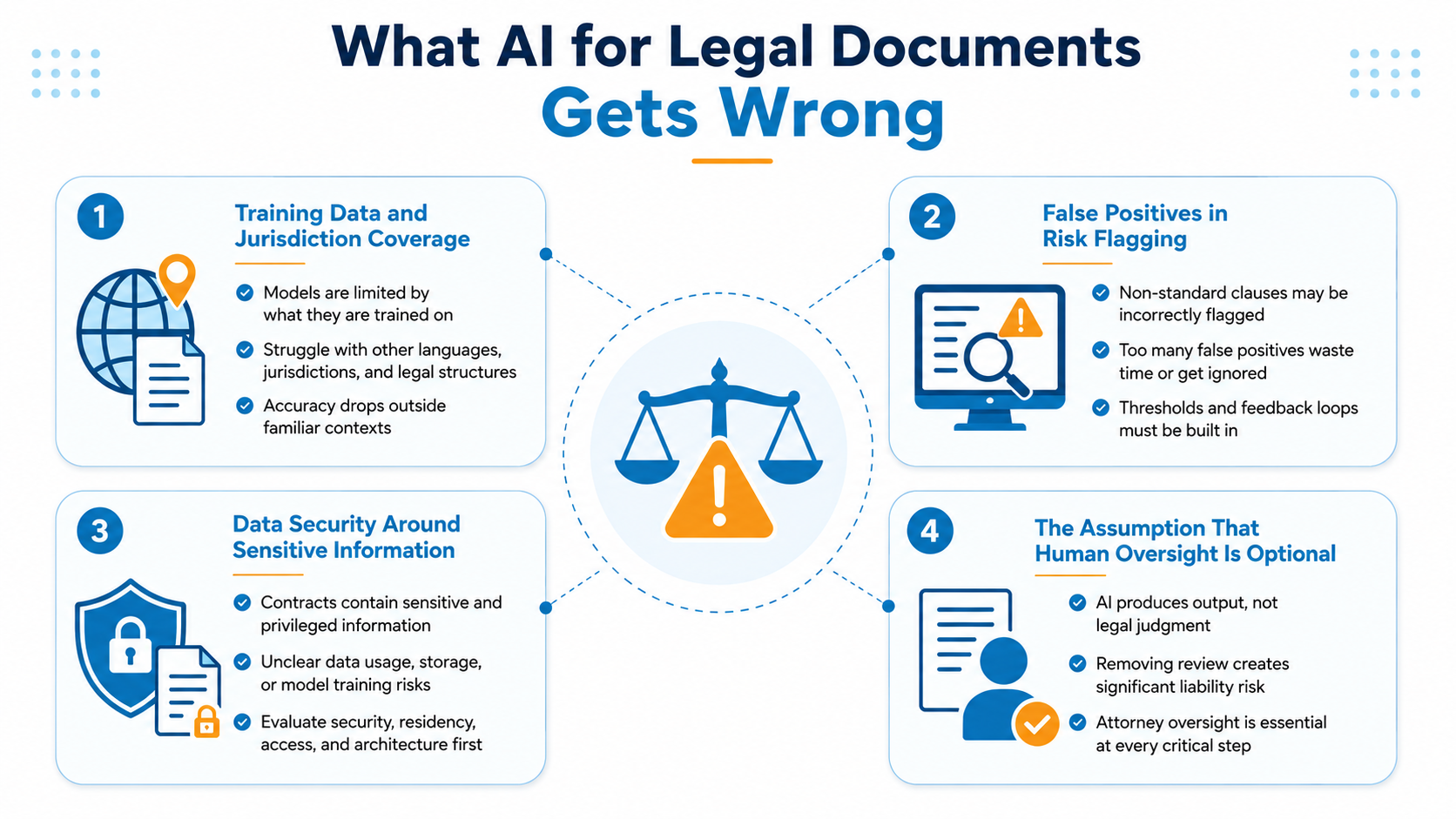
Deploying AI for legal document review without accounting for its failure modes creates problems that surface at the worst possible time, during an audit, a deal close, or a regulatory review. Four areas consistently cause difficulty.
Training Data and Jurisdiction Coverage
AI models are only as good as what they were trained on. Most commercial legal AI tools were trained primarily on English-language, US-jurisdiction commercial contracts. Apply them to French-language agreements, civil law structures, or heavily negotiated contracts in specialized industries and accuracy drops noticeably. This requires either retraining the model or an honest evaluation of where the tool does and does not apply before deployment.
False Positives in Risk Flagging
AI systems will flag non-standard clauses, and some of those flags will be wrong. When legal teams receive large numbers of false positives, one of two things tends to happen: they spend time clearing alerts, defeating the purpose of automation, or they start dismissing alerts habitually, which is considerably more dangerous. Threshold calibration and feedback loops need to be built into the deployment, not treated as a later optimization.
Data Security around Sensitive Client Information
Contracts contain commercially sensitive terms, pricing details, and in some contexts legally privileged communications. Running those documents through a third-party AI API without understanding where the data goes, how it is stored, and whether it is used for model training is a real risk. Data residency, access controls, and processing architecture should be evaluated before any document flows through an AI system.
The Assumption that Human Oversight is Optional
AI produces structured output for review. It does not replace the legal judgment involved in deciding what to do with that output. Workflows that eliminate attorney review entirely in the name of efficiency create liability exposure that no vendor indemnification clause addresses.
AI vs. Human Review: Where Each Belongs
| Task | AI Handles Well | Requires Human Review |
| First-pass contract review | Yes | Not required |
| Clause extraction and classification | Yes | Not required |
| Non-standard clause flagging | Yes | Confirmation advised |
| Risk scoring across contract volume | Yes | Contextual judgment needed |
| First-draft generation | Yes | Always needs final review |
| Legal strategy and negotiation | No | Required |
| Jurisdiction-specific interpretation | Partial | Required |
| Privilege review and redaction | Partial | Required |
What to Evaluate Before Deploying AI for Legal Documents
Most legal AI implementations that underdeliver share a common pattern: the tool was selected before the workflow was mapped. The teams that get the most out of these deployments spend more time on pre-deployment planning than on the actual technical implementation.
The most practical starting point is identifying which parts of the review process carry the highest volume and the lowest judgment requirement. Standard vendor contracts, NDAs, and software licensing agreements under a consistent governing law are usually right. They are high in number, structurally predictable, and the deviation rules are well-defined. Starting there lets the team build familiarity with the tool before applying it to more complex agreements.
Integration architecture matters more than most evaluation processes acknowledge. An AI tool that does not connect to the organization's existing CLM platform or document management system creates a parallel workflow. Parallel workflows do not get used consistently. Integration requirements, both technical and operational, should be worked through with the teams that will actually use the output before a solution is selected.
The build versus buy decision turns on specificity. Organizations with standard commercial contracts and common governing law can usually configure an existing platform. Those with proprietary clause libraries, highly specific contract types, or unusual regulatory requirements will often find that off-the-shelf tools need enough customization that a purpose-built solution is a better investment from the start.
Working with an experienced AI consulting company during this evaluation prevents the common outcome of selecting a tool that fits the demo better than it fits the actual work.
Why Legal Teams Choose Signity To Build AI for Legal Documents
Most organizations that come to us have already tried something. They ran a pilot with a commercial tool, found it flagging the wrong things too often, and concluded that AI contract review was not ready. In most cases, the tool was ready but the implementation was not.
Signity has been building AI solutions for law firms in the United States for sixteen years. That time has given us a clear picture of where deployments work and where they fail.
We build around those failure points directly. Here is what that looks like in practice:
-
Security and data residency are decided at the architecture stage, before a single document touches the system.
-
We map your actual contract types, clause libraries, and review workflows before any model is configured or trained.
-
We stay engaged through adoption, because a system your legal team does not trust is not a solution.
If you are evaluating AI for your legal documents, whether that is automated contract review, NLP-based clause extraction, CLM integration, or a broader workflow transformation, our AI development team can help you build something that fits how your legal team actually works.

Mangesh Gothankar


Ashwani Sharma
Achin Verma
Frequently Asked Questions
Have a question in mind? We are here to answer. If you don’t see your question here, drop us a line at our contact page.
What does AI for legal documents do?

Can AI replace lawyers in document review?
What is NLP contract review?
How long does AI contract review take?