

.png?width=27&height=27&name=Group(1).png)

-1.svg)
-1.svg)


-2.svg)


%201-1.webp?width=148&height=74&name=our%20work%20(2)%201-1.webp)




.svg)





.png?width=670&height=445&name=AI%20Solutions%20in%20Education%20A%20CXO%20Guide%20to%20Scalable%20ROI(1).png)
Introduction
Digital transformation in the banking industry is no longer a front-end exercise. In 2026, it is an architectural decision. This is why most banks have already improved their apps, portals, and digital workflows.
But the harder question is whether the bank underneath those channels can launch products quickly with secure service exposure. The focus even includes operationalizing AI responsibly to support real-time decision-making without introducing new risks. That is where many institutions still struggle.
The urgency is clear. KPMG reported that 61% of banks rank GenAI among top investment priorities and 57% see it as critical to long-term relevance. However, in February 2026, Wolters Kluwer found that only 31.8% of surveyed financial institutions had AI or ML in production, and just 12.2% described their AI strategy as well-defined and well-resourced.
That gap between ambition and execution is what defines Fintech transformation now. Let’s understand the concept in more detail.
 Generate
Key Takeaways
Generate
Key Takeaways

- The digital transformation of the banking industry in 2026 is centered on modular architecture.
- Banks are modernizing around legacy cores through APIs, domain services, and governed data layers.
- Fintech AI development is producing the strongest returns in compliance, fraud, servicing, and document-heavy workflows.
- Real-time payments and embedded finance are pushing banks toward event-driven integration with faster operational decisions.
- The best outcomes come from phased execution tied to business capabilities, measurable metrics, and disciplined delivery.
What Digital Transformation in Banking Really Means in 2026
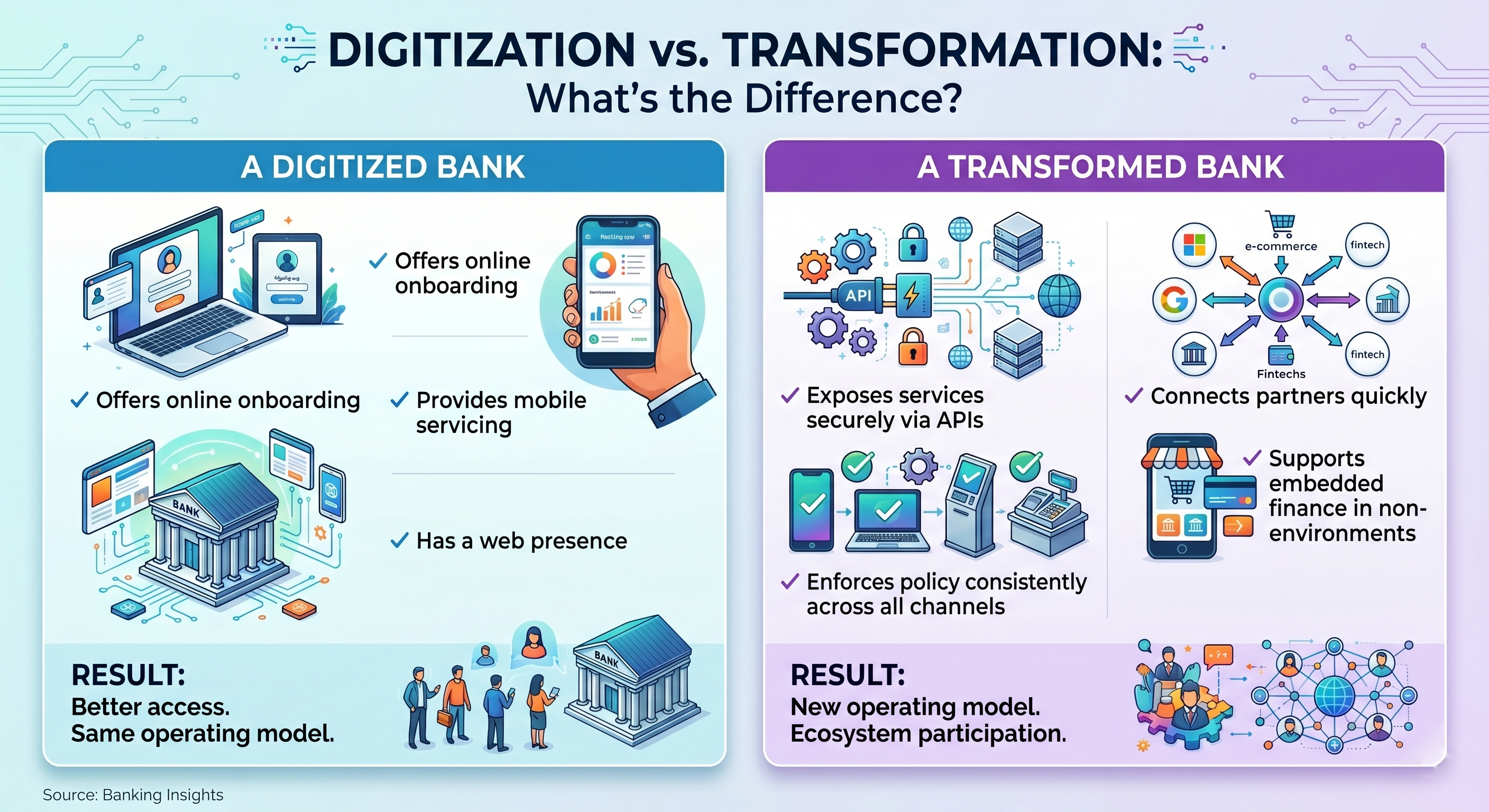
Traditional banks are organized around systems. Modern banks are organized around reusable capabilities. This change powers everything else.
|
Traditional Approach |
Modern Approach |
|
Separate silos: core banking, CRM, lending, compliance, payments |
Shared capabilities: onboarding, identity, servicing, fraud scoring |
|
Each system handles its own rules |
Consistent policy enforced everywhere |
|
Internal integration only |
Works across partners, apps, ecosystems |
The Ecosystem Reality
Banks no longer operate in closed environments. They must serve partner apps, merchant platforms, treasury systems, embedded finance journeys, and multiple external touchpoints.
But with one key requirement, “Same control and security everywhere.”
Digitization vs. Transformation: What's the Difference?
The Modular Architecture Advantage
The old or legacy systems had one problem: Monolithic Design. It means the product logic is scattered across:
- Channels
- Middle ware
- Batch jobs
- Legacy platforms
It all made the change slow and risky.
But the new approach to modular banking involves separate layers that evolve independently:
|
Layer |
Benefit |
|
Experience |
Update customer interfaces without touching logic |
|
Orchestration |
Route requests flexibly across services |
|
Domain Logic |
Reuse capabilities across channels |
|
Data |
Scale independently; improve governance |
|
Infrastructure |
Upgrade without full system replacement |
All that the banking industry needs to do is start where it hurts most. You don't need to replace the core immediately. Modernize around it by tackling high-friction areas first:
- On-boarding → Fast, secure customer signup
- Lending workflows → Faster approvals
- Notifications → Real-time, personalized alerts
- Compliance review → Automated checks, audit trails
- Fraud control → Smarter detection, instant response
The bottom line is that digital transformation isn't about having better technology. It's about thinking in capabilities, not systems. The banks need to focus on operating across ecosystems, not just internally. It can help build modular, not monolithic systems.
Reference Architecture for Digital Banking Transformation
The cleanest way to think about banking modernization is through a layered architecture that serves both customer-facing journeys and internal operations.
Core Architecture Layers
|
Layer |
Primary Audience |
Technical Purpose |
Business Outcome |
|
Experience Layer |
Customers, staff, partners |
Delivers digital journeys |
Better usability and faster service |
|
API and Integration Layer |
Internal systems, fintechs, external platforms |
Connects and orchestrates services |
Faster change and ecosystem readiness |
|
Services and Business Logic Layer |
Product, operations, compliance, risk |
Runs domain capabilities |
Re-usability and lower dependency on legacy systems |
|
Data and Analytics Layer |
Fraud, finance, compliance, and AI teams |
Powers insight and decisions |
Trusted reporting, personalization, and risk control |
|
Infrastructure and Cloud Layer |
Engineering, security, SRE |
Supports runtime and resilience |
Scalability, reliability, and governance |
Experience Layer
The experience layer includes customer apps, online banking portals, branch tools, advisor desktops, and partner-facing interfaces. In a strong digital bank, this layer stays focused on journeys and presentation, not deep business logic.
That distinction is important because channels become brittle when too much banking logic is embedded directly into them. If onboarding rules, pricing logic, or service exceptions live in the front end, every change becomes slower and harder to govern.
API and Integration Layer
The layer is the connective tissue of modern banking, as it allows the institution to expose internal capabilities securely. It allows integration with partner ecosystems and shifts away from fragile point-to-point interfaces.
Most mid-market banks evaluate Kong, Apigee, or AWS API Gateway for management; Kafka or Confluent for event streaming; and AsyncAPI for defining contracts between services so teams consume events reliably without breaking when upstream services change.
In 2026, this layer typically supports:
- Managed APIs for internal and external consumers
- Event-driven messaging for time-sensitive workflows
- Service discovery and versioning
- Policy enforcement, tokenization, and monitoring
- Observability across transactions and dependencies
This is the layer that makes ecosystem banking possible.
Services and Business Logic Layer
This is where modernization starts to generate business value. Domain services should hold the logic for capabilities such as:
- Onboarding and KYC orchestration
- Lending decision support
- Payments initiation and alerting
- Account servicing
- Disputes and case management
- Fraud control and compliance workflows
When these services are separated cleanly, teams can change specific capabilities without destabilizing the entire platform.
Data and Analytics Layer
Data is now a structural banking issue, not just an analytics issue. McKinsey noted in February 2025 that banks spend around 6% to 12% of their technology budgets on data. That level of investment makes sense because modern decision-making depends on trusted, governed, and accessible data.
A sound data layer should support both operational and analytical workloads:
|
Data Need |
Why It Matters in Banking |
|
Real-time event processing |
Fraud, alerts, payments, exceptions |
|
Batch pipelines |
Reporting, reconciliation, and regulatory workloads |
|
Shared semantic models |
Consistent customer and account definitions |
|
Data lineage |
Auditability and compliance evidence |
|
AI-ready datasets |
Reliable model behavior and decision support |
Infrastructure and Cloud Layer
By 2026, the cloud debate will be more mature. The real question is not whether a bank should use the cloud. It is how intelligently workloads are placed across hybrid environments.
Hybrid models remain dominant because they give banks flexibility across regulated workloads, customer-facing systems, analytics, and AI services. This layer also includes identity, observability, CI/CD, resilience, recovery patterns, and runtime governance.
Key Technology Decisions for CTO's
From a CTO’s perspective, a few decisions shape most transformation outcomes:
|
Decision Area |
Strategic Question |
|
Legacy modernization |
Which domains should be extracted first from the core? |
|
Integration design |
Where do APIs suffice, and where is event-driven architecture necessary? |
|
AI readiness |
Which use cases have strong enough data and controls for production? |
|
Platform design |
What should be built, bought, or composed? |
|
Governance |
How will the architecture stay clean as teams scale? |
Measurable Benefits of Digital Transformation in Banking
Transformation needs to earn its place through measurable outcomes.
Faster Time-to-Market
Modular services and reusable APIs reduce dependency on large release cycles. That makes it easier to launch new workflows, onboard partners, and deploy product changes with less operational drag.
Cost Optimization and Operational Efficiency
BCG reported in May 2025 that more than 60% of bank technology spend still goes to run-the-bank activity. That is one of the clearest cases for simplification. Modernization helps shift spending away from maintenance-heavy complexity and toward change capacity.
Improved Risk Management and Fraud Detection
Real-time integration and better data architecture help banks identify anomalies faster, reduce investigation delays, and make risk controls more responsive. This becomes even more important as digital volumes grow and fraud techniques evolve.
Enhanced Customer Experience and Retention
Customers do not see the architecture directly, but they feel the result. Faster onboarding, better self-service, timely alerts, and more contextual interactions all depend on cleaner architecture and better operating flow.
Core Challenges in Banking Transformation and How to Solve Them
The hardest part of transformation is rarely the vision. It is the friction inside existing systems, data, controls, and teams.
Legacy Core Systems
Legacy cores remain the biggest structural constraint when we talk about digital transformation in the banking industry. They still anchor transaction truth, but they also slow change when too much logic depends on them.
The right approach is usually phased modernization. Banks can expose capabilities through APIs, extract high-friction services around the core, and modernize the operating edge without forcing immediate replacement.
Data Silos and Integration Issues
Disconnected data across lending, payments, compliance, servicing, and analytics weakens decision-making. It also makes customer context inconsistent across functions.
The fix is not just a data lake. It is a governed data foundation with shared definitions, cleaner integration patterns, lineage, and ownership.
Quick Technical Insight:
In practice: dbt models transform raw events into trusted tables (customers, accounts, transactions); Kafka streams ingest in real-time; a feature store (Feast) serves precomputed features for fraud/lending models; OpenLineage tracks every transformation so compliance teams can answer 'where did this number come from?' Without this architecture, data work is manual, error-prone, and slow.
Regulatory Compliance and Security
Modernization expands the control surface. AI, APIs, cloud services, and partner ecosystems all create new operational and governance demands.
Banks need compliance built into the architecture through identity controls, encryption, monitoring, evidence automation, and model governance, where AI is used.
Talent and Execution Gaps
Strong strategy still fails without sustained delivery. Banking transformation needs architecture leadership, platform engineering, QA discipline, security involvement, and domain-aware teams that can keep momentum over time.
Execution Roadmap for Banking Leaders
The best execution roadmaps are simple enough to communicate and rigorous enough to deliver.
Phase 1: Assess and Align
Start by mapping where friction actually lives. Look at customer journeys, compliance loops, release dependencies, data fragmentation, and operational handoffs. That creates a business case grounded in reality.
Phase 2: Build Digital Foundations
This phase is about enabling future speed. It usually includes API management, identity controls, CI/CD, observability, data governance, and runtime standards. Without these foundations, later innovation becomes expensive and inconsistent.
Phase 3: Scale with Intelligence
Once the platform and data foundations are stable, banks can introduce AI where the workflow and controls are mature enough to support it. This is where targeted fintech AI development begins to produce measurable returns.
Phase 4: Continuous Innovation
Transformation is not a one-time program. The end state is an institution that can continue to modernize through architecture guardrails, domain ownership, reusable services, and disciplined platform evolution.
Real Success Story of AI in Banking (Powered by Signity)
A strong example of practical AI in banking is Signity’s AI-Assisted Financial Compliance Solution for FinVaultz Credit.
Problem
FinVaultz Credit was facing heavy manual effort in compliance operations. Staff were spending 3 to 4 hours per loan on document review, compliance teams were overloaded with repetitive regulatory questions, and regulatory monitoring was slow and administrative. Those delays were affecting approval speed, process quality, and operational efficiency.
The solution we delivered combined conversational AI, NLP, machine learning, and integration with banking systems to support real operational flows rather than siloed experimentation.
Read Full Case Study: AI-Assisted Financial Compliance Solution
How to Accelerate Digital Transformation with the Right Technology Partner?
Banks do not usually fail for lack of strategy. They fail because delivery becomes fragmented.
The right technology partner brings architectural judgment, engineering continuity, and domain familiarity. That is especially important when modernization spans APIs, compliance, cloud, data, and AI simultaneously.
Role of Dedicated Development Teams
Dedicated teams help banks retain context and build momentum. Instead of treating each initiative as a separate project, they support continuity across architecture, development, testing, DevSecOps, and domain knowledge.
Offshore Development and Cost Efficiency
Offshore delivery can improve cost efficiency, but its real value is access to scalable engineering capacity. When supported by strong governance and clear ownership, it allows banks to move faster without overloading internal teams.
Scaling with Proven Delivery Models
The strongest partners bring more than bandwidth. They bring reusable patterns, banking-specific execution experience, and delivery discipline that helps institutions modernize with less risk and more predictability.
Conclusion
The digital transformation of the banking industry in 2026 is more technical, more urgent, and more consequential than many earlier waves of digitization. This is no longer about polishing channels. It is about whether the bank can operate as a modular, intelligent, governable platform.
Banks that modernize in layers, strengthen data foundations, and apply AI where it improves workflow quality will create a more durable advantage. Banks that continue to rely on tightly coupled systems and manual control points will find it harder to move at the speed the market now expects.

Mangesh Gothankar


Ashwani Sharma
Achin Verma
Frequently Asked Questions
Have a question in mind? We are here to answer. If you don’t see your question here, drop us a line at our contact page.
What is digital transformation in banking?

What are the biggest challenges in banking transformation?
What technologies drive digital banking transformation?
How long does digital transformation take in banking?





.png?width=352&name=agentic-ai-strategy-for-enterprise-software%20(1).png)