

.png?width=27&height=27&name=Group(1).png)

-1.svg)
-1.svg)


-2.svg)


%201-1.webp?width=148&height=74&name=our%20work%20(2)%201-1.webp)




.svg)





.png?width=670&height=445&name=Guide%20to%20AGI%20(1).png)
Banks and other financial firms are becoming cognitively intelligent. Thanks to generative AI and large language models that have created this new wave of digital transformation. This allows them to move from experimentation to real-world deployment.
Integrating generative AI into their workflows allows banks to streamline activities such as synthetic identity fraud, automate manual tasks, monitor compliance, and deliver a personalized customer experience.
According to recent industry stats, around 92% of global banks use AI in their core banking functions, and 47% have already deployed generative AI applications in production. Also, as per research from Fintech magazine, 75% of banks are exploring and implementing generative AI solutions, signaling a major shift in how financial institutions operate. It helps deliver a measurable impact for the finance sector.
As digital transactions continue to rise, financial crimes evolve. Therefore, banks are now relying on AI models that help analyze transaction patterns and detect anomalies. Now, not only does it help the industry, but it also transforms the whole customer experience.
While chatbots help to streamline communication, AI-driven personalized recommendations allow customers to leverage faster support across digital channels. This ultimately allows banks to deliver hyper-personalized services and improve engagement.
Banks are embedding generative AI in fintech systems that can help build more secure financial services.
Here is an article that helps you explore how leading banks are using generative AI for fraud detection. We will walk through AI in banking examples, along with the real-world AI tools. Also, we will understand challenges the financial institutions face when they wish to implement enterprise-grade AI solutions.
 Generate
Key Takeaways
Generate
Key Takeaways

- LLM-powered generative AI models enables real-time monitoring with predictive fraud detection.
- AI simplifies regulatory reporting and risk analysis. It helps to reduce the manual efforts.
- AI chatbots and virtual assistants that support voice banking provide seamless customer support.
- Banks benefit from tailored generative AI services for secure integration and industry-specific training.
What Is Generative AI in Banking?
Generative AI is a powerful driver that uses advanced large language models like GPT or LLaMA. Banks leverage LLMs that help automate complex workflows, analyze large datasets, and generate actionable insights in real-time.
It is unlike traditional AI, which could only focus on rule-based tasks. Generative AI for financial services is powered by LLMs and can understand the context, summarize large documents and datasets, and assist with accurate decision-making.
AI in Banking Examples: How Leading Banks Are Using Generative AI
Generative AI transforms the way financial institutions operate while offering banks the ability to boost security and streamline operations. Integrating LLMs into the operations allows banks to achieve efficiency and accuracy across different domains.
Fraud Detection Using AI in Banking
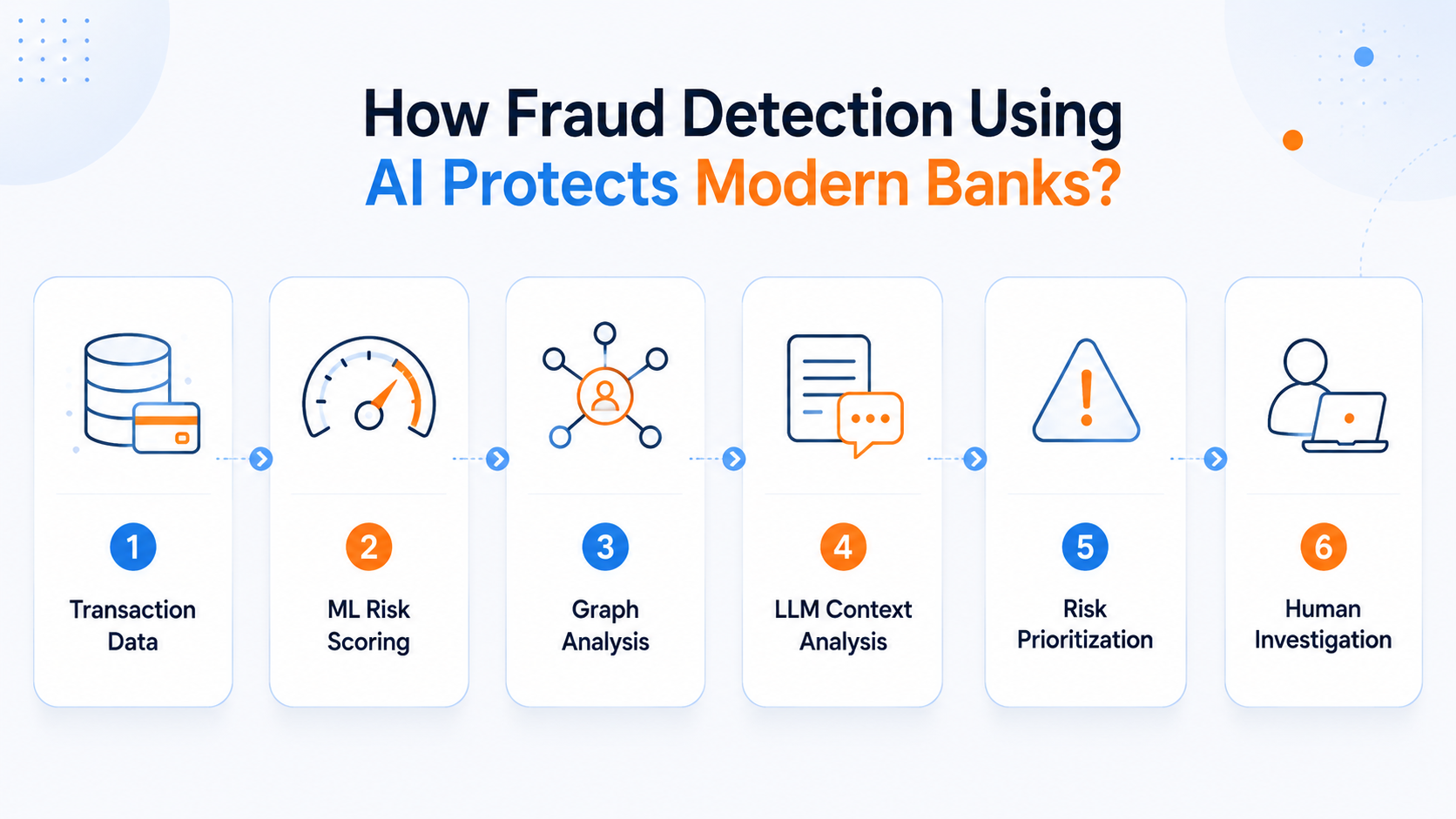
Fraud detection using AI has become one of the most valuable applications of generative AI in banking. Instead of relying solely on predefined rules, modern banking AI solutions combine machine learning models and graph analytics. It even involves pairing large language models (LLMs) to identify suspicious behavior across millions of daily transactions.
Banks rely on machine learning models to monitor transaction history and customer behavior alongside device information and login patterns. Merchant activity and location signals feed into the same system. Together, these inputs generate a real-time fraud risk score. When the system flags unusual activity, large language models take over to examine the surrounding context. They review customer communications and investigator notes. They also draw on identity documents and historical case records. This layered approach lets banks determine not just that a transaction looks suspicious but why it might be fraudulent.
Graph analytics plays a key role in detecting complex financial crimes such as money laundering and synthetic identity fraud along with account takeover and mule account activity.
It maps relationships between customers and devices as well as IP addresses, accounts, and merchants. This surfaces hidden fraud networks that rule-based systems typically miss. Combined with machine learning and LLMs, the approach helps banks cut down false positives and investigate faster. Customer experience stays intact throughout.
AI for Compliance and Reporting
Another domain where AI plays a major role is compliance. As the regulatory needs become complex, the manual compliance processes can be time-consuming and also lead to errors. An AI-powered system helps automate the compliance management process, beginning with AML, where the suspicious transactions are automatically flagged.
With risk analysis automation, businesses can analyze large datasets and identify financial risks. This ensures that compliance teams can focus on strategic decision-making, rather than repetitive manual tasks.
AI for Customer Experience
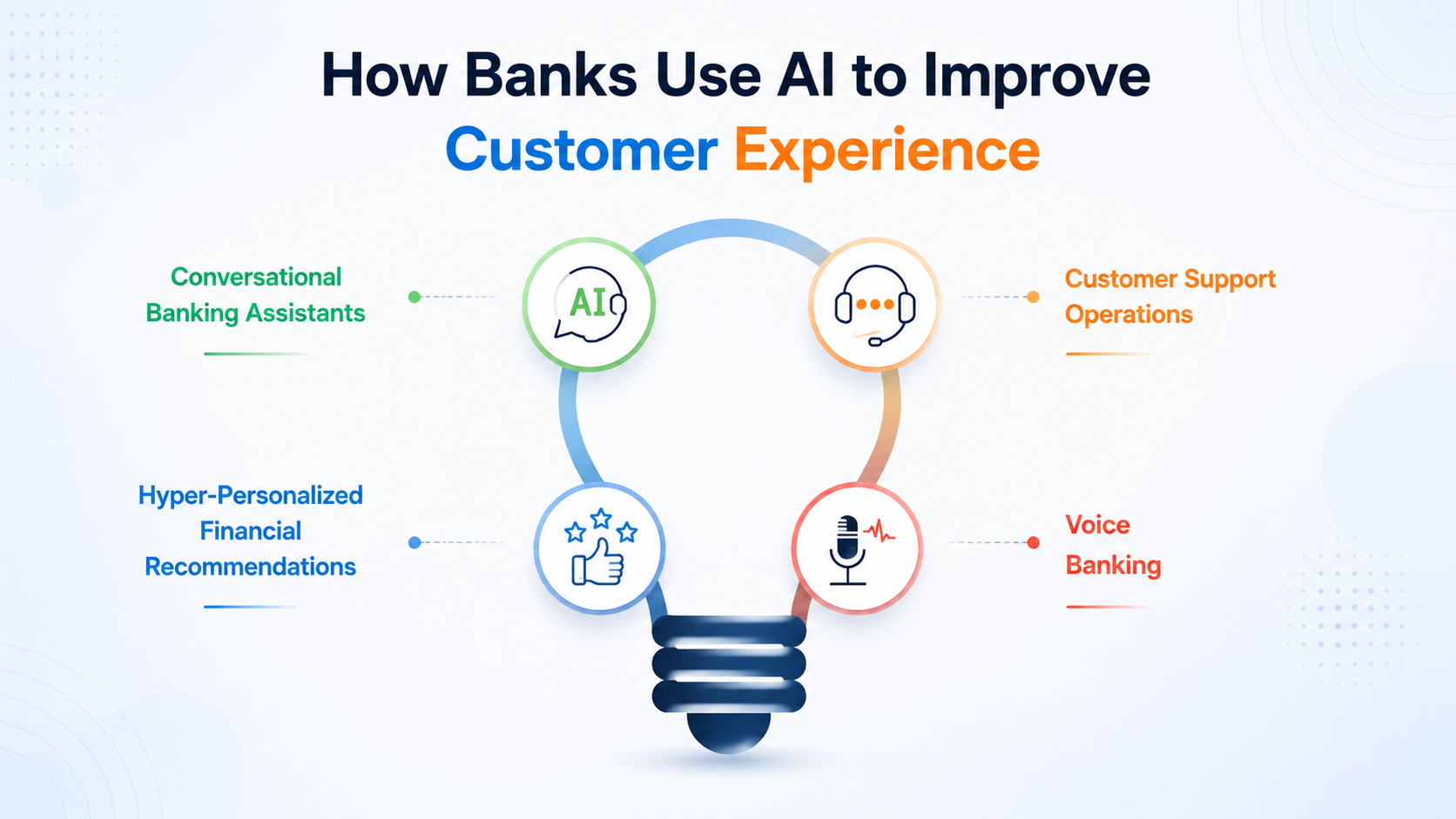
Generative AI in finance and banking allows customers to leverage more personalized and responsive banking services. The chatbots are powered by AI and can answer queries instantly across multiple channels, like web and mobile applications. The chatbots understand the context and respond accordingly to handle the large requests that previously needed human intervention.
It not only provides basic customer support but also offers personalized banking insights. AI analyzes the spending behavior, saving patterns, and goals of customers so that it can deliver them tailored advice. AI-powered financial assistants allow customers to manage their budget, track expenses, and ultimately make smart financial decisions.
Case Studies: AI Tools Used by Leading Banks
With the usage of advanced tools like LLMs and predictive analytics, banks are showcasing the real benefits of generative AI. Some of the finance platforms that leverage AI to transform the customer experience include.
Mastercard Decision Intelligent Pro
Mastercard Decision Intelligence Pro is an AI-powered fraud-detection system that approves genuine transactions in real time. The system uses advanced machine learning and generative AI models that help access transactions as they occur, and highlight if there are any potential fraud based on historical data and behavioral patterns. It is integrated with LLM-based analytics, which allow instant detection of anomalies that could not be detected by the traditional rule-based systems.
AI models use intelligence pro, which means it continuously learns from new data and adapt to the fraud patterns.
Bank of America’s Erica AI Assistant
An AI-powered virtual assistant that uses generative AI and natural language understanding to deliver personalized services. It does not rely on traditional chatbots but uses LLMs to understand context and offer tailored recommendations. Customers interact with the platform to perform banking transactions and tasks like paying bills, checking balances, and more via conversational interfaces.
Apart from basic tasks and transactions, it offers financial insights to the users, customized to their spending habits and patterns. Combining real-time data analysis with LLM boosts customer experience and reduces operational costs.
Emerging Technologies Powering AI Banking Systems
As more banks are leveraging generative AI, other emerging technologies collaboratively help financial institutions deploy AI systems more efficiently. The innovations include Retrieval-Augmented Generation (RAG), KYC copilots, and agentic AI that enables banks to integrate LLMs into real-world operations.
RAG and Its Collaboration with LLMs
Retrieval-Augmented Generation services (RAG) combine the generative capabilities of LLMs and real-time information retrieval from reliable data sources. This means RAG extracts data from internal databases, documents, and financial records before giving the answers.
The approach is quite valuable for banks and other sectors as it enables knowledge sharing and retrieval while ensuring data accuracy and compliance. Suppose a customer questions the assistant about transaction details, then the system will pull data from the internal knowledge base and ensure an accurate financial response. There is a reduced risk of hallucination, and banks can deploy a generative AI system with higher confidence.
AI KYC Copilot in Banking
KYC, also called know your customer, is critical for regulatory compliance but has complex verification procedures and documentation. AI KYC copilot uses generative AI and ML to assist teams in automating identity verification.
With this, the AI system can analyze documents and transaction history to validate user identities more accurately. The tool performs identity risk analysis as it evaluates behavioral patterns and risk indicators externally to detect any suspicious activity.
Agentic AI in Banking
Agentic AI is one of the emerging trends in financial services. It allows AI systems to perform tasks autonomously without needing any human intervention. The agents work independently to perform multiple tasks and functions as autonomous financial agents. These agents can monitor financial transactions, operations, analyze data, and execute tasks based on predefined objectives.
The systems can also assist with AI-driven compliance checks by continuously reviewing and monitoring transactions. Agentic AI can also allow for self-operating financial workflows, where agents can handle tasks like report generation, monitoring fraud, and more.
Traditional AI vs LLMs in Banking
Although both technologies fall under artificial intelligence, they solve different business problems. Understanding when to use each approach is essential for building effective banking AI solutions.
| Technology | Primary Strength | Common Banking Applications |
| Rule-Based Systems | Fixed business rules | Transaction limits, policy enforcement, basic compliance checks |
| Machine Learning | Pattern recognition | Fraud detection, credit scoring, transaction risk analysis |
| Deep Learning | Complex behavioral analysis | Customer behavior modeling, anomaly detection, forecasting |
| LLMs in Banking | Language understanding and reasoning | Customer support, compliance assistance, document analysis, investigation summaries |
| Agentic AI | Autonomous task execution | Workflow automation, KYC processing, fraud investigations, regulatory reporting |
Rather than replacing traditional AI, LLMs in banking complement existing machine learning models. While predictive models analyze structured financial data, LLMs process unstructured information such as customer communications, policy documents, and investigation records. Together, they provide more accurate recommendations, improve operational efficiency, and enable better decision-making across banking operations.
Implementation Roadmap for Generative AI in Banking
To implement generative AI in the banking sector, it is vital to follow a structured approach that can cover the selection of a model, data readiness, strategy for deployment, governance policies, and more. Here is a step-by-step implementation roadmap.
Step 1: Data Readiness & Infrastructure Setup
It is vital for the banks to build a secure data infrastructure before deploying any model. Here, the critical steps include:
- Collection of data from banking systems and CRM
- Clean the data and label datasets for AI training
- Secure data pipelines are set that offer encryption and role-based access
- Real-time data streaming can be implemented for Synthetic Identity Fraud
Step 2: Use-Case Prioritization
Rather than focusing on AI adoption, banks must focus on use cases that offer a high impact and have a low risk. It helps deliver measurable ROI. A few use cases here include:
- Money Laundering Detection in real-time
- AML & compliance automation
- Customer support, including AI assistants and chatbots
Step 3: Model Selection & AI Strategy
The next step is choosing the right model, architecture, and strategy to boost performance and compliance. Well, the decision is not only about model accuracy, as it directly impacts the security of data and control operations. The models include:
Closed Models (e.g., GPT APIs):
- Faster deployment
- High accuracy
- Ideal for non-sensitive workloads
Open-Source Models (e.g., LLaMA, Mistral):
- Allows complete control over data
- Ideal for on-premise deployment
- Requires MLOps and infrastructure maturity
RAG vs Fine-Tuning Decision:
- Use RAG for real-time, dynamic data retrieval (compliance, knowledge queries)
- Use fine-tuning for domain-specific tasks (risk scoring, underwriting)
Step 4: Deployment Strategy (Cloud vs On-Prem vs Hybrid)
The deployment strategy should be focused on data sensitivity, regulatory compliance, and the need for scalability. Ensure to make the decision carefully because the strategy directly impacts how quickly the model responds and how the data is stored and processed. Here the important deployment strategies.
Cloud Deployment (AWS, Azure, GCP):
- Scalable and cost-efficient
- Faster experimentation and rollout
On-Premise Deployment:
- Maximum data control
- Required for highly regulated environments
Hybrid Approach:
- Sensitive workloads on-prem
- Customer-facing AI on the cloud
Step 5: Governance, Risk & Compliance Framework
AI in the banking domain needs to work under strict regulatory compliance and operational boundaries. With the right governance and frameworks, the models are more reliable, auditable, and aligned with policies and regulations.
Key components:
- Model monitoring
- Explainability for AI decisions
- Audit trails for compliance reporting
- Bias detection and mitigation
Step 6: Integration with Core Banking Systems
Ensure the system can seamlessly integrate and connect with the existing bank infrastructure so that AI can deliver real value. This allows for real-time insights and automated workflows, without disrupting the operations.
Integration areas:
- Core banking platforms
- Payment gateways
- Risk and compliance systems
- Customer support platforms
Business Benefits of Generative AI in Banking
Banks are increasingly investing in generative AI because it delivers measurable business outcomes across operations, customer service, compliance, and fraud prevention. When implemented alongside existing banking systems, AI creates long-term value beyond automation.
Faster Fraud Detection
AI continuously analyzes customer activity and transaction data in real time, allowing fraud teams to identify suspicious behavior earlier and respond before financial losses occur.
Improved Customer Experience
LLMs in banking provide faster, more personalized support by understanding customer intent and delivering accurate responses across digital channels, reducing wait times and improving satisfaction.
Operational Efficiency
Routine activities such as document processing, compliance reporting, customer onboarding, and internal knowledge retrieval can be automated, allowing employees to focus on higher-value tasks.
Better Compliance and Risk Management
Generative AI helps compliance teams monitor regulatory requirements, summarize policy changes, support audit preparation, and identify potential risks more efficiently while maintaining transparency and governance.
Smarter Business Decisions
By combining structured banking data with contextual insights from LLMs, financial institutions gain a more complete understanding of customer behavior, operational risks, and emerging business opportunities, enabling faster and more informed decision-making.
Challenges of Implementing Generative AI in Banking
|
Why Banks Are Investing in Custom Generative AI Solutions
As AI adoption across financial firms and industries rises, they are shifting from generic AI tools to custom-built AI solutions that can align with their operational needs. As the banking sector operates in a sensitive data-intensive environment, it is vital to ensure that AI systems remain accurate and secure. Here is why banks invest in custom generative AI solutions.
Need for Custom Generative AI Services
Banks need custom AI systems that adapt to their workflows, compliance needs, and risk management processes. Ready-made AI solutions do not have the flexibility that is needed to support complex financial processes and operations. Thanks to custom generative AI development services that can be customized as per the internal system and business needs. It allows for more accurate insights and efficient operations.
Secure Enterprise AI Models
One of the major concerns, as we are aware, in the financial sector is security and data privacy. Financial institutions have plenty of data to handle, and it is therefore vital to protect it from unauthorized access. Custom enterprise AI models can be deployed in a secure environment, where banks can have complete control over their data. Also, the system allows for advanced security measures and data pipelines to ensure compliance with financial regulations.
Integration with Banking Systems
Custom generative AI solutions seamlessly integrate with the existing infrastructure, and this is another reason why businesses invest in the same. Financial institutions rely on multiple systems like banking platforms, compliance tools, and customer management systems. So, the AI solution is designed in a way that it connects with these systems and enables automated workflows and improved operational efficiency. This ultimately helps them with smarter decision-making across the organization.
Conclusion: The Future of Generative AI in Banking
Generative AI in banking is rapidly becoming a core capability for financial institutions looking to improve operational efficiency, strengthen fraud prevention, enhance regulatory compliance, and deliver more personalized customer experiences. Rather than replacing existing banking systems, modern banking AI solutions work alongside machine learning models, enterprise data platforms, and human expertise to support faster and more informed decision-making.
As LLMs in banking continue to mature, their role will expand beyond conversational assistants into areas such as intelligent compliance, automated investigations, document intelligence, financial advisory, and enterprise workflow automation. Combined with technologies such as Retrieval-Augmented Generation (RAG), agentic AI, and advanced analytics, they will help banks build more secure, scalable, and customer-centric operations.
Financial institutions that invest in responsible AI adoption today will be better positioned to respond to evolving customer expectations, increasingly sophisticated financial crime, and changing regulatory requirements. The future of AI in the banking industry will be defined not by isolated AI tools, but by intelligent systems that combine automation, contextual reasoning, and human oversight to deliver measurable business value.

Mangesh Gothankar


Ashwani Sharma
Achin Verma
Frequently Asked Questions
Have a question in mind? We are here to answer. If you don’t see your question here, drop us a line at our contact page.
How can generative AI improve investment advisory services in banks?

Generative AI can be integrated into advisory services by analyzing trends in the market, the portfolio of customers, and their spending patterns to offer customers accurate recommendations based on their behavior. LLMs help banks get data in real-time so that they can make informed decisions.
Can banks use generative AI to detect emerging financial Risks?
Yes. Banks can rely on generative AI to detect financial risks. It analyzes the transaction patterns of the customer and regulatory updates. LLMs summarize datasets to generate alerts on credit, operational, and liquidity risks. This allows banks to mitigate risks before they impact the operations.
How do custom Generative AI services enhance internal banking operations?
Custom generative AI services are customized as per the internal workflow of the bank. This streamlines the reports, documents, and more. Integrating these solutions allows banks to reduce the operational overhead and boost the decision-making process.
Is Generative AI effective in Multi-channel Banking Communication?
Yes. Generative AI in banking enables context-aware responses across channels like mobile apps and web chat. By using LLMs, banks can provide personalized customer support, financial guidance, and proactive alerts, ensuring an engaging experience across all digital touchpoints.





.png?width=352&name=agentic-ai-strategy-for-enterprise-software%20(1).png)