

.png?width=27&height=27&name=Group(1).png)

-1.svg)
-1.svg)


-2.svg)


%201-1.webp?width=148&height=74&name=our%20work%20(2)%201-1.webp)




.svg)





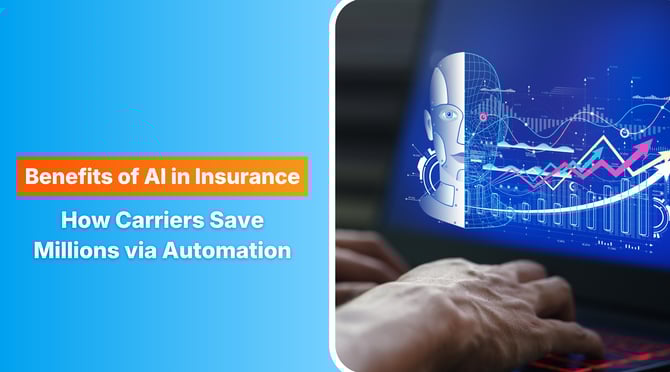
Insurance carriers lose money every year to slow underwriting and paperwork-heavy claims. Fraud adds to the loss. Legacy systems often catch it too late or miss it altogether.
AI is changing this picture. The use of machine learning, predictive analytics, and automation together has accelerated decision-making. Besides, the administrative load from manual review keeps shrinking too.
The market reflects the transformation. By 2026, the AI insurance market is projected to cross USD 14.39 billion, growing at a CAGR of 32.21%. Nearly 90% of insurance companies are already evaluating AI technologies to improve risk modeling and fraud detection.
Real pressure sits behind those numbers. With claims volumes continuing to rise, customers increasingly expect immediate responses. Regulators, meanwhile, are tightening oversight of automated decision-making, placing additional pressure. Much of this pressure originates in workflows that remain fragmented and dependent on paper-based processes.
This article walks through where AI in insurance actually saves efforts and expenses for insurance companies. Besides, we will underline how the automation works end-to-end, and what it takes to roll it out responsibly.
 Generate
Key Takeaways
Generate
Key Takeaways

- AI automates claims processing. It cuts the paperwork behind slow settlements.
- Predictive analytics and machine learning sharpen underwriting accuracy. Both also support faster risk decisions.
- AI fraud detection flags suspicious claims earlier. Losses get cut before they spread.
- AI-driven pricing personalizes policies. Automation brings operating costs down at the same time.
- Regulators now expect documented governance for AI-assisted decisions. Accuracy alone is not enough.
What is AI in insurance?
AI in insurance means pairing machine learning technology with natural language processing and computer vision to attain automation. The objective remains improving the underwriting process along with better claims handling with active fraud detection and enhanced customer service.
It does not replace insurance professionals. It takes over the repetitive and document-heavy work so underwriters can spend their time on decisions that actually need judgment.
Rule-based systems struggle once the data gets messy. Most of the time, the insurance data is complicated due to heavy claims documents, attached medical records, telematics feeds, satellite imagery, and years of policy history.
In short, rules cannot adapt to edge cases the way a trained model can. But AI closes that gap by reading structured and unstructured data together. It catches patterns a manual review would likely miss. It even routes routine cases through automatic decisioning while sending anything unusual to a person.
The real advantage comes from connecting underwriting, claims, fraud detection, and customer service into one decision-making system.
Key Benefits of AI in Insurance for Modern Carriers
AI helps insurers tighten claim management and sharpen underwriting. It pulls insights out of data that used to sit unused in old policy files. Paired with automation, the result is a measurable drop in cost per case with better customer experience.
-Picsart-CropImage.png?width=730&height=476&name=ac626a49-b3cd-48ad-9a01-37d33ea8c177%20(2)-Picsart-CropImage.png)
Lower Operating Costs Through Automation
Operational expenses in insurance usually come from manual, document-heavy workflows spread across systems that don't talk to each other. AI addresses the problem through several connected changes.
Document automation reads and classifies submissions instead of relying on manual data entry. At the same time, workflow routing sends each case to the right queue on its own. It means straight-through processing closes simple claims and endorsements without a human touch. Also, it allows fraud analytics to catch losses before they get paid out.
Every step that runs without manual work stops adding to the cost of a claim. Carriers that automate intake, coverage checks, and payments end to end need fewer people tied up in routine tasks and spend less on loss adjustment. They can also handle a spike in claims after a catastrophe without adding headcount to match.
Straight through processing changes the underlying math the most: a case closed with no human touch costs a fraction of one that a person reviewed line by line, and every point moved into that category adds up across a carrier's full claims volume.
Faster Claims Decisions
Claims automation is usually where the cost savings show up first. A typical AI-assisted claim moves through the following steps:
- First notice of loss gets captured digitally, through a portal, app, or chatbot, instead of a call center intake form
- Optical character recognition pulls data from submitted documents, photos, and forms
- A language model reads adjuster notes, medical reports, and policy language to find the fields underwriters and adjusters actually need
- Computer vision assesses vehicle or property damage from submitted photos and produces a structured severity and cost estimate
- The claim gets routed automatically: simple cases move to straight-through settlement, while complex or high-value claims go to a human adjuster with the file already put together
- A human still reviews anything above a set payment threshold, so oversight stays where it matters
The outcome shows up in cycle time. Claims that used to take days of manual document review now close in hours for standard cases. It gives adjusters their time back for claims that genuinely need judgment. Carriers that have automated this workflow report meaningful drops in average processing time and steadier settlement accuracy.
Smarter Underwriting
Underwriting is where AI's data advantage compounds the fastest. Instead of an underwriter manually cross-checking loss histories, financials, and third-party risk data by hand, a machine learning model reads all of it at once, structured records alongside unstructured inputs like medical reports and telematics, and returns a consistent risk score in place of a judgment call that used to eat up an afternoon.
NLP does the heavy lifting on the messy side. It pulls the relevant fields out of a long medical file or a multi page commercial submission in seconds, instead of asking a person to read the whole thing. That shifts the underwriter's job from gathering data to deciding on the cases where a model's confidence is lowest, which is exactly where a person adds the most value anyway.
The downstream effect is a submission to quote timeline measured in hours instead of days, more consistent pricing across different underwriters, and, because pricing reflects risk more accurately, better protection against adverse selection.
AI Fraud Detection
Insurance fraud costs the U.S. industry roughly $308.6 billion a year, according to the Coalition Against Insurance Fraud, a cost that eventually lands on every policyholder's premium. Rule based fraud checks catch the obvious cases. Facts + Statistics: Fraud - Triple-I® They tend to miss coordinated rings and synthetic identities built specifically to pass a basic review.
AI-based fraud detection works differently. Behavioral analytics flag claims that break from a policyholder's own history or from patterns typical of a given loss type. Anomaly detection surfaces statistical outliers across thousands of claims at once, something no manual review team could keep up with.
Network analysis maps the relationships between claimants, providers, and repair shops to catch organized rings that would slip past a single claim review. Computer vision checks image metadata and visual inconsistencies to catch staged or digitally altered damage photos, a fraud pattern that has grown alongside easy-to-use editing tools.
Together, these tools turn fraud detection from a reactive audit into a screening layer that sits in front of payment, catching losses before they go out instead of chasing them afterward.
Personalized Customer Experience
Customers no longer tolerate hold queues the way they used to. AI chatbots and voice assistants now answer policy questions, give claim status updates, and process routine endorsements around the clock. They work on whichever channel a customer prefers, and none of it requires extra staff.
The same behavioral and telematics data that improves underwriting also supports personalization. Usage-based auto pricing reflects actual driving behavior instead of a broad age and location bracket, and wellness-linked health coverage responds to real activity data in the same way. Property pricing follows the same logic: a specific address's flood or wildfire exposure now matters more than a zip code average.
Recommendation engines built on this data can flag a relevant cross-sell or renewal opportunity right when a customer is likely to act, rather than waiting for a generic annual renewal letter.
Put together, the service feels tailored to each customer even while it runs at a scale no purely human team could sustain. Agents get freed up for the conversations that actually need a person.
Better Risk Assessment
How accurately a model assesses risk depends on how many relevant variables it can weigh at once, and the data available to insurers has expanded well past the traditional paper application. Telematics devices supply continuous driving data.
Weather and satellite feeds capture property and catastrophe exposure close to real time. Wearables and health data inform underwriting for life and wellness products. IoT sensors in commercial and residential buildings flag maintenance issues before they turn into claims.
Predictive models that run on machine learning combine historical claims data with these live signals produce risk profiles that update continuously instead of once a year at renewal. That lets carriers price more precisely, and in some cases step in before a loss happens instead of just pricing around the risk of one.
Compliance Automation
KYC checks, anti-money laundering screening, audit documentation, and regulatory reporting have historically taken up almost as much back office time as claims handling itself, and that workload is growing rather than shrinking as AI oversight rules take hold. NLP-based document review now cross-checks policyholder information against KYC and AML requirements automatically, flagging exceptions instead of requiring someone to verify every file by hand.
Automated audit trails record what data a model used, what decision it produced, and why. That documentation matters because more than half of U.S. states have adopted the NAIC's Model Bulletin on the Use of Artificial Intelligence Systems by Insurers, which expects a written governance program for any AI system that touches a consumer decision.
Regulatory reporting that once meant weeks of manual data pulling can now run on demand, which turns compliance from a periodic scramble into something closer to a background process.
How AI benefits insurance operations at a glance
| Insurance function | AI capability | Operational advantage |
| Operations management | Workflow automation, document intelligence | Less administrative workload |
| Claims handling | Image recognition, NLP-based data extraction | Faster, more accurate claims evaluation |
| Underwriting | Predictive analytics, risk scoring models | Better risk assessment and pricing accuracy |
| Product design | Behavioral analytics, telematics data | Personalized policies and dynamic pricing |
| Customer support | Conversational AI, virtual assistants | Scalable service, faster response times |
How AI Insurance Automation Works?
Every benefit above depends on the same underlying flow. Data comes in, models interpret it, and a decision engine turns that interpretation into an action, without a person manually pushing the case from one system to the next.
A typical claim moves through something like this path: the customer submits a claim through a portal, app, or chatbot. OCR and computer vision extract data and assess damage from documents and photos. A language model reads the unstructured text: adjuster notes, medical reports, policy wording.
The fraud engine screens the claim against behavioral and network patterns. The decision engine applies business rules and risk scores to route the case. Policy admin and claims platforms carry out the outcome. Payment goes out for approved cases. Analytics feed the result back into the models so they keep improving.
| Layer | What it includes | What it does |
| Data layer | Policy records, claims history, telematics, IoT sensors, external risk feeds | Pulls together structured and unstructured data from internal and outside sources |
| AI model layer | Predictive analytics, fraud detection models, underwriting risk models, pricing models | Finds patterns, scores risk, flags anomalies |
| Decision layer | Automated underwriting, claims orchestration, pricing engines | Turns model output into an action: approve, route, price, or send for review |
The part most rollouts underinvest in is the connective tissue between these three layers: the orchestration that keeps a claim moving across systems over the days or weeks it takes to resolve, instead of stalling at the first exception a rule based system cannot handle. Getting AI outputs into an existing policy admin or claims platform through solid API integrations usually matters more to the final result than the accuracy of any single model.
Related Read: How AI credit scoring models are transforming lending decisions in 2026
How Carriers Save Millions through AI?
The savings rarely come from one dramatic change. They build up across several smaller ones running at scale.
On claims, moving even a modest share of volume into straight-through processing removes cost per touch from thousands of cases a year, not just the handful that make it into a case study.
On retention, faster claims resolution and more responsive service tend to track with renewal rates: a policyholder whose claim closes in days rather than weeks has less reason to shop around when the policy comes up for renewal.
Operating costs and expense ratio move too. Automating document-heavy back-office work, compliance checks, policy servicing, call center triage cuts into the administrative expense sitting inside every carrier's combined ratio, separate from how claims perform. On productivity, underwriters and adjusters spend less time gathering data and more time on the calls that genuinely need their judgment, which shows up as more cases handled per person rather than more people hired.
Carriers tracking this properly tend to watch a small set of numbers: claims cycle time, straight-through processing rate, loss ratio movement, and adjuster or underwriter case load. Model accuracy alone rarely tells the full story. A model that scores 95% accurate but never gets its output into a working system saves nothing.
Challenges of AI adoption, and how to get ahead of them?
AI in insurance is not risk-free, and the carriers getting the most out of it tend to be the ones that plan around these constraints instead of running into them mid-rollout.
- Legacy systems are the most common blocker. AI layered on top of a decades-old policy admin system without an integration plan produces recommendations nobody actually acts on, since the orchestration layer matters as much as the model itself.
- Data quality is the second blocker. A model is only as reliable as what feeds it, and fragmented or inconsistent records produce outputs that sound confident but are wrong, which is worse in an automated workflow because a wrong output can trigger a real action before anyone catches it.
- Compliance now sits alongside both. More than half of U.S. states have adopted the NAIC's Model Bulletin on AI systems, which calls for documented governance, bias testing, and human oversight on AI-assisted decisions. That belongs in the initial build, not bolted on afterward. Security follows close behind: insurance data is among the most sensitive information any industry handles, and every new AI integration point widens the attack surface a security team has to watch.
The carriers that avoid most of this start with one narrow, high-friction workflow, prove the outcome with real numbers, build governance in from day one, and only expand once that first deployment has shown a measurable result rather than just technical feasibility.
Why Choose Signity for AI in Insurance?
Building AI for insurance means working inside rules most general AI vendors never have to think about. Audit trails, bias testing, and explainability are not optional extras; they are baseline requirements. Signity's insurance work covers the full stack this article has walked through: underwriting risk models built on machine learning, document intelligence and computer vision for claims and damage assessment, fraud detection that combines behavioral and network analysis, and NLP-driven compliance automation for KYC, AML, and regulatory reporting.
The team connects these models to existing policy admin, claims, and CRM systems through API integrations, rather than asking a carrier to rip out core systems to adopt AI. MLOps practices keep models monitored and retrained as data shifts, and deployments are built to scale from a single pilot line of business to enterprise-wide use without a rebuild along the way.
For a carrier evaluating a development partner, that mix of insurance-specific domain knowledge and production-grade AI engineering is usually what separates a pilot that works from one that quietly stalls after the demo.
Conclusion: the Future of AI-driven Insurance
AI in insurance has moved past the pilot stage. Carriers using it well are not running one off chatbot or fraud detection projects in isolation. They are connecting underwriting, claims, fraud, and compliance into a single automated decision layer, and the savings compound because the systems work together instead of sitting apart.
The next phase of AI in insurance is already taking shape. Agentic AI systems will move beyond recommending actions to executing multi-step workflows across claims and underwriting. Predictive models will identify emerging risks before losses occur, while routine claims will increasingly be handled autonomously. Human expertise will remain essential for complex decisions, allowing adjusters and underwriters to focus on the cases where their judgment creates the greatest value.
Carriers that build this decision layer now, with governance in place from the start, will be setting the pace instead of catching up to whoever gets there first.

Mangesh Gothankar


Ashwani Sharma
Achin Verma