

.png?width=27&height=27&name=Group(1).png)

-1.svg)
-1.svg)


-2.svg)


%201-1.webp?width=148&height=74&name=our%20work%20(2)%201-1.webp)




.svg)





According to insights shared by the National Retail Federation, AI in the retail market is expanding at a 26.10% CAGR. A 2026 industry report shows that 91% of retail companies are actively using or evaluating AI.
More importantly, the adoption is already delivering results. Let’s take an example from Amazon.
Amazon’s AI-driven systems are working on things beyond product recommendations. Amazon’s AI manages inventory to forecast demand in order to optimize pricing based on real-time market conditions.
The shift defines modern retail artificial intelligence, which has improved the customer satisfaction while infusing autonomy into core retail operations.
Let us dig into the details to better understand the Retail AI landscape. We will aim to understand the AI trends in retail, the retailer’s approach to AI adoption, and much more.
 Generate
Key Takeaways
Generate
Key Takeaways

- Retail AI is shifting towards autonomous retail operations.
- AI enables retailers to set smarter prices based on demand forecasting.
- Retailers use AI to move from reactive decisions to predictive strategies.
- Unified data platforms are vital for the implementation of AI in retail.
Why Retail AI Investment Is Accelerating in 2026?
1. From Cost Optimization to Revenue Generation
Retailers once used AI solutions to save operational costs. Today, AI in retail enables real-time adjustments across the entire inventory and sales process. Also, AI enables brands to forecast demand using sales data.
Therefore, AI has forged the path to enhance customer experience through more relevant interactions. Retail AI investment is now tied directly to revenue rather than efficiency.
2. Data Explosion Driving AI Adoption
Retail businesses are generating massive volumes of valuable customer data every day. This includes purchase history, transaction patterns, and customer behavior across channels.
But raw data isn’t enough. Without unified data analytics, AI tools cannot deliver accurate insights. However, retailers that invest in connected data are likely to see smarter decision-making.
3. Industry Signals and Market Momentum
At the same time, the market itself is expanding rapidly.
AI in the retail market is expanding at a 26.10% CAGR. It is likely to grow from $16.54 billion in 2026 to $105.88 billion by 2034, marking the contribution of AI in retail transformation.
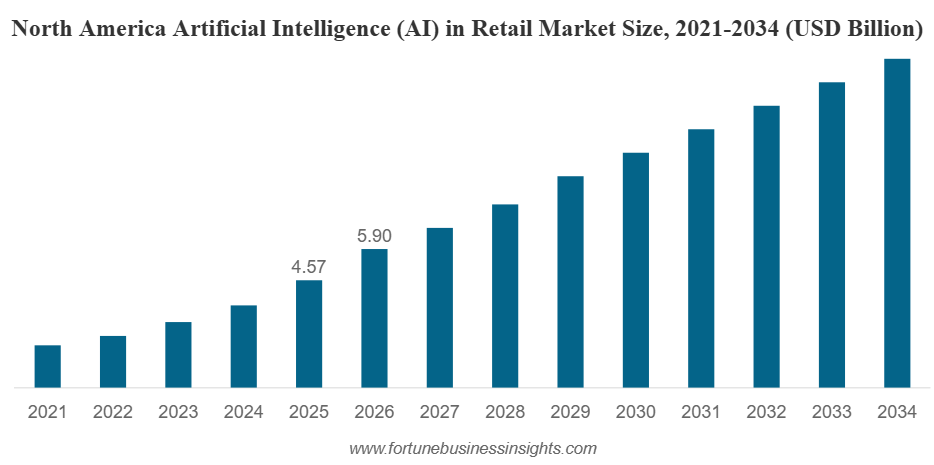
At NRF 2026, AI is declared essential to retail growth. Retailers are deploying it across store operations, such as supply chain and customer engagement.
It means the leading retailers are using AI to rebuild their operations and break competitive barriers.
Where Retailers Are Investing: Core AI Trends & Use Cases
1. Personalization Engines and Customer Experience
Primarily, the entire initial investment in AI was focused on customer experience. Retailers used AI to truly personalize customer journeys. The process involved analyzing past customer preferences to deliver relevant interactions at the right moment.
Key applications include:
- Personalized shopping experiences across web and mobile
- Targeted promotions based on customer insights
- Generative AI for product discovery and content creation
- Virtual assistants to handle real-time customer interactions
2. Predictive Analytics and Demand Forecasting
Predictive analytics is allowing retailers to build their market strategies with more confidence. AI has not only removed assumptions but has also enabled the analysis of historical sales data to identify transaction patterns.
What this enables:
- More accurate demand forecasting
- Reduced out-of-stock items
- Better alignment to match supply with demand
- Smarter inventory allocation across locations
This directly improves inventory management while reducing waste and missed sales opportunities.
3. AI in Pricing and Promotions
Pricing is no longer a static entity in the retail sector. Retailers are investing in AI solutions that can adjust pricing in response to real-time signals.
AI helps to manage pricing by:
- Reflecting on competitor pricing
- Checking for demand fluctuations
- Analyzing customers’ purchase intent
Therefore, AI helps foster dynamic pricing models and target promotions that maximize revenue.
4. Supply Chain with Inventory Intelligence
Retailers in 2026 are looking to harness AI in supply chain management with a focus on building highly resilient systems.
Core capabilities include:
- Automated inventory management
- Real-time inventory visibility across physical stores
- Early detection of any disruptions in supply
- Supply chain optimization
These investments help retailers optimize retail operations with a seamless shopping experience.
The Shift to Autonomous Retail Operations
Retail is entering a phase where systems don’t just assist. Now, AI itself makes decisions that once took hours, reducing effort with real-time data.
1. From Assisted Decisions to Autonomous Systems
Earlier, AI supported teams with insights. Now, it executes decisions.
- Optimizing pricing strategies automatically based on demand signals
- Inventory decisions happen without manual checks
- Store operations respond instantly to real-time data
What changes for retailers?
Less dependency on manual processes with more accurate execution across retail operations.
2. Autonomous Inventory and Smart Store Shelves
Inventory is no longer something teams “manage” daily. It’s something AI continuously optimizes.
|
Traditional Approach |
Autonomous Approach |
|
Periodic stock checks |
Continuous AI monitoring |
|
Manual replenishment |
Auto-triggered restocking |
|
Delayed response to gaps |
Instant stock gap detection |
The shift keeps store shelves aligned with actual consumer demand.
3. AI-Driven Store Operations and Layout Optimization
Physical stores are becoming data-driven environments. AI tracks customer interactions and movement to improve store performance.
- Optimized store layouts based on real behavior
- Better product placement for higher conversions
- Smarter staffing and store operations
The outcome is stores that are more responsive and profitable without constant manual intervention.
Technical Architecture Behind Retail AI Investments
Retail AI investment is more about building a connected architecture that enables seamless data flow for real-time decision-making. Think of it as four layers working together.
1. Data Layer: Sales and Third-Party Data
Everything starts with data. Retailers bring together customer insights, sales data, and third-party data into a unified system.
This layer includes:
- Customer data from interactions and purchase history
- Sales data across online and physical stores
- External inputs like market trends and competitor signals
2. Intelligence Layer: Machine Learning and AI Models
In this layer, raw data turns into valuable insights. Here, machine learning models analyze patterns to predict outcomes.
Core capabilities:
- Predictive analytics for demand forecasting
- AI algorithms to analyze transaction patterns
- Natural language processing for customer interactions
The intelligence layer powers smarter decisions across the retail ecosystem.
3. Application Layer: AI Tools and Retail Systems
Business insights are only useful when applied. The application layer includes AI software embedded into daily retail operations.
Key use cases:
- Pricing engines for dynamic pricing
- Inventory systems for automated inventory management
- AI tools for targeted marketing campaigns
These systems help retailers optimize operations in real time.
4. Experience Layer: Customer Engagement Interfaces
At the experience layer, we have everything that customers actually see and interact with.
Includes:
- Virtual assistants with dedicated chat interfaces
- Personalized omni-channel marketing
- Seamless online shopping experience
The experience layer ensures AI directly improves customer experience.
Challenges Slowing Down Retail AI Investment
Even with strong momentum, most retailers struggle to harness full potential of AI due to the foundational gaps. Let’s explore these challenges in detail:
1. Data Silos
Retailers generate massive amounts of data. But much of it sits across disconnected systems.
Since customer data is spread across multiple platforms, inconsistent or incomplete data affects the accuracy. It limits the ability to analyze transaction patterns. Thus, without unified data analytics, AI models fail to deliver insights that can help both decision-making and ROI generation.
2. Integration with Legacy Retail Systems
Many retail businesses still rely on outdated legacy systems. The reliance on legacy systems makes it difficult to integrate modern AI tools with existing infrastructure. Also, the slow data flow between systems leads to high cost and effort required for modernization
The approach creates friction in scaling AI across the supply chain, inventory, etc.
3. Governance and AI Transparency
As AI takes on decision-making roles, trust becomes a concern. The lack of clarity about how AI algorithms make decisions raises concerns about data privacy. Therefore, implementing governance frameworks becomes necessary to manage AI responsibly.
How Retailers Can Maximize ROI from AI Investments?
Getting value from AI is not about the size of investment. It depends on how well it is implemented and scaled across retail operations.
1. Build a Unified Data Foundation
AI performs only on the basis of the quality of training data. Retailers need to bring sales and third-party data into a connected system. When data is clean, it becomes easier to generate accurate customer insights that can help improve demand forecasting.
2. Focus on High-Impact Use Cases First
Instead of spreading efforts, retailers should begin with use cases that deliver immediate value. For instance, areas such as inventory management and personalized marketing deliver quick results.
3. Combine AI with Human Decision-Making
Though AI can process data, human judgment still plays an important role. Retailers that combine AI-driven insights with business context make more balanced decisions.
4. Continuously Optimize with Feedback Loops
AI is not a static process; it constantly learns from data. By tracking performance and analyzing outcomes, retailers can refine AI models. It ensures systems stay aligned with changing market trends.
Future Outlook: What Retail AI Investment Will Look Like Beyond 2026
Retail AI investment is moving toward a future where systems run entire parts of the business.
1. Rise of Autonomous Commerce and AI Agents
In coming times, AI agents are likely to take on more responsibility across retail operations. These will involve tasks related to inventory as well as pricing decisions. Besides, these systems will act independently using real-time data. This will allow retailers to skip manual oversight with more of self-learning systems.
2. AI Becoming a Demand Channel
Instead of searching on websites, customers are increasingly relying on AI-driven interfaces to find products. It will put AI into a new demand channel where visibility will depends on how well the retail data is structured.
3. Hyper-Personalization Becoming Baseline
Personalized shopping will no longer be a marketing differentiator in the future. It means AI systems will reflect on customer preferences to deliver highly tailored experiences across every touchpoint. Retailers that fail to meet the expectations will risk losing customer engagement.
4. AI-Native Retail Businesses Emerging
A new category of retail businesses is likely to be built with AI at the core. It means operations that are fully driven by AI allowing them to move faster in evolving market conditions.
Conclusion
Retail has moved far beyond early AI experiments. What began with personalization engines is now evolving into autonomous inventory, dynamic pricing, and intelligent supply chains.
Retail AI investment is becoming a clear competitive advantage. Businesses that invest in artificial intelligence in retail are not just improving customer experience. They are building faster, smarter, and more resilient retail operations. From demand forecasting to supply chain optimization, AI is helping retailers respond to change in real time rather than react after the fact.
At Signity, we believe the bigger shift is structural. It means AI is no longer a feature within retail systems. It is an operating system that will power retail driving decisions and workflows.
Thus, retailers that embrace the shift will lead the next phase of growth. Those who delay will risk falling behind in a market which is more data-driven and competitive every day.

Mangesh Gothankar


Ashwani Sharma
Achin Verma
Frequently Asked Questions
Have a question in mind? We are here to answer. If you don’t see your question here, drop us a line at our contact page.
What is AI in retail, and how is it used?

AI in retail uses machine learning and data analytics to automate pricing and inventory decisions. Also, it improves marketing and customer interactions across channels.
How does artificial intelligence improve customer experience in retail?
Artificial intelligence personalizes shopping journeys. It recommends products, powers, and virtual assistants. Moreover, it enables faster support and more relevant interactions.
What are the key benefits of artificial intelligence in the retail industry?
AI improves demand forecasting and pricing. It reduces costs and boosts engagement. Additionally, it supports data-driven decision-making to achieve better business outcomes.
How does AI help in inventory management and demand forecasting?
AI studies historical sales data and market trends. It predicts demand and adjusts stock levels. Also, it reduces stockouts and improves inventory management.
What are the challenges of implementing AI in retail?
Retailers face issues with poor data quality and data silos. However, legacy systems also slow adoption. Moreover, trust in AI decisions remains a concern.





%20(1).png?width=352&name=agentic%20rag%20(2)%20(1).png)