


.png?width=27&height=27&name=Group(1).png)

-1.svg)
-1.svg)


-2.svg)


%201-1.webp?width=148&height=74&name=our%20work%20(2)%201-1.webp)




.svg)





%20(1).png?width=670&height=445&name=agentic%20rag%20(2)%20(1).png)
For years, the focus of AI in the retail business has been on delivering personalized experiences, from tailored recommendations to targeted marketing campaigns. While this has improved customer satisfaction and customer engagement, it hasn’t solved the bigger challenge retailers face today: profitability.
And that is where AI in retail steps in. This fundamental shift helps drive a measurable economic value around the retail business. AI in retail helps manage the core retail business operations. These include inventory management, demand forecasting, supply chain management, and more. Businesses can leverage data in real time to make informed decisions. This allows retailers to make smarter decisions that directly affect sales, ensure wastage is minimized, and help with performance optimization.
Leveraging advanced AI technologies like machine learning, predictive analytics, and generative AI, retailers can unlock deeper efficiencies in customer behavior prediction, smart pricing strategies, and automate inventory management.
The future of AI in retail is not about knowing what the customer wants, but it is about how to deliver it to them in a profitable manner. Here is a complete blog that helps you explore how AI in retail helps transform your retail business into a profitable one and helps you remain competitive in the competitive market.
 Generate
Key Takeaways
Generate
Key Takeaways

- AI in retail focuses on profitability, not just customer experience personalization.
- It helps optimize inventory management, pricing strategies, and supply chain operations.
- Success depends on leveraging real-time data and data analytics effectively.
- Retailers can reduce operational costs and drive sustainable business growth.
The Profitability Imperative: Why AI Strategy Must Evolve?
AI in retail improves profitability by optimizing inventory, pricing, and supply chain operations using real-time data and predictive analytics.
This is where AI in the retail business is undergoing a critical transformation. Modern retail AI is focused on optimizing the entire value chain, where real profitability is created or lost.
Why Personalization Alone Falls Short
- It relies heavily on customer data and purchase history but doesn’t fully leverage real-time data for operational decisions.
- It improves customer satisfaction but is unable to directly reduce operational costs.
- It enhances marketing outcomes but ignores inefficiencies in inventory management and the supply chain.
As margins are tight and competition is increasing, retailers need AI strategies that go beyond customer engagement.
The Shift Toward Profit-Driven AI
AI and retail strategies revolve around high-impact profitability levers:
- Demand forecasting powered by machine learning models
- Dynamic pricing that adapts to competitor pricing and fluctuations in demand
- Automated inventory management for supply chain optimization
- Supply chain automation to mitigate supply chain disruptions
These AI-powered solutions are built on a foundation of data analytics, combining sales data, customer behavior, and third-party data to generate actionable insights in real time.
From Experimentation to Economic Value
The mindset around AI adoption is now changing, and retailers are moving from pilot projects to scalable solutions. These solutions help deliver economic value and also boost customer engagement.
This evolution is what defines the future of AI in retail.
The question is no longer, “How can we personalize better?”
It’s now, “Where can AI create the most financial impact across the retail business?”
Where AI Actually Drives Profit in Retail
AI in retail drives profit by improving demand forecasting, enabling dynamic pricing, optimizing supply chains, and reducing operational inefficiencies. Here is the detailed explanation.
1. Smarter Inventory & Demand Forecasting
When managed manually, inventory management can cause blunders. Both overstocking and understocking can have an impact on the profitability of and customer engagement.
The AI in the inventory management market has shown a potential growth in recent years and is estimated to grow from $9.54 billion to $12.36 billion in 2026, a CAGR of 29.6%.
AI-powered inventory management allows for seamless demand forecasting, analyzing sales data, and purchasing history of customers to know how high the product demand is. This allows retailers to make accurate and timely decisions. Here, the machine learning and predictive model learn from the behavior of customers.
It ultimately allows for an automated inventory management system where there is no overstocking or stockout.
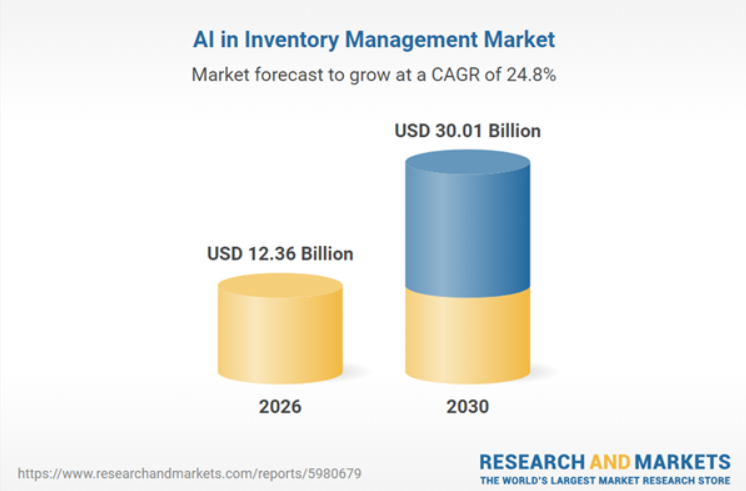 Source: Research and markets
2. Dynamic Pricing & Revenue Optimization
Pricing is not a static decision to be made; it is a real-time strategy. AI offers dynamic pricing models that analyze the demand fluctuations, analyze the price competitors are offering, and provide real-time transaction monitoring.
Leveraging customer data, these AI-powered solutions identify the optimal price point and boost conversions and margin rates. The benefits of AI in dynamic pricing include smarter pricing strategies that quickly respond to market conditions. It also can run targeted promotions based on customer interactions.
This shift allows retailers to move beyond guesswork and unlock consistent revenue growth through precision pricing.
3. Supply Chain & Logistics Optimization
Modern AI in retail and supply chain automation boosts more visibility, can predict disruptions, and streamline operations. AI in supply chain management offers the biggest benefits, as inefficiencies can disrupt the profit margin.
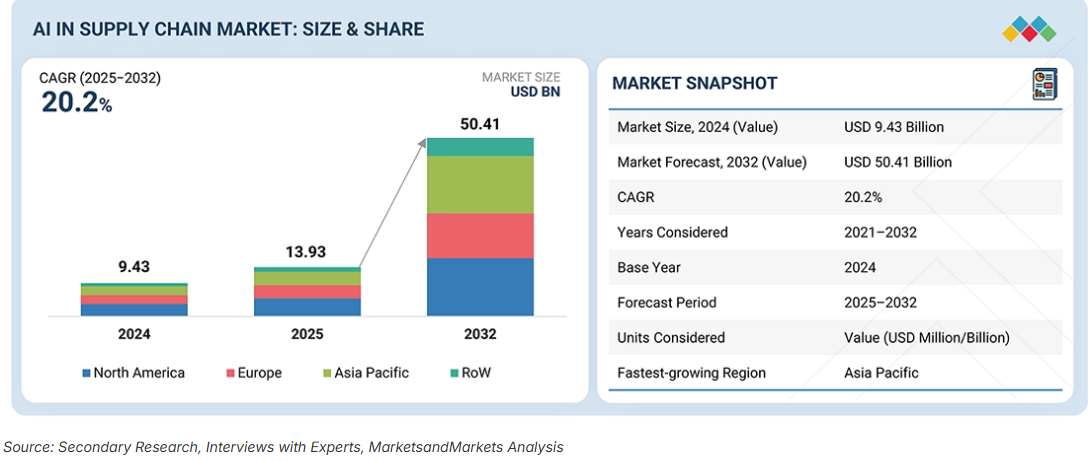
As per recent stats, AI in the supply chain market is projected to reach USD 50.41 billion by 2032, from USD 13.93 billion in 2025.
Data analysis in real-time, weather patterns, and logistic management allow AI retailers to respond to challenges proactively and make informed decisions. AI reduces the impact of supply chain disruptions and lowers operational costs.
4. Store Operations & Cost Reduction
Apart from offering digital transformation, AI also helps redefine the experience of how the stores operate. Technology integration, like AI systems and computer vision, helps retailers to optimize the store layouts and workflows. It seamlessly analyzes the customer interaction and behavior at the stores and creates an environment that boosts sales and cuts down costs.
AI automates repetitive and routine tasks. This frees up the staff and allows them to focus on other core operations. The results are smarter stores with better performance and optimized costs.
Recommended Post: What to Expect From AI in Retail in 2026?
How AI Technologies Transform Retail Data into Profit-Driving Decisions
Data is the heart of any industry, and retail is one of them. But the real question is, how is this data converted to actionable insights? AI in retail not only collects data but also transforms the structured and unstructured data in real-time and offers decisions that drive profit.
The Power of Connected Data
There are different touchpoints across which the retail industry operates. These include e-commerce, physical stores, social media platforms, and more. Each platform offers valuable insights about the behavior of customers and intent. AI does not treat data streams differently, they rather bring the advanced AI system and creates a unified view of customer data.
Retailers combine the capabilities of previous customer data, purchase history, and patterns in real-time to get detailed market insights and unlock more visibility about their customers.
From Analysis to Action
AI-powered solutions have the ability to move far beyond analysis and offer immediate action. Traditional methods delay the decision-making process; AI allows for action in real-time.
One of the examples here is adjusting the pricing dynamically as the demand fluctuates or rebalancing the inventory to ensure there is no stock imbalance. These capabilities in real-time allow businesses to detect anomalies and quickly respond before they start affecting the revenue.
Eliminating the Cost of Poor Data
Though we are well aware of the effectiveness of AI technologies, what if the data is inaccurate? Most retailers struggle due to poor and fragmented data. When the data is incomplete or inaccurate, even the most advanced AI tools fail.
Also, the disconnected systems limit the potential of AI applications and prevent businesses from leveraging the data ecosystem. Therefore, it is vital to ensure that data is clean and accurate in order to unlock the true value of AI.
What is the Role of Generative AI & AI Agents in Retail Profitability?
AI in retail business is evolving, and the focus shifts from traditional automation to smart autonomous systems. Generative AI and AI agents improve retail profitability by automating content, enhancing customer interactions, and streamlining operations. Here is the role of generative AI and AI agents in retail profitability.
Generative AI as a Revenue and Efficiency Multiplier
Generative AI in retail helps transform how retailers approach content and communication. They do not have to depend on manually creating content for their campaigns. AI can help generate quality content and output at scale. The outcomes align with the customer behavior and preferences. The campaign messages are created as per the customer segment, which helps with targeted promotion and boosts engagement. Whether it is writing product descriptions, emails for customers, or messages for a campaign, generative AI proves to be a game-changer.
Apart from generating content, it also helps with interactions across mobile apps and other digital platforms. Retailers ultimately can deliver improved, consistent, and quality engagement without boosting the manual efforts.
AI Agents as Autonomous Drivers of Operational Efficiency
While generative AI allows for a more focused approach to content and communication, AI agents help in seamless execution.
AI agents are intelligent autonomous systems and are designed to handle the complex tasks across retail operations. They can perform multiple tasks simultaneously and reduce the need for manual intervention.
They seamlessly help manage the customer queries and offer high speed and precision. The agents also analyze the customer feedback and help retailers to identify gaps in the customer journey. This helps improve the overall customer experience and satisfaction.
A real-world implementation by Signity Solutions highlights how agentic AI can go beyond insights to drive execution. In this case, a multi-agent AI system autonomously managed demand forecasting, inventory optimization, dynamic pricing, and marketing workflows in real time.
By continuously learning from customer behavior, sales data, and supply chain signals, these AI agents made coordinated, profit-driven decisions across the entire e-commerce lifecycle.
The combined impact of generative AI and AI agents marks a significant shift in the future of AI in retail. Retailers are no longer just automating isolated tasks; they are building intelligent ecosystems that can think, act, and optimize in real time.
Profitability Without Compromising Customer Experience
We have been lately talking about profitability, but does that mean customer experience is the least priority? Of course not, rather it is being approached in an intelligent way, and modern AI uses it as a force to drive better business results.
When retailers are able to analyze customer data in real time, the backend operations improve automatically, and this naturally boosts the front-end experience also. Demand forecasting and inventory management ensure that products are available on time, whereas dynamic pricing ensures more profit. AI agents and NLP improve customer experience, as retailers can deliver quick and accurate responses to customer queries.
This ultimately leads to a more efficient customer journey and satisfaction without impacting the operational cost.
Challenges Retailers Must Solve to Unlock Profitability
While integrating AI offers more profit and better operational efficiencies, there are challenges associated and retailers struggle with them. Let us talk about them in more detail.
|
Challenge |
Impact on Retail Business |
Why It Matters for Profitability |
|
Low-Quality Data |
Inaccurate or incomplete data leads to poor insights. |
Decisions are made wrong, which increases cost. |
|
Data Silos Across Systems |
Disconnected AI systems limits the visibility. |
Prevents full use of real-time data |
|
High Implementation Costs |
Initial investment in infrastructure and tools can be costly. |
Slows down the adoption of AI across areas |
|
Integration with Legacy Systems |
Difficult to integrate AI with existing platforms |
May create inefficiencies and limits scalability |
|
Supply Chain Complexity |
Different variables impact supply chain and logistics |
Makes supply chain automation more challenging |
|
Scaling Across Store Locations |
May be difficult to implement AI strategies across different store locations |
Unable to standardize processes |
|
Data Privacy & Compliance Concerns |
Handling sensitive customer interactions and data securely |
Impacts trust and restricts how data can be used for AI-driven insights |
Future of AI in Retail: Profit-First Innovation
AI's future in retail is not about experimentation anymore. It is all about seamless execution at scale. What sets the AI in retail is the ability to operate in real-time. Combining advanced AI technologies, machine learning, and more, retailers can instantly respond to changes.
From Reactive to Real-Time Retail Operations
The future of retail is all about managing the end-to-end operations dynamically. AI will help with instant and proactive responses, rather than reacting after it has happened. It will help:
- Adjust the pricing according to demand and competition.
- Optimize inventory in real-time and demand signals.
- Predict supply chain disruption before anything happens.
- Improve logistics to reduce delays and costs.
The Rise of Autonomous Retail Systems
Autonomous AI agents are already in action and have a robust impact on the retail system. With the rise of AI agents and intelligent automation, retailers can build systems that help them act independently and perform multiple tasks simultaneously. The systems:
- Automate the complex workflows and tasks in retail operations.
- Continuously learns from customer feedback and interactions.
- Optimize store layouts and physical experiences with computer vision.
Profitability as the Core KPI
AI capabilities continue to evolve, and their success depends on customer engagement and more, delivering unique and profitable business results. As it is becoming the core KPI, retailers now focus more on:
- Reducing operation costs with more automation
- Boosting margins with dynamic pricing
- Improving efficiency across the supply chain
- Driving a consistent and more economic value
Conclusion
The role of AI in the retail industry continues to evolve over time, and from improving the customer experiences to helping cut down the operational costs, it helps with everything. The overall success in the retail industry depends on how exactly businesses leverage AI technologies and make smart decisions in real-time.
Retailers adopting AI can seamlessly build more resilient and data-driven operations that offer improved growth in the competitive market. If you are looking forward to investing in the right AI solutions for retail industry, we can help you transform the operations, cut down costs, and scale profitability.
Frequently Asked Questions
Have a question in mind? We are here to answer. If you don’t see your question here, drop us a line at our contact page.
How long does it take to see ROI from AI in the Retail Business?

It depends on the use case and implementation scale. While dynamic pricing or AI agents can deliver results within a few months, more complex areas like supply chain automation or demand forecasting may take 6–12 months to show a measurable impact.
Can small and mid-sized retailers benefit from AI, or is it only for Large Enterprises?
With the rise of scalable AI-powered solutions and cloud-based AI tools, even small and mid-sized retailers can leverage retail AI for inventory management, customer engagement, and data analytics.
How does AI handle seasonal demand fluctuations in Retail?
AI uses predictive analytics, historical sales data, and customer behavior to anticipate seasonal demand shifts. Advanced machine learning models continuously adapt to new data, enabling retailers to improve demand forecasting, avoid stock imbalances, and optimize inventory even during peak seasons.
What are the key Metrics retailers should track when implementing AI?
Businesses should efficiently track metrics like profitability and efficiency, such as inventory turnover, forecast accuracy, pricing margin improvements, and reduction in operational costs. Additionally, monitoring customer satisfaction and overall business growth helps ensure that AI initiatives are delivering value.





.png?width=352&name=top-ai-tools-financial-services%20(1).png)