


.png?width=27&height=27&name=Group(1).png)

-1.svg)
-1.svg)


-2.svg)


%201-1.webp?width=148&height=74&name=our%20work%20(2)%201-1.webp)




.svg)





.png?width=670&height=445&name=top-ai-tools-financial-services%20(1).png)
Generative AI in retail shifts the paradigm from hype to high-impact reality. Today’s customers expect more personalized, interactive shopping experiences, whether online or in physical stores, and retailers are turning to AI to deliver them. Continuous advances in large language models, AI agents, multimodal AI, and automation are reshaping how products are delivered.
Most large companies are bringing this to reality; one retailer is NVIDIA, which introduced generative AI-powered assistants built using AI blueprints. This clearly highlights how quickly the generative AI project in retail is making an impact.
Generative AI-powered shopping rises with traffic to U.S. retail sites up 4,700%. It was one of the major trends Adobe observed. Moreover, enterprise adoption surged, with most retailers integrating AI tools across functions such as customer engagement, inventory management, and more.
Generative AI-powered stores are no longer a digital novelty; in fact, they are the future of retail. Here is a blog that explores why this is important, the latest AI use cases in retail, and how leading brands leverage AI to stay competitive.
 Generate
Key Takeaways
Generate
Key Takeaways

-
Generative AI in retail enables hyper-personalized shopping experiences for online and physical stores.
-
AI in retail stores improves operational efficiency with smart inventory and demand forecasting.
-
Leading retailers leverage generative AI for retail to automate marketing, content creation, and customer engagement.
-
Real-world generative AI use cases in retail demonstrate measurable improvements in conversions and profitability.
-
Generative AI is a strategic necessity for future-ready retail businesses.
Key Benefits of Generative AI in Retail
Generative AI in retail enables smarter, more personalized shopping experiences. There are numerous other benefits it offers. Let’s discuss why generative AI stores are actually the future of retail.
1. Personalized Shopping Experiences
A study from Forrester reported that 77% of consumers chose, recommended, and paid more for the brand that offers a personalized experience.
A personalized shopping experience for customers is one of the most impactful applications of generative AI in retail. Whether analyzing purchase history, browsing behavior, or customer choices, AI can seamlessly suggest products to the customer. It also helps retailers generate personalized marketing content in real time, from emails and notifications to special-occasion offers. AI helps drive customer engagement, boost conversions, and build long-term customer loyalty.
2. Intelligent Inventory and Demand Forecasting
Managing inventory is a critical challenge for retailers, but generative AI is transforming how it is managed. AI helps analyze the customer likes, historical sales data, latest trends as per season, hot-selling products, and real-time customer behavior, ultimately predicting the demand with precision.
This way, retailers can maintain inventory levels, reduce overstock or out-of-stock situations, and ultimately boost sales. A report from McKinsey suggests that retailers using AI-demand forecasting reduced the inventory cost by 20 to 30%. It not only reduces operational costs but also enables automated reordering and smart merchandising decisions, freeing staff to focus on other critical strategies.
3. Enhanced Customer Support
Customer support is one of the vital drivers that ensures brand loyalty, and generative AI in retail is helping the brands deliver the same. AI offers chatbots and virtual assistants that handle customer queries, product recommendations, and resolve customer issues.
Retail companies that leverage AI support to help customers report in a quick response time, higher customer satisfaction, and guidance for them, while turning support into a strategic advantage, not simply a service function.
4. Creative Marketing & Content Generation
AI in retail stores is more than operations and customer support. It transforms how proper marketing actually helps retailers deliver more personalized and compelling content quickly and more efficiently.
Whether it is about generating product descriptions, running ads, handling social media posts, and email campaigns, AI can generate content that resonates with the customer demands. It helps maintain brand consistency across channels and reduces the time and cost of manual content creation. Research says that AI-powered marketing has improved engagement rates with a stronger brand recall, which makes creative AI tools a vital component of modern retail strategies.
5. Data-Driven Decision Making
Leveraging data, customer behavior, and market trends if they choose the right generative AI development company. This helps them discover the actionable insights and have a clear understanding of the purchase patterns and customer choices to make an informed decision about the price, promotion, and merchandising.
With the accurate data, retailers can opt for different strategies, forecast outcomes, and optimize their decisions in real time. Organizations that leverage this trend have reported boosting their operational efficiency, increasing sales, and staying ahead in the competitive market.
6. Immersive In-Store Experiences
Generative AI trends in retail help bridge the gap between digital convenience and physical stores by offering interactive and immersive experiences. AI allows for AR-powered virtual try-ons, AI-driven kiosks, and in-store recommendations that engage more customers and offer them a seamless shopping experience.
It allows brands to make their in-store experiences more memorable for the customers and also increases the intent of purchase. Retailers who adopt these trends see more store visits and higher sales, demonstrating that generative AI is a game-changer that elevates the entire retail experience.
Real-World Generative AI Use Cases in Retail
Here are the leading examples of popular brands leveraging AI in retail to transform the shopping experience of customers.
|
Use Case |
How Generative AI Is Used |
Business Impact |
|
AI-Powered Retail Assistants |
Delivers personalized recommendations and real-time assistance by analyzing customer behavior and purchase history across online and offline stores |
Improved customer engagement, higher conversion rates, and personalized shopping experiences |
|
Marketing & Customer Engagement |
Creates personalized marketing campaigns, email campaigns, and AI-driven social media ads at scale |
Enhanced customer interaction, faster query resolution, and improved customer satisfaction |
|
Smart Inventory Management |
Predicts demand and optimizes inventory using historical sales data, seasonal trends, and real-time shopping patterns |
Reduced stockouts and waste, optimized inventory levels, dynamic pricing, and minimized waste |
|
Virtual Try-Ons & AR Experiences |
Enables virtual try-ons, AR experiences, and in-store kiosks for immersive customer interactions |
Increased customer confidence, improved in-store engagement, and higher conversion rates |
|
Automated Content Creation |
Automates product descriptions, promotional content, and marketing assets while maintaining consistent brand messaging |
Faster campaign execution, consistent branding, and reduced content creation effort |
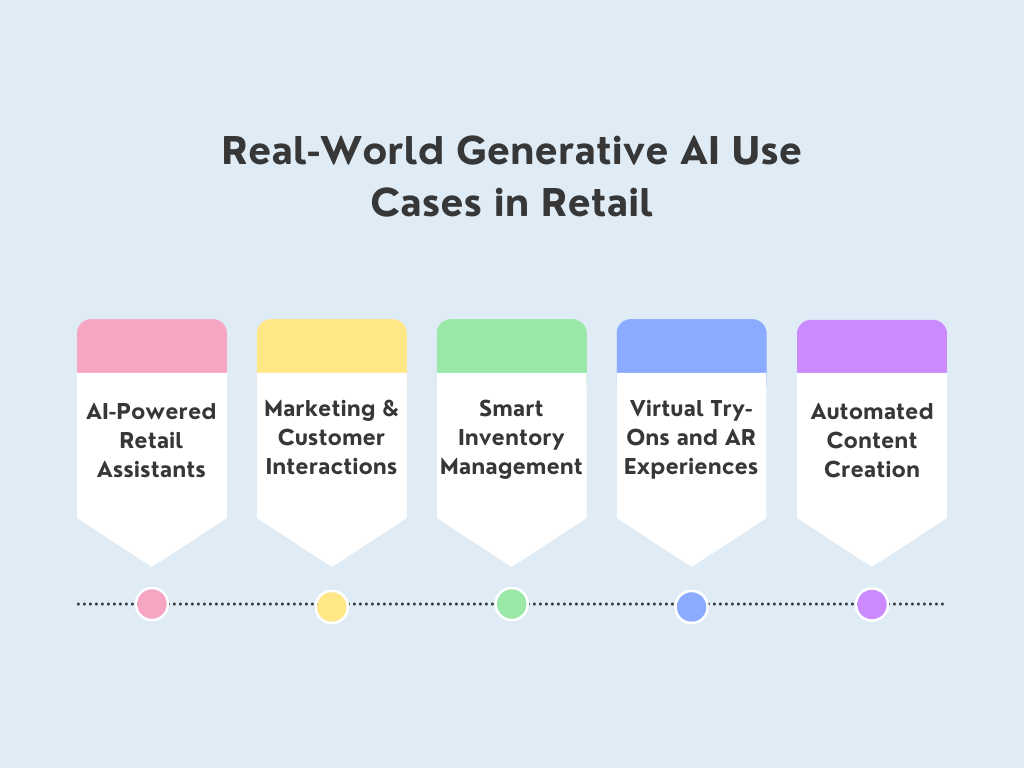
1. AI-Powered Retail Assistants
From purchase history to customer behavior analysis, Generative Artificial Intelligence helps deliver a customized shopping experience to users.
For example, Sephora is a popular cosmetics brand that uses AI-powered tools to offer personalized recommendations based on customers' past preferences, answer customer questions, and analyze purchase history, thereby improving conversion rates.
2. Marketing & Customer Interactions
Retailers leverage generative AI to create personalized marketing campaigns, offer product recommendations, generate email campaigns, and run social media ads.
For example, existing customers at H&M use AI chatbots for a streamlined communication process with customers, suggest outfits, offer style advice, and more, overall improving customer feedback and engagement.
3. Smart Inventory Management
AI in retail stores helps organizations to optimize their stock well in advance and predict the demand.
Walmart, a popular retail leader, relies on Generative AI tools to predict demand analytics and pricing. Here, generative AI helps them anticipate the customer shopping trends, optimize inventory, and adjust prices accordingly. It helps them achieve cost savings and reduce waste.
Related Read : Generative AI Applications in Various Industries
4. Virtual Try-Ons and AR Experiences
Virtual try-on features that offer an AR experience for customers, along with kiosks, help create an engaging experience that improves customer satisfaction and increases conversion rate.
Nike implemented AR-powered virtual try-ons in its apps for customers. It also integrated kiosks that fulfill customer expectations, solve their queries, and offer them an engaging experience.
5. Automated Content Creation
Integrating generative AI in business helps with automated content creation. From product descriptions to ad campaigns and other content, retailers can automate content workflows.
IKEA uses generative AI for retail that automatically creates product descriptions, social media content, and promotional material. It accelerates marketing campaigns and ensures consistent brand messaging across channels.
The Future of Retail Is Gen AI-Powered
Generative AI in retail helps transform how brands interact with customers, manage operations, and drive business growth. Whether it is a hyper-personalized shopping experience or planning inventory smartly, AI in retail stores has become a competitive necessity.
As consumer expectations rise, more businesses are embracing generative AI in retail to deliver a seamless, engaging experience across touchpoints.
Are you looking forward to implementing generative AI in your retail ecosystem? At Signity Solutions, we help retailers design and build AI-powered retail solutions that drive measurable business results and future-ready experiences.
Frequently Asked Questions
Have a question in mind? We are here to answer. If you don’t see your question here, drop us a line at our contact page.
How does generative AI differ from traditional AI in retail?

Traditional AI in retail focuses on predictions and automation based on predefined rules, while generative AI can create new content, recommendations, and responses in real time. It enables more dynamic customer interactions, personalized experiences, and creative outputs such as marketing content and virtual assistants.
Can generative AI be integrated with existing retail systems?
Yes, generative AI can be integrated with existing retail platforms such as POS systems, CRM tools, ERP solutions, and eCommerce platforms. With the right architecture, retailers can enhance current systems without replacing their entire technology stack.
Are generative AI solutions suitable for small and mid-sized retailers?
Absolutely. Cloud-based AI models and scalable architectures make generative AI for retail accessible to small and mid-sized businesses. Retailers can start with targeted use cases like customer support or content generation and scale gradually as business needs evolve.
How does generative AI impact data privacy and security in retail?
When implemented responsibly, generative AI systems follow strict data governance, encryption, and compliance standards. Retailers must ensure that customer unstructured data is anonymized, securely stored, and used in accordance with regulations such as the GDPR and the CCPA.
How can AI improve customer experience for my business?
AI can personalize experiences, provide instant support, and predict customer needs, ensuring each interaction is seamless, engaging, and tailored to individual preferences.





.png?width=352&name=agentic-ai-strategy-for-enterprise-software%20(6).png)
%20(1).png?width=352&name=agentic%20rag%20(2)%20(1).png)