


.png?width=27&height=27&name=Group(1).png)

-1.svg)
-1.svg)


-2.svg)


%201-1.webp?width=148&height=74&name=our%20work%20(2)%201-1.webp)




.svg)





.png?width=670&height=445&name=Building%20HIPAA-Compliant%20Healthcare%20AI%20Solutions%20(2).png)
The American Medical Association reported that 66% of physicians already use AI in practice, showing how quickly adoption is accelerating. The average cost of a healthcare data breach reached $10.93 million, the highest of any industry.
This creates a clear mandate for healthcare leaders: AI cannot be layered on top of weak security, unclear vendor contracts, or ungoverned data flows. HIPAA-compliant AI development is now a priority for architecture and implementation, not a late-stage legal review. Organizations that get it right accelerate automation, clear security reviews faster, and create a safer path to ROI.
 Generate
Key Takeaways
Generate
Key Takeaways

- HIPAA-compliant AI development begins with architecture and model selection.
- Healthcare AI security reduces rework, cutting deployment delays or any audit friction.
- Secure AI healthcare requires PHI boundaries, logging, and vendor governance.
- Strong implementation partners accelerate ROI and reduce the compliance risk.
What is HIPAA Compliant AI Development?
HIPAA-compliant AI development is the process of building AI systems that protect PHI across ingestion, inference, storage, integration, and monitoring.
The process includes more than encryption or a signed legal document. It covers the full system around the model:
- How does patient data enter the workflow?
- Where is PHI stored and processed?
- Which users and vendors can access it?
- How are outputs logged, reviewed, and governed?
- How does the organization respond to incidents, updates, and audits?
A common misconception in the market is that an AI tool can be “HIPAA certified.” That framing is misleading. HIPAA compliance is not a badge attached to a model. It depends on how the entire environment is designed, configured, accessed, monitored, and documented.
That matters even more now because the regulatory direction is getting stricter. HHS issued a proposed HIPAA Security Rule to strengthen cybersecurity expectations around ePHI. It is important to be precise: this is a proposed rule, not a final rule, and the current security rule remains in effect.
For healthcare organizations, the practical takeaway is simple: HIPAA AI compliance is no longer a narrow compliance exercise. It is a production-readiness requirement.
Why Healthcare AI Security Must Start with Architecture
Healthcare AI security is the architectural practice of controlling how PHI enters, moves through, and exits AI systems.
Most compliance problems do not begin with a model failure. They begin with weak system design. Teams move fast with a public API, route patient data through multiple tools, add logging later, and discover too late that the architecture cannot pass enterprise review.
The first steps to any serious AI strategy are answering five questions:
- Will the system process PHI directly, or will it work on de-identified data?
- Is the model hosted through a BAA-backed vendor, a private environment, or both?
- How will data move between EHRs, patient apps, agents, and analytics tools?
- What needs human review before AI outputs can trigger action?
- Which controls will prove auditability from day one?
Patient-facing AI and clinician-facing AI also create different risk profiles. A scheduling assistant, a benefits navigator, and a clinical summarization tool do not require the same deployment decisions. The more sensitive the workflow, the more important private or tightly controlled infrastructure becomes.
Architecture Priorities for HIPAA AI Compliance
| Decision Area | Recommended Direction | Business Risk if Missed |
| Model deployment | BAA-backed or private environment | PHI exposure |
| Data scope | Minimum necessary PHI | Compliance sprawl |
| Logging | Audit-ready immutable logs | Weak incident response |
| Access | RBAC, MFA, least privilege | Unauthorized use |
| Integration | Controlled EHR/FHIR flows | Data leakage |
A strong architecture enables secure AI healthcare adoption because it reduces rework later. It also creates faster approvals from security, legal, and procurement teams that increasingly expect mature healthcare AI security controls before launch.
Public vs Isolated Models: The Real Risk Decision
The biggest AI compliance decision is not the model brand. It is where the model runs and what data it is allowed to see.
The main risk is not “LLMs in general.” The risk is sending identifiers into public, multi-tenant environments where retention, training behavior, processing geography, and subprocessor exposure may sit outside your control.
For PHI-sensitive workflows:
- Prefer isolated or tightly governed deployments
- Keep raw PHI inside your boundary where possible
- Apply minimum-necessary prompting
- Require clear retention, deletion, and audit controls
For hosted enterprise options, platforms such as Azure OpenAI can support tenant-scoped, in-region processing with stronger enterprise controls. Even then, organizations still need de-identification, BAA review, retention limits, and immutable logging. Cloud branding does not replace compliance architecture.
Common HIPAA Compliance Challenges for Mobile Health Apps and AI
Common HIPAA compliance challenges arise when mobile apps and AI systems expand PHI exposure faster than governance and architecture mature.
Mobile health apps often create risk through convenience features. A symptom form, chat flow, image upload, or voice assistant may begin as a simple engagement tool and quickly become a PHI-processing workflow. Once that happens, the compliance burden expands across storage, transmission, analytics, access, and vendors.
AI adds another layer of complexity. Prompts can contain PHI. Logs may capture sensitive context. Third-party models may introduce retention or subprocessor risk. Workflow automation can move patient data across scheduling, billing, CRM, and EHR systems faster than teams realize.
Common failure points
- Scope creep around PHI in mobile forms, chat, and symptom tools
- Using general-purpose AI vendors without clear BAA coverage
- Hidden PHI in prompts, logs, temporary files, and analytics
- Fragmented integrations across EHR, scheduling, and messaging systems
- Weak traceability for AI outputs and user actions
- Black-box behavior with limited explainability
- Post-launch drift from prompt updates, model changes, or new vendors
These are not edge cases. They are common implementation failures that delay deployment and increase review friction.
Beyond HIPAA: Other Compliance Rules That Shape Healthcare AI
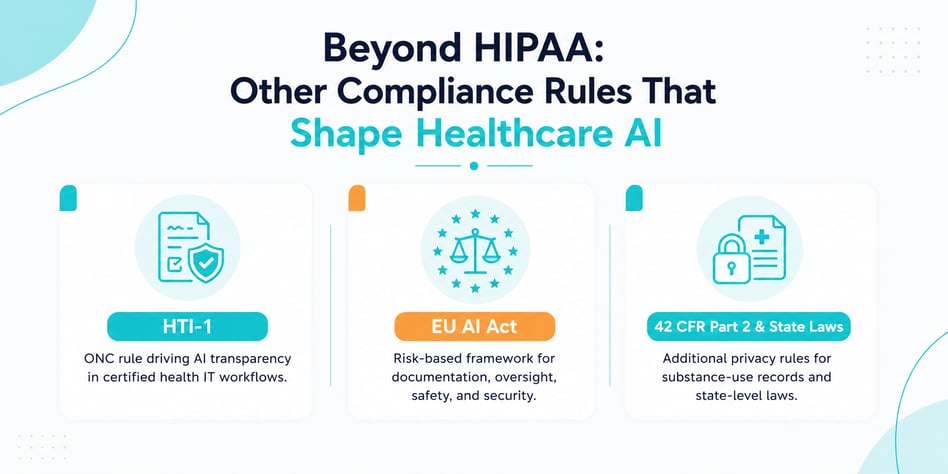
HIPAA sets the baseline, but healthcare AI often has to satisfy additional transparency, governance, and risk-management requirements.
HTI-1
The ONC’s HTI-1 final rule adds AI-related transparency expectations inside certified health IT workflows. For relevant decision support interventions, technical buyers should expect pressure for clearer source attributes, explainability, risk management, and ongoing maintenance of disclosures.
EU AI Act
For organizations serving EU markets or building cross-border healthcare products, the EU AI Act introduces a risk-based framework around technical documentation, logging, human oversight, accuracy, robustness, and cybersecurity. That matters especially for high-risk healthcare use cases.
42 CFR Part 2 and state privacy laws
If AI systems touch substance-use-disorder records, 42 CFR Part 2 may add stricter disclosure requirements. Multi-state healthcare organizations may also need to account for state privacy and consumer health data laws affecting consent, retention, and patient rights.
Mapping those overlapping requirements onto a vendor shortlist usually means evaluating the best data privacy tools against specific healthcare use cases including patient intake, telehealth consent, and PHI-aware analytics.
The takeaway is practical: healthcare AI compliance is not only about HIPAA. It is about building an operating model that can support overlapping rules without redesigning the stack later.
Best Practices for Building & Deploying HIPAA-Compliant AI
Best practices for building and deploying HIPAA-compliant AI reduce risk, shorten approvals, and improve time-to-value.
- Define PHI boundaries before selecting tools or vendors.
- Choose deployment models based on workflow sensitivity, not hype.
- Use de-identified data whenever it supports the use case.
- Keep human review in place for high-impact outputs.
- Validate every vendor and subprocessor handling PHI.
- Build secure MLOps and logging from day one.
- Document architecture, controls, and data flows early.
- Roll out in phases, starting with one measurable workflow.
- Measure ROI through time saved, call deflection, response speed, and reduced manual effort.
- Select a partner that can explain tradeoffs, not just build features.
These practices enable implementation because they reduce rework, improve security team confidence, and create cleaner paths to production.
Classifying AI Use Cases by Risk
A simple risk model helps healthcare organizations match deployment choices to compliance exposure.
| Risk Level | Typical Use Case | Recommended Model Strategy |
| Low | Public-source summarization, internal SOP drafting, non-PHI patient FAQs | Enterprise or public LLM with safeguards |
| Medium | De-identified internal retrieval, coding drafts, analytics summaries | BAA-backed or hybrid environment |
| High | Patient-level workflows, EHR-connected automation, CDS-adjacent support | Private or VPC-isolated deployment |
This type of classification helps teams avoid overengineering low-risk use cases while protecting high-impact workflows appropriately.
Security Measures & Core Controls for HIPAA AI Compliance.png?width=884&height=442&name=security-measures-and-controls-for-hipaa-ai-compliance%20(2).png)
HIPAA AI compliance requires layered controls that protect confidentiality, integrity, availability, and traceability.
Encryption and Key Management
Encryption should cover PHI in transit and at rest. Strong key management matters just as much. Healthcare organizations should know where keys are managed, who controls rotation, and whether the deployment supports tighter models like private VPC isolation or customer-controlled policies.
RBAC and Multi-Factor Authentication
Access should follow least-privilege principles, not convenience. Role-based access control, MFA, session restrictions, and privileged access review reduce unnecessary PHI exposure and strengthen enterprise confidence.
Vendor BAAs and Subprocessor Review
If a vendor creates, receives, maintains, or transmits PHI, a Business Associate Agreement is essential. The same scrutiny should extend to subprocessors, logging layers, analytics tools, and integration vendors. A compliant front-end experience can still fail if a hidden dependency weakens the chain.
Audit Logs and Monitoring
AI systems need traceability. That means immutable logs for user access, prompt handling, model outputs, configuration changes, and escalations. Without strong logs, organizations struggle to investigate incidents, validate workflow behavior, or meet audit requirements.
De-Identification and Data Minimization
Not every workflow needs identifiable patient data. In many AI data privacy healthcare use cases, de-identification or limited-data strategies reduce compliance burdens and implementation costs. The right question is not “Can we use all the data?” It is “What is the minimum necessary data required to make this workflow useful?”
Secure MLOps and Model Change Control
Healthcare AI systems change constantly, so secure MLOps must control prompts, models, retrieval layers, and release workflows. Use MLflow or Kubeflow for versioning, experiment tracking, validation, and rollback. In cloud deployments, apply governance using Azure AI Studio or AWS Guardrails to enforce policy, access, and output controls.
For PHI-sensitive use cases, run AI workloads in VPC-isolated environments with private endpoints and restricted network paths. If the system uses retrieval-augmented generation (RAG), secure the retrieval layer with encrypted embeddings, access-controlled document pipelines, and strong vector database security for tenant isolation, RBAC, query monitoring, and retention control.
Which Deployment Model Fits Secure AI Healthcare Best?
Secure AI healthcare deployment means choosing an architecture that matches PHI sensitivity, workflow criticality, and scaling goals.
There is no single best model for every healthcare organization. The right choice depends on risk, speed, budget, and the operational importance of the use case.
| Model | Best For | Strength | Tradeoff |
| HIPAA-eligible AI API with BAA | Fast pilots | Speed to launch | Lower control |
| Private cloud / VPC deployment | High-PHI workflows | Maximum control | Higher cost |
| Hybrid architecture | Multi-use-case programs | Flexibility | Greater complexity |
When a BAA-Backed API works
A HIPAA-eligible API deployment works well for narrow, well-governed workflows where the PHI boundary is clear, and the organization wants speed. It enables faster prototyping, controlled expansion, and shorter time-to-value.
When Private Hosting makes Sense
Private or VPC-based hosting is better for high-sensitivity use cases, deep integration programs, and organizations that need greater control over retention, networking, logging, and model lifecycle management. It is often the stronger fit for enterprise-grade secure AI healthcare rollouts.
When Hybrid Wins
Hybrid architectures work best when an organization has multiple AI use cases with different risk profiles. For example, patient education content may run in a lighter environment, while clinical support or PHI-heavy automation runs in a more isolated one. Hybrid often drives better long-term ROI because it matches cost to risk instead of overengineering every workflow.
Cost Drivers and Development Partner Selection
HIPAA-compliant AI development cost depends on integration depth, hosting model, security controls, and implementation maturity.
The biggest cost driver is usually not the model itself. It is the surrounding delivery complexity.
| What increases cost? | What reduces cost? |
| EHR, FHIR, HL7, and scheduling integrations | Starting with one high-value workflow |
| Private hosting and network isolation | Using de-identified data where possible |
| Human-in-the-loop validation workflows | Reusing secure architecture patterns across use cases |
| Security monitoring and audit infrastructure | Defining PHI boundaries before vendor selection |
| Documentation required for compliance and internal review | Working with a healthcare AI team that understands delivery and compliance together |
| Rework caused by poor early architecture decisions |
How to Choose a Development Partner?
A strong partner should do more than build features. They should help the organization make durable architecture decisions.
Look for:
- Healthcare implementation experience
- HIPAA-first architecture thinking
- Secure AI healthcare delivery depth
- Audit-readiness and documentation support
- Integration capability across EHR and operational systems
- Clear communication on tradeoffs, timelines, and ROI
The right partner reduces implementation drag. The wrong one creates technical debt disguised as velocity.
Related Case Study: HIPAA-Compliant Conversational AI in Healthcare
A live healthcare AI deployment shows how compliant architecture improves both access and efficiency. Signity built a HIPAA-aligned conversational AI solution for a U.S. healthcare environment to automate routine patient interactions securely.
The platform reduced inbound patient calls by 42%, improved patient query response times by 58%, and increased self-service resolution by 3.6x while maintaining encrypted data handling, role-based access, and audit-ready logs.
Read full case study: Healthcare Conversational AI Case Study
Signity’s Perspective on HIPAA and AI Compliance
HIPAA compliance is the foundation, but enterprise healthcare AI also demands broader operational and architectural discipline.
At Signity, we see HIPAA-compliant AI development as more than a privacy requirement. It is a design standard for building secure, scalable, production-ready healthcare systems. Strong healthcare AI security depends on how organizations define PHI boundaries, validate vendors, govern model behavior, and monitor integrations after launch.
It also requires alignment with broader enterprise expectations such as access governance, audit readiness, data retention controls, incident response planning, secure cloud configuration, and documented change management. Healthcare organizations that treat compliance as an architecture decision move faster, reduce rework, and clear internal security reviews with greater confidence.
The goal is not just compliant AI. The goal is to secure AI healthcare systems that deliver measurable value without compromising patient trust, operational resilience, or future scalability.
Conclusion
HIPAA-compliant AI development is not a legal checkbox or a vendor claim. It is an implementation strategy that determines how safely healthcare organizations can scale automation, accelerate time-to-value, and protect patient trust.
The organizations that lead in AI will not be the ones that move fastest without controls. They will be the ones who design secure AI healthcare systems that can withstand audits, support growth, and deliver ROI with confidence.

Mangesh Gothankar


Ashwani Sharma
Achin Verma
Frequently Asked Questions
Have a question in mind? We are here to answer. If you don’t see your question here, drop us a line at our contact page.
Can generative AI be used in healthcare under HIPAA?

What is the safest deployment model for secure AI healthcare?
How much does HIPAA-compliant AI development cost?
How do I find a healthcare AI development partner?