











The retail and eCommerce industry continues to face several challenges in meeting customer expectations, managing the latest market demands, and staying competitive. With the increasing number of buyers, these challenges are sure to increase for businesses that work in traditional ways. Shoppers also now start their search inside AI assistants. Adobe Analytics found that traffic to U.S. retail sites from generative AI tools grew 693.4% year over year during the 2025 holiday season, a period in which online spending reached $257.8 billion.
On the other hand, companies that integrate the best AI in retail have already started to tackle such problems. From managing inventory to instant response to customers, dynamic pricing, and more, AI in retail and eCommerce services is in demand. Retailers use AI tools to analyze historical sales data, collect customer data across online shopping and physical stores, automate repetitive tasks, and free human support teams for complex cases.
This blog will help you explore the applications, AI use cases in retail, benefits, challenges, and the future. You will also find the benefits of AI in retail, the benefits of artificial intelligence in ecommerce, and a roadmap for getting started.
Key Takeaways
- AI in retail enhances personalization, streamlines operations, and addresses key retail challenges.
- AI applications like predictive analytics and virtual try-ons improve customer experiences and boost sales.
- Data privacy, integration, and skill gaps remain hurdles for AI adoption in retail and eCommerce.
- Generative AI, computer vision, and sustainability-focused solutions lead the way. AI agents and agentic commerce are the next shift: McKinsey estimates AI agents could orchestrate $3 trillion to $5 trillion of global commerce by 2030.
- The benefits of AI in retail are measurable: higher conversion from personalized recommendations, less excess inventory, lower service costs, and enhanced customer satisfaction.
- Start small. Pick one high-impact use case, clean your data, and measure results before you scale AI tools across your retail business.
What Is AI in Retail and E-Commerce?
AI in retail and e-commerce (also written AI in retail and e commerce) is the use of AI algorithms, AI models, and automation to understand shoppers, predict demand, and run an ecommerce business or a retail business more efficiently. Five technologies do most of the work:
-
Machine learning: AI models trained on historical data and customer purchase history to forecast demand, set prices, and rank products.
-
Natural language processing (NLP): helps chatbots, AI agents, and site search understand questions, reviews, and customer feedback.
-
Computer vision: powers visual search, virtual try-on, and shelf monitoring in physical stores.
-
Generative AI: creates AI generated content such as product descriptions, ad copy, and email variants.
-
AI agents: software that completes multi-step tasks, from resolving a return to reordering stock, with limited human input.
The market reflects the shift. Fortune Business Insights values the global AI in retail market at USD 12.40 billion in 2025 and projects USD 105.88 billion by 2034, a 26.1% CAGR. Whether you sell through physical stores, an online store, or both, AI in ecommerce is moving from a back-office add-on to the front door of product discovery.
AI Applications in Retail and eCommerce
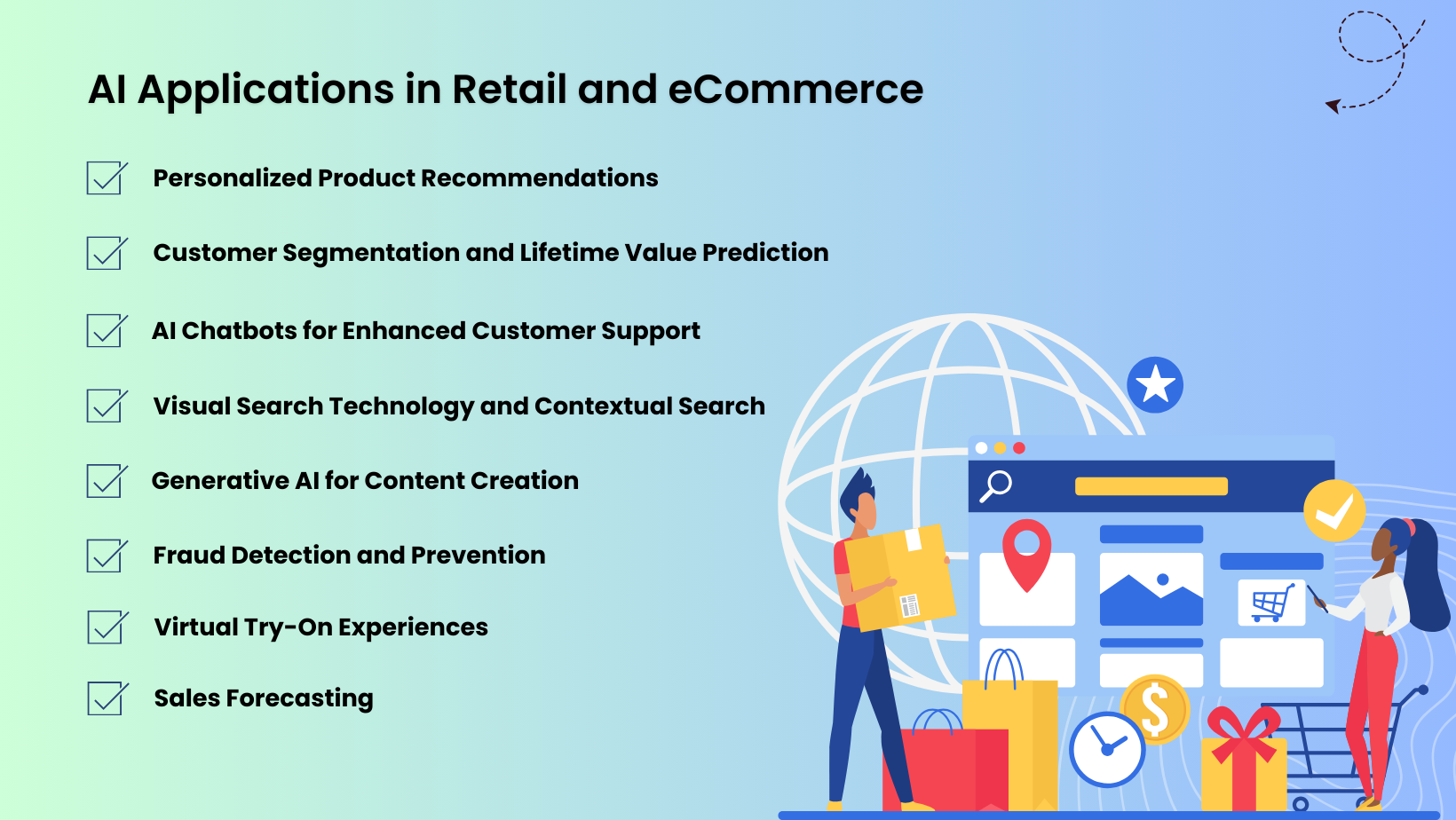
AI is unlocking new possibilities in retail and eCommerce by enabling data-driven decisions and personalized interactions. Some of the AI applications in retail and eCommerce include:
-
Personalized Product Recommendations
AI in retail and eCommerce also leverages machine learning algorithms to analyze customer preferences and browsing history. It helps deliver tailored product suggestions, further boosting conversion rates. AI models score each product against a shopper's customer purchase history and live behavior, so personalized recommendations update with every click.
It also helps enhance user satisfaction by making their shopping experience quicker and more relevant.
-
Customer Segmentation and Lifetime Value Prediction
Another application of AI in the retail industry is that it uses AI-powered analytics to segment customers based on their behavior to predict lifetime value. It identifies high-value customers to help businesses prioritize retention efforts and loyalty programs. To build accurate customer segments, retailers first collect customer data from the website, app, loyalty program, and physical stores, then let AI algorithms group shoppers by behavior and value.
Further, detailed segmentation allows for hyper-personalized campaigns to improve the overall marketing ROI. Teams can personalize marketing campaigns by segment, for example by timing emails around each shopper's usual purchase cycle instead of sending one offer to everyone.
-
AI Chatbots for Enhanced Customer Support
One of the applications of AI in retail and eCommerce is the AI chatbots. These AI-powered chatbots streamline customer interactions by handling queries and providing product information to assist with order tracking in real time. Modern chatbots use natural language processing to understand intent, not just keywords.
Gartner predicts that agentic AI will autonomously resolve 80% of common customer service issues without human intervention by 2029, with a 30% cut in operational costs.
AI is expected to handle 80% of all customer interactions by 2030. Chatbots are also available 24/7 to offer instant assistance to customers in order to reduce response time. They can be easily integrated with CRM systems to personalize interactions and maintain customer history. The best results come from a hybrid model: AI agents handle routine tasks such as order tracking and returns, and human support teams take over complex or sensitive cases.
-
Visual Search Technology and Contextual Search
Artificial Intelligence retail enables businesses to enhance users’ shopping experience with visual search technology to help customers find products using images. Visual search also simplifies product discovery by bridging the gap between online shopping and physical stores.
Moreover, contextual search helps eliminate irrelevant results to guarantee buyers quickly find exactly what they need.
-
Generative AI for Content Creation
The AI technology enables retail and eCommerce companies to automate the creation of product descriptions, ad copy, and promotional materials to improve efficiency and consistency.
For instance, generative AI enables faster product launches by reducing the time spent on manual content creation. Businesses can ensure that content remains engaging and aligned with their brand voice with AI in retail.
Treat AI generated content as a draft. Add human review for brand voice, pricing claims, and compliance, and ground the model in your own product data to avoid inaccurate descriptions. Clear attributes, sizing, and FAQs on each product page also help AI search tools understand and surface your products.
-
Fraud Detection and Prevention
Fraud is one of the major concerns in the retail and eCommerce industry. Deploying advanced AI systems helps identify and prevent fraudulent activities like payment fraud or account takeovers to ensure secure transactions.
Artificial Intelligence continuously monitors transactions for suspicious patterns to provide real-time alerts. It builds customer trust by maintaining a safe and secure shopping environment. By analyzing data such as device, location, order value, and customer purchase history in real time, AI algorithms can flag risky orders while letting genuine customers check out without extra friction.
-
Virtual Try-On Experiences
Businesses in the retail and eCommerce industries can use augmented reality and AI to enable customers to visualize how products like clothing or accessories will look.
Because size and fit drive a large share of apparel returns, virtual try-ons can reduce return rates when they help buyers make confident purchasing decisions. Results vary by category and tool, so pilot on one product range first. Virtual try-ons reduce return rates by helping buyers make confident purchasing decisions. They also help provide an engaging and interactive shopping experience to increase customer retention.
-
Sales Forecasting
Lastly, AI for retail and eCommerce predicts future sales trends by using AI-powered analytics to help brands manage inventory and align marketing efforts. Sales forecasting further helps minimize overstocking or understocking issues. Models trained on historical sales data, seasonality, promotions, and outside signals such as weather or local events produce more reliable forecasts than spreadsheets.
These factors help optimize inventory costs and enable businesses to anticipate peak seasons and plan promotional campaigns accordingly. Better forecasts also reduce excess inventory and let supply chain teams place orders earlier.
-
AI Agents and Agentic Commerce
AI agents go beyond chatbots. They plan and complete multi-step tasks, such as finding the right product, comparing prices, applying a coupon, or processing a return, with limited human input. On the shopper side, assistants like ChatGPT, Gemini, and Amazon's Rufus now research and recommend products, and a growing number can check out on the shopper's behalf.
McKinsey estimates that agentic commerce could orchestrate up to $1 trillion of U.S. retail revenue and $3 trillion to $5 trillion globally by 2030. For an ecommerce business, that means product data, pricing, and inventory feeds must be clean and machine-readable so AI agents can find and trust your catalog.
How Businesses Use AI for Retail and eCommerce
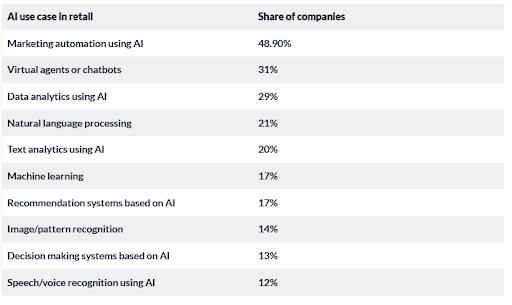
The AI use cases in retail and eCommerce are wide. As seen in the image below, companies use Artificial Intelligence for various purposes:
-
AI Chatbots
AI chatbots provide instant, round-the-clock support by answering customer queries, assisting with orders, and guiding users through the purchasing process. This seamless interaction boosts customer satisfaction and drives higher conversion rates.
-
Recommendations and Customer Loyalty Programs
By leveraging predictive analytics, AI analyzes customer preferences to offer tailored product recommendations. These insights can also fuel effective customer loyalty programs, encouraging repeat purchases and fostering long-term engagement.
-
Inventory Management and Demand Forecasting
AI-powered demand forecasting helps retailers predict market trends and optimize stock levels. Combined with smart inventory management, it minimizes overstocking and stockouts, improving operational efficiency. In supply chain management, AI also flags delayed shipments, suggests reorder points, and helps cut excess inventory before it ties up cash.
-
Dynamic Pricing and Assortment Optimization
Retailers can use AI for dynamic pricing, adjusting prices in real-time based on market demand, competitor pricing, and inventory levels. Assortment optimization ensures the right mix of products is available to meet customer needs. Dynamic pricing tools work best with guardrails, such as minimum margins, limits on how often prices change, and fairness checks, so frequent changes do not erode customer trust.
-
Virtual Try-On and Visual Product Search
AI-driven virtual try-on solutions enable customers to see how products like clothing or makeup will look on them before purchasing. Similarly, visual product search simplifies finding items by allowing users to upload images instead of typing search terms.
-
Computer Vision and Voice Commerce
Computer vision enables retailers to enhance in-store experiences with smart shelves and cashier-less checkouts. In e-commerce, voice commerce allows customers to search and shop hands-free, offering convenience and accessibility. Cashierless checkout has proven hard to scale, though. Amazon removed Just Walk Out from its Amazon Fresh grocery stores in 2024 in favor of smart carts, while keeping it in Amazon Go and third-party venues. Match the technology to your store format before you invest.
-
Automating Routine Tasks
AI can automate repetitive tasks such as product tagging, catalog clean-up, order-status updates, returns processing, and staff scheduling. Automating routine tasks frees human support teams and store staff for higher-value work, such as styling advice and complex complaints, and it removes the manual errors that creep into large catalogs.
Benefits of AI in Retail and eCommerce
AI in the retail and eCommerce industry brings several advantages for businesses to help connect with customers and personalize services.
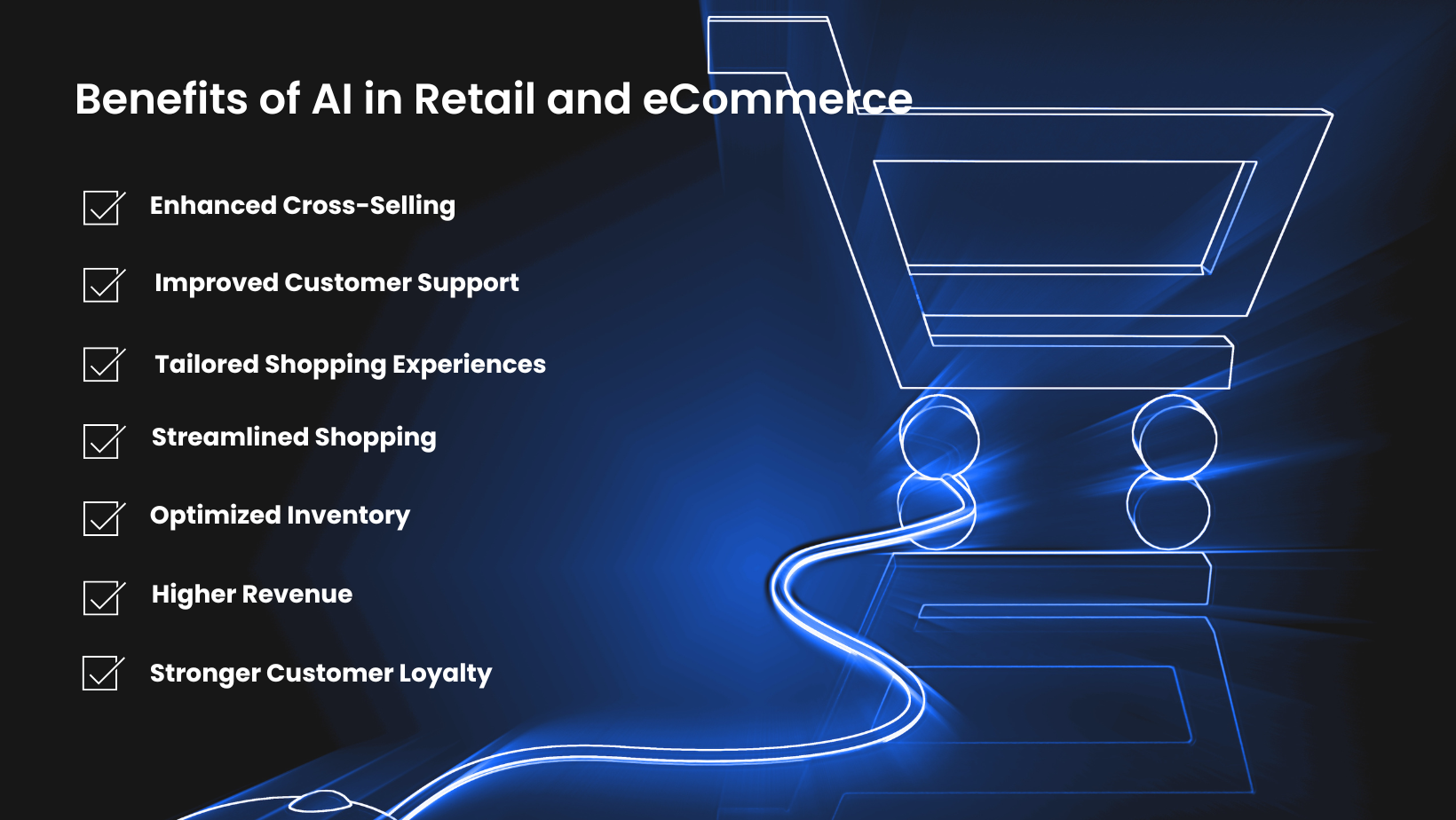
The benefits of AI in retail fall into three groups: revenue (personalized recommendations, dynamic pricing, cross-selling), cost (automating repetitive tasks, less excess inventory, fewer manual errors), and experience (faster support and enhanced customer satisfaction). The same benefits of artificial intelligence in ecommerce apply whether you sell online only or across physical stores and digital channels.
-
Enhanced Cross-Selling
AI-driven cross-selling increases average order value and sales by analyzing customer behavior and making recommendations for comparable products using predictive analytics.
-
Improved Customer Support
AI-powered chatbots and conversational AI give immediate support, manage several inquiries at once, and provide tailored answers, increasing client happiness and loyalty. Human support teams stay focused on complex cases.
-
Tailored Shopping Experiences
By examining browsing and purchase history, AI makes it possible to provide personalized product recommendations, increasing conversion rates and guaranteeing that customers locate items they are more inclined to purchase. Feed AI models with customer purchase history, browsing signals, and customer feedback to keep suggestions relevant.
“For instance, In this video, Amazon's Vice President of Machine Learning explains the role ML and AI play in Amazon's growth."
Video
-
Streamlined Shopping
While AI-powered site search provides precise, context-aware results, streamlining the shopping experience and increasing engagement, visual search enables shoppers to locate products using photos.
-
Optimized Inventory
AI-powered inventory control reduces overstocking and stockouts by guaranteeing ideal stock levels. Simultaneously, fraud prevention driven by AI identifies questionable transactions instantly, preserving consumer confidence. Linking forecasts to supply chain planning also cuts excess inventory.
-
Higher Revenue
AI makes it possible for dynamic pricing and promotions, which maximize profitability by modifying offerings and prices in response to consumer preferences, competitive analysis, and demand.
-
Stronger Customer Loyalty
Retailers can better comprehend and respond to client feedback by using customer sentiment analysis. When paired with AI-powered loyalty programs, companies may design customized incentives that encourage recurring business and sustained client involvement. Analyzing customer feedback from reviews, support tickets, and social posts gives teams valuable insights to fix product and service issues faster.
-
Faster, Better Decisions
AI turns large volumes of sales, inventory, and behavior data into valuable insights. Instead of waiting for monthly reports, merchandisers and marketers see what is selling, why, and what to do next, while the data is still fresh.
-
Lower Operating Costs
When AI tools automate repetitive tasks such as ticket routing, catalog tagging, and reporting, teams spend less time on manual work. Combined with better demand forecasts and fewer returns, this lowers the cost of running a retail business.
Challenges of Implementing AI in Retail and eCommerce
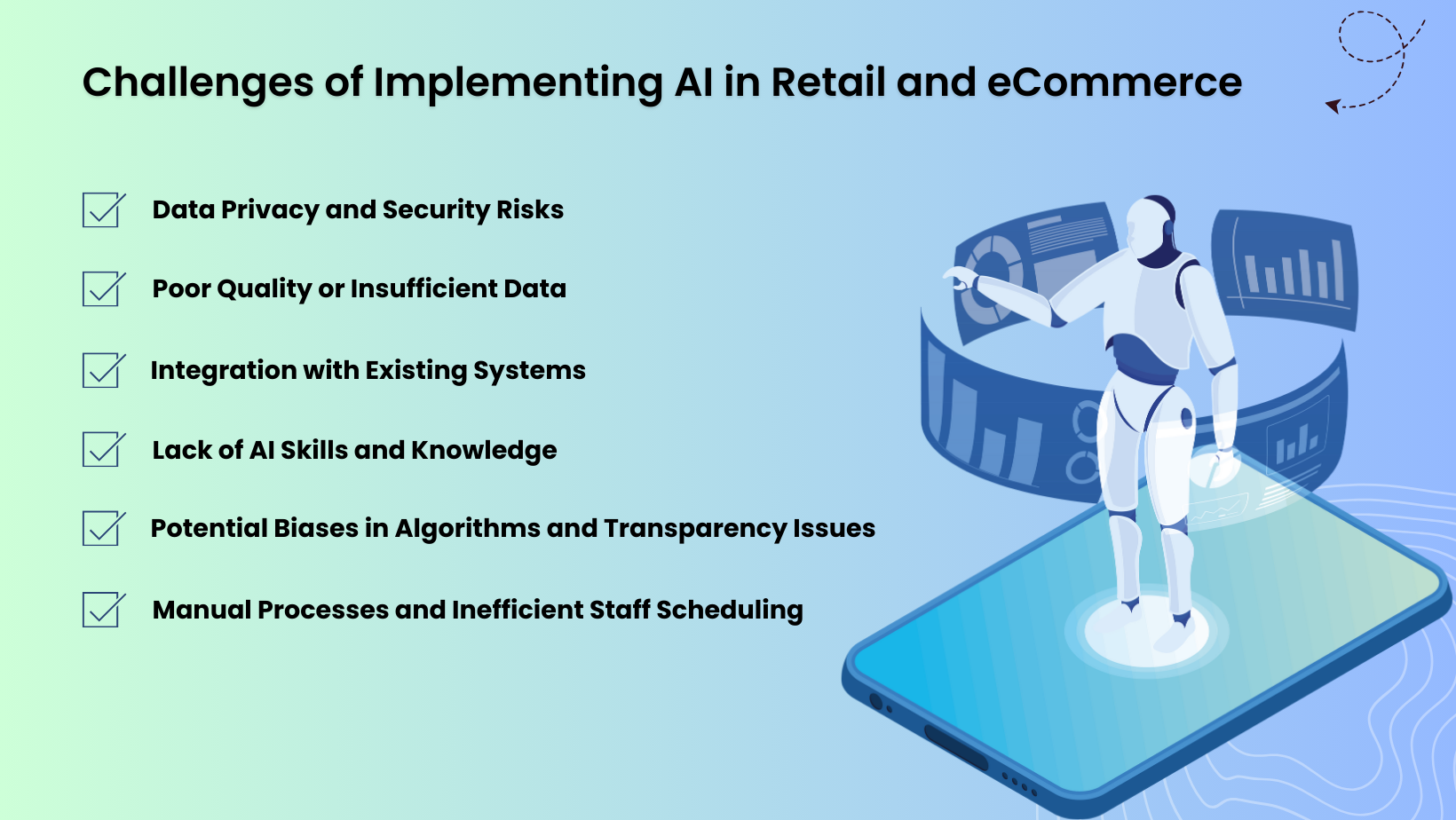
Even though AI plays a crucial role in the retail and eCommerce industry, this technology comes with several challenges that can be tough for businesses to handle.
-
Data Privacy and Security Risks
As AI systems frequently need access to sensitive customer data, ensuring data privacy and security is a significant concern. Large-scale data management also raises ethical and security issues.
Wondering how to address it? Collect only the customer data you need and get clear consent before you encrypt and restrict access. Further, review compliance with GDPR, CCPA, and the EU AI Act.
-
Poor Quality or Insufficient Data
AI systems are highly dependent on precise and thorough data. The efficacy of AI-powered solutions can be diminished by errors, inefficiencies, and erroneous outputs caused by inadequate or poor-quality data. How to address it: Audit and standardize product and customer data before you train or buy AI tools, and give one team ownership of data quality.
-
Integration with Existing Systems
It is frequently difficult to integrate eCommerce systems and other current technology seamlessly, necessitating a high level of technical competence. Deployment delays may result from businesses' difficulties integrating with current systems. How to address it: start with APIs and pre-built connectors, and pilot in one channel before a full rollout.
-
Lack of AI Skills and Knowledge
Effective implementation and management of AI systems are hampered by staff members' lack of AI expertise. This difficulty is especially noticeable for businesses making the shift to AI-powered operations. How to address it: train current teams on AI tools and bring in an experienced AI development partner for specialist work.
-
Potential Biases in Algorithms and Transparency Issues
Potential biases in AI systems could produce unfair results in areas like suggestions or pricing. Additionally, to keep customers' trust, AI-powered recommendations must be transparent. How to address it: test models for biased outcomes regularly, explain recommendations in plain language, and keep a human in the loop for pricing decisions.
-
Manual Processes and Inefficient Staff Scheduling
It can be challenging to switch from traditional processes and manual sales transactions to AI-driven automation. Additionally, if AI adoption isn't in line with workforce planning, ineffective staff scheduling can continue. How to address it: map which routine tasks to automate, retrain staff for higher-value roles, and plan schedules around AI forecasts.
-
AI Hallucinations and Over-Automation
Generative AI can state wrong details about sizing, ingredients, or return policies with confidence. Ground AI agents in verified product and policy data, set clear escalation rules, and review outputs, especially for high-value or regulated orders.
-
Unclear ROI and Scope
Many AI projects stall because goals are vague, and costs add up across data work, tools, and training. Define one business metric per use case, such as conversion rate, forecast accuracy, or cost per contact, and review results every quarter.
How to Get Started With AI in Retail and E-Commerce
Retailers that see results usually follow the same path. They start narrow, prove the value, and then aim to scale.
| Step | What to do | Example metric |
| 1. Pick one use case | Choose a problem with clear data, such as personalized recommendations, demand forecasting, or support automation. | Conversion rate, forecast error |
| 2. Prepare your data | Clean historical sales data, the product catalog, and customer data. Fix duplicates and gaps. | Data completeness |
| 3. Choose your tools | Compare AI-powered tools and advanced AI-powered tools, and decide what to build and what to buy. | Cost, time to launch |
| 4. Pilot | Run on one category or region with a control group so you can measure lift. | Lift vs. control group |
| 5. Scale and govern | Expand to more channels, monitor model performance, and document privacy and bias checks. | ROI, customer satisfaction |
Future Trends of AI in Retail and eCommerce
Conversational AI for tailored consumer interactions, generative AI for content production, and big data analytics for more profound insights are all part of the future of AI in retail and eCommerce. Demand forecasting and dynamic pricing optimize operations, while computer vision and virtual try-ons will improve shopping.
Agentic commerce and AI shopping assistants
Shoppers will increasingly ask an assistant to find, compare, and buy on their behalf. Retailers that expose accurate prices, availability, and policies to these AI agents will be easier to buy from than those that do not.
AI search and generative engine optimization
Product discovery is shifting from lists of links to AI-generated answers. Structured attributes, reviews, and up-to-date availability help your products appear in those answers.
Responsible AI and regulation
Expect tighter expectations on transparency, consent, and bias testing. Retailers that document how their AI models use customer data will move faster than those that retrofit controls later.
AI will also power sustainability programs, warehouse automation, and fraud detection, creating a more intelligent and effective sector.
Grow Your Business With Top AI Solutions for Retail and eCommerce
Signity is a leading provider of AI in retail and eCommerce services. Our experienced professionals help brands get custom solutions to meet their specific needs. Get in touch with our experts today to build AI-powered solutions that bring the best results.
Whether you need AI agents, dynamic pricing tools, or advanced AI-powered tools for your eCommerce business or retail business, our team can help you plan, build, and scale.
Frequently Asked Questions
Have a question in mind? We are here to answer. If you don’t see your question here, drop us a line at our contact page.
How is AI used in retail and eCommerce?

AI is used in retail and eCommerce to enhance operational efficiencies, personalize customer experiences, optimize inventory management, and drive sales through data-driven insights and automation. Common examples include personalized recommendations, chatbots and AI agents, dynamic pricing, demand forecasting, and fraud detection.
What is the future of eCommerce in AI?
The future of eCommerce in AI involves deeper personalization, improved predictive analytics, enhanced customer engagement through conversational interfaces, and streamlined operations through automation and real-time data analysis.
What is the future of AI in retail?
The future of AI in retail will feature hyper-personalization, predictive analytics, and automation to enhance customer experiences and operational efficiency.
What are the main use cases of AI in retail and eCommerce?
AI is used for personalized product recommendations, visual search, dynamic pricing, inventory management, conversational AI, customer sentiment analysis, AI-powered site search, and fraud prevention.
What are the challenges businesses face when implementing AI in retail and eCommerce?
Common challenges include high implementation costs, data quality and privacy concerns, integration with existing systems, and the need for technical expertise to manage AI solutions effectively.