



.png?width=27&height=27&name=Group(1).png)

-1.svg)
-1.svg)


-2.svg)


%201-1.webp?width=148&height=74&name=our%20work%20(2)%201-1.webp)




.svg)






Robotic Process Automation is an essential fusion of automation and cognitive technologies like Artificial Intelligence and Machine Learning that have the power to streamline rules-based repetitive business processes, enabling bots to make human like intelligent decisions.
However, the integration of RPA with legacy systems determines the scope of RPA and its ability to drive great revenues for businesses.
So, selecting the right RPA provider who can understand the unique business requirements and cater to the needs plays a vital role in successfully implementing RPA solutions.
Enabling organizations to choose the right RPA provider to work with, here we have crafted a list of the most popular Robotic Process Automation Companies in USA.
This list comprises skilled RPA Providers with industry-rich experience, technically adept teams, and a proven record.
 Generate
Key Takeaways
Generate
Key Takeaways

- Most RPA providers bundle automation software with AI features and enough consulting to get started right.
- Vendors split by depth, not breadth: some go deep on one platform, others spread thin across industries.
- Cost tracks complexity. A clean single process is cheap; tangled legacy integrations rarely are.
- Pick a partner for fit, not features. Security and scalability matter more than a long checklist.
12 Most Popular RPA Service Providers of 2026
Here is a list of top RPA service providers in the USA for your reference. Find the best one that matches your requirements and start automating your routine high-volume tasks seamlessly, optimizing your repetitive business processes.
1) UiPath
UiPath is the global leader in Robotic Process Automation (RPA), delivering a unified, end-to-end platform for intelligent automation. Their technology enables businesses to streamline complex workflows, deploy AI models, and automate repetitive tasks across systems such as SAP, Salesforce, Oracle, and modern web applications. UiPath’s software robots replicate human actions with precision, helping teams reduce manual effort and increase operational accuracy.
Although UiPath initially built its reputation around RPA, the company has now evolved toward a broader vision of agentic automation, where AI agents, robots, and humans work together to make smarter decisions and operate with greater autonomy.
Founded: 2005
Benefits:
-
Autopilot with Generative AI: UiPath now offers Autopilot, a native GenAI-powered assistant built into Studio, Apps, and Test Suite. It helps generate workflows, expressions, and test cases via natural language.
-
Bring-Your-Own-LLM capability: Customers can now plug in their own large language models (LLMs), rather than relying solely on UiPath’s, while still maintaining governance and auditing.
-
Unified Licensing: UiPath has introduced a new licensing model called Unified Pricing, which consolidates different licensing units (AI, API, rpa bots, AI agent) into a single “Platform Unit” for more flexibility.
-
Improved AI Governance: Through the AI Trust Layer, administrators get more control. For example, enforcing guardrails on agent actions, masking PII in-flight, and applying agent-design policies.
-
Global Data Residency & Compliance: Automation Cloud is now available in more regions, like Switzerland and the UAE, helping with data residency and regulatory compliance.
Target Industries:
UiPath's customers come from various industries, including banking, healthcare, insurance, government, manufacturing, retail, and telecom. UiPath RPA platform caters to organizations across multiple sectors looking to automate their business processes. Its platform with GenAI now deeply integrated is increasingly chosen by enterprises adopting AI-first automation.
Key RPA Features:
UiPath offers a comprehensive set of features for Robotic Process Automation (RPA), including:
- Workflow Designer: An intuitive visual interface for creating automation workflows.
- Recording: Ability to record and capture user actions to automate repetitive tasks.
- Orchestrator: A centralized platform for managing and monitoring automation processes.
- AI Capabilities: Integration with AI technologies like optical character recognition (OCR) and natural language processing (NLP) for advanced automation.
- Bot Development: Tools for building and configuring software robots (bots) to perform tasks.
- Integration: Support for integrating with various systems, applications, and databases.
- Analytics and Reporting: Insights and reporting features to monitor and optimize automation performance.
- Security and Governance: Features to ensure data security, access control, and compliance.
- Process Intelligence: The 2024.10 release consolidates task mining, process mining, and system logs into a unified “process intelligence” layer.
- Security and Governance: Features to ensure data security, access control, and compliance.
Pros:
- User-friendly interface with a visual workflow designer.
- Very strong AI & RPA fusion now (Autopilot, GenAI activities).
- Extensive library of pre-built automation components.
- Scalable architecture for both traditional bots and agent-based automations.
- Strong community support and a large marketplace for reusable automation components.
- Broad integration capabilities, supports LLM connectors, system integration, etc.
- Robust security and governance features.
Limitations:
- The steep learning curve for complex automation scenarios.
- Limited support for non-Windows environments.
- Higher licensing costs compared to some other RPA tools.
- Some advanced features may require additional coding or technical expertise.
- Limited support for mobile automation.
Pricing:
UiPath offers various pricing plans based on the specific needs of organizations. The pricing structure includes both annual and monthly subscription options.
2) Signity Software Solutions
Signity Software Solutions is known as one of the best Robotic Process Automation providers across the globe, as they offer AI development technology as well as robust RPA solutions. Depending on the support you need, you can choose between desktop automation for web and desktop tasks or enterprise automation.
Signity sets itself apart from other RPA services company by taking a customer-first approach. The idea is that every robotic process automation tool you can access with Signity is intended to make your human employees’ lives easier. Signity also offers UiPath development services to its customers.
Benefits:
- Open-Source RPA Expertise: Signity has significantly expanded its open-source RPA capabilities. They build bots using open-source tools and deploy them on client infrastructure (Docker, Kubernetes) to keep costs low while providing full ownership and scalability.
- Strong AI and Automation Integration: Through its AI development efforts, Signity now provides intelligent automation that integrates technologies such as machine learning, document intelligence (OCR), and RPA, enabling more cognitive, data-driven bots.
- 24/7 Managed Support: Their managed RPA services now emphasize high availability, continuous monitoring, disaster recovery, risk management, and scaling, making sure bots perform reliably around the clock.
- Flexible Deployment Options: You can choose fully on-premises automation, hybrid setups, or cloud-native deployments, depending on your infrastructure and regulatory needs.
Founded: 2009
Target Industries:
Signity Software Solutions caters to businesses and organizations of all sizes and across various industries that aim to automate their business processes in Human Resources, Manufacturing, Finance & Accounting, E-Commerce, Telecom, and Custom Solutions.
#Case Study: Telecloud saved 750+ man-hours per month in accounting with RPA bots
-
RPA Opportunity Discovery: Identify automation potential and maximize ROI through comprehensive business operations analysis.
-
RPA Consulting: Expert assessment, roadmap creation, and strategic adoption guidance for RPA implementation.
-
Automation Design & Implementation: Process mapping of manual processes, intervention-model design, and bot development using AI, ML, and cognitive services.
-
Automation Design: Mapping of manual processes, intervention model design, and clear RPA implementation view.
-
RPA Implementation: Design and develop bots using advanced technologies like Machine Learning, AI, and cognitive services.
-
Managed RPA Services: High availability, 24/7 monitoring, seamless process flow, intelligent document processing and assistance with robot management, disaster recovery, risk management, automation scaling, and upgrades.
-
Open-Source RPA Development: As mentioned, constrained licensing cost by leveraging free tools, with full control and ownership for the client.
-
Managed RPA Services: End-to-end bot management, monitoring, scaling, and 24/7 support.
-
AI & Intelligent Automation: Development of custom AI solutions using RAG, LLMs, and AI agents that integrate tightly with RPA workflows.
Pros of Signity Software Solutions:
- Comprehensive analysis of business operations to identify suitable business process automation opportunities.
- Expert RPA consulting for strategic adoption and implementation.
- Assistance in designing and developing bots using advanced technologies
- Managed RPA services provider and custom rpa solutions for seamless process flow and increased uptime.
- Comprehensive, full-stack automation & AI capability, not just bots.
- Ability to build on open-source RPA, reducing licensing cost and increasing flexibility.
- Strong support model with 24/7 bot monitoring, disaster recovery, and scaling.
- Deep expertise in UiPath and other leading RPA tools.
- Data privacy and security built-in, especially for automation of sensitive key business processes.
Limitations:
- Specific pricing information and cost structure may vary based on individual requirements.
- Limited information is available on community support and user base compared to other RPA providers.
Partner: UiPath
3) Kofax
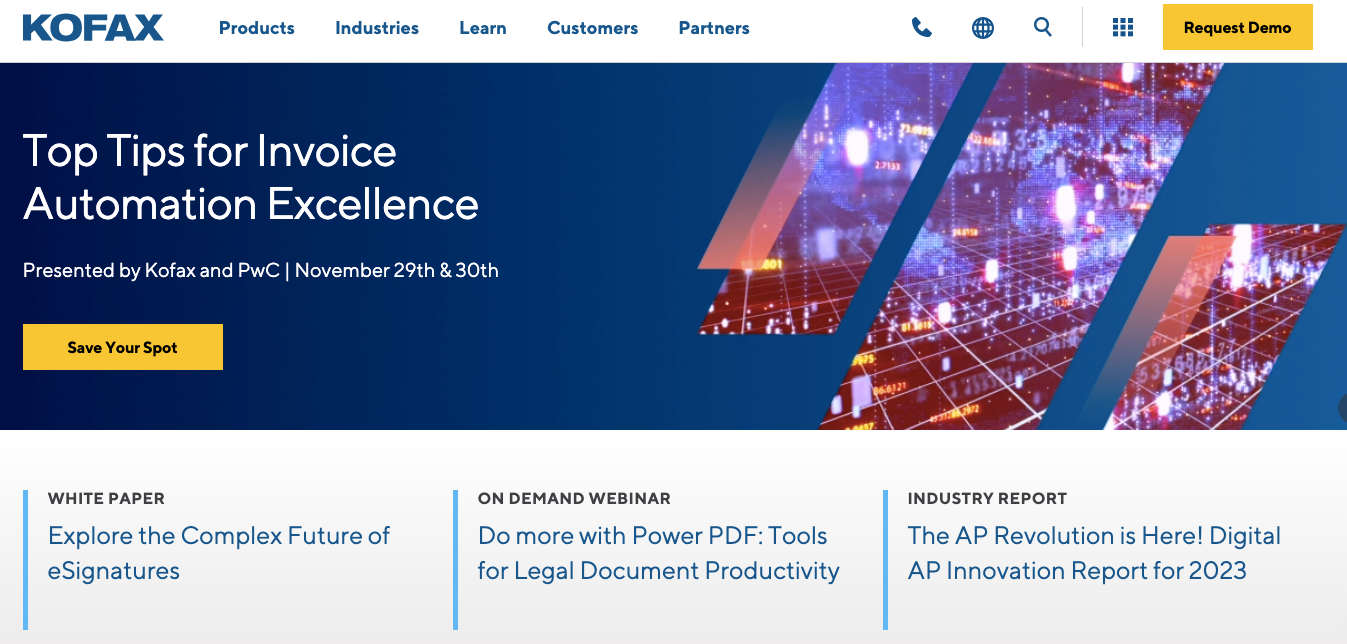
Kofax can work with any application virtually. Coding skills are not mandatory for this tool. It can process data from any website, desktop application, and portal.
Founded: 2005
Benefits:
- It does repetitive tasks efficiently.
- Intelligent tool for monitoring and optimizing processes.
- It can be managed centrally from a server.
- Easy to integrate with the Kapow Katalyst Platform.
Target Industries:
Kofax is among the leading robotic process automation service providers that cater to a wide range of industries, including banking, insurance, healthcare, government, manufacturing, retail, and transportation.
Key RPA features:
- Intelligent automation: Kofax offers advanced capabilities for automating both structured and unstructured data, allowing organizations to automate complex business processes.
- Cognitive capture: The platform leverages AI and machine learning to extract and process data from various sources, including documents, emails, and images.
- Process orchestration: Kofax RPA enables the orchestration of end-to-end business processes, integrating with other systems and applications to streamline operations.
- Analytics and reporting: The solution provides insights and analytics to monitor and measure the performance of automated processes, helping identify bottlenecks and areas for improvement.
- Scalability and security: Kofax emphasizes scalability and provides robust security measures to ensure the protection of sensitive data.
Pros:
- Comprehensive automation capabilities that cover both structured and unstructured data.
- Advanced AI and machine learning capabilities for intelligent automation.
- Strong process orchestration and integration capabilities.
- Analytics and reporting features offer valuable insights for process optimization.
- Scalable and secure solution suitable for enterprises of different sizes.
Limitations:
- Pricing: Kofax's pricing structure can be complex, and the costs may vary depending on the specific requirements and scale of implementation.
- Learning curve: As with any robust automation solution, there may be a learning curve for users and administrators to become proficient in utilizing Kofax effectively.
Pricing:
Pricing for Kofax RPA is typically not publicly disclosed, as it can vary based on factors such as the scope of implementation, the number of users, and additional services required.
4) Softomotive
Softomotive is another RPA company that helps companies put their repetitive tasks on autopilot. In particular, the Softomotive software aims to offer the smoothest RPA journey possible by giving businesses the guidance they need to start small with their AI solutions and gradually ramp up.
Founded: 2005
Target Industries:
Softomotive's RPA solutions cater to various industries and organizations, including banking, insurance, healthcare, manufacturing, retail, finance & accounting, e-commerce, telecom, and more.
Key RPA features:
- Process recorder: Softomotive provides a visual process recorder that allows users to easily capture and automate repetitive tasks by recording their actions.
- Drag-and-drop workflow designer: The platform offers a user-friendly interface with a drag-and-drop workflow designer, enabling users to create and customize automation workflows without the need for extensive coding.
- Screen scraping and data extraction: Softomotive's RPA tools include screen scraping capabilities, allowing users to extract data from various applications and systems.
- Integration and compatibility: Softomotive's solutions are designed to integrate with a wide range of systems and applications, enabling seamless automation across different software platforms.
- Error handling and exception management: The platform provides features to handle errors and exceptions that may occur during automation processes, ensuring smoother and more reliable execution.
Pros:
- User-friendly interface and intuitive workflow designer, making it accessible for users without extensive technical skills.
- Affordable pricing options are particularly suitable for small and medium-sized enterprises.
- Compatibility with a wide range of systems and applications, facilitating integration and automation across different platforms.
- Screen scraping capabilities for data extraction from various sources.
- Error handling and exception management features improve automation reliability.
Limitations:
- Limited advanced automation capabilities compared to some enterprise-level RPA platforms.
- The range of pre-built automation components and libraries may be more limited compared to larger RPA vendors.
- Softomotive was acquired by Microsoft in 2020 and has been integrated into Microsoft Power Automate. This integration may lead to changes in product offerings and pricing structures.
Pricing:
Pricing details for Softomotive's RPA solutions may vary based on factors such as the specific product edition, deployment model, and additional services required.
5) Pegasystems
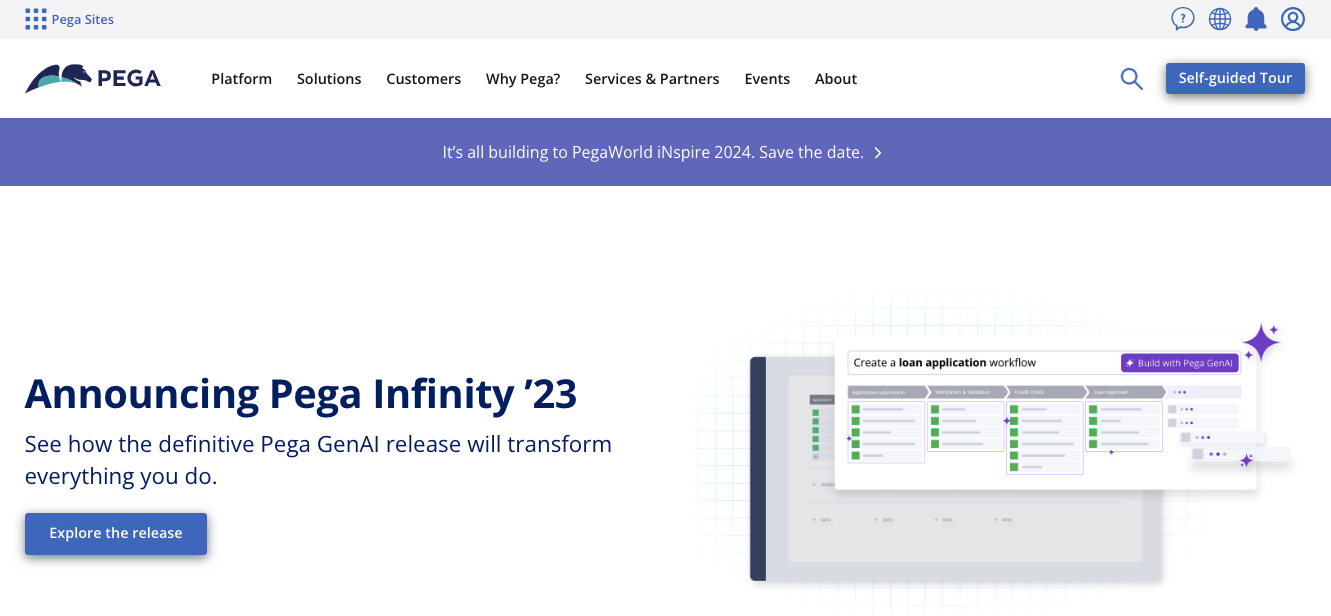
Another leading RPA service provider, Pega, offers business process management, customer relationship management, and digital process automation, all in a comprehensive package. To streamline and enhance your company’s operations with state-of-the-art technology, look no further than Pega.
Founded: 1983
Target Industries:
Pegasystems' RPA solutions cater to various industries and organizations, including banking, insurance, healthcare, telecommunications, manufacturing, retail, and more.
Key RPA features:
- Auto-balancing bots: Pega now supports auto-balancing in its RPA. Its Robot Manager uses AI to redistribute workloads dynamically among bots, helping reduce licensing and infrastructure costs.
- Next-gen Robot Studio: The revamped low-code Robot Studio simplifies bot creation. It includes intelligent recording, a cleaner interface, and reusable components, making automation accessible to both citizen and pro developers.
- Scalability and governance: The platform is designed to handle large-scale automation deployments with centralized governance, allowing organizations to manage and monitor their automation initiatives effectively.
- Customer service automation: Pega's RPA solutions include features for automating customer service processes, such as chatbots, virtual assistants, and case management, improving customer experience and operational efficiency.
- Generative AI / Agentic Automation: Pega Infinity ’23 introduces GenAI agents and a secure architecture for building prompt-based bots. These agents can construct automations even for legacy systems without APIs.
- AI-powered design & testing: In its newer platform version, Pega has added an AI developer agent that gives real-time guidance, suggests best practices, and auto-generates test suites to accelerate app development and ensure quality.
- Improved AI decisioning: With Pega Infinity 8.7, enhancements like Process AI help predict which cases may fail, allowing proactive routing and intelligent handling.
Pros:
- Advanced automation capabilities, including AI-powered features and decision-making capabilities.
- Scalable and robust platform suitable for large-scale automation deployments.
- Low-code development environment for faster automation workflow creation and modification.
- Strong customer service automation features, improving customer experience and operational efficiency.
- Comprehensive governance and monitoring capabilities for effective management of automation initiatives.
Limitations:
- Pega's RPA solutions may have a steeper learning curve compared to simpler RPA platforms, requiring more technical expertise.
- Pricing for Pega's RPA offerings can be higher compared to some other RPA vendors, making it more suitable for larger enterprises.
- Integration with certain legacy systems or applications may require additional configuration or customization.
Pricing:
Pricing details for Pega's RPA solutions can vary based on factors such as the specific product edition, deployment model, and additional services required.
6) EdgeVerve
EdgeVerve is another RPA-as-a-service provider in the industry that aims to give every business the power to benefit from Robotic Process Automation with its intuitive AssistEdge solution.
This end-to-end automation offering helps businesses of all sizes automate crucial tasks in their workforce. AssistEdge comes with process discovery, RPA implementation and orchestration functionality so that you can manage your entire automation journey from a single interface.
Founded: 2014
Target Industries:
EdgeVerve's RPA service caters to organizations across various industries, such as banking, financial services, insurance, healthcare, retail, manufacturing, and telecommunications.
Key RPA features:
- Combining Automation and AI: EdgeVerve's product roadmap emphasizes RPA governance and a sophisticated approach to automation that integrates AI. The company leverages its Infosys Nia division to manage the union of AI and automation effectively.
- Integration capabilities: EdgeVerve RPA can seamlessly integrate with existing systems and applications, facilitating smooth data exchange and interoperability.
- Customer Engagement: With a strong services component, Infosys facilitates the rapid deployment and overall scaling of RPA projects. EdgeVerve provides support for build and design, ensuring a smooth customer engagement experience.
Pros:
- Advanced AI capabilities improve automation accuracy and decision-making.
- End-to-end process orchestration enables the automation of complex business processes.
- Strong emphasis on enterprise-grade security and compliance.
- Robust analytics and reporting features for process optimization.
- Seamless integration capabilities with existing systems and applications.
Limitations:
- Specific pricing information and package details may vary and require contacting EdgeVerve directly.
- The learning curve for implementing and configuring the solution may be steep for some users.
- Limited availability of community support compared to more widely adopted RPA platforms.
Pricing:
For specific pricing information and package details, it is recommended to contact EdgeVerve directly, as pricing can vary based on the specific requirements and scale of the organization.
7) Automation Anywhere
Automation Anywhere is a global software company and a leader in Agentic Process Automation (APA), a field that combines artificial intelligence (AI) and robotic process automation (RPA) to automate complex business processes. The company offers a cloud-based platform called Automation 360. This platform helps organizations create a "digital workforce" using automation technologies to automate repetitive and time-consuming activities. Automation Anywhere uses software "bots" and AI agents to mimic human actions and perform tasks across various systems and applications.
Automation Anywhere provides intelligent automation solutions across industries such as manufacturing, financial services, and healthcare. Their Automation Success Platform includes process discovery, robotic process automation (RPA), process orchestration, intelligent document processing, analytics, process mining, and workflow automation, all powered by AI.
They help businesses improve customer satisfaction, delivers employee satisfaction, encourage innovation, increase productivity, streamline processes, speed up growth, simplify IT tasks, and ensure compliance.
Founded: 2003
Target Industries:
Automation Anywhere is designed to cater to a wide range of industries and organizations of various sizes. Its target users include businesses across sectors such as banking, finance, healthcare, manufacturing, retail, and more.
Key RPA Features:
- AI & Automation Enterprise System: Launched in 2024, this system combines GenAI Process Models 2.0 with new AI Agents, enabling enterprises to build and deploy intelligent agents that can make decisions and act autonomously.
- AI Agent Studio: A low-code studio for building custom AI Agents. These agents can be grounded in enterprise data using a native Retrieval-Augmented Generation (RAG) service, and support major LLMs from AWS, Google, and Microsoft.
- Responsible AI Layer: New governance features for AI Agents, including monitoring, auditing, prompt testing, guardrails, and data masking to ensure compliance.
- Automator AI: Includes Generative Recorder (self-healing UI automation) and an enhanced Autopilot that can convert BPMN or process documentation into working automation, reducing development time significantly.
- Document Automation with GenAI: Enhanced document processing capabilities that can extract data from unstructured documents, complex tables, supports 30+ languages, and is available for on-prem deployments using private cloud models.
- Enhanced Platform Scale & Control (Automation 360 v.26): New features for better license visibility, improved control room upgrades, and enterprise-scale trust.
- New Generative Recorder Package (v.32): For cloud customers, this generation-based recorder allows auto-updating of UI paths and fallback behavior when application UI changes, increasing automation resilience.
- Process Reasoning Engine (PRE): Introduced in 2025, this AI engine provides “reasoning” capabilities so agents can understand enterprise context, autonomously plan tasks, and dynamically drive outcomes across systems.
- New Agent Types:
Enterprise UI Agents: adaptive agents that can interact with enterprise software dynamically.
Reasoning AI Agents: goal-driven agents that plan and execute tasks, learn from outcomes, and handle higher-level automation.
Automation Co-Pilot Enhancements: The Co-Pilot is now conversational, embedded in any application, can route email, process service operations, and invoke AI agents on demand.
Pros:
- Comprehensive automation capabilities with support for both attended and unattended automation.
- Strong security features to protect sensitive data and ensure compliance.
- User-friendly interface and intuitive bot development tools.
- Integration with various systems and applications, enabling seamless automation across multiple platforms.
- Extensive community support and a vast library of pre-built automation components.
Limitations:
- The pricing structure may be complex and tailored to individual customer requirements.
- Advanced features and functionalities may require additional licensing or add-ons.
- The steep learning curve for beginners with a limited technical background.
- Some users have reported occasional performance issues or instability.
Pricing:
Automation Anywhere offers flexible pricing options based on individual business requirements.
8) Blue Prism
Founded in 2001, Blue Prism claims to have invented the term Robotic Process Automation. It offers a software platform to help organizations develop a digital workforce while making business operations more agile and cost-effective.
Founded: 2001
Target Industries:
Blue Prism is designed for enterprises and organizations across various industries that seek to automate their business processes.
Key RPA Features:
-
Next-Generation, Cloud-native Platform: Blue Prism has launched its Next Gen platform, which is cloud-native, allowing digital workers to operate securely behind a company’s firewall and scale without heavy infrastructure maintenance.
-
Blue Prism Assistant (AI Co-Pilot): An agentic AI assistant embedded in the Next Gen platform that responds to natural-language queries, recommends relevant Digital Exchange assets, and helps troubleshoot.
-
Automation Orchestrator: A unified orchestration layer that brings together Blue Prism Enterprise, Cloud, and Next Gen environments; supports event-driven execution, intelligent session queuing, and centralized management with strong governance.
-
Enhanced Application Modeller & Smart Vision: In Enterprise v7.3 and above, the Application Modeler is enhanced with SmartVision, using AI-driven vision to model GUIs, reconstruct legacy application interfaces, and reduce development/maintenance effort.
-
Improved Desktop Automation: Blue Prism Desktop (1.2 / 1.3) now supports a 64-bit client, SOAP web services, and better integration to work with Enterprise queues, increasing flexibility for attended automation.
-
Process Capture Enhancements (Capture v5.0): The Capture tool now supports custom Word templates for PDD (Process Definition Documents), the ability to export solution design documentation, and significant improvements in performance (e.g., reduced memory usage).
-
AI Agent Catalog & Governance (SS&C AI Gateway): Blue Prism now supports enterprise-grade AI agents via a catalog of prebuilt templates + a governance layer (SS&C AI Gateway) with guardrails, role-based controls, and audit trails.
-
New REST APIs: APIs have been introduced for process triggering, digital worker registration, admin operations, user and environment management, making it easier to integrate Blue Prism with enterprise tooling.
-
AI-driven Economic Impact: According to a Forrester TEI (Total Economic Impact) study, Blue Prism’s intelligent automation delivers measurable ROI for its customers.
Pros of Blue Prism:
- Strong security and compliance measures
- The visual and user-friendly process design interface
- Scalable and robust automation capabilities
- Advanced AI integration for intelligent automation
- Extensive integration options for seamless connectivity
- Dedicated control room for efficient process management and monitoring
Limitations:
- Relatively higher pricing compared to some competitors
- The steeper learning curve for non-technical users
- Limited community support compared to open-source RPA tools
Pricing:
Blue Prism offers enterprise pricing based on the specific needs and requirements of each organization.
9) Fortra
Fortra, previously known as HelpSystems, is introducing companies of all backgrounds to the benefits of RPA with their state-of-the-art automation solution.
The platform ensures that businesses can create comprehensive and intuitive robots that communicate with their existing business systems and applications to reduce the burden on their human employees.
Founded: 1982
Target Industries:
Fortra's RPA systems are designed for businesses across various industries, including finance, healthcare, manufacturing, retail, and more. It is among the leading RPA services companies that caters to organizations of all sizes, from small businesses to large enterprises.
Key RPA Features:
-
Workflow Designer: Fortra offers a visual workflow designer that allows users to create and automate complex business processes through a user-friendly interface. It enables users to build automation workflows using drag-and-drop functionality and pre-built actions.
-
Integrations and Connectivity: Fortra' RPA platform provides seamless integration capabilities with a wide range of applications, systems, and databases. It enables users to automate processes by interacting with legacy systems, web applications, APIs, and more.
-
Centralized Control and Monitoring: Fortra offers a centralized control centre that provides visibility and management of automation processes. It allows users to schedule, monitor, and control the execution of automated tasks, ensuring efficient workflow management.
-
Exception Handling: Fortra's RPA tools include features for handling exceptions and errors during the automation process. It provides options for defining custom error-handling mechanisms, enabling the system to handle unexpected scenarios effectively.
-
Security and Compliance: Fortra prioritizes security and compliance in its RPA solutions. It incorporates encryption, access controls, and audit logs to protect sensitive data and ensure regulatory compliance.
Pros of HelpSystems:
- The user-friendly visual workflow designer
- Seamless integration capabilities with various systems and applications
- Cognitive automation capabilities for intelligent processing
- Centralized control and monitoring for efficient management
- Strong focus on security and compliance
Limitations:
- Limited community support compared to some other RPA providers
- Pricing may be relatively higher compared to certain competitors
Pricing:
Fortra provides customized pricing based on the specific requirements of each organization's business objectives. The pricing model typically considers factors such as the number of users, processes, and deployment options.
10) NICE
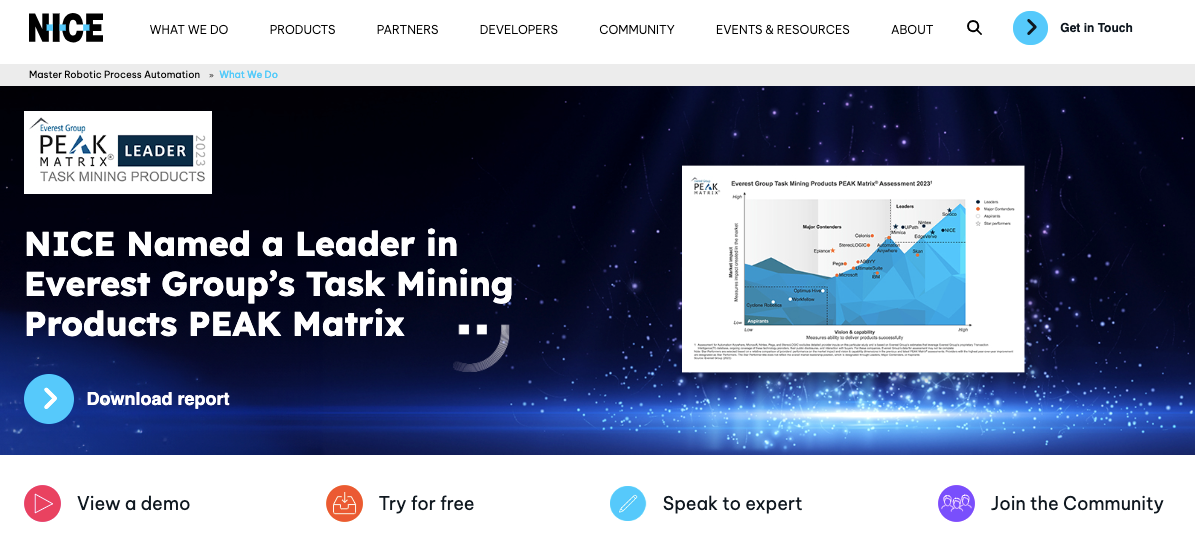
NICE RPA is a robust and intelligent automation solution designed to streamline business processes and enhance operational efficiency.
With its advanced capabilities, including AI-driven automation, desktop automation, and process discovery tools, NICE RPA empowers organizations to automate repetitive tasks, optimize workflows, and make data-driven decisions.
The user-friendly interface and comprehensive analytics provided by NICE RPA enable businesses to design, develop, and deploy software robots effectively.
Founded: 1986
Target Industries:
NICE's RPA solutions target enterprises and organizations across different industries that aim to automate and optimize their business processes. It caters to businesses of all sizes, from small businesses to large enterprises.
Key RPA Features:
-
Intelligent Automation: NICE's RPA platform utilizes advanced technologies such as AI and machine learning to enable intelligent automation, allowing businesses to automate complex tasks and decision-making processes.
-
Desktop Automation: NICE offers desktop automation capabilities that enable the automation of repetitive tasks performed on individual desktops, increasing productivity and reducing errors.
-
Process Discovery and Analysis: NICE provides tools for process discovery and analysis, allowing businesses to identify and analyze potential automation opportunities and optimize their workflows for greater efficiency.
-
Bot Development and Deployment: NICE offers a user-friendly interface for designing, developing, and deploying software robots (bots) to automate business processes. It provides a range of automation tools and features to support bot development.
-
Analytics and Reporting: NICE's RPA platform includes analytics and reporting capabilities, allowing businesses to gain insights into their automation performance, monitor bot activities, and make data-driven decisions for process improvement.
Pros:
- Advanced intelligent automation capabilities
- User-friendly interface for bot development
- Process discovery and analysis tools for identifying automation opportunities
- Analytics and reporting features for monitoring and optimizing automation performance
Limitations:
- Pricing information is not readily available and may vary based on individual requirements
- Limited information on community support and user base compared to some other RPA providers
Pricing:
Pricing details for NICE's RPA solutions are typically provided on a custom basis, tailored to the specific requirements of each organization.
11) Nintex RPA
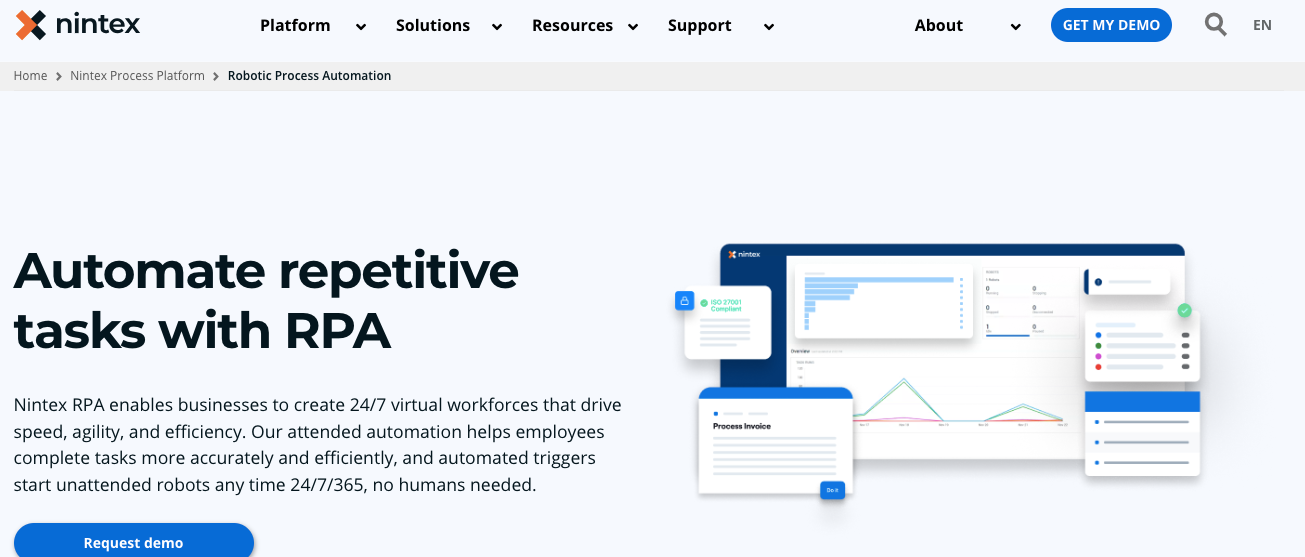
Nintex RPA is a powerful automation platform that helps businesses streamline their processes and accelerate digital transformation. It is designed for organizations of all sizes and industries that aim to automate routine tasks, intelligent data processing, improve operational efficiency, and enhance employee productivity.
Key RPA Features:
- Visual Designer: Nintex RPA offers a user-friendly visual designer that allows users to create automation workflows with ease, even without extensive coding skills.
- Integration Capabilities: The platform integrates seamlessly with various systems and applications, enabling automated interactions and data exchange.
- Intelligent Automation: Nintex RPA leverages AI and machine learning technologies to enable intelligent decision-making and process optimization.
- Centralized Management: It provides a centralized dashboard for managing and monitoring automation processes, allowing for better control and governance.
- Scalability: Nintex RPA systems can scale to accommodate the automation needs of growing businesses and handle large volumes of tasks efficiently.
Pros:
- User-friendly interface and visual designer
- Robust integration capabilities
- Intelligent automation with AI capabilities
- Scalability for growing businesses
- Strong support services
Limitations:
- Some advanced functionality may require additional customization
- Pricing may be more expensive for smaller businesses
Pricing:
Nintex RPA offers various pricing plans tailored to the specific requirements of each organization.
12) ServiceNow:
ServiceNow's RPA solution is designed to automate repetitive tasks, efficiently resource utilization, and streamline business workflows. It targets a wide range of users across industries, including IT departments, HR, finance, and customer service teams.
Key RPA Features:
- Integration with ServiceNow's IT Service Management (ITSM) platform
- A visual workflow designer for creating automation workflows
- Robotic Process Automation bots for executing tasks
- AI-powered chatbots for enhanced customer support
- Analytics and reporting capabilities for performance monitoring
Pros of ServiceNow RPA:
- Seamless integration with ServiceNow's ITSM platform
- Extensive automation capabilities across various business functions
- Strong IT service management features
- Scalable solution suitable for large enterprises
- Access to a wide range of ServiceNow's additional products and services
Limitations:
- The complex implementation process for organizations without prior ServiceNow experience
- Pricing may be higher compared to some other RPA providers
- Customization options may require additional expertise and resources
Pricing:
ServiceNow's RPA solution can vary based on the specific requirements and scale of the organization.
How to Choose the Right RPA Partner?
Choosing the right RPA partner can significantly impact the success of your automation initiatives. Before selecting an RPA company, evaluate these key factors to ensure long-term value, scalability, and operational efficiency:
- Evaluate Industry Experience: Look for RPA service providers with proven experience in your industry and similar business processes.
- Assess Platform Expertise: Ensure the provider has expertise across leading RPA platforms and modern automation technologies.
- Review AI and Automation Capabilities: Consider their ability to deliver intelligent automation, document processing, analytics, and AI-enhanced workflows.
- Understand Support and Scalability: Choose an RPA partner that offers ongoing support, maintenance, and scalable solutions that can grow with your business.
RPA Implementation Cost in the USA
The cost of RPA implementation services depends on process complexity, integrations, AI requirements, and deployment scale. While enterprise programs can exceed six figures, many businesses begin with targeted automation initiatives before expanding their automation footprint.
- Small Automation Projects: $10,000–$30,000 for automating simple, rules-based processes such as data entry and report generation.
- Mid-Sized Automation Initiatives: $30,000–$100,000 for multi-process workflows involving integrations, approvals, and document processing.
- Enterprise RPA Programs: $100,000–$500,000+ for large-scale automation across departments with advanced governance and AI capabilities.
- Long-Term ROI: Most organizations achieve cost savings through reduced manual effort, faster processing, improved accuracy, and minimal human intervention.
Key Questions to Ask Before Hiring an RPA Provider
Before choosing an RPA partner, ask these questions to assess their expertise and ability to support your automation goals:
- Which RPA platforms and technologies do you specialize in?
- Do you provide custom RPA solutions tailored to specific business needs?
- What industries and automation use cases have you supported?
- How do you measure ROI and automation success?
- What implementation, maintenance, and support services are included?
- Can your RPA solutions scale as business requirements evolve?
Why Businesses Choose Signity for RPA Development?
Businesses choose Signity Solutions for its ability to deliver scalable automation solutions that align with operational goals and growth strategies. From initial assessment to deployment and optimization, Signity provides end-to-end RPA consulting services tailored to unique business requirements.
- End-to-End RPA Consulting: Strategic guidance, process discovery, implementation, and governance support.
- Custom Automation Solutions: Tailored workflows designed around specific processes, systems, and business objectives.
- AI-Powered Automation Expertise: Advanced automation enhanced with intelligent document processing, analytics, and AI capabilities.
- Ongoing Support and Optimization: Continuous monitoring, maintenance, and performance improvements to maximize long-term automation ROI.
To Sum It Up
Robotic Process Automation (RPA) has emerged as a transformative technology, offering businesses innovative ways for task automation and making accurate decisions.
RPA combines automation and cognitive technologies like Artificial Intelligence and Machine Learning, enabling bots to make intelligent decisions and streamline routine and more complex tasks.
As RPA continues to disrupt the conventional business landscape, choosing the right robotic process automation services company becomes crucial for successful implementation.
By selecting the right RPA partner, businesses can leverage the power of automation in innovative solutions and drive revenue while achieving their unique business goals.





.png?width=352&name=AI%20Solutions%20in%20Education%20A%20CXO%20Guide%20to%20Scalable%20ROI%20(2).png)