

.png?width=27&height=27&name=Group(1).png)

-1.svg)
-1.svg)


-2.svg)


%201-1.webp?width=148&height=74&name=our%20work%20(2)%201-1.webp)




.svg)





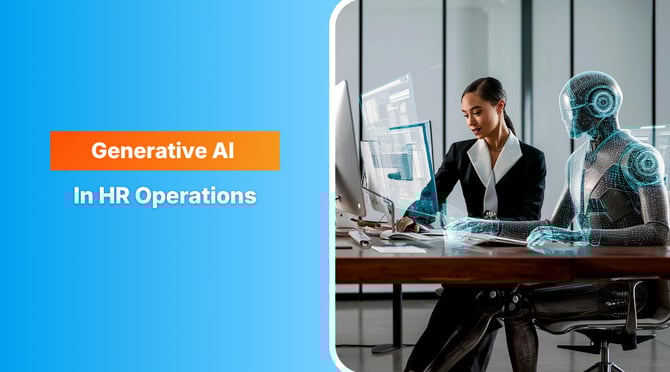
Traditional HR systems were never designed to transform organizational data into actionable insights. But the convergence of AI and human resources is beginning to close that gap.
Precisely, human resources is entering a new era with generative AI redefining organizational management. Back in 2024, Gartner reported that 38% of HR departments were leveraging generative AI tools to streamline human capital management. Besides, the recent McKinsey's comprehensive analysis reveals that HR functions can automate up to 45% of their activities using AI.
This AI adoption is not accidental. HR teams face increasing hiring complexity and growing expectations around employee experience. Generative AI introduces capabilities that automate HR operations with personalized employee development.
Since generative AI is enabling HR leaders to reform the workforce strategy, let us dive into the potential of the use case.
 Generate
Key Takeaways
Generate
Key Takeaways

- Gen AI automates routine tasks, enabling focus on strategic HR initiatives.
- AI recruitment tools accelerate hiring processes through skill-matching accuracy.
- HR analytics powered by AI models help leaders forecast talent needs.
- Organizations adopting AI have a competitive advantage with better talent management.
Generative AI as a Strategic Value Proposition for HR
As organizations grow, human resources must manage rising expectations. Yet many HR departments rely on fragmented systems made of manual workflows for organizational management.
Traditional HR Challenges
|
HR Challenge |
Business Impact |
|
Manual hiring workflows |
Delays in acquiring top talent |
|
Fragmented workforce data |
Poor workforce planning |
|
Limited employee insights |
Low employee engagement |
|
Administrative workload |
Reduced strategic focus |
Using Machine Learning and NLP for AI-based HR analytics systems, teams can analyze workforce data to automate tasks.
State of AI in Human Resources
The adoption of AI in human resources is steadily growing as organizations are integrating AI tools to extract insights from HR data.
Studies from Deloitte and Mercer show that 60–65% of large enterprises are already piloting AI in HR functions. Additionally, IBM indicates that AI-enabled recruitment platforms can reduce the hiring cycle time by up to 50%.
Enterprise Adoption Snapshot for AI in HR
|
HR Function |
AI Adoption Level |
|
Talent Acquisition |
High |
|
HR Operations |
Medium |
|
Workforce Analytics |
Medium |
|
Employee Development |
Emerging |
|
Performance Management |
Emerging |
Gen AI adoption has the most potential for talent acquisition, where it can automate employee screening for interview scheduling and job postings. These improvements significantly reduce administrative workload.
Leading Organizations Already Using Generative AI in HR
Several global organizations are already using Generative AI and machine learning in HR. Below are a few implementations that demonstrate how AI systems create measurable value in HR.
Real Enterprise Examples
- Unilever uses AI-powered recruitment platforms that analyze employee data using ML models. The technology helps to fasten the recruitment process.
- IBM implemented its internal AskHR AI assistant that runs on natural language processing to answer employee queries. The system now manages millions of employee interactions each year. It has helped HR teams to automate answering repetitive support requests.
- L'Oréal also runs AI systems for candidate matching through resumes. It allows HR teams to quickly locate the right talent with minimal screening time.
- Microsoft applies AI-driven workforce intelligence to work at internal talent mobility. By analyzing skills, the company helps employees seek roles that match their capabilities.
- Similarly, Hilton uses AI recruitment platforms to automate screening. It enables faster decisions with improved HRMS software and their efficiency across HR departments.
Generative AI Use Cases Across HR Lifecycle
From attracting top talent to retention, AI systems enable HR teams to generate insights that enhance core HR functions.
Talent Acquisition
Recruitment remains one of the most important applications of AI in HR. Gen AI automatically creates optimized job descriptions and matches candidates with the open roles. By automating these tasks, AI allows HRs to focus on engaging with top talent.
Employee Onboarding
Once a candidate joins the organization, generative AI assistants can support onboarding by answering employee queries. For instance, it can guide new hires through HR documentation. The AI assistants improve the employee experience by providing instant support.
Employee Development
Generative AI contributes a lot in employee development. By analyzing employee performance reviews and skills, AI models create personalized learning paths for employees. It can aid organizations to align employee capabilities with evolving objectives.
Performance Management
Traditional performance management processes often worked through limited feedback cycles. Generative AI allows the analysis of multiple data sources. These insights help managers to conduct more informed employee evaluation.
Employee Engagement and Retention
Gen AI sentiment analysis can track employee disengagement. By monitoring workforce sentiment, HR can cut the attrition risk proactively.
Together, the above-defined capabilities demonstrate how gen AI turns data into actionable insights enabling HR departments to simplify organizational flow.
Recruitment Automation
Recruitment is one of the most important applications of AI automation in HR.
Traditionally, recruiters spent hours comparing candidates to shortlist for the right skills. However, Generative AI systems streamline the process by automating several stages of the hiring workflow. A typical AI-enabled recruitment process works in the following steps:
Step 1: Candidate Data Collection
Candidate’s information enters the recruitment system through career portals. The data typically includes resumes highlighting skills, experience, and professional history.
Step 2: AI Resume Screening
AI-driven tools use natural language processing to extract relevant information and machine learning filters the candidates based on predefined criteria.
Step 3: Skill Matching and Qualification Analysis
The system compares extracted candidate data with requirements defined in the job description. AI models evaluate experience and competencies to determine the role alignment to the vacancy.
Step 4: Candidate Ranking
Qualified candidates are ranked based on relevance and experience level. AI work for skills matches helps recruiters quickly identify top talent.
Step 5: Recruiter Review and Decision Making
Recruiters review the AI-generated shortlist data. Further, they schedule and conduct interviews which are analyzed to make final hiring decisions. However, the process involves human judgment and oversight.
The process enables faster candidate screening with improved talent acquisition outcomes.
AI-led Employee Engagement
Understanding workforce sentiment is critical for improving employee retention. Modern AI systems use machine learning to uncover patterns that humans otherwise miss.
Key engagement signals analyzed by AI include:
• Internal communication platforms to identify sentiment trends and collaboration patterns across teams.
• Employee surveys to detect engagement levels, workplace concerns, and emerging morale issues.
• Performance feedback systems to analyze comments shared during reviews and development discussions.
By combining these signals, AI generates insights that help HR leaders to understand workforce sentiment. These insights allow organizations to address workplace issues quickly.
The AI Tech Stack Behind Modern HR Platforms
Behind every intelligent AI solution is a multi-layer technology stack. It connects workforce data with generative AI capabilities. Modern HR platforms integrate data from multiple enterprise systems and use AI to transform information into decision intelligence.
|
Layer |
Technology |
Role |
|
Data Layer |
HRIS, ATS, payroll software |
Central storage for employee data and workforce records |
|
Data Processing |
Data pipelines, ETL tools |
Integrates and prepares workforce data from multiple sources |
|
AI Layer |
Machine learning models, predictive analytics |
Identifies patterns in hiring, engagement, and workforce trends |
|
Generative AI Layer |
Large language models (LLMs) |
Generates job descriptions, HR reports, and employee communication |
|
Application Layer |
HR dashboards, decision support tools |
Enables HR leaders to visualize insights and make strategic decisions |
In practice, AI systems analyze historical data to identify potential attrition risks. Generative AI converts such insights into actionable recommendations. Also, they enable HR teams to support data-driven decisions.
Mapping AI Technologies for HR Operations
Advanced AI in HR platforms combines multiple technologies to generate strategic insights. Each technology supports specific HR operations. They help HR teams to move from manual administration to automated decision-making.
|
Technology |
HR Application |
|
Natural Language Processing (NLP) |
Automates resume screening Analyzes job applications Extracts skills from candidate profiles. |
|
Machine Learning |
Identifies patterns in workforce data Predict employee retention risks & hiring success. |
|
Generative AI |
Creates job descriptions HR policy documents Training material Internal communication. |
|
Sentiment Analysis |
Interprets employee feedback Surveys Communication to measure engagement levels. |
|
Deep Learning |
Detects complex workforce patterns Helping organizations forecast skills gaps and workforce needs. |
Business Impact of Gen AI in HR
The adoption of Generative AI in human resources has showcased significant benefits across HR operations. By automating repetitive tasks, AI insights allow HR leaders to shift toward strategic growth.
Industry research highlights how these improvements are already materializing across organizations. According to Deloitte Human Capital Trends, AI-driven recruitment tools save a lot of time to hire. Similarly, insights from SHRM show that AI automation reduces manual HR workload.
Employee experience also improves as organizations deploy AI-powered engagement analytics. Studies from Gartner HR Research and Deloitte workforce analytics reports indicate that AI-enabled insights can improve employee engagement scores through better feedback analysis.
Predictive analytics further strengthens workforce stability. Mercer workforce research highlights that AI models analyzing historical workforce data can reduce attrition risk. Moreover, it can aid in improving employee retention through early intervention strategies.
Challenges and Governance
As organizations expand the use of AI in HR, risk management becomes a priority. Since AI systems feed on employee data, enterprises must implement responsible frameworks to ensure compliance.
Data Privacy
HR platforms store sensitive employee data including compensation and benefits. Organizations must implement strict data governance policies and ensure compliance with global regulations.
Algorithmic Bias
AI models trained on historical performance data may unintentionally reproduce bias. HR leaders must regularly audit AI outputs to ensure fairness in performance management.
Regulatory Compliance
Organizations using AI-driven tools in HR operations must ensure compliance with emerging AI governance regulations. Transparent policies help prevent legal risks while ensuring responsible use of artificial intelligence.
Limited AI Literacy
Many HR professionals lack the technical knowledge required to interpret AI-driven insights effectively. Building AI literacy is essential for enabling HR teams to confidently leverage AI tools.
Need for Human Oversight
Responsible AI adoption in human resource management requires human oversight with ethical AI policies. Combining human judgment with AI capabilities ensures balanced decision-making.
The Future of AI and Human Resources
The next phase of AI will transform HR departments into AI-assisted workforce intelligence centers. Instead of focusing primarily on administrative HR processes, organizations will use AI to guide strategic workforce decisions.
AI HR Copilots for Managers
AI-powered copilots will assist managers with everyday HR decisions. These tools will analyze employee data, performance reviews, and engagement signals to recommend actions for employee development, team management, and performance improvement.
Autonomous Recruitment Assistants
Future AI-driven recruitment platforms will automate sourcing, candidate screening, interview coordination, and job description generation. These systems will help HR teams identify top talent faster while reducing manual hiring workloads.
Predictive Workforce Planning
Machine learning models will continuously analyze historical workforce data, hiring patterns, and skills gaps to forecast talent demand. This enables HR leaders to align workforce planning with long-term business objectives.
Continuous Employee Learning Systems
Generative AI will enable personalized learning experiences by recommending training programs based on skills gaps, employee roles, and career progression paths.
Despite these advancements, AI technology will augment rather than replace HR professionals. Human judgment, leadership, and emotional intelligence remain essential for managing people, building culture, and guiding organizational change. AI will empower HR leaders with deeper insights, enabling them to make better data-driven decisions across the entire employee lifecycle.
Conclusion
The convergence of AI and human resources is redefining how organizations manage workforce strategy. Generative AI and advanced AI-driven tools are enabling HR departments to generate actionable insights for better decision-making.
From accelerating the recruitment process to improving employee engagement, AI is transforming HR into a strategic intelligence capability. By leveraging technologies such as machine learning, natural language processing, and generative AI, organizations can enhance the entire HR lifecycle.
Nevertheless, successful AI adoption requires responsible governance and strong human oversight. At Signity, we help enterprises to operationalize custom AI solutions and generative AI development services tailored to HR ecosystems.
By integrating AI models with existing HR platforms, workforce data systems, and analytics frameworks, organizations can build scalable intelligence layers for future-ready workforce management.
Frequently Asked Questions
Have a question in mind? We are here to answer. If you don’t see your question here, drop us a line at our contact page.
How is AI used in Human Resources?

AI helps automate resume screening and candidate matching. It analyzes workforce data and supports workforce planning. HR teams use AI insights to improve hiring, employee engagement, and performance management.
What are the Benefits of Generative AI in HR?
Generative AI creates job descriptions and HR documents. It analyzes employee feedback and engagement signals. HR teams gain faster insights and improve talent acquisition and employee experience.
Can AI replace HR Professionals?
No. AI supports HR professionals by automating repetitive tasks. It provides insights for better decisions. Human judgment and leadership remain essential for managing people and workplace culture.
What are the Risks of Implementing AI in HR?
Key risks include data privacy issues and algorithmic bias. Organizations must also address compliance challenges and low AI literacy. Strong governance and human oversight help reduce these risks.