


.png?width=27&height=27&name=Group(1).png)

-1.svg)
-1.svg)


-2.svg)


%201-1.webp?width=148&height=74&name=our%20work%20(2)%201-1.webp)




.svg)





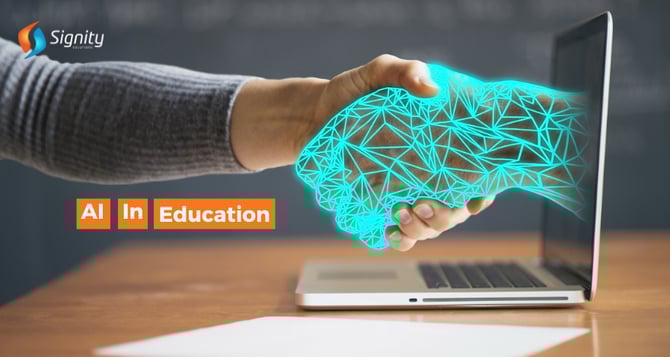
The use cases of Artificial Intelligence can be seen in every industry. AI in education helps deliver personalized learning experiences by adapting content, feedback, and support to individual student needs.
This kind of experience relies on AI technologies and digital tools that support student learning well beyond a single classroom.
Not only that, AI education has also eliminated the global gap in personalized learning. It is helping students connect with quality learning resources, regardless of their location. The technology has enabled students in underserved areas to access quality content and tutoring.
Though there are a few challenges of AI in education, like data equity frameworks, privacy breaches, and data security, partnering with an AI education development company can help you get the right solutions.
Overall, data privacy and responsible use remain top priorities for school leaders and district leaders as adoption grows. This blog will take you through the best ways Artificial Intelligence can be used in the education sector. Also, we will underline how institutions can benefit from it.
 Generate
Key Takeaways
Generate
Key Takeaways

- Some of the major use cases of AI in education include personalized learning for improved student engagement.
- It cuts admin load through automated grading systems and predictive analysis.
- Key benefits of AI in education include improved classroom management, automation in education, enhanced curriculum, and professional development.
- A few challenges of AI in education are data security, ethical use, privacy breaches, and algorithmic biases.
- Integrating AI in the education industry enables educational institutions to gain the best growth opportunities by automating tasks and focusing on each student.
13 Ways How AI Education is Making the Industry Better
The use cases of Artificial Intelligence in the education industry are changing the industry for the better. From personalized learning to quick accessibility, smart content, and automated admin operations, we have listed the advantages of AI in education below:
.png?width=1920&height=1080&name=How%20AI%20Education%20is%20Making%20the%20Industry%20Better%20(1).png)
1. Personalized Learning
One of the biggest benefits of AI in education is personalized learning. The personalized learning market is projected to grow to $57.2 billion by 2035. AI's personal recommendations help students to get insights into their weak areas. It even helps to maximize potential by analyzing performance data and suggesting relevant resources. This kind of personalized content also draws on a student's past experiences with a subject. The insights can be helpful to fine-tune what comes next.
2. AI-Powered Tutors and Assistants
The virtual AI tutors provide students with real-time assistance by helping answer queries. Also, they offer feedback on assignments and guide them through lessons. This 24/7 assistance provides students with continuous support. It further frees up teachers' time by handling routine queries.
This kind of support is especially valuable for supporting students who need extra guidance. It still leaves room for the human connection a good teacher brings, since AI offers assistance without taking over that relationship.
3. Smart Content Creation
Another use of AI in education is smart content creation. About 37% of educators use Artificial Intelligence to generate classroom materials. These include tests for students and other interactive learning materials. It helps them save time and effort while delivering dynamic materials.
Many teachers use these generative AI tools to draft lesson plans. They can also use them to create writing prompts and treat AI-generated output as a first draft that requires human review and refinement.
4. Predictive Analytics for Student Success
AI in education helps institutions identify students who may be at risk of underperforming. It even helps to identify students who are likely to drop out by analyzing their academic data. These insights, along with early warning systems, help schools design better retention programs. These systems draw on historical data to help school leaders. AI can be used to spot patterns early and act before small issues grow.
5. Enhanced Student Engagement
AI helps educators integrate gamified elements into learning programs. It helps to create interactive experiences that make learning more enjoyable. Personalized challenges and interactive quizzes keep students motivated through an enhanced learning experience. These student activities keep engagement high in the modern classroom.
6. Automated Grading Systems
Artificial Intelligence in education reduces the time required for grading by up to 90%. AI streamlines the grading process by automatically assessing exams and assignments. It even helps educators focus on more complex tasks including feedback and mentoring.
Hence, it accelerates feedback loops and provides students with timely insights into their progress. This also gives students instant feedback. However, tasks requiring nuanced judgment and contextual feedback still require teacher involvement.
7. Adaptive Learning Platforms
The AI platforms in the education industry adjust learning content in real-time based on the students' progress. It also continuously assesses each student's performance for adaptive learning.
Overall, it fosters a more effective learning environment where students can work at their own pace. These AI programs work to personalize the pace for one student at a time.
8. Immersive Learning with AI-Driven Simulation
Artificial Intelligence in education is integrated with virtual and augmented reality (VR/AR) to create immersive learning environments. It provides students with hands-on, practical experience in fields like science, medicine, and engineering to boost understanding and retention.
For example, in a PTA to PT program, AI can be used to practice diagnosing diseases and creating treatment plans with simulated VR patients. Hence, students can engage with complex scenarios and experiments. These kinds of digital tools work well in many educational contexts beyond healthcare training alone.
9. Streamlined Administrative Tasks
The combination of AI and education helps reduce educators' administrative burdens. It can be used to scheduling classes or manage student records and processing applications. It further lowers errors and streamlines communication between students, parents, and educators. Cutting down these routine tasks frees up school leaders to spend more time on decisions that need their direct attention.
10. Virtual Classrooms for Better Learning
Did you know that studies have shown that about 63% of students choose to study online due to the flexibility of virtual learning? AI helps power virtual classrooms by enabling real-time interactions. It can track student engagement and suggest improvements to online teaching methods. This also supports more equitable access to quality instruction for students who cannot attend in person.
11. Language Translation and Localization
Another advantage of AI in education is that it breaks language barriers by translating educational materials into multiple languages. It creates more inclusive classrooms, where language is no longer a barrier to learning. Also, AI ensures culturally relevant examples are used through localization. This helps increase accessibility for students learning in a second language.
12. Special Needs and Accessibility Support
AI-driven tools like speech-to-text and text-to-speech assist students with disabilities. AI can make learning more accessible to those with visual, hearing, or cognitive impairments. These technologies promote greater inclusivity in classrooms to level the field for students with different learning needs. These tools increase accessibility and help ensure equitable access to the same lesson content as their peers.
13. Data-Driven Insights for Curriculum Improvement
AI collects and analyzes vast amounts of data from classrooms to offer insights into what's working and what isn't, helping educators refine their curriculum and teaching strategies for better student outcomes. By identifying patterns and trends, AI helps schools create more effective curricula. By reviewing historical data over multiple terms, schools can better anticipate future events like enrollment shifts or emerging skill gaps.
Key Benefits of AI in Education for Schools and Education
AI in education offers various benefits to schools and education institutes, making the process easier and more efficient.
1. Professional Development of Teachers
AI provides tailored training and feedback for teachers, helping them improve their teaching techniques and stay updated with evolving educational trends. It can recommend specific resources or training modules based on individual teacher performance. This kind of AI offers ongoing skills development for many teachers across a school, from new hires to veteran staff, keeping good teaching practices current.
2. Improved Classroom Management
AI tools help teachers manage classrooms more effectively by analyzing student’s behavior patterns. These insights enable teachers to adjust their approach and optimize seating arrangements. Teachers can work to enhance group dynamics for better learning outcomes. This helps in the modern classroom, where behavior patterns can shift quickly during a term.
3. Predictive Enrollment and Resource Planning
AI forecasts student enrollment trends, enabling schools to plan resources. These may include staffing, classroom spaces, and learning materials more efficiently. It ensures that schools are prepared for future growth or declines in student numbers. This helps district leaders plan ahead for future events like growth spurts or enrollment drops.
4. AI-Enhanced Curriculum Design
AI can analyze global educational trends and student performance data. Also, it can feed on industry demands to help schools create or update curricula. It ensures that educational content stays relevant and aligns with future skills requirements. This keeps education technology and curriculum planning aligned with real skills demand.
5. Automation in Education
AI education leads to the automation of administrative tasks. It ensures fairness in assessment and interpretation in marketing. Both actions help to nurture improvement of the education system. AI has emerged as one of the most important tools in the education system. Artificial intelligence AI continues to expand its role in cutting down routine tasks across school operations.

Challenges of AI in Education
Implementing AI in the education industry comes with different challenges. From privacy concerns to location, accessibility, and ethical considerations, here is the list of the challenges.
1. Algorithmic Biases
AI systems can inherit biases from the data they are trained on. This may lead to unfair outcomes for certain student groups. For example, inaccurate assessments or unequal access to opportunities.
Responsible use of these AI programs requires regular checks to correct such patterns early.
2. Data Security
Educational institutions face challenges in securing large amounts of student data collected by AI systems. This makes them vulnerable to hacking and data breaches.
3. Privacy Breaches
With AI collecting sensitive student information, there is a growing risk of unauthorized access. It raises concerns over how personal data is stored and used.
This makes data privacy one of the most important issues schools need to manage carefully.
4. Ethical Use of AI
The ethical implications of AI in education are still evolving. It brings concerns over transparency and accountability. Moreover, the potential misuse of AI-driven decisions can even affect student futures.
Human judgment still needs to guide decisions in cases where AI-driven output could affect a student's future.
5. Over-Reliance on AI
Leaning on AI too heavily can chip away at critical thinking if students start treating AI output as the final answer. Some educators worry that over-reliance on generative AI tools shrinks the productive struggle that builds real skills. Which is why human judgment still needs to guide how these tools get used in the classroom.
Build the Best AI Education Tools With Our AI Experts
Whether you want AI in higher education institutions or for personalized learning, our educational technology will help you get the perfect solutions. With technology like machine learning, deep learning, natural language processing, and data analysis, we build high-quality tools to enhance the learning experience.

Mangesh Gothankar


Ashwani Sharma
Achin Verma
Frequently Asked Questions
Have a question in mind? We are here to answer. If you don’t see your question here, drop us a line at our contact page.
How is AI used for Education?

AI is used in education to personalize learning experiences, providing tailored support and feedback for both students and teachers, thereby enhancing teaching practices and improving educational outcomes.
Why is AI the Future of Education?
AI is considered the future of education because it promotes personalized learning at scale, allowing educators to address diverse student needs effectively while enhancing engagement through adaptive tools and systems.
How AI has a Positive Impact on Education?
AI positively impacts education by providing personalized adaptive learning solutions that cater to individual student needs, thereby improving learning outcomes and engagement.
How does AI Personalize Learning for Students?
AI personalizes learning by analyzing individual student data, such as learning styles and performance metrics, to tailor educational content and recommend resources that match their unique needs and pace.
How does AI Improve student Engagement?
AI enhances student engagement through interactive learning experiences, personalized feedback, and gamified learning environments that motivate students to participate actively in their education.
What is an AI Agent in Education?
Is AI in Teaching Meant to Replace Teachers?






.png?width=352&name=enterprise-rag-business-usecases%20(2).png)