


.png?width=27&height=27&name=Group(1).png)

-1.svg)
-1.svg)


-2.svg)


%201-1.webp?width=148&height=74&name=our%20work%20(2)%201-1.webp)




.svg)





Most plants run maintenance one of two ways: fix it when it breaks, or service it on a fixed schedule, whether it needs it or not. Both cost money they didn't have to spend. Reactive maintenance means downtime nobody planned for. Scheduled maintenance is safer on paper, but technicians still end up in the field too early or too late.
Predictive maintenance takes a different approach. It uses sensor data, maintenance history, and production context to feed into a model that is trained to catch early signs of wear. That means catching a failing part before it actually fails, planning maintenance windows around real need instead of a calendar, and putting technicians on machines that actually need attention.
According to Deloitte, around 84 percent of respondents report measurable value from AI in their operations. Additionally, the reports predicted an average improvement potential across core operational KPIs reported at around 20 percent.
The opportunity is real, the difference lies in execution., and every hour of unplanned downtime has a visible cost. Let's quickly move to learning how AI for manufacturing related predictive maintenance has the potential to transform the manufacturing industry.
 Generate
Key Takeaways
Generate
Key Takeaways

- AI predictive maintenance identifies a failing component with enough lead time to schedule a proper repair.
- Manual inspection often misses early warning signs that vibration and temperature readings pick up clearly.
- Most of the return on a predictive maintenance program comes from avoided downtime.
- Bad sensor data sinks a model just as fast as a bad algorithm.
- 2026 plants are pairing digital twins with edge AI and explainable predictions.
What Is Predictive Maintenance Machine Learning?
Equipment failure is rarely sudden. A bearing wearing down, a motor running hotter than spec, a pump's vibration signature drifting, these changes build for days or weeks before a breakdown actually occurs. Predictive maintenance machine learning is built to catch that drift, feeding sensor data and maintenance history into a model trained on the patterns that preceded past equipment failures.
Why Traditional Maintenance Strategies Fall Short?
| Strategy | Limitation |
| Reactive maintenance | Repairs happen after failure, which creates downtime and emergency costs |
| Preventive maintenance | Work is scheduled on a calendar, even when the asset is still healthy |
| Predictive maintenance | Maintenance is triggered when risk indicators emerge, not when the clock says so |
Predictive maintenance runs on evidence, not assumptions.
How does AI predictive maintenance work?
A sensor on a bearing or motor housing doesn't know it's important. It just reports temperature, vibration, current draw, whatever it's built to read. What makes that data useful is the model behind it. Trained on years of past failures, AI in manufacturing aligned on predictive maintenance can usually tell normal wear from the kind of reading that shows up right before something actually breaks, and that's the gap a work order gets filed into.
Typical flow
Data Collection → Sensor Data → Analytics Platform → Machine Learning Models → Predictive Insights → Maintenance Teams → Work Orders
The signals that matter most
| Signal | What it reveals |
| Vibration analysis | Bearing wear, imbalance, looseness, and alignment issues |
| Temperature monitoring | Heat drift, friction, overload, and thermal stress |
| Pressure monitoring | Blockages, leaks, and abnormal system behavior |
| Acoustic analysis | Early-stage mechanical wear and hidden anomalies |
| Machine performance tracking | Throughput decline, cycle instability, and process drift |
| Equipment health scoring | A single operational view of asset condition |
These signals are especially useful for assets with repeatable operating patterns, such as CNC machines, motors, pumps, compressors, robotics systems, and production lines. In 2026, predictive maintenance is also showing up in fleet management equipment and material-handling systems. Downtime in those areas spreads quickly across the plant.
The Architecture Behind AI Based Predictive Maintenance
AI based predictive maintenance architecture combines IoT devices, edge computing, cloud analytics, machine learning models, maintenance systems, and operational workflows into one decision layer.
Core Architecture Components
| Layer | Purpose |
| Sensors | Collect machine and process data |
| Edge systems | Process signals close to the equipment |
| Data platform | Store, clean, and normalize information |
| AI models | Predict failures and score risk |
| CMMS integration | Turn insights into maintenance execution |
| Dashboard layer | Give operations visibility into asset health |
Data sources that matter most
- Sensor data: Provides the live signal stream from equipment.
- Maintenance logs: Shows failure history and prior interventions.
- ERP records: Connects maintenance to cost and supply context.
- Production schedules: Reveals load changes and bottleneck timing.
- Quality control systems: Links asset condition to output quality.
- Energy consumption data: Surface efficiency drift and operating strain.
Machine Learning Models Commonly Used
| Model type | Typical use |
| Random Forest | Baseline classification and failure scoring |
| Gradient Boosting | Higher-accuracy risk prediction on structured data |
| Deep Learning | Complex pattern detection in large sensor datasets |
| Time series forecasting | Trend and remaining-useful-life estimation |
| Anomaly detection models | Early warning when equipment behavior changes |
Why poor data quality breaks ROI?
Predictive maintenance fails fast when the data foundation is weak. The biggest issues are inconsistent sensor calibration, missing maintenance history, disconnected legacy systems, and fragmented production data.
That is why many manufacturing programs spend more time on integration than model training.
2026 insight
The most practical AI maintenance stacks are becoming hybrid where Edge AI handles latency-sensitive inference near the machine. Besides, Cloud systems handle retraining and fleet-level analytics. Maintenance teams handle exceptions and approvals.
Building the Business Case: Predictive Maintenance ROI Explained
Predictive maintenance ROI is the financial return from less downtime, lower maintenance costs, and longer equipment life. Better resource allocation tends to follow once these three improve.
The five ROI drivers
| ROI driver | How it creates value |
| Reduced unplanned downtime | Protects output, delivery commitments, and customer satisfaction |
| Lower maintenance costs | Shifts spend from emergency work to planned interventions |
| Increased equipment lifespan | Slows degradation and extends asset life |
| Better resource allocation | Frees technicians for planned, higher-value work |
| Energy optimization | Reduces waste and improves operating efficiency |
ROI formula
ROI = (Financial Benefits - Implementation Cost) ÷ Implementation Cost x 100
Example ROI scenario
| Metric | Before AI | After AI |
| Downtime hours per quarter | 120 | 72 |
| Maintenance cost per quarter | $480,000 | $360,000 |
| Asset utilization | 78% | 87% |
| Emergency repairs | 34 | 11 |
If the program costs $250,000 to implement and saves $400,000 to $700,000 annually through downtime reduction and maintenance efficiency, the payback case becomes easy to defend.
Executive metrics to track
| Metric | Why it matters |
| MTBF | Shows whether failures are becoming less frequent |
| MTTR | Shows whether repair time is shrinking |
| OEE | Captures availability, performance, and quality together |
| Asset utilization | Tracks whether equipment is producing more value |
| Maintenance cost per asset | Exposes the financial effect of the program |
| Failure prediction accuracy | Measures whether the model is trustworthy |
Related Read: Role of AI in Predictive Maintenance
A Practical Implementation Roadmap for Manufacturers
| Phase | What to do | Why it matters |
| Asset prioritization | Start with critical, bottlenecked, or failure-prone assets | Concentrates effort where ROI is visible fast |
| Data collection | Gather sensor data, maintenance records, production context, and asset metadata | Creates the dataset the models need |
| Model development | Build anomaly detection, predictive classification, and failure forecasting | Turns raw data into useful signals |
| Operational integration | Connect predictions to CMMS, ERP, and work-order workflows | Makes the insight actionable |
| Continuous optimization | Retrain models, monitor drift, and validate alerts | Keeps performance stable over time |
Common reasons projects fail
| Challenge | Impact |
| Poor data quality | Low prediction accuracy |
| Legacy systems | Integration delays |
| Lack of governance | Limited adoption |
| Undefined KPIs | Weak ROI visibility |
| No maintenance buy-in | Operational resistance |
If the maintenance team does not trust the alerts, the project stalls. If the project does not connect to work orders, the model becomes a dashboard nobody uses.
Emerging Trends Shaping AI Predictive Maintenance in 2026 and Beyond
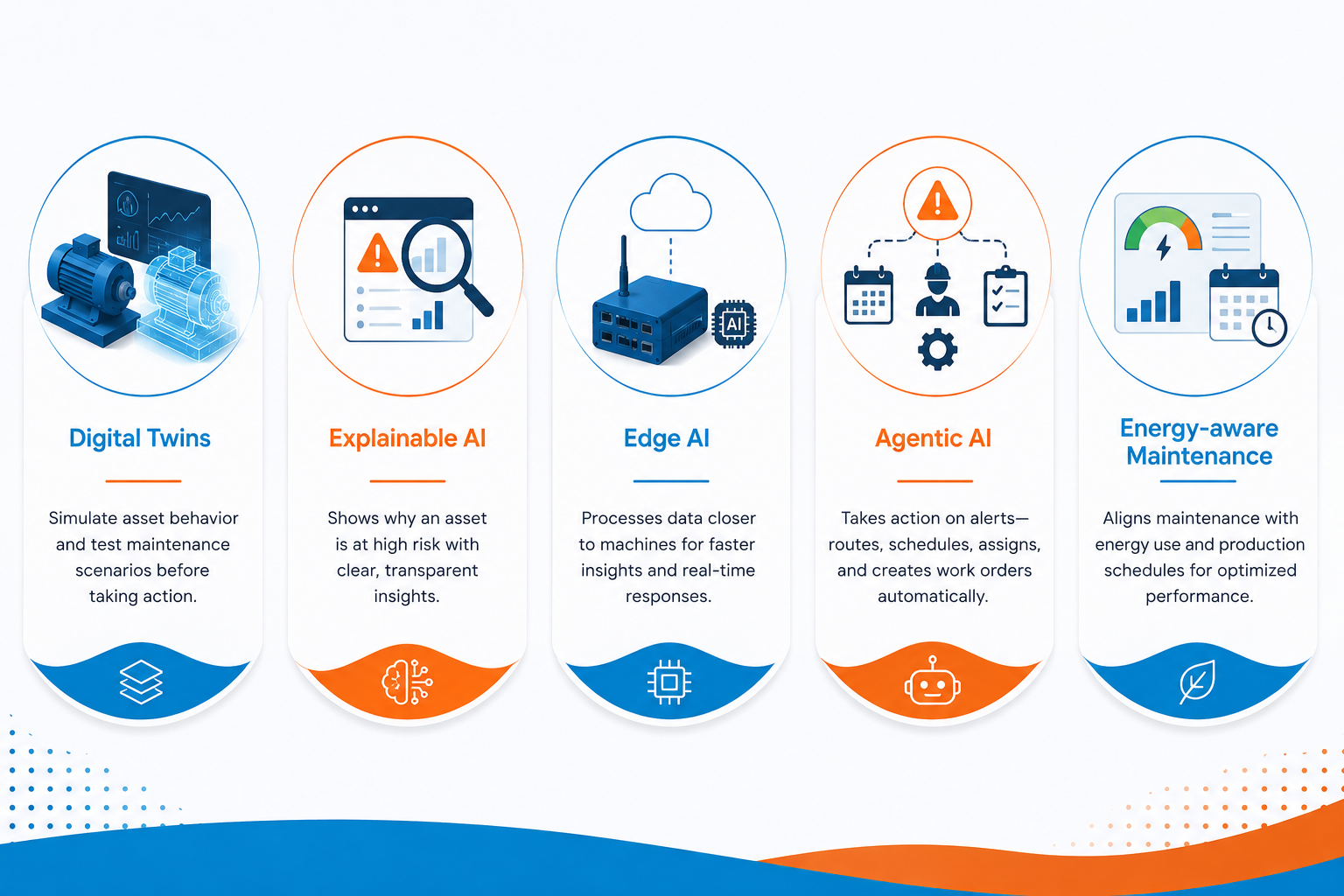
- Digital Twins
Enable manufacturers to simulate asset behavior, evaluate performance under different operating conditions, and test maintenance scenarios before taking action on physical equipment. - Explainable AI
Provides transparency into model recommendations by showing maintenance teams why a machine, component, or asset has been flagged as high risk. - Edge AI
Moves data processing and inference closer to the machine, reducing latency and enabling faster responses to emerging equipment issues. - Agentic AI
Agentic AI takes a failure alert and runs the response: it routes the alert, schedules the maintenance window, assigns a technician, and generates the work order, with little need for manual intervention. - Energy-aware maintenance planning
Energy-aware maintenance planning ties maintenance timing to energy consumption and production schedules. The result is better operational efficiency and more consistent asset performance, without one coming at the expense of the other.
Recent research keeps reinforcing the explainability point. A 2026 arXiv paper, Explainable AI to Improve Machine Learning Reliability for Industrial Cyber-Physical Systems, shows how SHAP can uncover model reasoning and improve reliability.
A 2026 review, Neuro-symbolic AI for Predictive Maintenance, argues that hybrid approaches can improve accuracy and robustness. It means the future is more autonomous factories, smarter scheduling, tighter supply chain integration, and better quality control.
What does 2026 mean?
The 2026 AI Index report shows a wider gap between AI capability and enterprise readiness. Governance frameworks, evaluation methods, and data infrastructure are still struggling to keep pace, which is exactly why predictive maintenance programs need traceability, continuous monitoring, and clear ownership.
Why Manufacturers Partner With Signity for AI in Manufacturing?
AI predictive maintenance requires more than a model. It needs industrial data engineering, integration work, and enough delivery discipline to survive the plant floor.
Service capability map
| Capability | What it covers |
| Industrial data engineering | IoT integration, real-time pipelines, predictive analytics platforms |
| Machine learning development | Anomaly detection, machine failure prediction, deep learning solutions |
| Manufacturing system integration | ERP, MES, CMMS, and SCADA connectivity |
| Enterprise AI governance | Model monitoring, security, scalability, and explainability |
Every deployment worked at Signity is tied back to one of four outcomes: downtime reduction, maintenance cost savings, operational efficiency, and asset reliability. That is the part many vendors skip. For us, the point is not to deploy AI, but the point to make the factory run better.
Conclusion
Predictive maintenance machine learning is a high-value AI use case in manufacturing. It turns machine data into decisions before failure hits the line.
Ultimately, the success depends on architecture, data quality, implementation discipline, and ROI measurement. Winners connect AI, IoT predictive analytics, manufacturing, and maintenance workflows into one model.

Mangesh Gothankar


Ashwani Sharma
Achin Verma
Frequently Asked Questions
Have a question in mind? We are here to answer. If you don’t see your question here, drop us a line at our contact page.
What is predictive maintenance machine learning?

How does AI predictive maintenance reduce downtime?
What data is required for predictive maintenance solutions?
What ROI can manufacturers expect from AI predictive maintenance?
What are the biggest challenges in predictive maintenance implementation?