











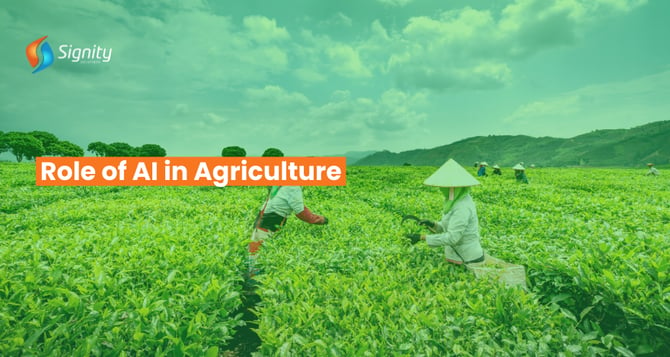
Artificial intelligence is changing how agricultural businesses monitor crops, manage resources, predict yields, and make operational decisions. By combining machine learning, computer vision, IoT sensors, and predictive analytics, AI helps farmers move towards more precise and data-driven farming practices.
As a digital technology, AI in agriculture relies on AI algorithms, AI models, computer vision, and machine learning to analyze historical data and guide farming decisions. The UN projects that the global population will rise from 8.2 billion in 2024 to about 10.3 billion by the mid-2080s, which places agricultural production under growing pressure.
According to BCC Research,the AI in agriculture market is projected to grow from $2.8 billion in 2025 to $8.5 billion by 2030, reflecting the growing adoption of AI-driven technologies across the agricultural sector.
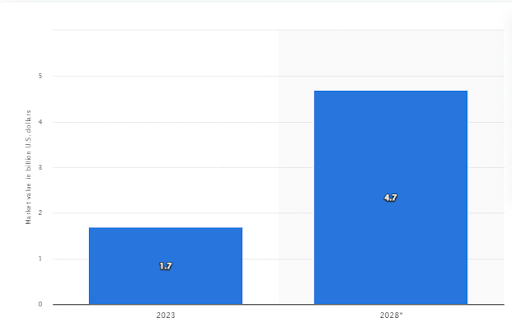
Discover the use cases, benefits, and challenges of implementing AI in agriculture in the sections below.
Key Takeaways
- Optimized Farming: AI boosts productivity with precision farming, predictive analytics, and smart irrigation.
- Automation Benefits: Robots and drones cut costs and streamline farming tasks.
- Sustainable Practices: AI minimizes waste, conserves resources, and supports eco-friendly farming.
- Adoption Challenges: High costs and tech integration hurdles limit wider use.
Applications of AI in Agriculture
The use cases of AI in the farming and agriculture sectors can be seen in various ways. From smart irrigation systems to water monitoring and more, applications of AI in agriculture are listed below:

1. Precision Farming
In order to maximize productivity, farmers can optimize planting dates, crop management, and resource allocation with the aid of AI-powered predictive analytics and Internet of Things sensors. Satellite imagery and spatial data also map variations in soil and crop vigor, which allows inputs to be adjusted zone by zone, unlike traditional methods that treat an entire field alike.
These tools assess data such as crop health, weather trends, and soil quality using machine learning algorithms. By using data to inform their decisions, farmers may increase output and decrease waste. The reliability of these recommendations depends on the quality of the farm data collected.
2. AI-Enabled Drones for Monitoring
Drones with artificial intelligence (AI) and sophisticated image and data processing tools offer real-time information on soil conditions, pest infestations, and crop health. Computer vision models analyze the captured images to detect stressed plants, weeds, and gaps in crop stands.
Large areas are swiftly covered by these drones, which provide high-resolution data that is unmatched by manual inspections. Farmers can use this information to pinpoint issues and implement quick fixes.
3. Automated Irrigation Systems
Water waste is decreased via automated irrigation systems that use AI and IoT to modify water levels based on crop requirements, weather forecasts, and soil health. Precision irrigation relies on soil moisture readings and local conditions rather than fixed schedules, ensuring crops receive water only when needed.
In order to predict rainfall and modify irrigation schedules appropriately, these systems interface with weather forecasting technologies. In addition to saving water, this helps ensure that crops receive the ideal amounts of moisture for robust development. Since agriculture accounts for more than 70 percent of global freshwater withdrawals, according to FAO, this kind of water management can help lower water usage.
4. AI-Powered Pest Management
Real-time data analysis is used by AI-driven pest management systems to detect and forecast pest outbreaks, allowing for prompt intervention. These systems use picture recognition to identify particular pests and suggest suitable treatment methods. Computer vision supports pest detection by identifying weeds, insects, and disease symptoms in images, which makes pest control more targeted.
They contribute to crop quality and environmental balance by reducing the use of chemicals. In crop protection, John Deere reports that its See & Spray technology covered more than 5 million acres in 2025 and reduced non-residual herbicide use by nearly 50 percent on average, although these figures are company-reported.
5. Nutrient Optimization
AI systems evaluate crop and soil health data to suggest accurate fertilizer applications that support balanced nutrient delivery. To prevent overfertilization, they take into consideration factors such as crop type, development stage, and weather.
This method increases crop yields while lowering expenses and the impact on the environment. AI models estimate nutrient levels from soil tests and recommend variable-rate applications, with more fertilizer where plants need it and less elsewhere.
6. Farm Management Platforms
Through data analysis, AI-integrated farm management systems offer actionable insights that enhance decision-making and operational effectiveness. These solutions provide a consolidated dashboard with capabilities like task scheduling, cost analysis, and inventory management. Agricultural professionals can use these dashboards to make informed decisions across farming operations.
With less work, farmers may streamline everyday tasks and manage resources more effectively.
7. Robots for Harvesting
AI-powered robots increase production and lower labor costs by automating operations like planting, weeding, and harvesting. These robots, which are outfitted with sensors and artificial intelligence algorithms, operate precisely to protect fragile crops. Computer vision allows robotic harvesters to judge fruit ripeness, while predictive models determine harvest timing from weather and crop stage.
They can work around the clock, which can mean quicker harvests and more productivity during busy times, especially when paired with harvest management software to plan and track outcomes. However, harvesting robots remain at an early stage and currently suit only a limited range of crops.
8. Weather Forecasting for Crop Planning
Farmers can better plan their planting and harvesting operations with the aid of AI-powered weather forecasting tools that evaluate both historical and current data.
These devices offer hyper-local weather information, including temperature variations and rainfall forecasts. Farmers can reduce risks and save losses from unforeseen weather events by using precise forecasts. Over several seasons, these tools also support climate adaptation by helping farmers choose planting windows and varieties suited to changing conditions.
9. Data-Driven Soil Health Analysis
Farmers can carry out focused treatments to improve soil health by using AI and IoT devices to gather and evaluate soil data. Insights like pH levels, moisture content, and nutritional deficits guide sustainable agricultural methods.
In addition to improving the total productivity of agricultural land, this helps maintain soil fertility in the long run. The analysis also shows which parts of a farm need amendments or a different land use.
10. AI-Enhanced Crop Yield Predictions
Better supply chain planning is made possible by AI-powered predictive analytics, which forecast crop yields using information from IoT devices, weather patterns, and historical trends. These forecasts assist suppliers and farmers in anticipating demand and effectively allocating resources. Models trained on historical data also inform crop selection and help plan logistics across the value chain.
This AI in agriculture technique helps to increase market stability and profitability by reducing uncertainty.
11. Generative AI for Farmer Advisory
Generative AI and natural language processing allow farmers to ask questions in their own language and receive guidance on pests, weather, and crop care through text or voice.
7 Major Benefits of AI in Agriculture
Artificial Intelligence in agriculture not only saves time for the farmers but also provides smart solutions for better results. Some of the most notable benefits include:
1. Enhanced Resource Optimization
Water and fertilizers are given exactly where and when needed, thanks to AI-driven irrigation systems and machine learning techniques. Crop productivity is increased, and waste is reduced through real-time weather and soil monitoring. In turn, this improves farm efficiency and supports food security by producing more from the same land.
2. Improved Crop Health Monitoring
AI-enabled drone technology analyzes visual and multispectral data to deliver comprehensive insights on crop health. It makes it possible for farmers to identify illnesses, pests, and nutrient shortages early on and take appropriate action. Timely action protects yield and results in healthier crops at harvest.
3. Increased Yield Prediction Accuracy
Machine learning and AI-powered data analysis methods provide more precise yield forecasts based on both historical and current data. Farmers may better plan, prevent shortages or overproduction, and effectively satisfy market demands with the use of these insights. Accuracy still depends on how well the models are trained for the region.
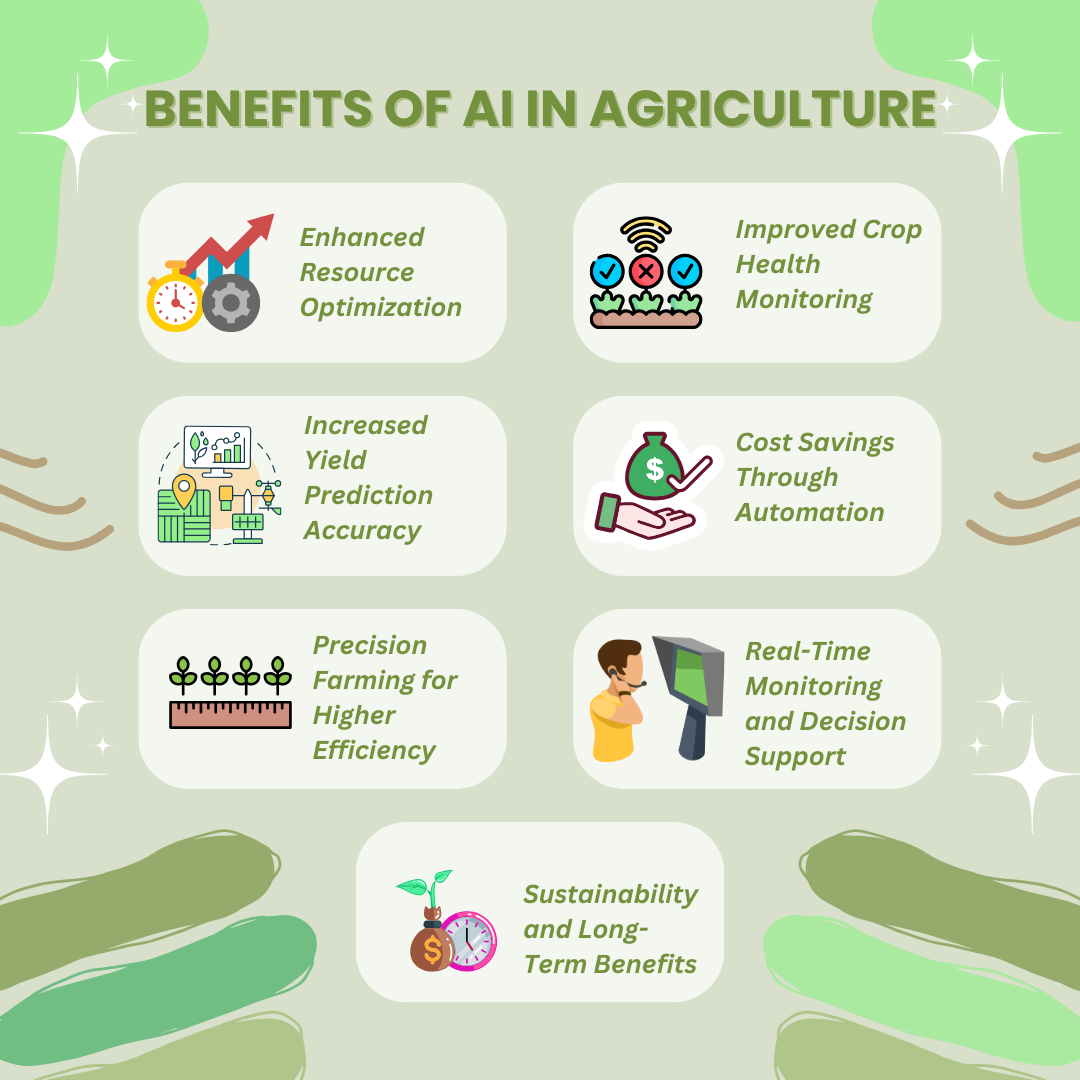
4. Cost Savings Through Automation
Automation and AI-powered robots lessen the need for human labor in repetitive operations like weeding, planting, and harvesting. Farmers can increase speed and efficiency while lowering operating costs by automating these procedures. This results in greater efficiency during busy seasons, although the upfront equipment cost must be weighed against the savings.
5. Precision Farming for Higher Efficiency
With the use of AI and drone technologies, precision farming gives farmers comprehensive, useful information for field management. Input costs are decreased by treating particular areas, for example, by using pesticides or fertilizers. Targeted treatments also improve operational efficiency because chemicals are applied only where a problem is detected.
6. Real-Time Monitoring and Decision Support
Real-time weather, crop, and soil monitoring are made possible by AI-enabled technologies, which facilitate prompt decision-making. Farmers are given tips and actionable notifications to assist them in promptly reducing risks. This supports data-driven decisions at the moment they matter most.
7. Sustainability and Long-Term Benefits
By using less water, fertilizer, and pesticide, AI-driven irrigation systems and resource optimization tools promote sustainable farming. Through the identification of the most effective farming techniques, automated data analysis encourages ecologically friendly activities.
Such practices form the core of sustainable agriculture, as AI minimizes environmental impact by applying each input only where needed. According to FAO, agrifood systems produced about 32 percent of global emissions in 2023, so lower fertilizer and fuel use can help reduce greenhouse gas emissions.
Challenges of AI in Agriculture
AI in agriculture comes with several challenges, some of which include the following:
1. High Costs and Financial Challenges
Because AI technologies, like AI-driven robotics or surveillance tools, are expensive, the initial investment is frequently prohibitive. Widespread adoption is constrained by the financial difficulties faced by many farmers, especially those operating on a small scale. Farmers may therefore evaluate the payback period before investing, starting with the use case expected to recover costs fastest.
2. Integration Issues with Existing Systems
It can be difficult and time-consuming to integrate AI technologies with conventional farming methods. Compatibility between new AI tools and historical equipment is necessary for agricultural data processing, but this isn't always easy to do. Moving from traditional methods to connected tools usually requires phased AI deployment and open data formats.
3. Need for a Tech-Savvy Workforce
Implementing AI successfully frequently calls for a tech-savvy staff with technical know-how in AI system operation and maintenance. Adoption time is slowed by the difficulty many farmers have hiring or training staff with the requisite capabilities. Hands-on experience with pilot projects helps staff build the skills needed to operate these systems.
4. Data Ownership and Security Gaps
Large volumes of valuable data are produced by agricultural data analysis, which raises questions about data ownership and governance. Sensitive agricultural data may be exposed to breaches or misuse by other parties due to security flaws. Ownership is often unclear between the farmer, the equipment maker, and the software vendor.
5. Job Loss Fears and Resistance to Change
Agricultural workers are worried about losing their jobs as a result of the automation of farming chores, including harvesting and monitoring. The difficulty of switching from conventional to new farming methods is another factor contributing to resistance to AI.
6. Poor Data Quality and Weak Connectivity
AI models depend on accurate inputs, and data quality suffers when sensors are miscalibrated or records are incomplete. Limited rural connectivity can further restrict cloud-based tools.
7. Models Not Suited to Local Conditions
Models trained in one region may not perform well under different local conditions, and generative tools can produce incorrect advice. Testing across a full season and expert review help limit these risks.
Future Trends in AI for Agriculture
AI in agriculture has the potential to revolutionize the industry in the future thanks to new developments and innovations that increase sustainability and production. Robots driven by AI will grow more productive, automating chores like planting and harvesting while reducing their negative effects on the environment.
More precise real-time monitoring of soil, crops, and weather conditions will be made possible by machine learning and sophisticated algorithms, which will also help anticipate pest outbreaks and maximize resource utilization. AI use in the agriculture supply chain will increase productivity from farm to market and streamline processes.
However, the equitable implementation of AI technologies would need to tackle issues like data protection, adjusting to legal changes, and guaranteeing fair access.
Generative AI is also expected to provide daily advisory support, particularly through voice assistants in local languages.
Build Custom AI Agriculture Solutions
Are you looking for smarter solutions, or do you want to boost productivity? Whatever your business needs might be, our AI experts at Signity Software Solutions will help you design and develop a tailored solution. Together, we can build innovative solutions suited to specific fields, crops, and data.
Connect with our professionals, explain your project needs, and get customized solutions for your business.

Mangesh Gothankar


Ashwani Sharma
Achin Verma
Frequently Asked Questions
Have a question in mind? We are here to answer. If you don’t see your question here, drop us a line at our contact page.
How is AI used in Agriculture?

Will AI Replace Farm Workers?
While AI will enhance farm operations and may replace certain tasks traditionally performed by farm workers, it is expected to complement human labor rather than completely replace it, leading to a shift in job roles within the agricultural sector.
What are the Benefits of AI-Powered Robots in Agriculture?
Can AI Improve Sustainability in Agriculture?
How does AI impact the Agriculture Supply chain?
AI enhances supply chain efficiency by improving yield prediction, optimizing logistics, and stabilizing commodity prices through better demand and supply planning.