


.png?width=27&height=27&name=Group(1).png)

-1.svg)
-1.svg)


-2.svg)


%201-1.webp?width=148&height=74&name=our%20work%20(2)%201-1.webp)




.svg)





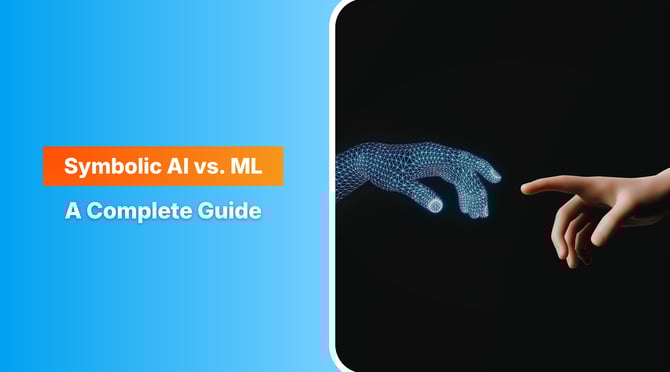
The artificial intelligence world continues to evolve at breakneck speed, and it is driven by two popularly described models: symbolic systems that work on logic and machine learning that detects patterns from the data given. These two paradigms help shape how businesses design AI solutions, ensure explainability, and build intelligent systems.
As per a report from Yahoo, the investment in AI has reached a ground breaking record. It is expected to surpass $300 billion by 2026. This highlights the importance of understanding how logic and patterns differ and how they help businesses seek innovation.
Symbolic AI follows a classic approach. It excels in tasks that need logical reasoning and knowledge-intensive applications. Whereas machine learning excels in handling complex and unstructured data like natural language and images.
Well, here is a blog that covers the differences between symbolic AI and machine learning, with symbolic AI examples, and why it is relevant for businesses.
 Generate
Key Takeaways
Generate
Key Takeaways

- Symbolic AI vs. machine learning is all about logic-based reasoning and pattern-based learning.
- Symbolic AI is focused on compliance and explainability, while machine learning handles unstructured and complex data.
- Choosing the right approach depends on use cases and business goals.
- Hybrid AI is one of the emerging trends that combines reliability and scalability.
What is Symbolic AI
It is a unique and classic approach in AI research that is built on logic and properly structured data. It does not need data training as these systems learn from human-written logics. It simply encodes the expertise of humans to text, rules, and relationships. The machine then predicts and explains its decisions.
This is quite a useful approach in domains that are knowledge-intensive, like medical diagnosis, reasoning, and compliance. A few real-world examples include systems that can offer recommendations on diagnostics and chatbots that are rule-based and can help solve customer queries via a structured approach.
What is Machine Learning
Machine learning follows a different approach from symbolic AI. It does not rely on defined rules; it continuously learns from the data to generate a response. It uses large and complex datasets to identify patterns that would be difficult to encrypt manually. For tasks like image recognition and fraud detection, it is an ideal approach.
It may rely on specialized techniques to translate its decisions. Analyzing the experiences allows these systems to improve and adapt to evolving patterns, the latest information, and more. So whether you are shopping online or browsing social media. Machine learning analyzes the data and patterns according to the user's behavior and predicts their preferences automatically.
Logic vs. Patterns: Core Differences
The section covers the basic differences between symbolic AI and machine learning, including the core approach, decision-making capabilities, use cases, and more. Understanding the features helps businesses choose the right approach as per their business needs.
|
Feature |
Symbolic AI |
Machine Learning |
|
Core Approach |
Logic-based and rule-driven |
Data-driven, pattern recognition |
|
Decision Making |
Predictable and explainable |
Probabilistic, maybe opaque |
|
Best For |
Knowledge-intensive tasks, compliance |
Large, complex, unstructured data |
|
Examples |
Expert systems, knowledge graphs, and rule-based chatbots |
Image recognition, NLP, recommendation systems |
|
Adaptability |
Limited, requires manual updates |
Learns and improves from data |
|
Transparency |
High, as every decision is traceable |
Low to medium, requires interpretability tools |
1. Core Approach
Symbolic AI relies on predefined rules and logic. Here, all actions are governed by clear frameworks that humans can understand. On the other hand, machine learning follows a data-centric approach that analyzes the most complex and large datasets. Symbolic AI needs experts to define knowledge, and machine learning discovers dynamic insights that make it useful for environments with complex patterns.
2. Decision-Making
In symbolic AI, decisions can be traced and are explainable. Each outcome follows a rule or reasoning chain. It is vital in industries that need accountability. Examples include AI in healthcare, finance, and other legal systems. On the other hand, machine learning generates data based on decisions. However, it can be opaque occasionally. Machine learning is highly effective in spotting anomalies, and these decisions need interpretability tools for more transparency.
3. Best For
Symbolic AI is efficient for domains that are knowledge-intensive, as it requires structured reasoning. It is more often used for medical diagnostics, compliance checks, and chatbots. However, machine learning can handle complex and unstructured data like images, predict user behavior, and more. To select the right approach, you must be aware of whether your goal is explainability or adaptability.
4. Examples
Symbolic AI is mostly used by doctors, as it assists them in clinical decisions and knowledge graphs that map complex connections in enterprise data. Machine learning is used by e-commerce platforms, in fraud detection systems, and in natural language processing tools for understanding and responding to humans.
5. Adaptability
For symbolic AI, you have to manually update whenever there is new information that needs to be added. Therefore, it may be less adaptable in the ever-evolving environment. Machine learning continuously adapts to new data and learns, improving the decision-making process. They learn from the user experiences only and can scale intelligent systems.
6. Transparency
One of the most important benefits of symbolic AI is transparency. Here, every decision can be traced to a specific rule. This makes the auditing and compliance process simple and straightforward. However, machine learning models may require interpretability tools like AI frameworks to make the model trustworthy.
When to Use Symbolic AI vs Machine Learning
To choose between a symbolic AI and a machine learning system, you must know the actual problem and business priority. Symbolic AI can be used where businesses need structured knowledge and proper rules. Tasks including compliance, reasoning, and regulatory reporting can benefit from a symbolic approach. It has an inevitable nature that ensures all the decisions can be audited.
Machine learning, in contrast, is used when large, complex, and unstructured amounts of data are involved. Examples where machine learning is used include predictive analytics, image and speech recognition, fraud detection, and more, which help detect patterns. One of the drawbacks of this model is that it does not offer transparency, but easy adaptability and scalability make it an ideal choice for data-rich environments.
Nowadays, most of the modern AI solutions follow a hybrid approach, which means a combination of both symbolic and machine learning. It is known as neuro-symbolic AI. It leverages the explain ability of symbolic reasoning and the predictive power of machine learning. This hybrid approach allows businesses to achieve reliability and innovation while bridging the gap between logic and patterns.
The Future of AI: Integrating Logic and Patterns
1. Trends in Neuro-Symbolic AI
Neuro-symbolic AI, the hybrid model, is gaining popularity as it helps bridge the gap between reasoning and learning. This space focuses on adding knowledge graphs with deep learning models and enabling systems to process data while understanding context. Business leaders invest in architectures that combine symbolic reasoning and neural networks to improve explainability and decision accuracy.
2. Benefits of Combining Symbolic Reasoning and Machine Learning
Combining symbolic AI and machine learning allows businesses to take advantage of both these approaches. While machine learning offers scalability and pattern recognition, symbolic AI allows for transparency and consistency. This delivers AI systems that are more reliable and can handle both structured and unstructured data.
Conclusion
Well, the difference between symbolic AI and machine learning is all about the logic versus patterns. Both approaches are quite different from each other and have their own benefits and strengths. Combining the rule-based reasoning with the models that continue to learn from data delivers systems that could be easily understood and offers scalability. Ultimately, businesses should know when and how to use these systems for building intelligent and trustworthy AI systems. Choosing the right machine learning development services is crucial for businesses to implement scalable, reliable, and intelligent AI systems.

Mangesh Gothankar


Ashwani Sharma
Achin Verma
Frequently Asked Questions
Have a question in mind? We are here to answer. If you don’t see your question here, drop us a line at our contact page.
Can symbolic AI and machine learning be used collaboratively in a single system?

Is symbolic AI still relevant in modern AI development?
What are the drawbacks of machine learning compared to symbolic AI?
How do businesses decide between symbolic AI vs. machine learning?






.webp?width=352&name=What%20is%20webmcp%20(1).webp)