


.png?width=27&height=27&name=Group(1).png)

-1.svg)
-1.svg)


-2.svg)


%201-1.webp?width=148&height=74&name=our%20work%20(2)%201-1.webp)




.svg)





What if banks and fintech companies could make faster financial decisions with greater accuracy and less manual effort?
That's exactly what AI in fintech makes possible. Unlike traditional fintech systems that rely on predefined rules, AI can analyze large volumes of historical and real-time data to automate decisions, identify risks, and continuously improve outcomes.
Banks, payment providers, insurers, and investment firms are increasingly adopting AI in fintech to streamline operations, strengthen risk management, and deliver more personalized customer experiences. From real-time fraud detection and intelligent credit assessment to automated compliance and faster lending decisions, AI is transforming financial processes that once required significant manual effort.
The numbers back this up. Financial industry AI spending is projected to reach $126.4 billion by 2027. That growth comes down to one thing: more businesses are betting on Fintech AI to run smarter systems.
The next evolution of AI in fintech goes beyond simple automation. Generative AI and machine learning models can now understand context and generate real insights, which means they're starting to support genuinely complex financial decisions.
Banks, payment providers, insurers, and fintech startups are all in on this. After all, every organization wants better customer engagement and resiliency.
The truth is, organizations want to innovate faster, but they also need to keep regulators happy. That's a hard balance, and scalable AI-powered platforms make it easier.
Thus, to stay competitive, businesses need to invest in the right platform, and that starts with finding the right fintech software development company to build it. The right company will help with seamless integration and development of future-ready solutions customized as per the evolving market trends.
 Generate
Key Takeaways
Generate
Key Takeaways

- AI in fintech allows businesses to make decisions in real-time and improve efficiency.
- It also improves security, lending, and detects fraud on a prior basis.
- Fintech AI boosts personalized experience for the customers and also helps scale.
- Partnering with an intelligent fintech software development company enables future-ready solutions.
What is AI in Fintech?
AI in fintech refers to the use of artificial intelligence technologies to help financial institutions automate operations, improve decision-making, strengthen risk management, and deliver more personalized customer experiences.Traditional software follows a fixed set of rules. AI systems don't work that way. They feed on historical and real-time data, then use what they have learned to make recommendations.
Modern Artificial Intelligence in Fintech pulls together several technologies, including machine learning, natural language processing, predictive analytics, computer vision, and generative AI. Together, these technologies enable real-time fraud detection, intelligent credit assessment, personalized financial recommendations, automated compliance monitoring, and more efficient customer interactions.
Financial ecosystems keep moving further online with AI enabling them to keep pace. It lets them make decisions faster and more accurately, without sacrificing security or the ability to scale.
Why AI Adoption is Accelerating in the Fintech Industry
The customer expectations are ever evolving. They expect secure and fast services, and that pushes the fintech industry to adopt AI. Here is why turning to intelligent systems is vital to staying competitive in the future-ready market.
1. Demand for Secure Digital Banking Systems
People rarely prefer offline transactions nowadays. As online transactions are quick and require minimal effort, there is a surge in the same. Artificial intelligence in fintech allows for real-time transactions, detects fraud patterns, and has an advanced data protection system. This reinforces the digital banking system and ensures safer financial interactions.
2. Rise of Digital Payments & Banking Apps
There is a rising demand and adoption for mobile banking apps and digital wallets. This means fintech companies need smarter backend systems for security, speed, and awareness. Fintech AI boosts transaction speed and ensures that financial transactions are transparent across the digital banking platforms.
3. Increasing Need for Risk Management
As financial fraud continues to rise, traditional systems can no longer offer a secure fintech ecosystem, and therefore, financial service providers suffer. An AI fintech solution relies on pattern recognition and predictive analytics to detect any kind of fraud and suspicious transactions in real-time. This can help businesses reduce the risk of fraud and prevent financial losses.
4. Pressure of Regulations and Compliance
Financial regulations keep changing. Moreover, compliance requirements change right along with them. It means businesses have to keep up without letting it slow their operations down.
This is where AI in fintech earns its keep. It automates reporting, monitoring, and risk assessment. Also, it catches issues before they become problems with less manual work and consideration to make fewer mistakes.
5. Emerging Role of Generative AI
More financial institutions are bringing Generative AI in to boost productivity. With its intelligence, it significantly improves how clients engage with customers. AI assistants can now summarize financial documents and answer customer questions accurately. They can even draft compliance reports and dig through large volumes of financial data. The manual workload drops, and decision-making across banking and financial operations gets sharper.
How AI in Fintech Works?
AI-powered fintech platforms pull data from customer transactions and banking systems. They also draw from payment gateways CRM platforms credit bureaus and regulatory databases. Machine learning models sift through all of it looking for patterns and predicting risks. They catch anomalies too and generate recommendations worth acting on.
Those insights feed straight into automated workflows. A loan gets approved or a suspicious transaction gets flagged. A financial product gets personalized for the customer in front of it or a compliance check runs the moment it's needed instead of days later.
And the models don't stay still. They keep learning as new data comes in and get sharper with every cycle. That's the real payoff. Financial institutions make decisions faster while cutting down on manual work and the operational risk that comes with it.
Key Use Cases of AI in Fintech
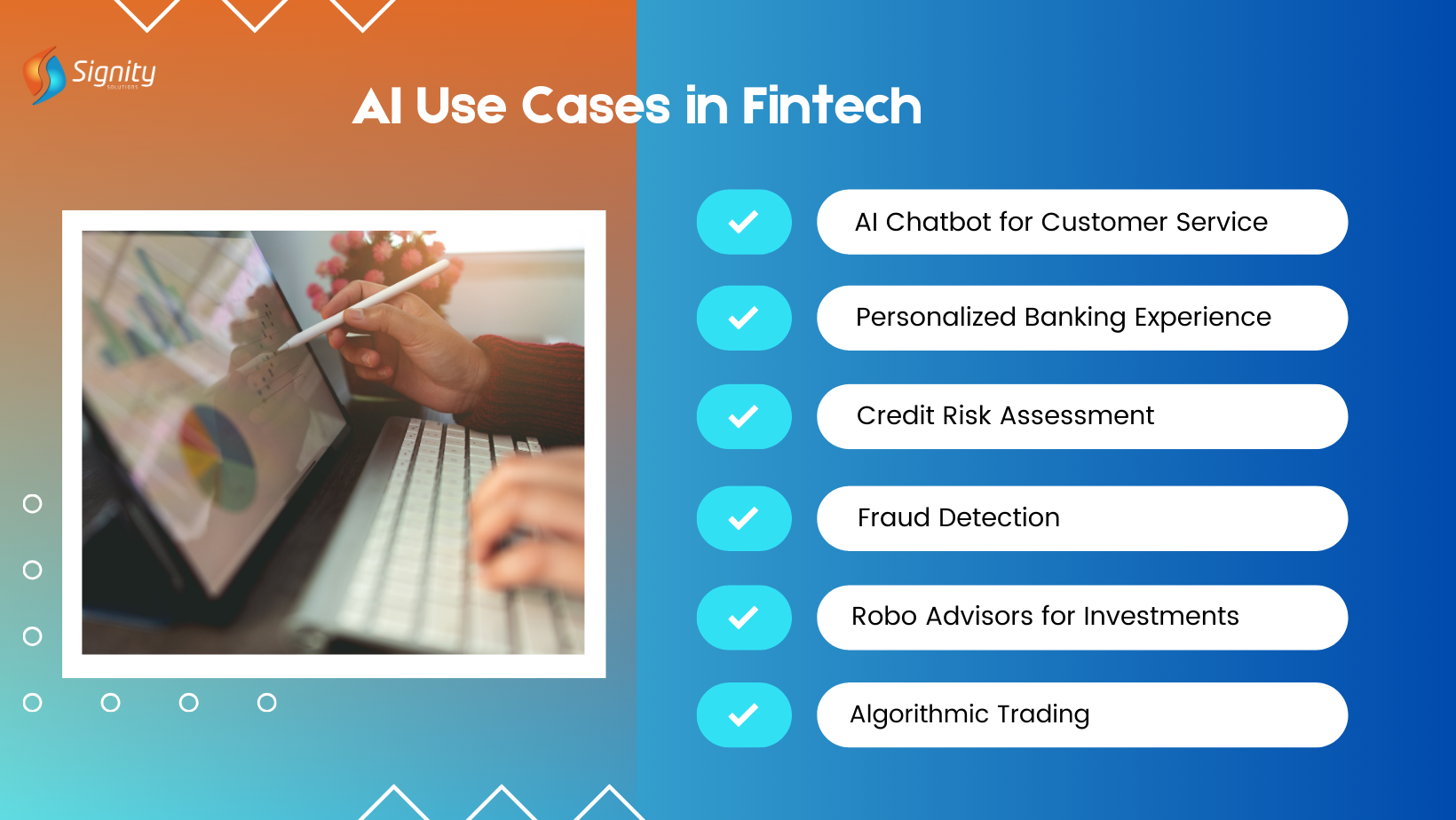
As businesses are realizing the potential of AI in fintech market, businesses across the investment and banking sectors are intelligently adopting it to boost efficiency and deliver personalized experiences. Here is how different industries use AI in the fintech industry.
1. Fraud Detection and Financial Security
The financial service industry faces the challenge and threats from different fraud schemes. The fintech AI systems rely on machine learning algorithms to monitor the patterns of transactions. The results can therefore be seen in real-time. It also offers results in real-time and detects if there are any suspicious activities involved.
The AI systems combine predictive analytics and multifactor authentication, which allow businesses to eliminate financial losses. As there is reduced fraud and more financial security, customer satisfaction rises, too.
One of the robust examples of this use case is Fraud Shield, which was offered to one of the clients in the financial sector. We developed an AI-powered financial fraud detection software that combines behavioral AI, real-time risk scoring, and machine learning models to instantly analyze transactions and detect abnormalities before the problem escalates.
Global payment providers such as Mastercard and Visa leverage AI-driven fraud detection systems to monitor millions of transactions in real time, helping identify unusual spending patterns before fraudulent transactions are completed.
2. Credit Scoring and Lending
As the credit history is limited in traditional lending models, it excludes different potential borrowers. AI in fintech relies on different sources of data, such as user history, their transactions, social signals, and more, that together combine to offer accurate credit scores. Based on the information, lenders can make quick decisions and also have access to the population located remotely. This ultimately improves the overall accuracy of lending and minimizes the default risk.
We collaborated with CrediSure, a credit decisioning platform, to implement AI-driven credit insights to reduce the turnaround time for loan approvals and boost the accuracy of risk prediction across different borrower profiles. The partnership depicts how to leverage fintech AI and turn complex data into actionable intelligence. This allows financial institutions to make smart and fast decisions.
AI also strengthens underwriting by evaluating alternative data sources, enabling lenders to assess applicants with limited credit histories while expanding financial inclusion without significantly increasing lending risk.
3. Robo-Advisors & Wealth Management
Manually managing the portfolio can be a time-consuming process and is prone to errors. Fintech AI has robo-advisory platforms that analyze the trends in the market, optimize allocation of assets, and ultimately deliver personalized investment recommendations. When these processes are automated, businesses can offer more smart strategies to scale their portfolios and engage clients with personalized financial insights.
4. AI-Powered Customer Support & Virtual Assistants
AI-powered chatbots and assistants can be integrated into the fintech applications that work around the clock and answer customer queries instantly. Automating the routine tasks allows businesses to focus more on their other productive tasks, improve response times, and reduce operational costs. The business offers a smooth and satisfying experience to its customers.
5. Algorithmic Trading and Portfolio Optimization
High-frequency and algorithm trading needs quick speed and precision. Integrating AI fintech tools helps analyze vast datasets, detect patterns and execute tasks in seconds. This also improves trading accuracy, enables faster decision-making, reduces errors, and gives businesses a measurable advantage in a competitive market.
6. Compliance and Regulatory Technology
AI-powered RegTech solutions automate Anti-Money Laundering (AML), Know Your Customer (KYC), transaction monitoring, and regulatory reporting. By continuously monitoring financial activities and identifying compliance risks in real time, organizations can reduce manual reviews while improving regulatory accuracy.
Powered by Large Language Models (LLMs), modern virtual assistants provide contextual responses, multilingual support, and personalized financial guidance across digital banking channels.
7. Payment Processing and Digital Wallets
As digital payments are rising at a higher speed, integrating AI ensures more secure and faster transactions. Fintech AI helps optimize the payment gateways, monitor the patterns of transactions, safeguard payments, and more. This process allows companies to offer a seamless and fraud-free experience. It also boosts the confidence of customers and brings more customer satisfaction across different digital platforms.
Benefits of AI in Fintech
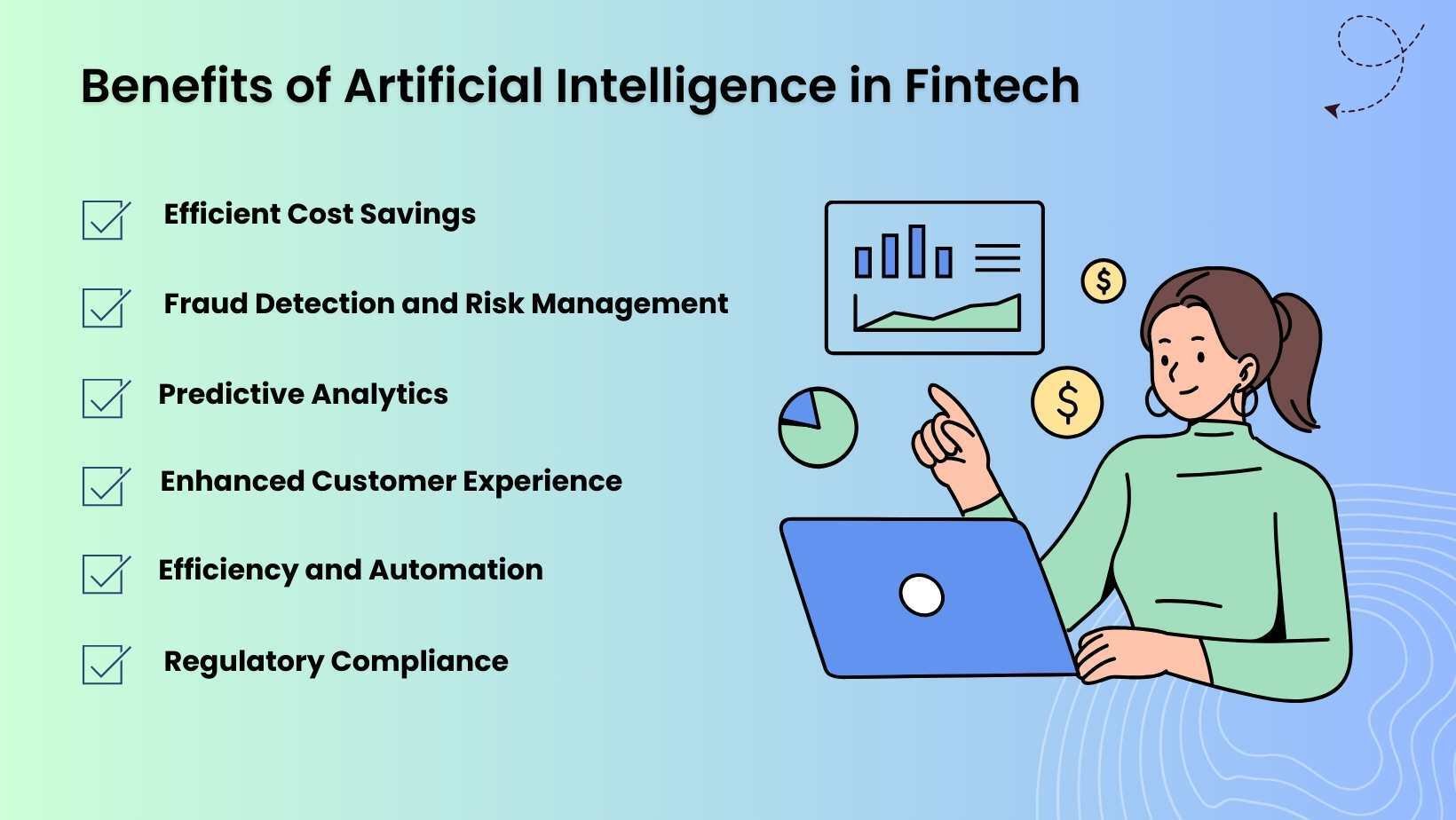
As AI in fintech evolves, businesses leverage different benefits to improve security, decision-making, and boost efficiency. Let us discuss this in more detail.
1. Operational Speed & Efficiency
It is one of the critical benefits of AI fintech. It has the ability to process and analyze a huge volume of financial data in real-time. Tasks that otherwise take hours or days to process and still may have errors can be completed in seconds. This operational speed allows for a quick decision-making process, streamlined workflow, and improved productivity.
2. Cost Reduction and Resource Optimization
As repetitive tasks are automated, AI in the fintech industry significantly reduces operational costs. Whether it is offering customer support or compliance, an AI-driven system reduces manual interference while allowing businesses to allocate resources more efficiently.
3. Enhanced Financial Inclusion
The traditional financial system may shut out individuals who don’t have limited credit histories. Thanks to AI in fintech that addresses this challenge and leverages other data sources to access their credits. This allows lenders to reach anywhere, even in remote areas. Apart from expanding the market reach, it also leads to more growth across the financial ecosystem.
4. Improved Risk Management & Decision-Making
AI offers advanced predictive analytics that allow businesses to identify risks before issues escalate. By integrating technologies like Firebase SQL, it can analyze trends and patterns in real time, enabling proactive, data-driven decision-making. This reduces exposure to financial risks and improves overall stability.
5. Stronger Data Security and Fraud Prevention
Security is a critical factor when it comes to the financial sector. Integrating AI in fintech allows for real-time monitoring and detection of anomalies and offers adaptive learning solutions. With such capabilities, fraudulent transactions and activities can be detected much faster, and it also builds more trust among the users.
6. Personalized Customer Experiences
Users in today’s time expect customized financial services, and AI in fintech makes that possible. It seamlessly analyzes the behavior of user, their preferences, and more to allow delivery of personalized recommendations, customized products, and seamless interactions across all touchpoints. This not only improves customer satisfaction but also helps in their retention.
7. Improved Customer Retention
AI enables financial institutions to build stronger customer relationships through personalized recommendations, proactive financial insights, and intelligent engagement across digital channels. These personalized experiences increase customer satisfaction, improve retention, and strengthen long-term customer value.
Recommended Post: AI in Accounting and Finance: A Complete Guide
Challenges of Artificial Intelligence in Fintech
According to Bain & Company, 70% of financial services companies reported AI talent gaps across functions, especially in technical fields, risk management, and regulatory compliance.
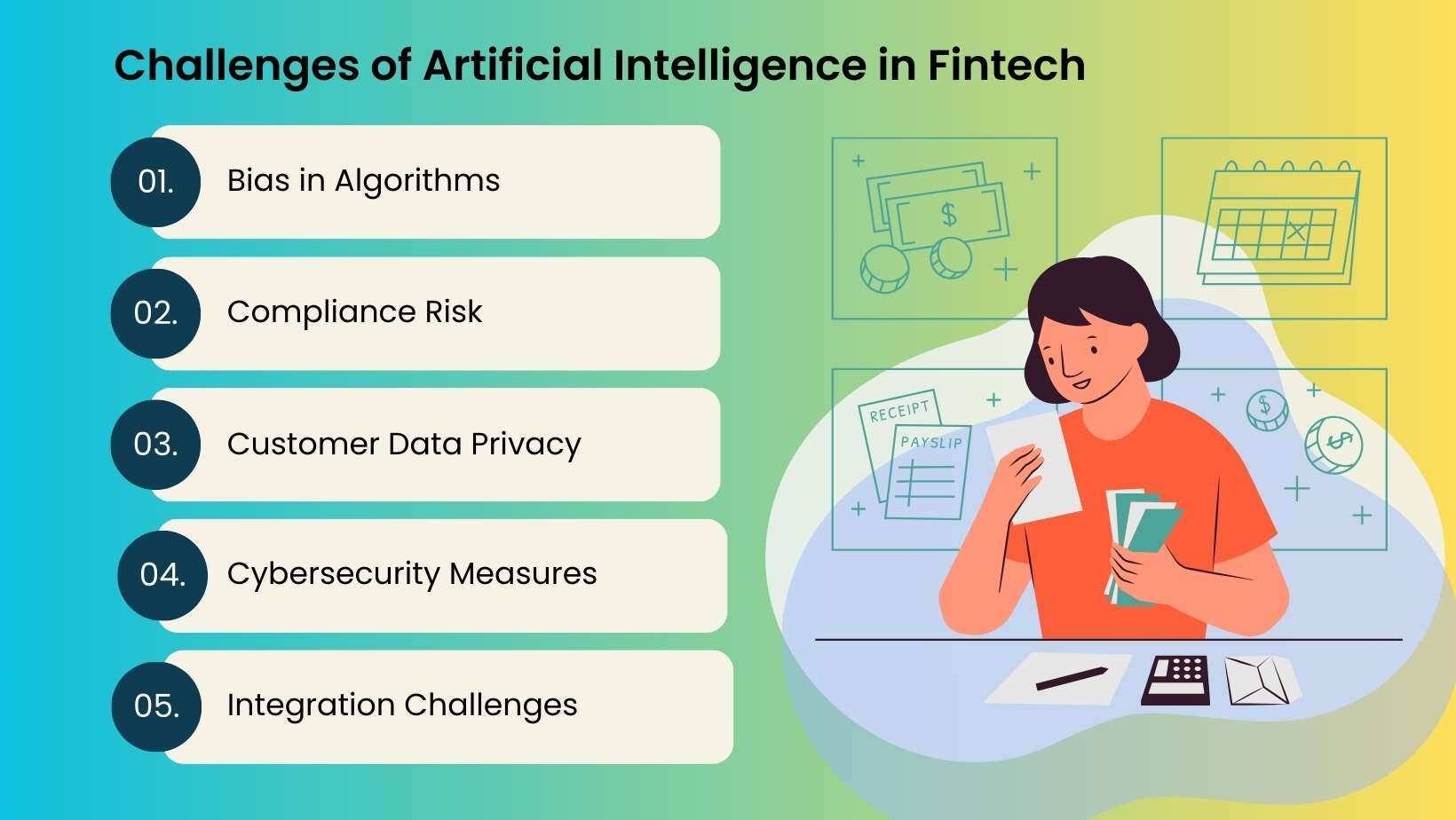
While AI in Fintech offers plenty of benefits, it is also important for the businesses to address challenges and ensure its successful implementation. Here are a few of the critical challenges and their business implications.
|
Challenge |
Description |
Business Impact |
|
Data Privacy and Security Risks |
Handling a large volume of data increases the exposure to threats. |
Customer trust is lost, and there may be penalties |
|
Regulatory Complexity |
Evolving financial regulations make it difficult to maintain compliance. |
Increases the legal risk and reduces delays |
|
Integration with Legacy System |
Financial institutions rely on outdated infrastructure. This may not be ready for AI integration. |
The implementation process is slow, and the transformation cost rises. |
|
High Implementation Costs |
Initial investment may be higher as businesses have to purchase tools and invest in infrastructure. |
Budget constraints can be there. |
|
Talent Shortage |
There may be a shortage of skilled experts and expertise in AI. |
Delays the deployment process |
|
Data Quality and Availability |
High-quality and structured data is needed to perform effectively. |
Leads to poor decision-making. |
|
Model Bias and Accuracy Issues |
The AI model may produce biased or inconsistent outcomes if they are not trained well. |
Leads to poor decisions and compliance problems. |
|
Scalability Challenges |
AI solutions scaling across multiple systems can be a complex process. |
There are performance bottlenecks and inefficiencies. |
Beyond technical implementation, financial institutions must ensure AI models remain transparent, explainable, and free from unintended bias. Responsible AI practices, continuous model monitoring, and human oversight help organizations maintain regulatory compliance while building customer trust in AI-driven financial decisions.
How to Successfully Implement AI in Fintech Solutions
As more financial sectors are leveraging AI in Fintech, businesses must know how to successfully implement AI in fintech solutions. Here is a step-by-step guide.
1. Define Clear Business Goals
The very first step in creating a fintech solution is to identify the problem it must solve. No matter if you are looking forward to solving the fraud challenges, enhancing customer experience, or optimizing operations, there must be a well-defined objective. Defining the business goals clearly allows businesses to deliver strong business results.
2. Choose the Right Tech Stack
The next step is choosing the right technologies that actually help build scalable solutions. AI in fintech relies on a combination of ML frameworks, tools for data processing, and integration capabilities. When the technology stack is well defined, it can ensure seamless performance and more flexibility.
3. Partner with a Reliable Partner
AI implementation needs specialized expertise, and it becomes vital for businesses to collaborate with an experienced fintech software development company. The right partner helps businesses accelerate the development process, allows for seamless system integration, and builds customized solutions as per the specific needs. With the right partner, businesses can also bring the best industry-valuable insights and practices and improve time to market.
4. Regulatory Compliance with Financial Regulations
Ensuring compliance with financial regulations is one of the vital components of any fintech solution. Integrating AI in fintech development must be designed in a way that it adheres to changing financial regulations and privacy standards. It is a better practice to implement compliance in the development from the very beginning. This helps avoid any legal complications and ensures the operations remain smooth.
5. Focus on Scalable Cloud Infrastructure
Scalability is essential for handling growing data volumes and user demands. Cloud-based infrastructure enables fintech AI solutions to scale efficiently, process large datasets in real time, and support continuous innovation. It also enhances flexibility, reduces infrastructure costs, and improves system reliability.
Future Trends of AI in Fintech Market
The future of AI in fintech is centered around smarter automation, deeper personalization, and intelligent decision-making at scale. Here are the key trends shaping the next phase of AI in the fintech market:
1. Hyper-Personalized Banking Experiences
Fintech AI will enable real-time personalization, offering tailored financial products, spending insights, and recommendations based on user behavior and preferences.
2. Agentic AI and Autonomous Financial Operations
The next evolution of Fintech AI will include autonomous AI agents capable of monitoring financial activities, initiating workflows, detecting risks, and supporting operational decisions with minimal human intervention while maintaining governance and compliance controls.
3. Generative AI & AI Copilots
Generative AI is enabling financial professionals to automate document analysis, generate financial reports, summarize regulations, and provide intelligent customer assistance. AI copilots are expected to become an integral part of banking, wealth management, and insurance operations.
4. Predictive Financial Analytics
Advanced analytics will allow businesses to forecast trends, assess risks proactively, and make data-driven decisions with greater accuracy using AI in fintech.
5. Autonomous Finance
The next evolution of fintech AI will automate entire financial journeys. From budgeting and saving to investing, it minimizes human intervention and optimizes financial outcomes.
Conclusion
As AI in fintech reshapes how financial services are delivered, it makes them much faster, smarter, and more efficient. Whether it is fraud detection or leveraging personalized banking, fintech AI helps drive measurable business impact across the industry.
AI in the fintech market grows, and businesses that leverage AI in fintech will have a competitive edge over others. It will also be better positioned to scale and innovate much faster. Well, if businesses invest in the right strategy and partner with an experienced fintech software development company, they can turn the potential of AI into real business value.
As Artificial Intelligence in Fintech continues to mature, competitive advantage will increasingly depend on how effectively organizations combine intelligent automation with responsible AI governance, high-quality data, and scalable digital infrastructure. Businesses that invest strategically today will be better positioned to deliver secure, personalized, and future-ready financial services.

Mangesh Gothankar


Ashwani Sharma
Achin Verma
Frequently Asked Questions
Have a question in mind? We are here to answer. If you don’t see your question here, drop us a line at our contact page.
How is AI transforming the custom fintech software development market beyond traditional use cases?

Apart from detecting fraud and lending, financial product development enables behavioral biometrics, financial forecasting, and automation of financial workflows. This further allows businesses to move from a reactive to a proactive financial ecosystem.
What factors should businesses consider before investing in a fintech software development company?
Factors like data readiness, integration capabilities with already existing systems, and scalability must be considered before choosing AI in fintech. An experienced and professional fintech software development company ensures a smooth implementation and quick time to market.
How does artificial intelligence in fintech improve customer retention?
AI in the fintech industry boosts customer retention as it delivers a personalized user experience, recommendations based on customer feedback, and needs. Fintech app development services also help businesses to anticipate the needs of their customers and build long-term relationships.
Can fintech software developers leverage AI without a complete system overhaul?
Yes, modern fintech AI applications integrate the capabilities of AI via APIs and do not replace the entire system. Businesses adopt a structured approach and embed AI in fintech features like chatbots, analytics, and fraud detection.






.png?width=352&name=Real-Time%20Payment%20Intelligence%20Systems%20AI%20Architecture%20and%20Implementation%20Guide%20(1).png)
.png?width=352&name=Guide%20to%20AGI%20(1).png)