


.png?width=27&height=27&name=Group(1).png)

-1.svg)
-1.svg)


-2.svg)


%201-1.webp?width=148&height=74&name=our%20work%20(2)%201-1.webp)




.svg)





Leading healthcare organizations are incorporating AI into their daily operations.
Google Health is using AI models to improve breast cancer screening and predict patient outcomes. Medtronic is enhancing its medical devices with AI to provide real-time patient monitoring and diagnostics. PathAI is using AI to assist pathologists in diagnosing diseases with greater accuracy.
These are just a few examples of a market poised for rapid growth. These developments reflect a broader market shift toward large-scale AI adoption in healthcare systems worldwide. The global AI healthcare market is expected to grow at a compound annual growth rate of 38.90% from 2026 to 2033.
Market Snapshot (Quick View):
~$18.7 billion (2023) - Global Market Insights
~$36.96 billion (2025) – Precedence Research
~$613.81 billion (2034) - Precedence Research
These are just a few examples of a market that is ready for rapid growth. So, keeping up with technology is imperative for healthcare leaders. The most recent data indicates the global AI in healthcare market size is projected to reach USD 187.69 billion by 2030, growing at a CAGR of 38.62% from 2025 to 2030.
In this blog, we’ll explore the current market size, the latest trends influencing the market growth, future insights for business.
 Generate
Key Takeaways
Generate
Key Takeaways

- With the support of technical innovations, the healthcare industry's use of AI is expected to grow significantly and reach billions of dollars in the near future.
- Around 95% of healthcare organizations are using AI in some capacity.
- Market adaptation and AI in healthcare market growth vary in different regions. Europe and North America are leading with healthcare innovation.
- In the coming years, the growth of healthcare data will exceed 10 trillion gigabytes, according to the DATCON index.
How to Read AI in Healthcare Market Estimates?
Published estimates for the AI in healthcare market vary because research firms define the market differently. Some include software, hardware, services, and AI-enabled medical devices, while others place more emphasis on provider, pharmaceutical, or life-sciences use cases.
Base years, geographic coverage, and forecast horizons also differ. For that reason, healthcare leaders should use market-size figures as directional indicators of adoption and investment momentum, rather than treating estimates from different reports as directly interchangeable.
For this article, use one primary source consistently in the main snapshot and label it clearly. A current Grand View Research estimate values the market at USD 36.7 billion in 2025 and projects USD 50.7 billion in 2026, reaching USD 505.6 billion by 2033 at a 38.9 percent CAGR.
Other reputable reports use different scope assumptions and therefore arrive at different forecasts. The common signal is strong growth in AI-enabled clinical, operational, and research workflows.
How is AI Used In the Healthcare Market?
Deep learning, machine learning, neural network processing, and many more algorithms are used to provide advanced AI solutions in the healthcare sector. These technologies are the reason behind the improved research innovation. Patient diagnosis and patient care have improved with the help of these technologies.
Why is it important?
- Better Patient Care: AI helps in individualized treatments and early disease identification.
- Diagnostic Innovations: Cutting-edge algorithms are used for diagnosis and imaging, producing more accurate and quicker results.
- Operational Efficiency: Resource management is optimized through automation and predictive analytics.
Related Read: AI Revolution in Healthcare: Transforming the Industry
AI in Healthcare Market Size and Growth Trends
According to a report by Towards Healthcare, the global market for generative AI in the healthcare segment is expected to reach USD 39.8 billion in 2035. At the moment, North America has the largest market share worldwide.
- Healthcare companies are opting for AI-powered medical imaging technologies on a larger scale.
- The market is dominated by North America, which has many substantial firms.
- Due to 24/7 support systems, virtual assistants and AI chatbots are experiencing increased demand.
- Precision medicine and healthcare delivery are revolutionized when AI is combined with complementary technologies like blockchain or robotics.
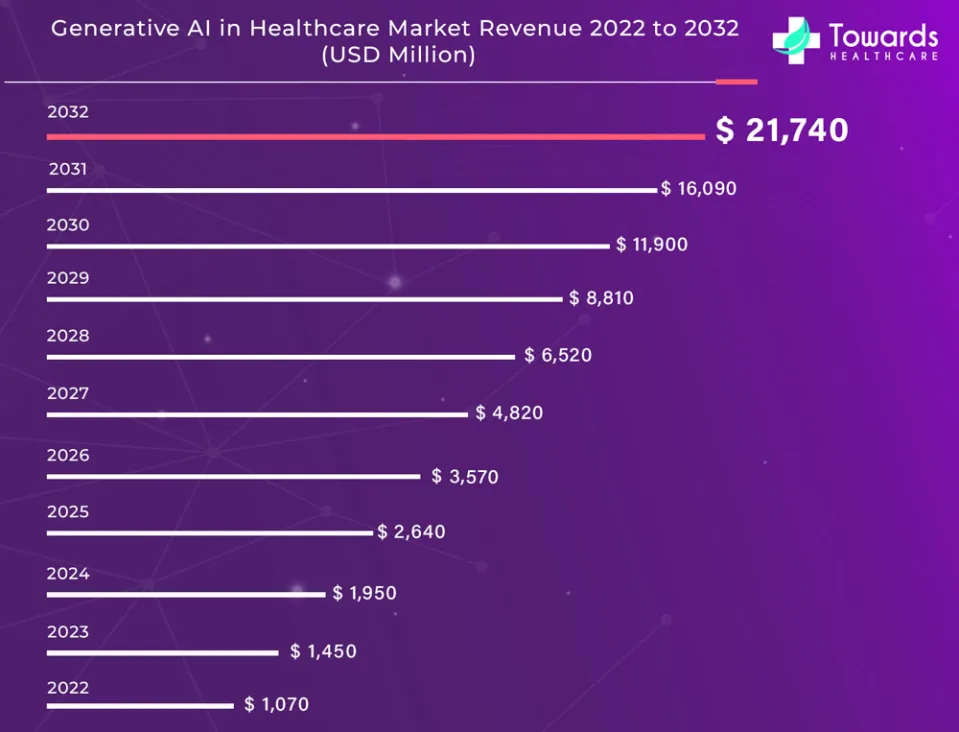
Healthcare AI Market Size Analysis
The global artificial intelligence in the healthcare sector market is divided into four segments:
- Component
- Technology
- Applications
- Geography
Let’s explore all four segments in detail.
1. AI in healthcare Market Size by Component
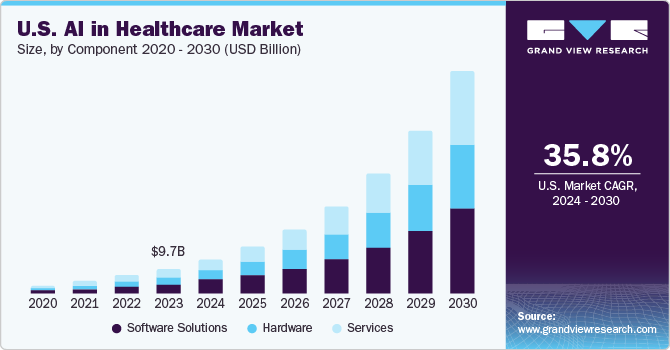
The software solution component category held a notable market share because of the growing demand for AI-powered healthcare solutions.
Over time, in the healthcare industry, hardware solutions are expected to grow at a rate of 39.4%. The main reason behind the market's expansion is the use of AI-based technologies in various healthcare applications like dosage error reduction, robot-assisted surgeries, chatbots, and other clinical trials.
2. Healthcare Artificial Intelligence Market Size by Technology
Machine Learning is the leading technology in the AI healthcare market, making up the largest share of tools used in 2024–25. The technology is extensively integrated into healthcare systems to generate data-driven decisions and provide insightful information derived from large data sets.
Machine learning is widely used for various operations in healthcare systems. Machine learning models can evaluate, estimate, and identify diseases early. ML algorithms can suggest personalized treatment plans by studying the data patterns.
Deep Learning makes up about 40% of the artificial intelligence used in healthcare. It improves the accuracy of medical imaging diagnosis by 70%. Natural language processing (NLP) accounts for around 35% of the market. In electronic health records, NLP has cut down the administrative workload by 40%.
Also, the natural language processing technology market is anticipated to expand at substantial market growth between 2024 and 2030. Medical transcription, coding, and charting are examples of clinical documentation procedures that can be automated and optimized using natural language processing.
| Technology | Approx. Market Share | Key Benefit for Healthcare Organizations |
| Machine Learning | Largest overall | Predictive analytics, early detection & personalized treatment |
| Deep Learning | 40% | High image accuracy, lower diagnostic errors |
| Context-Aware AI | 29% | Tailored interventions using multi-source data |
| NLP | 25–35% | Efficiency gain in charting, documentation, and patient interaction |
By automatically collecting and classifying information from clinical data, natural language processing speeds up documentation workflows, lessens administrative load, and guarantees billing and payment accuracy.
3. Analysis of the AI in Healthcare Market Size By Application
The three main areas leading the way for AI applications in healthcare are connected machines, assisted surgeries, and clinical trials. Diagnostics, error reduction, and cybersecurity are progressing slower.
Robots with AI capabilities improve the accuracy of surgical procedures. AI robotics can provide the utmost precision for intricate neurology or cardiovascular surgery. AI systems are also altering clinical trial procedures.
Every stage of clinical trials benefits from the ability to analyze patient health data quickly, which increases accuracy, cost-effectiveness, and focus on patient care.
Furthermore, AI is essential to using connected machines in the medical field. AI combines sensor and Internet of Things data into a unified healthcare system. Large volumes of data can be collected, shared, and analyzed.
4. AI in Healthcare Market Size by End Users
Hospitals and healthcare providers account for the largest share of the AI in healthcare market, driven by the growing use of AI in diagnostics, medical imaging, patient monitoring, and hospital operations. These institutions are increasingly adopting AI to improve clinical decision-making, reduce workload, and enhance patient healthcare outcomes.
Pharmaceutical and biotechnology companies represent one of the fastest-growing segments, leveraging AI to accelerate drug discovery, optimize clinical trials, and analyze complex biological data. Additionally, diagnostic laboratories are integrating AI tools to improve accuracy and efficiency in testing and reporting, further expanding the adoption landscape across the healthcare ecosystem.
5. AI in Healthcare Market Size by Deployment
Cloud-based AI solutions are gaining significant traction due to their scalability, flexibility, and cost efficiency. These platforms enable healthcare organizations to process large volumes of data, integrate AI models quickly, and support remote and real-time healthcare applications such as telemedicine and patient monitoring.
On-premise deployment, however, remains critical for organizations that prioritize data security, regulatory compliance, and control over sensitive patient information. Large hospitals and institutions with established IT infrastructure often prefer on-premise solutions to ensure strict data governance, especially in regions with stringent healthcare regulations.
Competitive Landscape and What It Means for Healthcare Buyers
The AI in healthcare market includes several types of providers: cloud and foundation-model platforms, medical-device and imaging companies, EHR and workflow vendors, life-sciences technology providers, and consulting and systems-integration partners.
Microsoft, Google, Amazon Web Services, NVIDIA, Oracle, GE HealthCare, Siemens Healthineers, Medtronic, IQVIA, and other specialized vendors are active across different parts of the ecosystem.
For hospitals and health systems, the most important distinction is not simply which company is largest. It is whether a solution fits the intended workflow, integrates safely with the EHR and existing clinical systems, has appropriate evidence for its intended use, and can be monitored after deployment.
A diagnostic AI product, for example, should be assessed differently from an ambient documentation tool or a custom automation program. Buyers should evaluate clinical value, implementation effort, governance, privacy, cybersecurity, and measurable outcomes together.
Geographical Breakdown Of The AI In Healthcare Market Size
North America
North America holds the largest share of the AI healthcare market, accounting for over 50% globally (Grand View Research). This dominance is driven by strong investment, advanced healthcare infrastructure, and early adoption of AI technologies.
The government provides excellent support to healthcare providers and the healthcare sector in the United States. Future application of AI solutions is made possible by the public and private healthcare sectors' early adoption of AI technologies.
The growing number of chronic diseases, the need to cut healthcare spending, the increased investment in AI-based startups, and the increasing integration of cutting-edge technology into healthcare systems are some of the significant healthcare market growth factors driving the North American region's extensive use of big data and deep learning in healthcare.
Europe
Europe is the AI healthcare market's second-largest region. Germany, UK, France, Spain, Ireland, Switzerland, and Belgium are important countries in the healthcare sector. They are concentrating on biotechnology, drug discovery, and research and development.
In Europe, highly developed public healthcare systems use AI solutions to increase patient care and productivity.
Asia-Pacific
The Asia-Pacific area is anticipated to grow the fastest in the coming years. High technological advancement and strong regulatory frameworks are advantages of developed markets, whereas rising healthcare digitalization in emerging economies offers enormous unrealized potential.
The Asia-Pacific region is expected to grow at the fastest rate, supported by rapid healthcare digitization and increasing adoption of AI-driven solutions (Mordor Intelligence).
Local tech companies frequently collaborate with multinational corporations to customize AI solutions for regional healthcare needs.
Regulatory & Compliance in AI Healthcare
AI adoption in healthcare is closely tied to regulatory and compliance requirements.
AI-based medical tools must undergo validation and approval processes, particularly in diagnostics and treatment applications. Regulations such as patient data protection laws (e.g., HIPAA and GDPR) play a critical role in governing the deployment of AI systems.
Clinical validation and transparency are essential to ensure safe and reliable use of AI in healthcare (JAMA Network).
AI Governance and Implementation Roadmap for Hospitals
Successful AI adoption requires more than selecting a promising platform. Hospitals and health systems need a repeatable process that links technology decisions to clinical safety, operational goals, and accountable ownership.
|
Step |
What the organization should do? |
|
Define the use case |
Start with a measurable problem, such as reducing documentation time, improving image triage, or lowering no-show rates. Define the clinical and operational outcome before choosing a tool. |
|
Assess data and workflow readiness |
Confirm data quality, EHR interoperability, privacy controls, staff workflow, and the availability of baseline performance measures. |
|
Validate before scale |
Review intended use, evidence, subgroup performance, safety risks, human oversight, and any applicable medical-device requirements. Run a controlled pilot. |
|
Integrate and train |
Design the handoffs between the AI system and clinicians or operational teams. Provide role-specific training and escalation paths. |
|
Monitor continuously |
Track adoption, accuracy, fairness, drift, cybersecurity events, user feedback, and ROI. Reassess models whenever data, workflows, or the model changes. |
In the United States, organizations should also consider FDA requirements when AI functionality meets the definition of a medical device, and they should account for algorithm-transparency requirements that apply to certified health IT.
Privacy obligations such as HIPAA and, where relevant, GDPR remain foundational, but governance should extend to validation, oversight, monitoring, and incident response.
AI in Healthcare Market Forecast and Latest Trends
AI is all set to ace the global healthcare industry with its powerful solutions. The healthcare provider needs to gear up for AI in healthcare market trends in the coming years.
We have witnessed the power of AI in previous years.
AI continues to reshape the healthcare industry through advancements in diagnostics, automation, and data-driven decision-making. The following trends are driving the next phase of AI adoption:
1. Generative AI in Healthcare
Generative AI is expanding the AI in healthcare market beyond predictive models and image analysis. Early enterprise use cases include ambient clinical documentation, summarization of longitudinal records, patient-service communications, prior-authorization support, coding assistance, knowledge retrieval, and research support.
These tools can reduce repetitive administrative work and help teams find relevant information faster, but they require safeguards because generated content can be incomplete, inaccurate, or inappropriate for a particular patient context.
2. Agentic AI in healthcare
Agentic AI extends this concept by coordinating multi-step tasks, such as retrieving authorized information, preparing a draft, routing work for approval, and recording the outcome.
In healthcare, agentic workflows should be introduced first in bounded, low-risk administrative processes. Clinical use should retain qualified human review, clear escalation rules, audit logs, access controls, and monitoring for errors or unexpected behavior.
The near-term opportunity is not autonomous care; it is safer, better-designed support for clinicians, staff, and patients.
3. Precise Diagnostics of Diseases
Artificial intelligence is enhancing the field of diagnostics in the healthcare market. It not only helps in the accurate diagnosis of the disease but also simplifies workflows, such as remote patient monitoring and analyzing patient data. The global AI in diagnostics segment is forecasted to reach a staggering USD 96.5 B by 2032, growing at ~45% CAGR.
The NHS's AI-powered CT scan software has increased the recovery rate for stroke patients from 16% to 48%. It also cuts treatment times to under 80 minutes, helping tens of thousands of patients each year.
4. Enhancing Precision in Medical Imaging
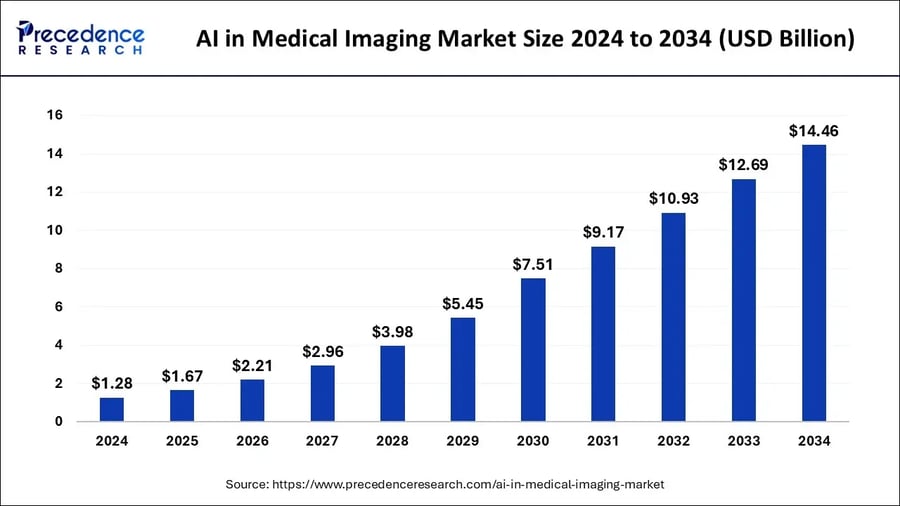
The current AI in medical imaging market size is calculated at 1.67 billion in 2025, and it will reach around USD 14.46 billion by 2034 at a market growth rate of 27.10% from 2025 to 2034.
AI in CT imaging uses convolutional neural networks to enhance image quality. This approach is trained to improve image reconstruction by identifying and reducing noise without harming specific anatomical structures. It can help reduce radiation doses.
Related Read - Early Disease Detection through AI in Medical Imaging
5. Early Disease Detection
AI is being used for early disease detection with the help of different IoT devices and wearables. Gen AI can analyze patient-reported symptoms and data from wearable devices. By studying the patterns in the analyzed data, Gen AI can indicate early disease detection.
6. Easier Ultrasound Measurements
Ultrasounds have emerged as an essential tool in cardiac disease treatment. Echo quantification has become faster and more accurate with the help of AI-powered automatic ultrasound measurements. Automatic measurements provide precise patient data and accurate diagnostic decisions by eliminating the fluctuations involved in manual tasks.
7. Remote Patient Monitoring
Cloud-based AI is utilized to detect irregularities in the heart rhythm and atrial fibrillation early by monitoring the remote electrocardiogram readings. This proactive monitoring trend is improving patient outcomes.
8. Customized Treatment Plans
Gen AI examines patient data such as medical history, genetic data, and lifestyle to create a customized treatment plan. This process effectively ensures the treatment of patients' unique medical requirements, reducing the risk of unwanted effects.
9. Cancer Research and Treatment
AI in the healthcare market is being used to increase understanding of the spread, development, and metastasis of cancer. With the help of AI in the healthcare market, cancer detection is becoming more accurate and dependable.
Artificial intelligence is being used to generate new cancer treatments using data analysis and drug discovery. AI technology has the power to speed up treatment decisions for patients by assisting in the genetic subtyping of brain tumor tissue after surgery.
10. Drug Discovery
AI is improving drug development and discovery in the pharmaceutical sector while facilitating healthcare professionals with the availability of new treatments. AI in the drug discovery market size is projected to reach 6.93 billion in 2025 and is forecasted to hit around USD 16.52 billion by 2034.
Traditional approaches for drug development are expensive and time-consuming. They may take billions of dollars and years to reach the preclinical stage. Conversely, AI can reduce the expenses and time period for research.
A recent study found that drugs discovered by AI in phase 1 clinical trials are more successful than those found through traditional methods. AI-developed drugs have a success rate of 80% to 90%, while traditionally discovered drugs have a success rate of 40% to 65%. Almost 30% of all uses of AI in drug discovery and development focus on anticancer drugs.
Given the potential to cut costs and time in drug research, generative AI is a promising technology for the healthcare sector.
11. Chatbots and Virtual Assistants
The shortage of skilled medical staff increases the burden of excessive duties on the existing staff. This results in errors and poor employee performance and can negatively impact patient care. AI in healthcare is there for rescue; AI chatbots and assistants can automate tasks and improve patient outcomes.
AI-powered virtual chatbots and virtual assistants are very helpful for patients. These bots can respond to patient queries. These AI solutions have seen an increased demand due to the 24/7 access and trustworthy answers they provide.
This technology can communicate with patients efficiently in a human-like way and can transfer conversations to other channels if required.
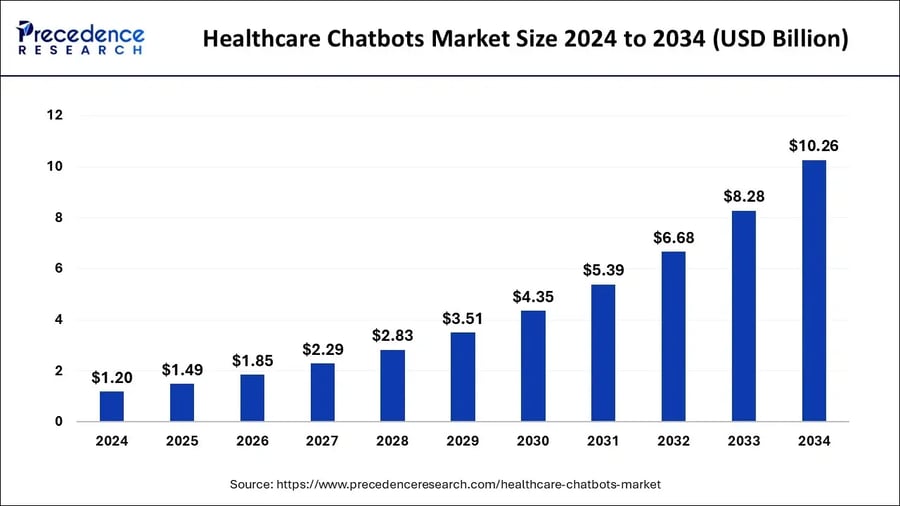
AI-powered assistants can reduce the staff workload. The healthcare chatbot market size is expected to reach USD 1.49 billion in 2025.
Challenges For AI in Healthcare Sector
Healthcare providers are effectively using AI for various purposes. It includes early disease diagnosis, medical imaging, streamlining operations, and data monitoring. However, despite all the benefits, AI for the healthcare sector has major challenges. Let's discuss them further.
1. Lack of Quality Data
AI adoption in the healthcare industry encounters the challenge of insufficient data. AI systems need a lot of accurate data to perform tasks like predictions and recommendations. The AI system will not work efficiently with the availability of poor-quality data to train algorithms.
2. Research Methods Issues
The number of peer-reviewed studies and established techniques on AI in the healthcare market is insufficient. Most of the research and study is based on old medical data.
It is important to use prospective research over time to incorporate the benefits of AI into the healthcare industry fully.
3. Data Security and Privacy Concerns
Data security is a great challenge for AI in healthcare companies. Healthcare providers are most likely to encounter cyberattacks because they have vast amounts of sensitive patient data.
To overcome security concerns, healthcare companies can discuss strategic AI planning and implementation with a software development company to develop a secure and reliable AI-powered tool.
Factors Affecting AI In Healthcare Market Trends
Various factors are affecting AI trends in the healthcare market. Some of them are listed below.
1. Healthcare Data Growth
The volume of healthcare data is rapidly increasing due to electronic health records, medical imaging, and wearable devices, creating a strong need for AI-driven data processing (World Economic Forum).
2. Population Ageing
As individuals live longer, they need more medical care and treatment. AI-powered technologies have the potential of analyzing medical data and improving patient care.
3. AI Integrated Software
Introducing AI-integrated software in web hosting solutions allows systems to learn from large datasets and make data-driven decisions efficiently. This software can perform different tasks, such as disease diagnosis and medical image analysis, more effectively and accurately.
4. Rising Chronic Diseases
The rapidly growing numbers of chronic diseases such as heart disease, diabetes, and cancers are putting a strain on the whole healthcare system for better preventative and treatment strategies.
5. Investments and Funding For the Healthcare Market
The government and many other organizations are investing in AI for the healthcare industry to provide better care at lower healthcare costs. Investors are funding AI for different operations that can speed up the process of disease diagnosis and improve treatment.
6. Innovation In Services and Products
AI use cases in the healthcare market is experiencing a significant rise due to the growing need for AI-powered solutions. A massive increase in the launch of new services and products can be seen in the future.
Who Are the Top AI Consulting Firms for Hospitals and Health Systems?
Hospitals and health systems often need more than an AI product. They need a partner that can connect strategy, clinical workflow design, data engineering, interoperability, governance, and adoption.
There is no single best firm for every organization. The right fit depends on whether the priority is enterprise transformation, cloud modernization, EHR-centered workflow improvement, clinical AI validation, or custom application development.
Enterprise transformation consultancies are commonly considered for strategy, governance, and large transformation programs. Besides, technology and systems-integration firms are often evaluated for data platforms, cloud, integration, and managed services. Also, specialized health-tech and custom-development partners can be considered for focused workflow automation and tailored AI implementations.
Bottom Line
The size of AI in the healthcare market is expanding quickly. It offers many opportunities for healthcare workers, developers, and investors. Everyone can make strategic decisions for their businesses depending on the various factors such as the AI in healthcare market size, challenges, opportunities, and applications in different healthcare sectors.
Whether you want to enhance efficiency in disease diagnosis, individualized patient care, improve patient engagement, or data-driven decision-making, our AI-driven digital health care solutions offer the efficiency, flexibility, and optimization you want.
Our AI healthcare consulting company can help you simplify your medical operations while also enhancing patient care. We help you get the desired competitive edge with personalized healthcare software solutions & engage like never before.
Get an expert AI solution development company to help you with reliable solutions for your healthcare needs.

Mangesh Gothankar


Ashwani Sharma
Achin Verma
Frequently Asked Questions
Have a question in mind? We are here to answer. If you don’t see your question here, drop us a line at our contact page.
How big is the AI Market in Healthcare?

Precedence Research demonstrates on AI in the healthcare market report shares that it is valued at USD 27 billion. This global ai market is expected to grow to USD 613.81 billion by 2034.
What Percentage of Healthcare Companies use AI?
Which Country Leads the Global Market for AI in Healthcare?
What are the Challenges for AI in the Healthcare Sector?
What are the use cases of AI in Healthcare?
AI can be used in varied ways in the healthcare industry. It can assist in surgeries, help healthcare workers in making data driven decisions, early detection of diseases, ensure patient safety, perform clinical research, assist clinical decision support systems, do the administrative works and even improve the health. All with the use of trending and advanced technologies like computer vision, NLP and more.






-2.png?width=352&name=microsofts-recall-feature%20(1)-2.png)