


.png?width=27&height=27&name=Group(1).png)

-1.svg)
-1.svg)


-2.svg)


%201-1.webp?width=148&height=74&name=our%20work%20(2)%201-1.webp)




.svg)






When you see reports showing that AI adoption in real estate has jumped to 75% in just two years, it’s hard not to wonder whether we’re witnessing a subtle evolution or a full-blown industry reset.
The real estate industry is undergoing major change due to artificial intelligence. AI systems are changing the way people research, evaluate, and buy properties.
The truth is, AI solutions for real estate are changing how buyers search, how investors decide, and how properties are managed. But the bigger story isn’t the technology itself. It’s the long-term implications of AI for real estate markets, business models, and even the kinds of properties being built.
In this blog, we’ll explore whether these changes are a slow evolution or a true revolution, and what this means for the future of the industry.
 Generate
Key Takeaways
Generate
Key Takeaways

- AI personalizes property searches, improving buyer experience and decision-making.
- Predictive analytics enhances the accuracy of market forecasting and investment planning.
- AI tools automate property management, boosting efficiency and tenant satisfaction.
- AI-powered, data-driven insights help realtors target buyers more effectively and optimize marketing.
Impact of AI on Real Estate
Several enterprises like Zillow are already using artificial intelligence in real estate to provide instant home value estimates based on AI algorithms. We have already discussed the practical ways to use AI in real estate. As per the JLL research, the main impact areas with achieved goals in real estate are represented in the graph below.
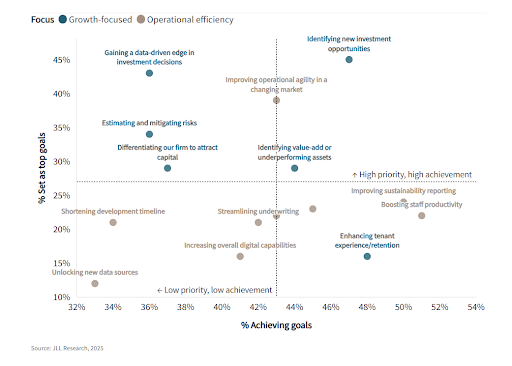
Now, let us analyze the impact of AI on real estate. Let us check out some of the key impactful areas below:
1. Improved Property Search and Matching
AI has changed the entire property search process. AI-based search tools that analyze user behaviour and preferences deliver personalized property recommendations. AI-driven search tools are creating a more intuitive, personalized discovery experience. Instead of scrolling endlessly through listings, buyers now get recommendations tailored to:
- Desired amenities
- Budget
- Neighborhood characteristics
- Lifestyle preferences
- Past search behavior
2. Conversational Property Search Powered by NLP
Keyword search is outdated. Natural Language Processing (NLP) enables buyers to search conversationally.
Like using a prompt - “Show me spacious 3BHK apartments near a good school with parks nearby.”
AI understands context, intent, sentiment, and constraints, leading to highly accurate results. This improves both the quality and speed of discovery.
3. Improvized Buyer Experience and Decision Making
The improved search capabilities of artificial intelligence in the real estate industry lead to delivering a more satisfying buyer experience. Because AI can match preferences with listings instantly, buyers spend less time searching and more time evaluating the right options.
In fact, realtors benefit too; they can route the right properties to the right audience, improving conversion rates and reducing marketing waste.
4. Optimizing Marketing Strategies
Generative AI is changing real estate markets by creating personalized content, automating ads, and predicting customer behavior. AI evaluates market trends and customer data to create marketing campaigns that appeal to specific buyer types.
For example, AI can generate engaging property listings, recommend the best visuals, and create virtual property tours. This way, generative AI is improving the buyer's experience and helping real estate agents attract more leads with less effort. With AI solutions in real estate, marketing strategies are becoming more data-driven, efficient, and effective.
5. Computer Vision for Automated Property Analysis
One of the top implications of AI for real estate is automated property analysis. The digital transformation of real estate has sped up significantly because of computer vision technologies that gather structured information from property images on a large scale. Using Convolutional Neural Networks (CNNs), which are deep learning models specifically made for processing and analyzing images. These networks have several specialized layers, including
- Convolutional layers that detect visual features.
- Pooling layers that reduce data size while keeping important spatial relationships.
- Fully connected layers that make final classifications based on the identified features.
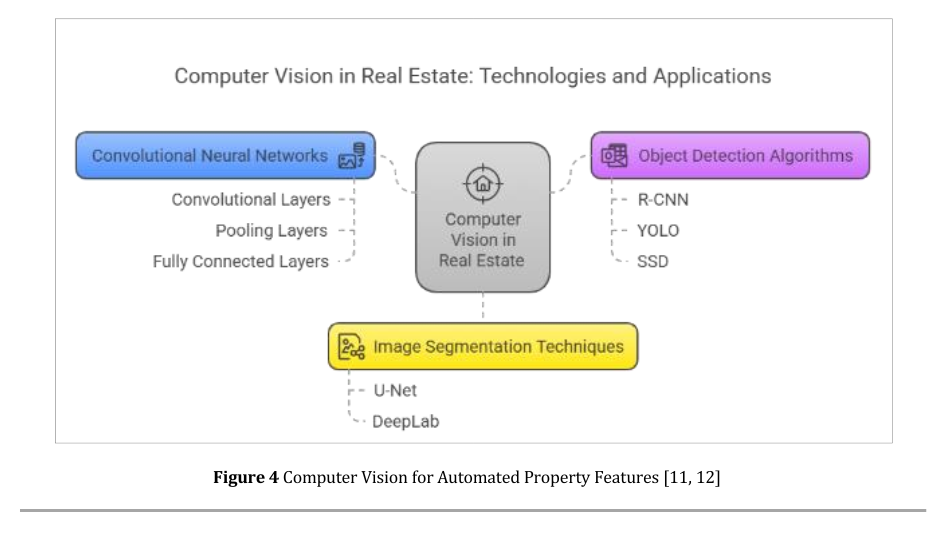
Being used for real estate images, these neural networks learn from millions of labeled property photos to accurately recognize renovation quality, type of materials, and architectural features.
By using pre-trained network weights and adjusting them to fit specific data, these systems create specialized classifiers. These classifiers can distinguish between different interior design styles, identify high-end versus budget finishes, and assess the overall condition of properties. This process has already resulted in standardized and objective property traits, moving away from what used to be a subjective visual assessment.
6. AI-Driven Property Investment Analysis
Investors no longer need to trust their instincts or old data to make decisions. AI-driven tools for property investment assess market trends, neighborhood growth, past price changes, and rental yields to predict possible returns on investment.
These tools can model different investment scenarios and estimate future gains or losses. For example, platforms that use new real estate technology help investors find undervalued properties, up-and-coming areas, or places with increasing rental demand.
To see how AI is transforming real estate intelligence in real-world enterprise environments, explore our AI-powered Real Estate Intelligence Platform case study, where we helped a leading real estate firm automate market analysis, property scoring, and investment insights, resulting in faster, smarter decision-making.
7. Predictive Analytics and Machine Learning for Market Forecasting
AI-driven predictive maintenance helps property managers identify equipment problems before they happen. By analyzing how equipment is used and evaluating historical data, AI can see when maintenance is needed. This approach is reducing downtime and repair costs, while improving efficiency.
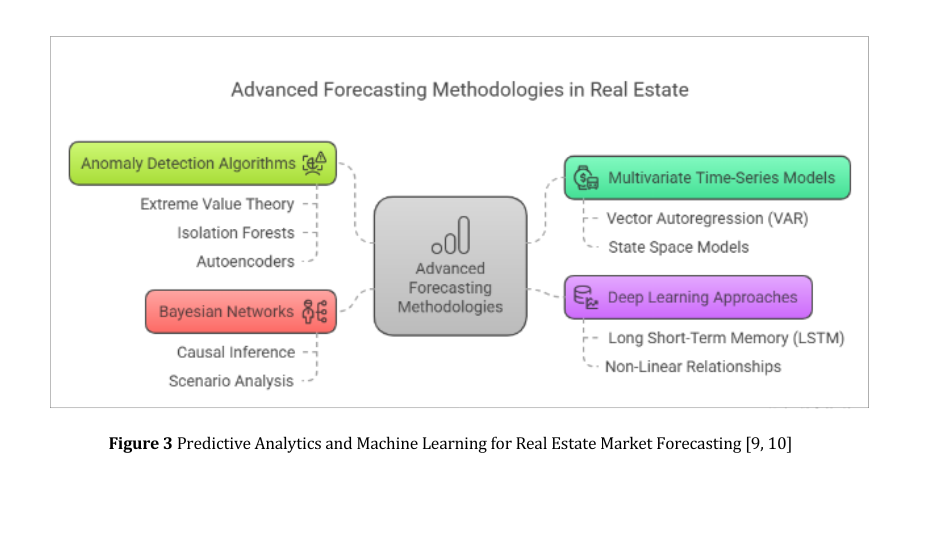
Also, the use of advanced machine learning systems instead of traditional statistical methods. These systems can analyze large volumes of diverse data. AI is consistently helping in real estate by looking at complex relationships among factors like mortgage rates, job statistics, construction permits, migration trends, and property values. This creates a clear picture of how the market works.
8. Anomaly Detection for Enhanced Forecasting
Anomaly Detection Algorithms are becoming more important for identifying unusual patterns in market data. These patterns might indicate new trends or opportunities before they are widely noticed. These systems use a range of techniques, from statistical methods like Extreme Value Theory to machine learning methods such as isolation forests and autoencoders. They learn what normal market behavior looks like and identify significant changes.
AI algorithms analyze real-time data from listings, search trends on real estate sites, and social media to identify early signs of neighborhood changes, investor activity, and shifts in buyer preferences that traditional indicators may miss.
These advanced forecasting systems are trained on many years of historical property data, economic factors, demographic changes, and policy updates. They often use millions of transaction records from different market conditions.
9. Efficient Property Management
Managing residential or commercial properties involves many tasks, such as maintenance, collecting rent, answering tenant questions, and ensuring compliance with laws. AI tools for real estate can automate these tasks, including scheduling repairs and tracking energy use.
Smart buildings with IoT devices can detect problems like water leaks or power surges. They can alert property managers before major issues happen. This helps reduce downtime and improve tenant satisfaction.
10. Enhanced Customer & Tenant Experience Through AI-Driven Interactions
AI is changing how real estate companies interact with potential renters and tenants by making communication faster and more personal.
AI chatbots are tools that work around the clock. They answer questions about floor plans and schedule site visits. AI chatbots provide 24/7 support, handling:
- Maintenance requests
- Amenity inquiries
- Lease information
- Appointment scheduling
They reduce tenant response time by up to 80%, boosting satisfaction scores by 25–30%. The impact of AI on the real estate market has certainly augmented the performance and efficiency of the industry.
11. Smarter Tenant Insights Through AI-Driven Data Analytics
AI's main strength is in how it analyzes data. By evaluating tenant behavior, preferences, and past interactions, AI helps property managers see what tenants value most. This information allows teams to customize their services, respond better, and build stronger connections with tenants.
12. AI-Enhanced VR Experiences Benefitting Both Buyers and Sellers
AI-enhanced virtual reality (VR) experiences are giving buyers a more in-depth understanding of a property without the need for an in-person visit. This is especially valuable in today’s fast-paced market. Meanwhile, sellers are reaping the benefits by showcasing their properties more effectively, attracting the attention of potential buyers, and improving their chances of making a sale.
Is AI a Real Estate Revolution or Evolution?
It’s both.
It is an evolution, as AI steadily improves workflows, operations, and the customer experience, making the sector more efficient and data-driven.
It is a revolution when AI real estate trends trigger seismic changes that are fundamentally reshaping the industry:
- Automated valuations
- Real-time price prediction
- AI-powered property search
- Intelligent investment platforms
- Smart building automation
- Digital AI agents & AI concierges
Conclusion
Artificial intelligence is changing the real estate industry in significant ways. It is modifying how information flows and decisions are made. AI systems are making complex data analysis easier for everyone, not just experts. This means that regular consumers can access information that was previously available only to professionals. As a result, the industry is moving away from decision-making based on intuition to methods that rely on data, which are clearer, more efficient, and fair.
This shift has major consequences for traditional brokerage models. Value is shifting from just providing information to helping with negotiation strategies, understanding the emotional sides of homebuying, and solving complex issues that AI cannot handle.
As AI continues to develop, it is important to address issues such as data fragmentation, privacy, transparency, and bias. How well we address these challenges will affect how AI can help create a real estate market that is more accessible, efficient, and fair.
For those working in real estate, understanding how these AI technologies work is crucial. At this stage, Signity Solutions can help you identify AI opportunities for your specific business case, leveraging top development expertise in the field. Connect today to discuss your requirements.
Frequently Asked Questions
Have a question in mind? We are here to answer. If you don’t see your question here, drop us a line at our contact page.
How will AI impact real estate?

What does AI mean in real estate?
What are the risks of AI in real estate?
While AI offers many benefits, it also has some risks. These include concerns about data privacy, potential bias in valuations or recommendations, and reliance on automated systems without human oversight. Inaccurate or incomplete data can lead to poor predictions. Additionally, integrating AI systems needs proper management to ensure fairness and compliance with real estate rules. With the right measures, these risks can be managed well.
Will realtors be replaced by AI?