


.png?width=27&height=27&name=Group(1).png)

-1.svg)
-1.svg)


-2.svg)


%201-1.webp?width=148&height=74&name=our%20work%20(2)%201-1.webp)




.svg)





Real estate has never been an early adopter of new tech. Gen AI in real estate is the exception.
Deloitte's 2026 commercial real estate outlook, based on a survey of more than 850 C-level executives across 13 countries, puts a number on the hesitation. 19% of commercial real estate organizations still describe themselves as early in their AI journey. Another 27% say they are running into real implementation problems. These include thin technical expertise, systems that don't talk to each other, and staff who aren't sold on the change.
That's the gap that matters. Not whether AI in real estate works in theory, but whether real estate companies can actually get it running against their own data and workflows. This piece covers where generative AI applications are producing real results in the real estate industry, what enterprise AI systems and governance require, and what to check before picking a generative AI development company.
 Generate
Key Takeaways
Generate
Key Takeaways

- Interest in AI models across commercial real estate is broad, but execution still lags behind adoption.
- Real estate firms increasingly favor smaller, fine-tuned generative AI systems over large, general-purpose foundation models.
- Enterprise data quality, not model choice, is the deciding factor in most gen AI rollouts.
- Governance and data privacy discipline are becoming baseline expectations.
1. Streamlining Property Design and Development
Generative AI is changing the first stage of a project, before a single brick gets laid. Architects and developers used to test a handful of layouts by hand against zoning limits, environmental constraints, and cost targets. Now they feed those same parameters into generative AI models and get dozens of design variations back in the time it used to take to sketch one.
The output includes floor plans, interior visualizations, and layout recommendations built around space efficiency and energy performance. Problems that used to surface mid-construction show up in the model instead. Remember, shorter design cycles lead to less expensive rework.
The real decision in any generative AI integration effort happens here too, and it's easy to underestimate. Does the tool plug into existing CAD and BIM systems? Does it force a separate workflow on top of what teams already use? Get that wrong and design teams just stop using the tool.
2. Enhancing Property Search
Traditional property search still makes buyers do the work: check a box for bedrooms, set a price range, pick a ZIP code. Generative AI applications skip that. They learn from browsing behavior, saved property listings, and stated preferences, and surface options a buyer never thought to search for. That runs on continuous data analysis happening in the background, not on the buyer submitting one more query.
For agencies and portals, this matters for one reason: search personalization directly affects lead quality and conversion. Firms still relying on static filters are losing ground to platforms built on stronger generative AI systems, and the buyers who'd have found those better matches just go somewhere else.
3. Optimizing Marketing Strategies
Generative AI is rebuilding real estate marketing around data instead of guesswork. It analyzes market trends and buyer segments to generate listing copy, produce image generation for property visuals, and build virtual property tours without a full production crew. Work that used to take a marketing team days now runs with far less manual effort, freeing agents to focus on buyers who are actually ready to move.
Firms adopting this at scale report faster campaign turnaround and stronger lead volume per listing, because the content adapts to the audience instead of one generic description getting reused everywhere. Signity's breakdown of practical AI use cases in real estate covers which generative AI solutions deliver ROI fastest for small teams versus enterprise portfolios.
4. Virtual Assistants and AI Agents
AI-powered virtual assistants and AI agents now handle a meaningful share of the first conversation with a buyer or tenant: answering questions, scheduling tours, and pulling live property details with minimal human intervention. These systems function less like static chatbots and more like AI copilots for the front office, using prompt engineering behind the scenes to keep responses accurate and on-brand.
The value isn't just coverage outside business hours. It's consistency. An AI agent gives the same accurate answer at 2 a.m. that a well-trained agent would give at 2 p.m., and as AI agent development matures, more of this work shifts from scripted responses to genuinely adaptive customer support automation.
5. Predictive Analytics
Investment decisions in real estate live or die on how good the underlying enterprise data is. Generative AI systems now pull from economic indicators, property histories, and market trends to flag opportunities and risks faster than manual analysis ever could. Some firms are extending this into fraud detection on transaction and lease data, catching anomalies that would take a human analyst far longer to spot.
Model quality here depends heavily on training data and continuous model optimization; a model trained once and left alone drifts as market conditions shift. That kind of precision changes what "data-driven investing" actually means in practice, provided the underlying data pipeline and enterprise data sources are sound. More on that in the architecture section below.
6. Smart Building Management
Sustainability and AI are converging inside buildings themselves. Generative AI systems monitor energy consumption patterns and automatically adjust heating, cooling, and lighting to cut waste without sacrificing comfort. For property owners, that translates into measurable labor cost savings, since fewer staff need to be physically on-site monitoring routine building systems around the clock.
This is also one of the lower-risk entry points for firms just starting with AI. The data involved is operational rather than personal, and unlike maintaining staff on-site for round-the-clock monitoring, AI-based building management scales without adding headcount.
Technical Architecture Behind Gen AI in Real Estate
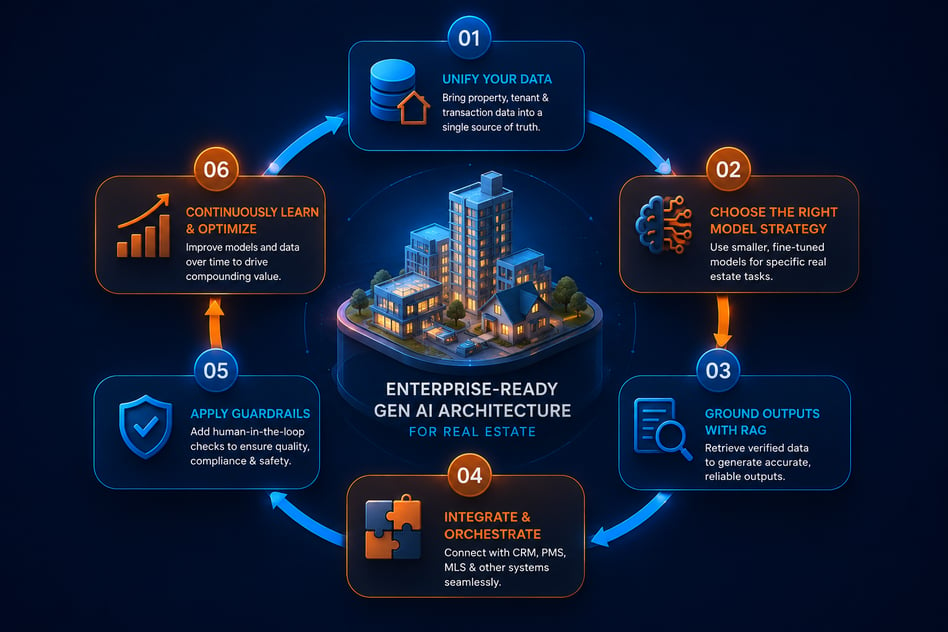
The specific AI models you pick matter far less than the data layer underneath them. Real estate firms getting the most from generative ai adoption keep their property, tenant, and transaction data on unified data platforms they control, often called a data lakehouse, rather than scattering enterprise data across whatever tool each vendor prefers. That single source of truth is what lets a firm switch AI platforms later without rebuilding its entire enterprise AI systems from scratch.
According to Deloitte's commercial real estate research, about 22% of firms now use industry-specific software platforms for AI, such as Integrated Workplace Management Systems, while another 20% rely on publicly available large language models.
Model strategy: smaller, fine-tuned models over one large LLM
The same Deloitte research found that many real estate organizations are shifting away from training one large, monolithic foundation model in-house, and instead assembling a portfolio of smaller, fine-tuned models suited to specific tasks such as lease abstraction or tenant communications. Fine-tuning a smaller model on domain-specific training data, rather than relying on generic model training alone, tends to produce faster inference and more relevant outputs for narrow real estate use cases.
Grounding outputs with RAG
Reliability depends on retrieval-augmented generation (RAG) grounded in verified property records, not the base model alone. Without that grounding layer, a listing description generator can invent square footage or misstate a school district, which is not a cosmetic error; it's a fair housing and consumer-protection problem covered in the compliance section below.
Integration layer and guardrails
A production-ready architecture typically includes an integration layer connecting AI platforms to existing CRM, property management, and MLS data, document summarization tools for lease review, and guardrails that flag low-confidence outputs for human review before they reach a buyer.
Knowledge management and proprietary data
This is also where knowledge management matters: the more consistently a firm structures its proprietary data, the more its generative AI systems compound in value over time rather than starting from zero on every new deployment.
Compliance and Governance for AI-Driven Real Estate
The Hallucination Risk
Real estate is a regulated industry, and generative artificial intelligence doesn't get a pass on that. The clearest risk is hallucination. An AI system generating a listing with the wrong square footage or an incorrect school district assignment isn't just an embarrassing error; it's exposure under fair housing and consumer-protection law.
Workforce Impact: What the Data Actually Shows
There's also a workforce dimension worth being direct about. Research from PwC and the Urban Land Institute's Emerging Trends in Real Estate 2026 report found that generative AI had directly replaced only 0.7% of the roughly 2,900 job skills analyzed in 2025, up from effectively zero the year before.
AI is changing administrative tasks and technical roles faster than it is changing in-person service roles, which is a useful, evidence-based counterweight to overstated claims about headcount reduction.
Data Governance as a Baseline
Data governance matters just as much as compliance framing. Solutions built with comprehensive data security and strong data privacy controls, including encryption and role-based access, protect both the firm and the client, and responsible AI practices are increasingly a baseline expectation from enterprise buyers rather than a differentiator.
All in all, before selecting a development partner, ask directly how they ground outputs against verified enterprise data sources and what data strategy governs model access to sensitive tenant and financial information.
Traditional Workflow vs. AI-Enabled Workflow
| Task | Traditional Approach | AI-Enabled Approach |
| Listing search | Static filters, keyword match | Behavioral personalization, intent-based ranking |
| Lease document review | Manual read-through per document | AI-assisted document summarization across a full portfolio |
| First buyer contact | Agent-dependent response time | AI agent available continuously, consistent response quality |
| Design iteration | Days per layout revisio | Multiple AI-generated variations same day |
| Building monitoring | On-site staff for routine checks | Automated monitoring with exception-based human review |
Why Choose Signity Solutions for Gen AI in Real Estate?
A lot of real estate firms exploring generative AI hit the same wall: strong ideas, no in-house team that has actually built a production RAG pipeline or integrated an AI layer into an existing MLS and CRM stack. That's the gap Signity closes. Beyond cost efficiency, which matters but isn't the whole story, Signity's team brings hands-on technical expertise architecting data governance, model training, and system integrations specifically for real estate clients, not generic AI solutions retrofitted to the industry after the fact.
As a generative AI development company, Signity works across the full lifecycle: AI strategy and AI consulting up front, custom generative AI development and generative AI integration services through build, and ongoing support to integrate generative AI solutions with the systems a firm already runs.
Signity's case study on an AI-powered real estate intelligence platform walks through what that looks like end-to-end, from valuation models to client engagement workflows, built by generative AI developers with real estate-specific experience rather than a horizontal AI team applying the same playbook to every industry.
Conclusion
Generative AI in real estate has stopped being a differentiator and started being table stakes. The firms pulling ahead aren't the ones that adopted first; they are the ones that paired generative AI adoption with solid enterprise data architecture and real governance discipline.
Design, search, marketing, and investment decisions are all faster and more informed than they were two years ago, but none of that holds up without grounded data and the right AI models underneath it. The gap between piloting AI and scaling it across the real estate industry is where the real competitive advantage sits right now, and it's closing fast for firms willing to get the architecture right the first time.
FAQs
Is generative AI actually being adopted in commercial real estate, or is it still mostly hype?
Adoption is real but uneven. Deloitte's 2026 commercial real estate outlook found broad executive interest in AI models across the industry, alongside a meaningful share of firms still working through early-stage implementation challenges.
What are the biggest risks of using AI in real estate?
The two biggest risks are hallucinated listing details, which can create fair housing and consumer-protection exposure, and weak data governance, which undermines both accuracy and compliance.
Will generative AI replace real estate jobs?
Current research suggests the direct impact on job skills has been modest so far. PwC and the Urban Land Institute found generative AI had replaced only 0.7% of skills analyzed in 2025, concentrated more in administrative and technical tasks than in-person service roles.
How do we choose a gen AI development partner for real estate?
Look for RAG-grounded architecture, verified compliance practices around data privacy and security, and prior experience integrating generative AI solutions into real estate-specific systems like MLS and property management platforms, rather than generic AI tooling applied without industry context.





.png?width=352&name=AI%20Solutions%20in%20Education%20A%20CXO%20Guide%20to%20Scalable%20ROI%20(3).png)

.png?width=352&name=What%20Is%20Autonomous%20AI%20and%20How%20Does%20It%20Work%20(1).png)