










A production machine learning (ML) model goes live after months of development. Weeks later, a security review reveals that a subset of its training data was quietly manipulated long before the model reached the optimizer.
The poisoned samples skewed the model's behavior in ways that standard testing never caught, and by the time the issue surfaced, the model had been making decisions at scale. This is the failure mode that perimeter defenses were never built to catch. Firewalls and endpoint controls secure the network boundary. They don't inspect training pipelines, model registries, or inference APIs for adversarial manipulation.
According to Gartner's April 2026 forecast, 25% of enterprise generative AI applications will experience at least five minor security incidents per year by 2028. Gartner also predicts that AI applications will drive 50% of cybersecurity incident response efforts by that same year.
AI data security requires controls built into the pipeline itself. The strategies that matter at enterprise scale are zero-trust architecture applied across every internal ML service call, federated learning and differential privacy for data exposure reduction, confidential computing for regulated workloads, and MLOps governance that treats model promotion as a security gate.
 Generate
Key Takeaways

- AI data security covers every stage where models read, store, or act on data.
- Unmanaged AI tools and ungoverned agents expand exposure, so asset discovery must come first.
- Zero-trust governance, least privilege, and runtime monitoring form the core control stack for enterprises.
- Regulations such as the EU AI Act and GDPR shape architecture choices before launch.
What Is AI Data Security and Why Does Enterprise AI Security Matter Now?
AI data security is the set of controls that protect enterprise data across the AI lifecycle. It applies to training data and retrieval stores. It also covers prompts, model outputs, and agent actions. The goal is to keep sensitive information inside approved boundaries.
Traditional data security assumed that people opened files and applications moved records. AI changes that assumption. A model can summarize a contract, and an agent can send an email on its own. Enterprise AI security therefore has to follow both the data and the identity that touches it.
| 2026 data point | What it means for enterprises | Source |
| Average breach cost reached $4.99 million, up 12% year over year | Every incident now carries a higher financial penalty | IBM |
| One in four malicious breaches was AI-enabled and averaged $6 million | Attackers use AI to move faster, so defenders must match that speed | IBM |
| Only one in five companies has a mature governance model for autonomous agents | Most agents run with access that nobody has reviewed | Deloitte |
| 25% of enterprise GenAI applications will see at least five minor security incidents a year by 2028, up from 9% in 2025 | Small leaks become a routine operating cost without controls | Gartner |
| Agentic AI security spending grows from $1.65 billion in 2026 to $13.52 billion by 2032 | Boards already fund AI data protection as a priority | MarketsandMarkets |
Attackers use AI to scale their work, and enterprises deploy agents faster than they govern them. Teams that begin with a governance model move faster later.
Related Read: AI Implementation Challenges Enterprises Face and How to Overcome Them
Where Does Enterprise AI Data Get Exposed?
Enterprise AI data exposure happens where sensitive information enters a model, leaves a model, or moves through an agent. Prompts, retrieval stores, and connected tools are the most common sources.
Prompts and outputs are the first exposure point. Staff paste confidential text into public tools, and a gateway with redaction and logging closes that path. Retrieval stores are the second. A RAG system can return documents that a user should not see, so permissions must be enforced at query time. Third-party models add a further risk because a vendor may retain or train on your data. Contract terms and private deployment options address that risk.
Shadow AI and Unapproved Tools
Shadow AI is any AI tool that employees use without a security review. It is hard to see because it often arrives as a browser tab or a plugin. IBM found that only 37% of breached organizations encrypt sensitive data both at rest and in transit. Unmanaged tools widen that gap because data leaves before any control applies. Discovery scans and a sanctioned alternative bring that usage back under control.
Agents and Non-Human Identities
An AI agent is software that takes actions on a user's behalf. It needs credentials to do that work. Deloitte's State of AI in the Enterprise report shows that only one in five companies has a mature governance model for autonomous agents. Most agents therefore run with access that nobody has reviewed. Each agent needs its own identity, a narrow scope, and a named owner.
Related Read: AI Agent Architecture: Components, Patterns & Best Practices
Which AI Security Strategies Protect Enterprise Data?
AI security strategies are the governance, access, and monitoring controls that keep enterprise data safe as AI scales. Five strategies carry most of the weight. Teams should discover and classify data first and then enforce least privilege. Zero-trust data governance and runtime monitoring follow. Vetting the AI supply chain completes the set.
Govern and Classify Data Before Models Touch It
Classification is the base layer. A model that reads unlabeled data will treat a salary sheet like a press release. Gartner predicts that 50% of organizations will adopt a zero-trust posture for data governance by 2028 because unverified AI-generated data keeps growing. Zero-trust governance means every data source is verified before it feeds a model.
Control Access for People and Agents
Least privilege applies to agents as much as to employees. Retrieval systems should check document permissions at query time. An agent that drafts email does not need access to payroll. Short-lived credentials also limit the damage when a token leaks.
Monitor AI at Runtime
Policy alone does not stop an incident. Runtime monitoring watches prompts, outputs, and tool calls as they happen. IBM reports that one in four malicious breaches is now AI-enabled, and these breaches average $6 million. Real-time alerting shortens the time between a bad action and a response. An AI gateway gives security teams one place to apply filters, logs, and rate limits.
The fifth strategy covers the supply chain. Teams should inventory every model, dataset, and plugin in use.
What Does a Secure Enterprise AI Architecture Look Like?
A secure enterprise AI architecture organizes controls into four distinct zones, each addressing a different stage where data or models can be compromised.
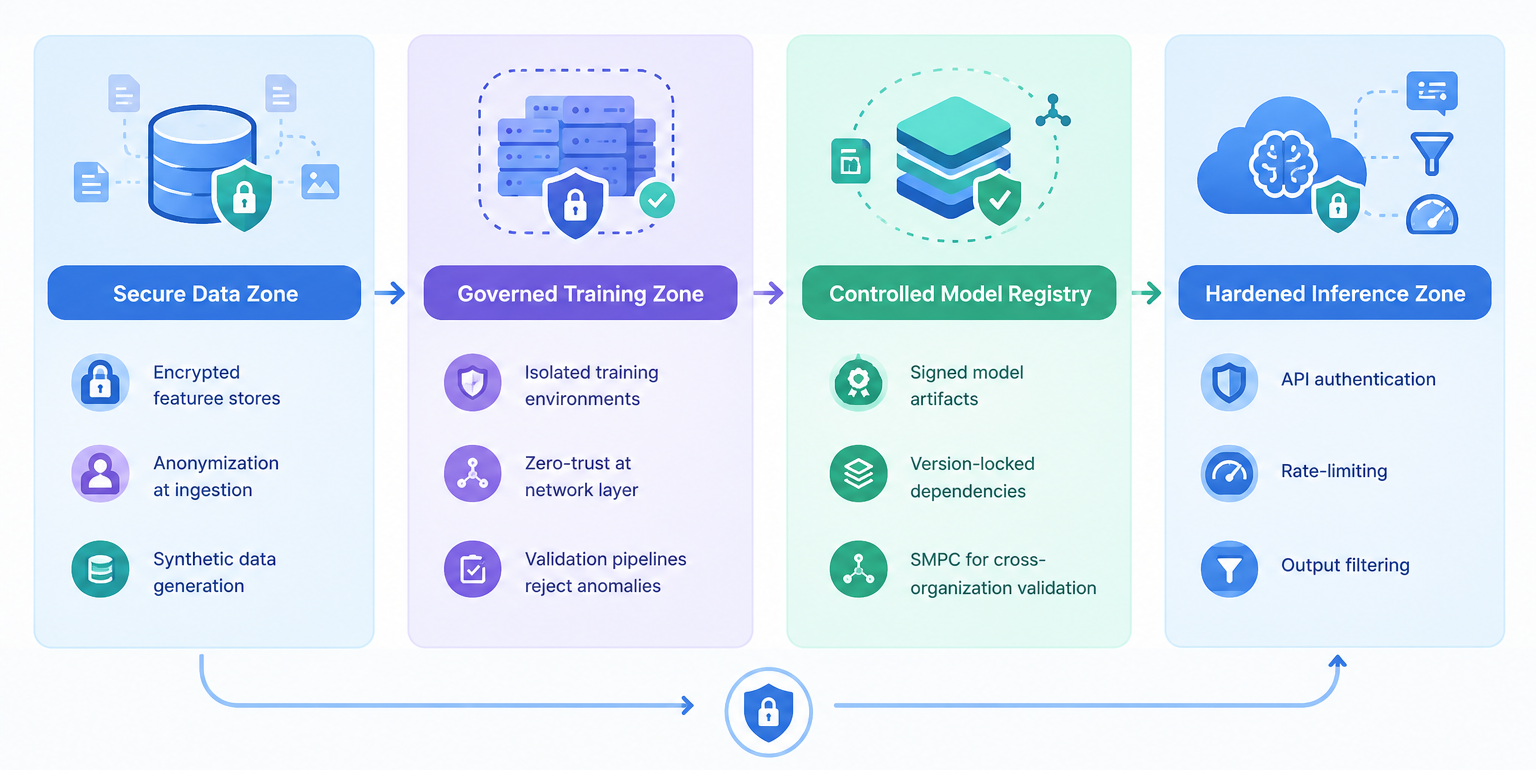
- Secure Data Zone: Encrypted feature stores, anonymization applied at ingestion, and synthetic data generation for healthcare and fintech workloads where live personally identifiable information (PII) carries too much regulatory exposure.
- Governed Training Zone: Isolated training environments with zero-trust architecture enforced at the network layer, plus validation pipelines that reject anomalous samples before they reach the optimizer.
- Controlled Model Registry: Signed model artifacts, version-locked dependencies, and secure multiparty computation (SMPC) for validating models across organizational boundaries without exposing raw weights.
- Hardened Inference Zone: API authentication, rate-limiting, and output filtering to block data exfiltration through model responses.
A detail that surfaces repeatedly in architecture reviews: zero-trust means every request is authenticated and authorized, including internal service-to-service calls within the ML pipeline. Treating it as an external-only control leaves the training and serving layers open to lateral movement.
Enterprises deploying models on-premises or at the network edge face an additional consideration: edge AI security requires the same signing and access controls applied centrally, since edge nodes are harder to patch quickly.
Organizations that need full control can use private LLM development services. It can help deploy models inside your own cloud and connect them to your governed data.
Related Read: How to Build an Enterprise AI Architecture That Scales
Which Compliance Requirements Shape AI Data Protection?
AI compliance is the set of legal and standards-based obligations that govern how enterprises collect, process, and protect data used by AI. Requirements differ by region and industry. Most programs map one control set to several frameworks at once.
| Framework | What it requires | Design implication |
| EU AI Act | Risk-based duties for AI providers and deployers | Classify each use case and keep technical documentation |
| GDPR | Lawful basis, data minimization, and subject rights | Limit personal data in prompts and support deletion |
| HIPAA | Safeguards for protected health information | Encrypt health data and log every access |
| SOC 2 | Independent assurance of security controls | Collect evidence from AI systems like any other system |
| ISO/IEC 42001 | A management system standard for AI | Assign owners and run documented risk reviews |
| NIST AI RMF | A voluntary risk management structure | Use it to organize governance and testing |
Timing matters for the EU AI Act. The Digital Omnibus moved the high-risk system obligations to December 2027. The rules on prohibited practices and general-purpose models were not delayed. Regulators still expect the same outcomes, so teams that collect audit evidence now will avoid a rushed program later.
Related Read: AI Compliance for Enterprises: Frameworks, Risks, and Best Practices
How Do You Plan Implementation and Choose a Partner?
Six steps move AI security strategies from policy documents into working pipeline controls. Each step targets a specific failure point, and skipping any one of them leaves a gap that the others can't cover.
- Run an adversarial robustness evaluation on every production model before it connects to any external API. This surfaces input manipulation risks before exposure widens.
- Add model robustness testing as a mandatory CI/CD gate using tools like CleverHans or the Adversarial Robustness Toolbox (ART). A model that passes functional tests can still fail under adversarial inputs.
- Deploy backdoor attack detection on the training dataset before training begins. Activation clustering and spectral signature methods both catch poisoned samples at the data level, not after the model has absorbed them.
- Define data classification tiers, retention limits, and access rules for all ML feature stores as part of your enterprise data governance policy.
- Apply differential privacy at the model update level for any model trained on user-generated data.
- Run red-team exercises that target model extraction via the inference API directly.
That last step is where most enterprise security programs have a gap. Red-team scope typically covers the application layer. Model IP can be extracted from a hardened application if the API boundary isn't probed separately.
Remember, a good partner designs security into delivery from the first sprint. Look for experience in regulated industries and for audit-ready documentation. Ask how the team handles agent permissions and who owns incident response. Working with a reliable agentic AI services team builds agents with these controls from day one.
Related Read: Choosing The Best Enterprise AI Agent Deployment Consultants in 2026
Why Do Enterprises Choose Signity for Secure AI Development?
Signity has delivered AI solutions for more than 16 years. The team has completed over 1,000 projects with 200+ certified experts. Our delivery practices align with major frameworks such as GDPR and HIPAA. They also cover SOC 2, ISO/IEC 27001, and CCPA depending on industry needs. We build on AWS, Microsoft Azure, and Google Cloud so that security controls fit the platform you already run.
We have applied these principles in production. Our RAG-powered financial intelligence assistant and our AI solution for a law firm both handle sensitive information. Our medical radiology chatbot does the same in healthcare. Each one demanded strict access boundaries from the first design review.
-
AI readiness audits that map data exposure and agent permissions
-
Secure architecture design with private model and RAG options
-
Governed delivery with compliance evidence built in
Conclusion: Secure AI Data Before You Scale
Enterprise AI adoption creates a security surface that perimeter defenses were never designed to address. Training pipelines, model registries, and inference endpoints each carry distinct exposure points that network-layer controls can't reach.
The highest-risk gap isn't a missing tool. It's treating AI data security as a compliance checkpoint rather than a continuous engineering discipline. Security embedded at ingestion holds. Security bolted on after deployment tends to catch failures only after they've already had an effect.
Before expanding any AI deployment further, technology leaders should run two assessments: an adversarial robustness evaluation on current production models, and a data lineage audit on the training datasets behind them. Starting with those two audits gives you a clear picture of current exposure before that pressure arrives.
Frequently Asked Questions
Have a question in mind? We are here to answer. If you don’t see your question here, drop us a line at our contact page.
What is AI data security?

How do you secure enterprise data used with generative AI?
What is shadow AI and why is it risky?
Which regulations apply to enterprise AI data protection?
How much does AI data security implementation cost?