

.png?width=27&height=27&name=Group(1).png)

-1.svg)
-1.svg)


-2.svg)


%201-1.webp?width=148&height=74&name=our%20work%20(2)%201-1.webp)




.svg)





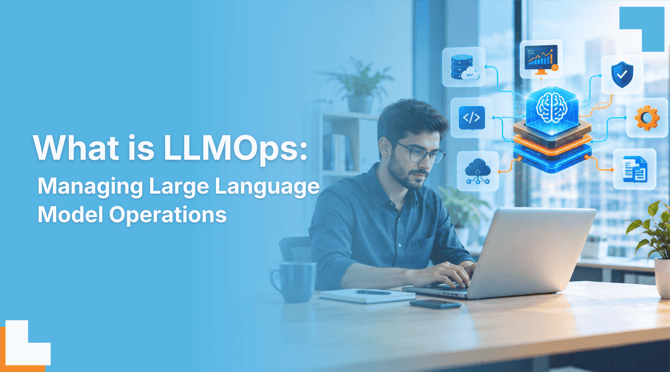
Treat a large language model like a software release, and you'll hit production failures that no sprint retrospective can fully explain. The model ships. Traffic flows. Then, quietly, output quality degrades, token costs spike, and a hallucinated response reaches a regulated end user before anyone notices.
That's the operational gap that LLMOps exists to close.
The LLMOps software market reflects how seriously enterprises are taking this. According to Research and Markets, the sector was valued at $5.88 billion in 2025 and is projected to reach $15.59 billion by 2030, growing at a CAGR of 21.6%.
The growth tracks with a specific organizational pain: teams discovering that large language model operations require disciplines their existing MLOps workflows weren't designed to handle.
This piece covers what separates LLMOps from conventional ML operations, the six technical components that define the discipline, deployment architecture trade-offs, governance requirements, and the practices that keep enterprise LLM systems reliable past the pilot stage.
 Generate
Key Takeaways
Generate
Key Takeaways

- Treat every prompt change as a deployment artifact - version it, test it, and give it a rollback path.
- Instrument token consumption and latency percentiles from day one; retrofitting telemetry after scale is expensive.
- Build hallucination detection into the inference pipeline itself, running in parallel, not as a post-hoc audit layer.
- Evaluate llmops services vendors on observability depth and model versioning support, not feature marketing.
- Establish your model governance framework before the first production deployment; governance retrofitted after an incident is always incomplete.
Defining LLMOps: Core Concepts and Fundamentals
LLMOps is the set of engineering practices, tooling, and governance processes that manage the full lifecycle of large language models, covering everything from development and fine-tuning through production deployment and eventual model retirement.
Most engineering teams inherit MLOps workflows and assume they will stretch to cover LLMs. They won't. The gap isn't tooling preference; it's structural. MLOps was built around deterministic models where the same input reliably produces the same output.
Large language model operations carry no such guarantee, and that non-determinism changes every downstream decision, from evaluation metrics to rollback strategy.
Consider prompt versioning. In standard ML workflows, the model artifact is the deployable unit. With LLMs, an unversioned prompt change in production carries equivalent risk to an untracked code commit, and it's harder to detect because the system keeps responding, just with degraded quality. Most teams discover this only after a production incident.
The five foundational differences worth anchoring your engineering allocation around:
- Determinism: MLOps models produce consistent outputs; LLM outputs vary across identical inputs
- Artifact type: MLOps versions model weights; LLMOps must version prompts as first-class deployment artifacts
- Evaluation metrics: MLOps uses quantitative accuracy scores; LLMOps requires semantic evaluation with human-in-the-loop scoring
- Cost model: MLOps costs center on training compute; LLMOps costs accumulate at inference through token consumption
- Failure modes: MLOps failures are typically systemic and visible; LLM failures are semantic and silent
Gartner estimates that over 30% of generative AI projects will be abandoned after the proof-of-concept stage, citing quality and operational risk as primary drivers. That abandonment pattern maps directly to teams treating LLM deployment as a one-time release rather than an ongoing operational discipline requiring its own governance layer.
Key Components of Large Language Model Operations
LLM operations span six discrete architectural layers, each solving a failure class that the previous one can't catch.
- Prompt versioning systems: Track every prompt change as a deployable artifact with rollback capability, because unversioned prompt edits are the most common source of silent production regressions.
- Fine-tuning pipelines with dataset governance: Enforce data lineage and versioning at the training stage so every model update is reproducible and auditable by compliance teams.
- Vector database and RAG integration: Connect retrieval layers to generation pipelines, with refresh schedules governing how current the retrieved context actually is.
- Model versioning and registry management: Maintain a central registry tracking which model version serves which endpoint, making rollbacks a two-minute operation rather than a two-day incident.
- Inference optimization: Apply batching, quantization, and semantic caching to cut per-request token costs and latency at production traffic volumes.
- Observability stack: Instrument latency percentiles, throughput, token consumption, and output quality scores from day one.
Here's the insight most teams miss on RAG: it's a data freshness problem, not a retrieval problem. Organizations that treat their vector database as static storage see measurable answer quality degradation within 60 to 90 days of deployment, because the embedded knowledge drifts from ground truth.
Chunking strategy and refresh cadence matter more than which retrieval algorithm you pick.
On inference architecture, the trade-offs are real:
| Dimension | Self-Hosted | Managed API |
| Cost at scale | Lower per-token | Higher per-token |
| Latency control | Full | Rate-limit constrained |
| Telemetry depth | Full token-level | Abstracted |
| Governance fit | Strong | Depends on vendor |
Managed APIs abstract token-level telemetry your internal observability stack must later reconstruct. Teams that migrate mid-project consistently underestimate that reconstruction cost.
Related Read: Multimodal vs Standard LLM: Architecture Choice Drives Business AI ROI
LLMOps Services and Deployment Strategies
Enterprise LLM deployments follow one of three infrastructure patterns: managed API consumption, self-hosted open-weight models, or hybrid architectures that route requests by data sensitivity and per-token cost thresholds.
Managed APIs (such as OpenAI or Anthropic endpoints) let teams ship quickly. The trade-off isn't hidden cost, it's hidden telemetry. Providers surface aggregated latency and error rates. Token-level traces, prompt-level output scoring, and per-request cost attribution don't come included.
When your model governance framework requires that audit trail, you're rebuilding it from scratch on your own observability stack.
Self-hosted open-weight models flip that equation. You own the telemetry. But fixed GPU compute costs accrue before a single request arrives, and inference optimization decisions like quantization precision and batch scheduling become your team's problem to solve, not the provider's.
Hybrid architectures are the pattern most mature teams land on. Route general-purpose requests to a managed API. Send anything touching regulated data to a self-hosted endpoint. This controls both cost exposure and data residency risk simultaneously.
LLMOps services vendors fall across four functional categories that your stack needs to cover:
- Prompt management platforms: version, test, and deploy prompt templates through CI/CD pipelines with rollback support
- Model serving frameworks: handle batching, caching, and quantization at the inference layer
- Evaluation tooling: score outputs against defined metrics automatically, before responses reach users
- Content moderation layers: enforce safety and compliance policies at the API boundary, not post-hoc
When evaluating an LLMOps vendor, apply these five criteria:
- Observability depth: does it capture token-level telemetry or only aggregated metrics?
- Model versioning support: can it track prompt versions alongside weight versions in a single registry?
- Governance framework compatibility: does it export audit logs in formats your compliance team can actually use?
- API rate limiting controls: does it support fallback routing when upstream providers throttle requests?
- Evaluation metric coverage: does it support semantic scoring, or only traditional accuracy measures?
Monitoring, Governance, and Scaling Considerations
Production LLM monitoring differs fundamentally from traditional application monitoring because the failure mode is semantic, not systemic. Your infrastructure stays green while response quality quietly collapses. No error codes fire. No alerts trigger. Users just start getting wrong answers.
Why Semantic Failures Are Hard to Catch
A conventional observability stack catches crashes, timeouts, and error rates. It can't catch a model that's confidently wrong. That gap is why you can't bolt on hallucination detection after the fact.
It requires a parallel evaluation layer running at inference time, scoring outputs against defined criteria before they reach users. In regulated industries, post-hoc detection isn't a policy choice. It's a liability.
The Stanford HELM benchmarking framework offers a principled starting point for evaluation metric selection, covering accuracy, calibration, and robustness across model types.
Five Monitoring Signals Your Observability Stack Must Capture
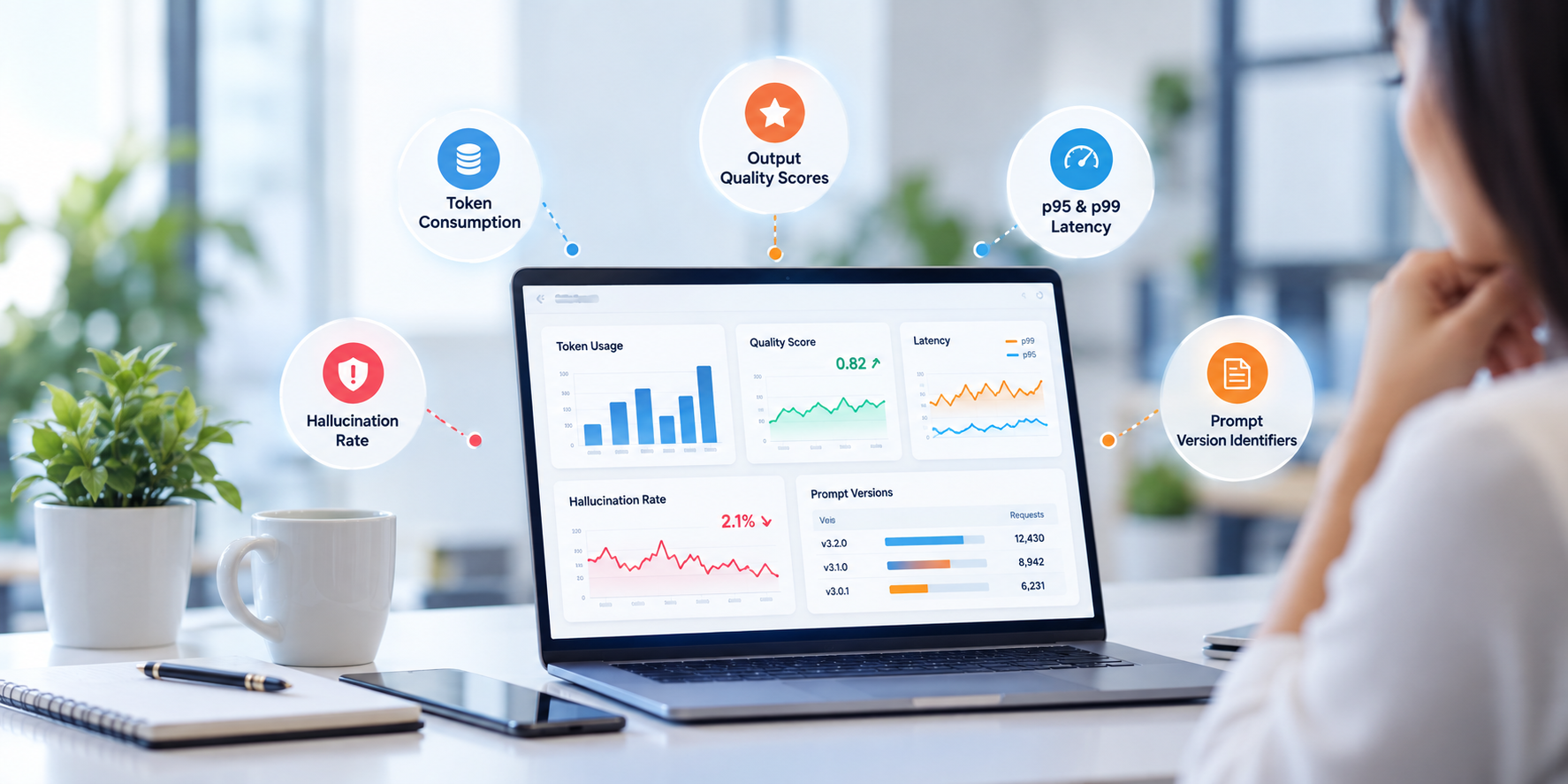
Every enterprise team operating LLMs in production should instrument these signals from day one:
- Token consumption per request, segmented by use case, so cost anomalies surface before billing cycles close
- Output quality scores from your parallel evaluation layer, tracked as percentiles over time rather than point-in-time snapshots
- Latency at the p95 and p99 percentiles, because median latency masks the tail behavior that breaks user experience SLAs
- Hallucination rate thresholds, with alerting configured per use case rather than a single system-wide threshold
- Prompt version identifiers attached to every trace, so regressions can be attributed to a specific prompt change rather than a model update
Setting Latency SLAs by Use Case
Most teams set latency targets based on infrastructure defaults. That's the wrong starting point. A customer-facing chat interface needs sub-two-second p95 response times. A back-office document summarization pipeline can tolerate ten seconds without user impact.
Calibrate your SLA to user expectation first, then work backward to infrastructure and inference optimization decisions that support it. Skipping this step means you're optimizing for a number that doesn't reflect actual business risk.
A cost governance framework tied to token consumption dashboards closes the monitoring loop, connecting quality signals to spend accountability before either drifts out of control.
LLM Operations Best Practices for Enterprise
Enterprise teams that sustain reliable LLM operations share five structural practices that separate production-ready systems from teams permanently stuck in pilot mode.
- Version every prompt template as a deployment artifact, complete with tests and a rollback path. A prompt change without version control is a production change with no recovery option if quality degrades.
- Establish your model governance framework before the first production deployment. Retrofitting governance after an incident means writing policy under pressure, which consistently produces incomplete coverage of the failure modes that already occurred.
- Instrument the full observability stack on day one: token consumption per session, latency percentiles by use case, and automated output quality scores. Teams that add telemetry after scaling spend weeks reconstructing data they should have collected from request one.
- Build fine-tuning pipelines with explicit data lineage so every model update is reproducible. Without lineage, a model update that degrades performance has no auditable path back to the training data that caused it.
- Implement API rate limiting with fallback routing so upstream provider throttling doesn't cascade into a full service outage. Third-party model endpoints are single points of failure until your architecture treats them as such.
The governance failure most teams don't anticipate: the absence of a prompt rollback procedure. When prompt drift causes a production incident, the only recovery is manual intervention, which is operationally unacceptable in regulated environments.
Signity's Proficiency & Understanding of LLMOps
Signity's approach to large language model operations is built around one principle: production readiness requires engineering discipline, not just tooling selection.
Most engagements begin with an audit of prompt management practices and observability gaps before any infrastructure is touched. That sequencing matters. Teams that deploy first and instrument later consistently rebuild telemetry under pressure, which produces incomplete coverage of the failure modes that already occurred.
Signity's delivery across LLM operations follows four structured phases:
- Prompt versioning setup with CI/CD integration and rollback procedures defined before go-live
- Observability stack configuration capturing token consumption, latency percentiles, and output quality scores at the request level
- Hallucination detection layer built in parallel at inference time, not added post-deployment
- Cost governance dashboards tied to per-session token accounting, not raw API spend
The honest practitioner note: governance retrofitted after a production incident is always incomplete. Signity's model governance framework gets established at project start, which is where it actually protects you.
Conclusion: Getting Started with LLMOps
Large language model operations is a discipline question, and teams that answer it before scaling avoid the failures that follow ungoverned deployments.
Start with a prompt management audit. If your team can't answer which prompt version is running in production right now, that's your highest-priority gap. Next, define evaluation metrics tied to your specific use case before you write a single monitoring query.
A customer-facing assistant and an internal summarization pipeline need different quality thresholds, and setting them after deployment means your SLA reflects infrastructure defaults, not actual user risk.
Select your observability stack before production traffic arrives. Retrofitting telemetry is expensive and leaves your worst failure window uncovered.
Teams that ship with governance already in place don't just recover faster from incidents. They compete differently, because operational discipline at the inference layer compounds into output quality that ungoverned systems can't replicate.
Frequently Asked Questions
Have a question in mind? We are here to answer. If you don’t see your question here, drop us a line at our contact page.
How does LLMOps differ from MLOps in practice?

What's the typical cost structure for LLM operations at enterprise scale?
How do organizations implement hallucination detection in production?
What role do vector databases play in LLMOps?
How should a CTO evaluate LLMOps services vendors?