

.png?width=27&height=27&name=Group(1).png)

-1.svg)
-1.svg)


-2.svg)


%201-1.webp?width=148&height=74&name=our%20work%20(2)%201-1.webp)




.svg)





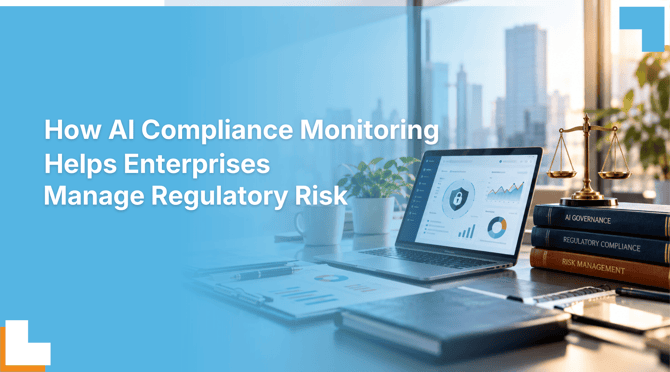
Regulators noticed. Enterprises rolled out artificial intelligence fast. Governance didn't keep pace. The EU AI Act's phased enforcement is here. US state AI laws keep expanding. Evolving regulations in finance and healthcare are adding to the load.
All of that now sits on top of existing data privacy obligations. Compliance teams used to review AI outputs once a quarter. Now they're asked to prove in real time that every model stays inside approved boundaries.
That's the gap AI compliance monitoring fills. It doesn't wait for a scheduled review. It watches AI systems continuously. That coverage spans build, deployment, and retraining. Compliance stops being a periodic checklist. It becomes a daily habit instead.
For enterprises, that's a real shift. AI risk management moves from a defensive cost center to something legal, security, and engineering teams can operate together. It's central to managing AI risks at scale. The architecture proves itself the moment an auditor shows up.
 Generate
Key Takeaways
Generate
Key Takeaways

-
Manual audits check in once a quarter. AI compliance monitoring never stops watching closely.
-
A layered architecture ties data lineage, policy engines, and monitoring into one measurable system.
-
The EU AI Act and NIST AI RMF define the baseline for enterprise AI risk.
-
Automation flags the anomaly fast. A person still makes the actual compliance call.
What Is AI Compliance Monitoring?
AI compliance monitoring tracks how AI systems and AI models behave. It tests that behavior. It documents everything against regulatory requirements, internal risk policies, and ethical standards. This runs across the model's entire lifecycle. Not once. Continuously. It flags potential risks before they turn into violations.
A one-time model validation only looks once. AI compliance monitoring never stops. It sits in the background of production AI systems. It watches for data drift. It watches for bias creep too. It flags unauthorized use cases and access violations as they happen. The moment a model's behavior drifts outside approved thresholds, alerts fire. Compliance reporting kicks in automatically. Compliance officers get the evidence regulatory bodies expect before a regulator even has to ask.
Here's the distinction that gets missed: AI governance writes the policy. Compliance monitoring proves someone is following it. Skip that part. Compliance programs quietly turn into point-in-time audits. Those audits go stale the moment a model retrains. No one is left keeping those AI compliance requirements honest in between.
Related Read: AI Governance Framework 2026: What You Need to Use AI Responsibly
Why Manual Compliance Processes Can't Keep Up
Manual compliance runs on a fixed rhythm that includes quarterly audits and spreadsheet trackers. Compliance officers cross-reference AI outputs by hand against a growing stack of compliance requirements. Fine, until AI systems start retraining weekly. Then regulatory compliance processes can't keep pace. The risk management processes underneath them fall further behind every cycle.
Deloitte's 2026 State of AI in the Enterprise report found something uncomfortable. 73% of enterprises name data privacy and security as their most pressing AI risk. 50% cite legal and regulatory compliance. Only 21% actually have a mature governance model for autonomous AI agents.
Three numbers, one story. The gap between AI system risk and regulatory oversight is exactly where exposure piles up fastest. Closing it is now a core part of any broader compliance program spanning every business unit running AI.
The cost of getting this wrong keeps climbing, and fast. Data breaches tied to AI systems aren't a hypothetical line item anymore. IBM's 2026 Cost of a Data Breach Report puts the global average at $4.99 million, up 12% year over year. AI-enabled breaches now make up one in four malicious breaches. They cost an average of $6 million, about $1 million above the global average. Manual effort alone can't close a gap moving this fast. That's why compliance budgets are shifting toward continuous automated monitoring.
The Technical Architecture Behind AI Compliance Monitoring
AI compliance monitoring isn't a single tool you buy off a shelf. It's a layered technical stack, purpose-built. Serious AI development work treats compliance as an architecture problem, instead of a checkbox. Each layer hands evidence to the next one. Raw model activity slowly becomes an audit trail. Regulators, auditors, and boards can actually sit down and review it.
| Layer | Function | Compliance Outcome |
| Data lineage & ingestion | Tracks training data sources, consent status, and data quality at the point of entry | Supports data privacy and access controls; helps protect sensitive data |
| Model registry & version control | Maintains a record of every AI model version, training run, and configuration change | Enables audit trails and reproducibility for regulators |
| Policy & rules engine | Encodes regulatory requirements as machine-readable rules, covering EU AI Act risk tiers and NIST AI RMF functions | Flags AI systems that fall outside approved risk categories |
| Continuous monitoring & anomaly detection | Watches live model outputs for drift, bias, and performance degradation | Enables real-time risk assessments instead of quarterly checks |
| Reporting & escalation | Routes alerts to compliance officers, legal and compliance teams, and affected business units | Reduces manual effort and speeds regulatory reporting |
Why the Layering Matters
Enterprises that skip a layer almost always skip the same one: data lineage. It's the hardest to retrofit. Without it, a model flagged for bias or drift can't be traced back to the training data that caused it. So every investigation becomes a manual forensic exercise. Security controls and access controls belong in this stack too.
They are held to the same industry standards the rest of the security program already follows. Get the architecture decisions right early, before a model reaches production. Then that investigation takes hours instead of weeks.
Related Read: Overcoming Challenges in Generative AI Implementation
Regulatory Frameworks Shaping AI Risk Management
Three frameworks anchor most enterprise AI risk management programs right now. The EU AI Act. The NIST AI Risk Management Framework, or NIST AI RMF. A widening pile of sector-specific rules too. Compliance teams don't get to pick just one anymore. Their AI compliance frameworks have to map against multiple frameworks at once.
| Framework | Scope | What It Requires |
| EU AI Act | Risk-tiered obligations for AI systems sold or used in the EU | Conformity assessments, human oversight and technical documentation for high-risk systems; penalties up to €35 million or 7% of global revenue |
| NIST AI RMF | Voluntary US AI risk management framework built around four functions | Govern, Map, Measure and Manage activities for identifying and mitigating AI risk across the model lifecycle |
| Sector-specific rules | Financial services, healthcare organizations and other regulated industries | Domain controls layered on top of the above, such as AML-focused AI rules for finance and emerging healthcare compliance requirements for clinical AI |
Gartner's 2026 research on AI governance platforms projects fragmented AI regulation will more than triple in scope by 2030. It will reach roughly three-quarters of the world's economies. Spending on AI governance platforms follows the same curve. It's projected to pass $1 billion by 2030, up from an estimated $492 million in 2026.
That math points in one direction for enterprises operating across borders. Framework-agnostic compliance monitoring is the safer architecture decision. It's built on regulatory intelligence that can monitor regulatory changes as they happen, instead of discovering them months later.
How AI Compliance Monitoring Reduces Regulatory Risk

AI compliance monitoring reduces regulatory risk by closing three specific gaps. The gaps trigger the largest enforcement actions: undetected model drift, missing audit trails, and slow response to emerging regulatory obligations. Closing those gaps ends up enabling organizations to shift from reactive fixes towards proactive compliance.
- Continuous monitoring catches policy violations in near real time. It doesn't wait for the next scheduled audit six months out.
- Automated audit trails hand regulators the documentation they'll ask for during an EU AI Act conformity assessment or NIST AI RMF review. Compliance status stays audit-ready year-round.
- Reduced manual effort means compliance teams stop cross-checking AI system behavior against compliance obligations by hand.
- Cross-framework mapping lets one set of compliance tools support multiple regulatory frameworks at once. No duplicated compliance programs per jurisdiction.
- Faster incident response routes anomalies straight to legal and compliance teams. That shrinks the window between a violation and its fix.
Enterprises using AI and automation inside their security and compliance operations cut breach costs by close to $2 million on average. Yet one in four organizations still haven't adopted these tools. That's according to IBM's 2026 Cost of a Data Breach Report. That gap has turned into a measurable competitive disadvantage. Boards are starting to notice.
Human Oversight and Responsible AI Governance
Human oversight means exactly what it sounds like. A qualified person can review an AI system's decision. They can question it. They can override it too. The requirement sits at the center of nearly every AI regulation written since 2024.
Automation accelerates detection. It doesn't get tired doing it either. What it can't do is weigh the ambiguous cases. A flagged loan denial. A biased hiring signal. A healthcare recommendation that falls outside protocol. Responsible AI governance means putting a name next to those decisions.
Ethical concerns don't disappear just because a company wrote a policy. That includes concerns about AI system behavior, training data bias, and explainability. Most enterprise AI compliance frameworks still leave them unresolved.
That's exactly why regulators keep writing human-in-the-loop requirements into law. AI compliance monitoring gives that human reviewer something concrete: an alert tied to the exact data point and threshold that triggered it. The specificity separates responsible AI practices that survive an audit from governance policies that just sit in a binder.
Building Your Implementation Roadmap: Architecture, Cost, and Partner Selection
Enterprises rolling out AI compliance monitoring tend to move through four stages. First, map applicable regulations to specific AI systems and AI technologies. Second, pick an architecture that fits existing infrastructure. Third, select a development partner with real regulatory domain expertise. Fourth, budget for both the build and the ongoing monitoring costs that follow. Get the sequence wrong, and compliance efforts spend years trailing the engineering roadmap instead of matching it.
- Regulatory mapping: Figure out which AI systems fall under high-risk EU AI Act categories, NIST AI RMF functions, or sector rules before anyone writes a line of code.
- Architecture decisions: Does monitoring integrate into existing MLOps pipelines, or run as a standalone layer? Retrofitting later almost always costs more than designing it in from the start.
- Partner selection: Ask for prior verifiable work on regulatory-grade systems. A portfolio of unrelated AI projects doesn't count.
- Cost planning: Budget separately for the initial build and for the continuous cost of monitoring, retraining, and reporting. The second number is usually the bigger one.
Enterprises that treat this as a one-time project almost always underestimate the cost. Build it as core infrastructure instead. It scales automatically as new AI systems come online. That's the foundation of continuous compliance. It doesn't reset after every audit cycle like a one-off fix would. That's what a durable compliance posture looks like once it's actually running in production.
Signity's Proficiency in AI Compliance Monitoring
Signity Solutions builds the technical layer that turns AI compliance monitoring from a policy document into working infrastructure. Our engineering teams design data lineage pipelines. We build model registries too.
We build policy engines that map directly to EU AI Act risk tiers and the NIST AI RMF. Compliance and technical teams end up working from the same source of truth instead of parallel spreadsheets. Everything is built to support compliance officers making real-time calls. It's grounded in compliance practices the architecture can actually enforce.
Our AI governance consulting practice has worked alongside enterprise legal and compliance teams. Together we translate regulatory requirements into monitoring rules an engineering team can actually build. It closes the gap between what a policy says and what a production AI system actually does. We've also built the generative AI systems and AI tools those same policies need to govern. That work spans finance and other regulated sectors. Our recommendations come from having shipped both sides of the problem.
Enterprises evaluating a development partner should check for that combination before signing a statement of work. Regulatory fluency and production AI engineering under one roof is what to look for.
Conclusion
AI compliance monitoring is becoming table stakes for enterprise AI programs. Regulators have stopped accepting quarterly self-attestations as proof that an AI system behaves the way a company says it does. Every major framework written in the last two years assumes continuous evidence instead of periodic promises. That includes the EU AI Act and the NIST AI RMF.
The enterprises pulling ahead built compliance monitoring into their AI architecture from day one. They didn't bolt it on after a regulator started asking questions. That's an engineering decision as much as a legal one. It needs a development partner who actually understands both sides of it.
Wherever your AI programs stand today, the gap between deploying AI systems and governing them is the one to close first.

Mangesh Gothankar


Ashwani Sharma
Achin Verma
Frequently Asked Questions
Have a question in mind? We are here to answer. If you don’t see your question here, drop us a line at our contact page.
What is the difference between AI governance and AI compliance monitoring?

Which regulations should enterprise compliance teams prioritize first?
How much human oversight does AI compliance monitoring still require?
What does it cost to implement AI compliance monitoring?
How do we choose the right development partner for AI compliance monitoring?


%20(1).webp?width=992&height=800&name=Mask%20group-Jul-22-2025-12-09-04-9904-PM%20(1)%20(1).webp)


.png?width=352&name=AI%20Cybersecurity%20Threats%20(6).png)