


.png?width=27&height=27&name=Group(1).png)

-1.svg)
-1.svg)


-2.svg)


%201-1.webp?width=148&height=74&name=our%20work%20(2)%201-1.webp)




.svg)





Vibe coding in software development has moved from a niche term to a daily reality. 84% of US developers use AI coding tools every day, but only 29% trust the accuracy of what those tools produce. This number says something about where this technology actually stands. And the trend matters more than it might first appear, because a growing share of the people writing code this way aren't developers at all.
A quarter of Y Combinator's startup batch had codebases that were 95% AI-generated, with founders going from building their own products by hand to letting AI do nearly all of it within a year.
For a mid-market company trying to show real AI progress in 2026, that's not a future risk to plan around. Someone in your team has probably already done it. May be, inside a sales ops dashboard, a customer-facing prototype, or an internal tool nobody bothered to flag to IT.
Now the question isn't whether vibe coding is happening at your organization. It's whether anyone has decided where it's allowed to run free, and where it needs the same scrutiny as everything else in your stack.
This guide breaks down the rise of AI vibe coding inside mid-market teams. What it actually is, how it's different from the AI-assisted development your engineering team already uses, why adoption is outrunning governance, where the risk shows up once code hits production, and a framework CXOs can use to get the speed without taking on the exposure.
 Generate
Key Takeaways
Generate
Key Takeaways

- Vibe coding shifts code ownership from developer to AI model.
- Gartner expects 40% of enterprise software to use vibe coding by 2028.
- Developer trust in AI code is falling as adoption keeps rising.
- Governance beats avoidance as the real competitive advantage here.
- Internal tools suit vibe coding better than regulated production systems.
What Is Vibe Coding?
Vibe coding is a software development approach where someone describes what they want in plain, simple language. The AI model then writes the code, tests it, breaks it, fixes it, and keeps going until the output works.
There's often very little manual coding involved on the human side. The term became popular last year and adoption since then has outpaced most other AI trends.
The real distinction between this and traditional AI-assisted coding isn't the tooling. It's who's responsible when something breaks. A developer using Copilot still reads every suggestion before it ships and owns the result. With vibe coding, that ownership drifts toward the model itself. The person prompting it becomes a reviewer of outcomes rather than the author of the logic underneath. Once you see it that way, it stops looking like a developer-tools question and starts looking like a governance one.
Real Difference Between Vibe Coding and AI-Assisted Development
People use these terms interchangeably, and that's where the confusion starts. If you want a deeper comparison, including how agentic coding fits into this picture, we've written a full breakdown of vibe coding versus agentic coding.
| Dimension | AI-Assisted Coding | Vibe Coding |
| Who writes the logic | Developer, AI suggests | AI, developer prompts |
| Code review depth | Line by line | Outcome based |
| Best suited for | Production systems | Prototypes, internal tools |
| Skill required to operate | Strong engineering background | Minimal to none |
| Governance need | Standard SDLC | Elevated oversight |
The Business Case Driving Rapid Vibe Coding Adoption
The appeal for mid-market leaders is easy to see. AI vibe coding shrinks the time between 'we have an idea' and 'we have something to show. A few numbers explain why teams keep reaching for it:
- Forrester now counts 16.2 million active citizen developers building software worldwide.
- 84% of developers globally already use, or plan to use, AI coding tools as part of how they work
For organizations still stuck validating which AI use case actually moves the needle, vibe coding offers a fast, low-cost way to test an idea before committing real engineering budget.
And this is precisely the gap our MVP development services are built to close, taking a vibe-coded proof of concept and turning it into something that can actually survive contact with real users and real data.
What Are the Risks of Vibe Coding at Production Scale?
Here's where the speed starts costing more than it saved.
| Risk Area | What It Looks Like in Practice | Business Impact |
| Security | Hardcoded credentials, exposed secrets | Breach exposure, compliance failure |
| Code Ownership | No one fully understands the logic | Slower fixes, vendor lock-in |
| Technical debt | Unstructured, hard-to-scale architecture | Rising long-term maintenance cost |
| Quality | Higher defect rates after deployment | 41% jump in bug rates post-adoption |
Forrester's State of AI Survey found a related pattern at the organizational level. Over 70% of firms already run generative or predictive AI in production, but most still lack the governance and measurement needed to actually capture its value. Vibe coding just inherits that same gap at the code level instead of the strategy level. The pattern repeats itself wherever AI gets deployed without a plan attached to it.
A Framework for Responsible Vibe Coding Adoption
The UK's National Cyber Security Centre put forward a useful idea here: treat this as a spectrum, not an on or off switch. Not every piece of AI-generated code deserves the same level of scrutiny, so don't give it the same scrutiny. A working framework for leadership teams looks something like this.
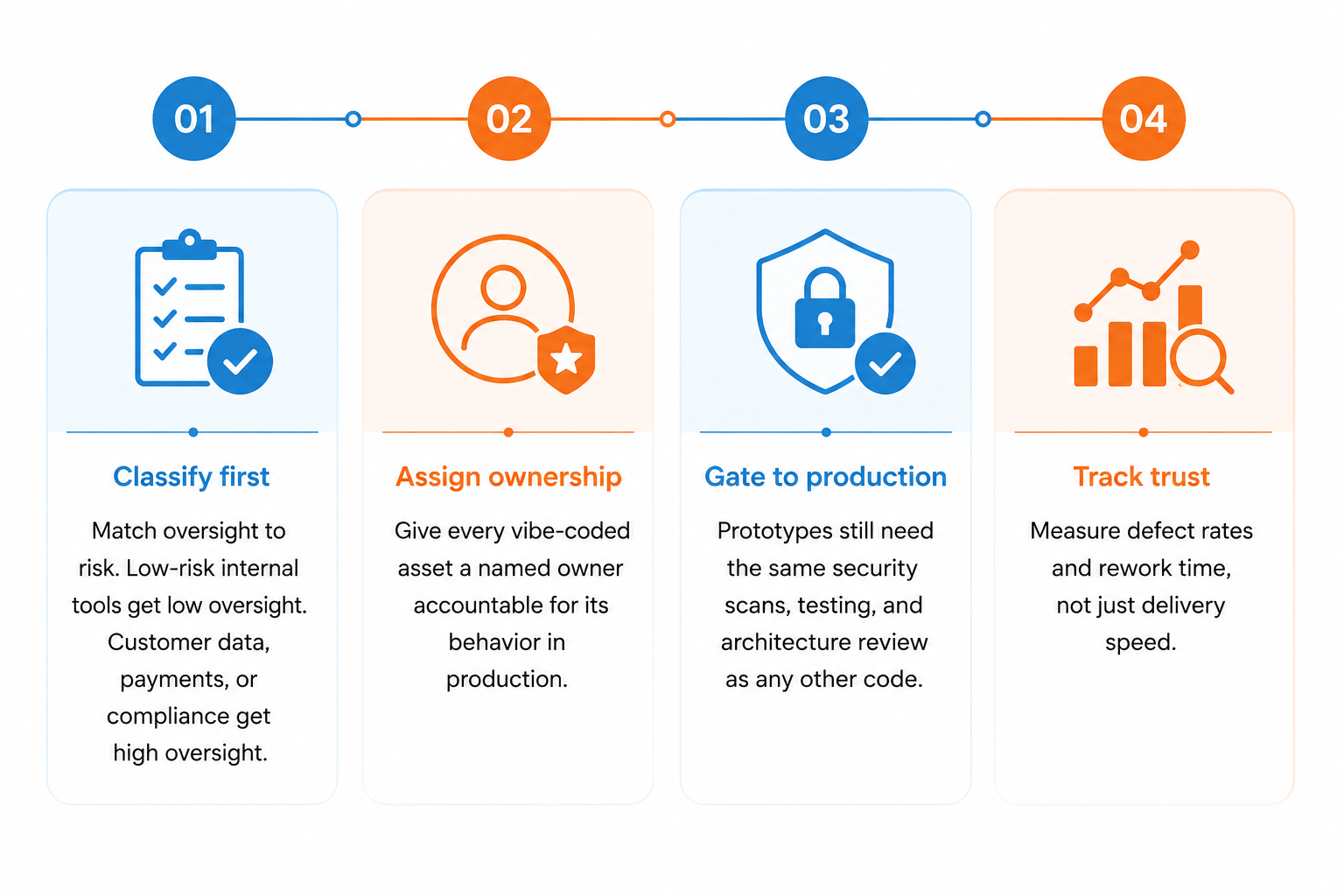
Classify before anyone starts building
Internal tools and disposable prototypes can sit at the low-oversight end. Anything touching customer data, payments, or compliance moves straight to the high-oversight end, no exceptions.
Give it a named owner, not just a reviewer
Someone needs to be accountable for what a vibe-coded asset does once it's live, not just sign off once and move on.
Don't let prototypes skip the gate to production
Whatever security scanning, testing, and architecture review your other code goes through, this code goes through too.
Track trust, not just speed
Watch defect rates and rework time, not just how fast something shipped. McKinsey's data shows high performers are nearly three times more likely to scale AI successfully. And the difference usually comes down to process discipline rather than which tool they picked.
Where Does Vibe Coding Fit Into an Enterprise AI Roadmap?
AI vibe coding works best as one tool inside a broader strategy, not as the strategy itself. It shortens the distance between an idea and something a team can actually test with real users. But only when used well. Else, in place of proper engineering on customer-facing or regulated systems, it tends to surface later as a security gap or an audit finding nobody planned for.
The difference usually comes down to a few decisions made early, rather than avoiding the practice altogether:
- Define upfront which systems can use vibe coding and which cannot.
- Treat early builds as proof of concepts, not finished products.
- Set a clear handoff point where prototypes move into standard engineering review.
- Revisit the boundary as the team's AI maturity grows, rather than fixing it once.
This is the same sequence we walk enterprise teams through in our AI Adoption Playbook. Get it now to decide at the strategy level, validate with a proof of concept, then scale only what holds up.
How Signity Can Help
We have been working with mid-market companies to large enterprises. We know AI matters but it needs an actual path from idea to production, not another tool demo. So, we help you start with
AI Readiness Assessment
A focused engagement to find out where vibe coding and other AI use cases create real ROI, and where they'd create real risk, before a single line of code gets written.
Proof of Concept Development
A structured four to eight week build with business-aligned success metrics, built from day one to scale instead of staying a prototype forever.
Full AI Solution Development and Integration
Production-grade engineering, governance, and MLOps work that takes a vibe-coded idea and turns it into something your compliance and security teams can actually approve.
Adoption Enablement
Practical change management so the people using these tools know exactly where the guardrails are.
Frequently Asked Questions
Have a question in mind? We are here to answer. If you don’t see your question here, drop us a line at our contact page.
Is vibe coding safe for enterprise use?

How is vibe coding different from AI-assisted coding?
Can non-developers really build production software?
What industries should be most cautious with vibe coding?
Does vibe coding actually reduce development costs?





.png?width=352&name=AI%20Solutions%20in%20Education%20A%20CXO%20Guide%20to%20Scalable%20ROI%20(3).png)
.png?width=352&name=What%20Is%20Autonomous%20AI%20and%20How%20Does%20It%20Work%20(1).png)