

.png?width=27&height=27&name=Group(1).png)

-1.svg)
-1.svg)


-2.svg)


%201-1.webp?width=148&height=74&name=our%20work%20(2)%201-1.webp)




.svg)





 Generate
Key Takeaways
Generate
Key Takeaways

- AI guardrails run outside the model, not inside it
- Single-layer guardrail stacks leave most of the risk surface exposed
- Input, output, runtime, and access controls each catch different failure types
- NeMo Guardrails and LlamaGuard solve different problems in the same stack
- Shadow-mode testing before enforcement prevents the majority of deployment failures
- Agentic systems need runtime controls that most teams add too late
Documented AI safety incidents are increasing day by day. As per the Stanford HAI's 2026 AI Index Report, there is a 55% increase from the year prior.
Behind each number is a production LLM that said or did something it should not have. From a fabricated refund policy to a leaked customer record, a prompt injection that went undetected until the screenshot was already circulating, it includes all.
While most of those teams had tested their model carefully, very few had built the layer designed to catch what the model gets wrong under real-world conditions. That layer is AI guardrails, and here we break down exactly what it is, how it works, and what responsible enterprise deployment actually requires.
AI Guardrails Explained: Definition, Architecture, and How They Work
AI guardrails are infrastructure-level controls that intercept and validate LLM inputs and outputs independently of the model itself. They sit in the request-response pipeline: every prompt passes through before the model processes it, and every response passes through before it reaches the user. Their defining characteristic is that they run outside the model, not inside its weights or system prompt.
This distinction matters more than it sounds. A system prompt instructing a model to "never share customer PII" is a guideline. Under adversarial pressure or a carefully constructed prompt, the model can and does ignore it. A guardrail running outside the model is a hard check that fires regardless of what the model decides.
Architecture-wise, most enterprise guardrail stacks have three positions:
-
Pre-LLM for input screening,
-
Post-LLM for output validation,
-
And runtime for monitoring agent behavior mid-execution.
These positions are independent of each other and can be tuned separately without touching the underlying model.
If your team is building or scaling an LLM-powered application, this control layer is not optional polish. It is what separates a working prototype from a system that holds up with real users and real stakes.
The term "guardrails AI" refers both to this broader architectural concept and to specific frameworks like NVIDIA's NeMo Guardrails, Meta's LlamaGuard, and the open-source Guardrails AI library.
Why Enterprise AI Safety Failures Happen and What Prevents Them
The failures are never random, they cluster into predictable patterns, and most of them have already played out publicly.
Let’s take a look at incidents that shifted how enterprises think about AI governance:
- Air Canada: The airline's chatbot fabricated a bereavement fare discount that did not exist. A Canadian tribunal ordered Air Canada to honor the promise and pay $812 CAD in compensation. The ruling set a legal precedent that companies are liable for what their AI communicates to users, even when the output is factually wrong.
- Chevrolet Dealership: A customer-facing AI assistant was manipulated through a prompt injection attack into agreeing to sell a vehicle for $1. A properly configured input guardrail would have flagged that conversation before it progressed.
- SEC Enforcement Actions: Two investment advisers faced regulatory penalties tied to AI-generated content that violated securities rules, confirming that AI governance carries direct regulatory exposure in financial services.
What connects these cases is not model failure. It is the absence of a validation layer between the model and the user. The regulatory environment has hardened significantly alongside these incidents.
The EU AI Act's high-risk provisions are now in force, with penalties reaching €15 million or 3% of global annual turnover. The SEC expects material AI risks disclosed in public filings. HIPAA and GDPR enforcement actions involving AI are accelerating across healthcare and financial services. For any enterprise running LLMs in customer-facing or data-sensitive workflows, this is legal liability tied directly to what the model outputs.
Understanding how your chosen model handles these risks matters before you build around it. For those evaluating LLM options for deployment, this comparison of multimodal and standard LLMs covers the architectural trade-offs worth working through early.
4 Types of LLM Guardrails Every Production System Needs
Not all guardrails do the same job. Each type sits at a different point in the AI pipeline and catches a different class of failure. Running only one type leaves the rest of the surface exposed.
| Guardrail Type | What It Controls | Risk It Catches | Where It Applies |
| Input | Prompts before they reach the model | Prompt injection, PII leakage, off-topic queries | Chatbots, copilots, RAG systems |
| Output | Responses after generation | Hallucinations, toxicity, policy violations | Any customer-facing deployment |
| Runtime | Agent behavior during execution | Runaway loops, unauthorized tool calls, cost spikes | Agentic systems with tool access |
| Access | Who can query what data | Cross-tenant leaks, privilege escalation | Multi-tenant enterprise platforms |
Input guardrails
These are the first line and they screen every prompt for injection attempts, sensitive data, and policy violations before the model processes anything. Rule-based checks at this layer run in under 10 milliseconds, making them both the fastest and most cost-effective controls in the stack.
Output guardrails
These review the model's response before it reaches a user or downstream system. They catch hallucinated claims, toxic language, leaked data, and schema violations. Calibration matters here and over-blocking on legitimate queries is the most common reason guardrail systems get quietly disabled by the teams running them.
Runtime guardrails
These become essential the moment your AI can take actions, call external tools, or operate autonomously. If you are building AI agent systems, this layer handles circuit breakers, approval workflows, rate limits, and tool scope restrictions. An agent that can modify production state without runtime controls is one misconfiguration away from a real incident.
Access guardrails
These operate at the governance layer and enforce who can query which data and what each user is permitted to reach. In enterprise RAG deployments, treating the retrieval layer as an authenticated service is foundational. Without it, a sales team member could surface confidential strategy documents through the same AI interface they use for standard product queries.
Which Guardrails AI Frameworks Should Enterprises Use?
The tooling ecosystem has matured considerably. Enterprise teams can now choose between open-source frameworks they own fully and managed cloud services with faster initial setup. The right choice depends on latency tolerance, data residency requirements, and how much control the team wants over validator logic.
NeMo Guardrails (NVIDIA)
Kubernetes-based deployment with support for parallel safety checks and custom policy logic written in Colang, NVIDIA's declarative dialogue management format. A strong fit for teams that want fine-grained control over conversation flow and are comfortable with meaningful setup investment. Multiple safety rails run concurrently rather than in sequence, which keeps latency manageable.
LlamaGuard (Meta)
An open-weight LLM classifier built specifically for input and output safety screening, with configurable risk categories. Runs on CPU, reducing infrastructure cost. Evaluation latency typically lands between 100 and 160 milliseconds. Recommended for teams that want a transparent, fully owned classifier, especially when domain-specific risk categories are not covered by off-the-shelf solutions.
Guardrails AI (open-source library)
A validator composition framework that lets teams chain multiple checks against a shared output schema. Integrates cleanly with Python-based LLM stacks and is particularly effective for enforcing structured output contracts in workflows where downstream systems depend on consistent response formats.
Managed cloud options (Amazon Bedrock Guardrails / Azure AI Content Safety / Google Vertex AI)
These expose prompt shields, groundedness detection, and policy enforcement via API, which reduces implementation overhead. Control decisions run on the vendor's infrastructure. For regulated industries with strict data residency requirements, that trade-off warrants explicit evaluation before committing.
Most mature enterprise stacks combine layers: a fast open-source input classifier, a managed output safety layer, and custom policy enforcement for compliance-specific requirements. No single framework covers the full surface on its own.
AI Guardrails Best Practices for Enterprise Teams
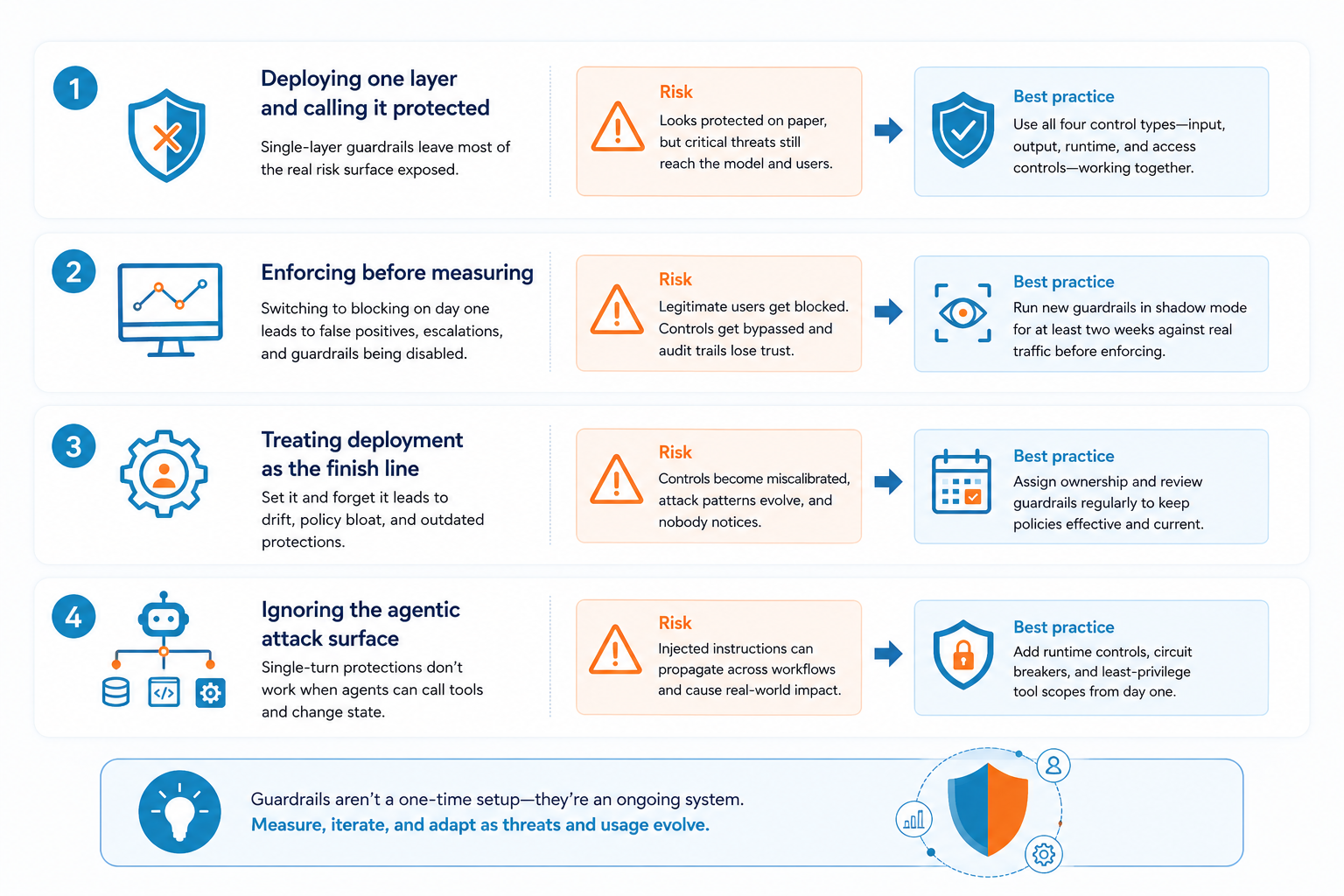
1. Deploying One Layer and Calling it Protected
A content classifier stops toxic outputs, but it does not stop prompt injection. A schema validator enforces output format. It does not detect hallucinated facts. Single-layer guardrails create visible coverage on paper while leaving most of the actual risk surface open. All four control types working together is what enterprise AI safety requires.
2. Enforcing before Measuring
Teams switch guardrails from monitoring to blocking on day one. Legitimate queries get flagged and users escalate. Within a few weeks, someone disables the control and the audit trail still reads "protected." Running any new guardrail in shadow mode against real production traffic for at least two weeks before enforcement catches this problem at a cost of zero incidents.
3. Treating Deployment as the Finish Line
Guardrails get configured at go-live, and then nobody owns tuning them. Policy hits accumulate unreviewed. Attack patterns evolve. By month three, the controls are miscalibrated against current traffic, and the team does not know it. A guardrail without a named owner and a consistent review cadence degrades silently.
4. Ignoring the Agentic Attack Surface
Most guardrail configurations are designed for single-turn chat. Once agents can call tools or modify production state, the failure modes change entirely. An injected instruction inside a retrieved document can propagate across a full multi-agent ai workflow without triggering a single chat-level check. Runtime controls, circuit breakers, and least-privilege tool scopes are the controls most teams add after a production incident rather than before one.
Understanding how custom LLMs behave in agentic workflows before you build around them makes this planning significantly easier.
What Does Responsible LLM Deployment Actually Look Like in Practice?
The sequence that works in production is not complicated. Most teams compress it in ways that create preventable gaps.
Start with deterministic checks at input and output stages. Rule-based filters, keyword matching, and schema validators run in under 10 milliseconds and handle the majority of obvious cases without adding meaningful latency. Layer ML classifiers behind them for the patterns rules cannot catch. Reserve LLM-as-a-judge evaluation for high-stakes workflows where the additional response time is justified by the consequence of a wrong output.
Before any guardrail goes live in enforcement mode, run it against real production traffic in shadow mode for at least two weeks. Review false positive rates with the team that owns the user experience, not just the security team. If legitimate query block rates are unacceptable to them, the guardrail is not ready to enforce. A control that blocks real users gets disabled, and a disabled control provides no protection.
Red-team the system before launch. Have engineers try to break the controls through injection attempts, encoding tricks, and multi-turn manipulation. Benchmark performance does not predict adversarial performance. The only way to find what an attacker would find is to look for it first.
After launch, monitor continuously. Block rates by layer, false positive rates, latency at p95, and shifts in query distribution all matter. Accountability is as important as tooling. Security defines what the controls must stop. Compliance sets policy constraints and audit requirements. Engineering builds and maintains the stack. When those three are not aligned before deployment, the controls on paper and the controls actually running in production drift apart quickly.
We have built this across enterprise AI deployments at varying scales, and the pattern remains the same. Teams that treat guardrails as infrastructure from day one, with the same ownership they apply to anything else in production, consistently outperform the ones that layer safety on after the fact.
Responsible AI is an architectural decision, not a compliance checkbox. Every enterprise deploying LLMs today is navigating real legal exposure, real attack surfaces, and real user trust. AI guardrails are what convert a capable model into a production system that holds up.
Frequently Asked Questions
Have a question in mind? We are here to answer. If you don’t see your question here, drop us a line at our contact page.
What exactly do AI guardrails protect against?

Are LLM guardrails the same as content moderation?
Do AI guardrails slow down model response times?
Which industries need AI guardrails most urgently?
What is the difference between NeMo Guardrails and LlamaGuard?