

.png?width=27&height=27&name=Group(1).png)

-1.svg)
-1.svg)


-2.svg)


%201-1.webp?width=148&height=74&name=our%20work%20(2)%201-1.webp)




.svg)





The DPO vs PPO LLM debate has moved well beyond research circles. For CTOs and CXOs, it now affects architecture decisions, implementation timelines, operating costs, governance, and long-term AI ROI.
As enterprises scale large language models into copilots, AI agents, internal knowledge assistants, and customer-facing automation, the real challenge is not just generating responses. It is aligning model outputs with human values, human expectations, compliance rules, and business outcomes. In 2026, Gartner forecasts that worldwide AI spending will reach $2.59 trillion, which raises the stakes for every model training choice.
That is why direct preference optimization and proximal policy optimization deserve a practical enterprise lens.
 Generate
Key Takeaways
Generate
Key Takeaways

- DPO training removes the need for a separate reward model and simplifies the fine-tuning process for enterprise language models.
- PPO training enables deeper reward optimization when model behavior must follow stricter policy and business requirements.
- For most enterprise copilots, DPO accelerates production readiness, reduces cost, and lowers operational complexity.
- CTOs should evaluate DPO and PPO through architecture, governance, data quality, implementation readiness, and evaluation rigor.
What is DPO vs PPO in LLM Alignment?
DPO and PPO are two methods for aligning large language models with human preferences after supervised fine-tuning.
Direct Preference Optimization: A simpler Preference Learning Path
Direct preference optimization (DPO) trains a language model directly on preference data. Each example includes a prompt, a preferred output, and a rejected output. Instead of building an intermediate reward model, DPO directly updates model parameters so the preferred responses become more likely than the dispreferred ones.
In technical terms, the DPO training objective turns preference learning into a binary classification problem using a DPO loss function, often described as a binary cross-entropy objective over paired preference feedback. This direct optimization path makes DPO attractive for teams that want stable learning, lower cost, and a shorter route from training data to production deployment.
A critical technical detail in DPO training is the beta hyperparameter, usually written as β. Beta controls how strongly the model prefers the chosen response over the rejected response during optimization. In practice, β is the most important DPO tuning knob. If it is set too low, the model may not learn human preferences strongly enough. If it is set too high, the model can overfit narrow preference patterns and weaken fluency or general response quality. For enterprise teams, this matters because DPO is simpler than PPO, but it is not tuning-free.
Proximal Policy Optimization: A Reinforcement Learning Path
Proximal policy optimization (PPO) is a reinforcement learning algorithm used in reinforcement learning from human feedback. PPO training does not optimize directly from human preferences alone. It usually depends on reward model training, where a separate reward model learns to score model responses based on human feedback.
The policy model is then updated to maximize expected reward while controlling how far it moves from a reference model. That gives teams more precise control over the model’s behavior, but it also adds complexity across data collection, reward function design, model training, and monitoring.
One technical reason PPO is harder to tune is the KL divergence penalty, which constrains how far the updated policy can move from the reference model. This mechanism is central to PPO’s training stability because it prevents aggressive policy shifts that can collapse output quality or distort behavior. At the same time, it introduces another tuning dimension because teams must balance reward maximization against policy drift. For enterprise ML teams, that is a major reason PPO usually requires more experimentation cycles than DPO.
Is DPO the Same as PPO? No, and that Difference Matters
Is DPO the same as PPO is one of the most common questions in this space. The answer is no. DPO avoids explicit reward modeling and directly matches human preferences. PPO relies on a separate reward model, a reward signal, and a broader policy optimization loop. In enterprise terms, DPO reduces architecture overhead, while PPO expands control.
Which Method Is Better for Enterprise AI?
DPO is better for most enterprise deployments. PPO is better for specialized systems that require stronger reward-driven control.
DPO as the Enterprise Default: Why it Usually Wins
For most organizations, DPO is the stronger starting point because it reduces the number of moving parts in the alignment pipeline. A typical DPO setup begins with a base model, proceeds to supervised fine-tuning, uses a curated preference dataset, and then runs a DPO fine-tuning job to align model outputs with preferred responses.
There is no need to train reward models or maintain a separate reward model across repeated cycles. That translates into faster implementation, lower compute cost, and less experimentation friction. For enterprise copilots focused on support, summarization, workflow assistance, search, or knowledge retrieval, that simplicity usually drives better time-to-value.
This is also where implementation maturity matters. In enterprise environments, both DPO and PPO are commonly executed through the Hugging Face TRL library, which has become the dominant implementation path for preference optimization workflows. TRL supports both DPO and PPO training loops, but DPO setups are usually faster to operationalize because they avoid reward-model orchestration and reduce the number of moving components that engineering teams must monitor.
PPO for Higher Control: Is it the Better Choice?
PPO becomes more compelling when enterprises need explicit reward modeling and tighter optimization of model behavior. If success depends on a well-defined reward function, if the model must optimize across multiple constraints, or if the use case involves structured reasoning and tool behavior, PPO provides more control.
It is especially relevant when teams want to maximize expected reward across a broad range of outputs rather than just rank preferred output pairs. In these cases, the heavier training process can be justified by the higher degree of behavioral shaping.
From an enterprise architecture standpoint, PPO is usually justified only when the business actually benefits from that extra control. If the use case depends on structured reasoning, multi-step tool use, safety-sensitive workflows, or high-stakes automation, PPO’s explicit reward optimization can outperform simpler preference learning. If the use case is a support copilot, knowledge assistant, or summarization layer, the added training burden often does not translate into enough business value to justify the complexity.
Related Read: What is LLM & How to Build Your Own Large Language Models?
How PPO Training Works in Practice?
PPO aligns model responses by optimizing a policy against a reward signal while preserving training stability.
The RLHF Pipeline: What Enterprises Actually Build
In enterprise settings, PPO usually sits inside a larger reinforcement learning from human feedback workflow. Teams begin with supervised learning so the model learns basic instruction following.
They then collect human preference data or other preference feedback over candidate outputs. That data is used to train reward models, creating a learned reward model that scores future responses. The final stage is PPO fine-tuning, where the policy is updated to maximize reward while staying close to a reference model.
In production workflows, this stack is often implemented using TRL’s PPOTrainer or equivalent internal wrappers. That means enterprise teams are not just tuning the policy model itself; they are also tuning the reward model, KL controls, batch behavior, and rollout settings. This makes PPO a capable but operationally heavier path for aligning large language models.
The Enterprise Implication: More Power, More Responsibility
This architecture enables precise control, but it also creates additional operational layers. Teams need to manage reward model training, reward signal drift, model weights across multiple stages, and significant hyperparameter tuning. For CTOs, PPO is not only a model choice. It is a platform maturity choice. It demands the ability to manage reinforcement learning safely and repeatedly.
PPO also carries a real compute premium. For a 7B model, DPO can often be run with a lighter GPU footprint using parameter-efficient fine-tuning, while PPO typically needs additional memory for rollouts, reward scoring, and policy updates in the same loop. In practical terms, enterprise teams should expect PPO to demand materially more VRAM, longer training time, and more monitoring overhead than DPO for the same base model size. Even when both methods use the same backbone, PPO behaves like a larger systems problem.
A useful technical framing for enterprise teams is that DPO training for a 7B model is often feasible with a leaner fine-tuning setup, while PPO usually requires enough headroom for policy generation, reward inference, and KL-constrained updates to run together. Exact GPU planning depends on sequence length, batch size, quantization strategy, and whether LoRA or full fine-tuning is used, but the direction is consistent: PPO is materially heavier than DPO in both VRAM and wall-clock training time.
How DPO Training Works in Practice
DPO trains the model directly on pairwise preferences without a separate reward model.
In a DPO workflow, the organization prepares training data containing prompts and paired responses where one answer is marked as preferred. The model is then optimized so preferred responses receive a higher probability than rejected ones.
In enterprise deployment practice, DPO is commonly implemented with the Hugging Face TRL DPOTrainer, which makes it one of the most accessible alignment paths for teams that want to fine-tune on preference pairs without standing up a separate reward-model stack. That library-level maturity is one reason DPO has become a preferred choice for fast-moving production teams.
Because DPO works directly on preference data, it avoids the extra step of explicit reward modeling. The result is a cleaner optimization process with fewer dependencies and often more predictable convergence.
The enterprise implication: Faster alignment, but data still matters
DPO’s simplicity does not remove the need for quality data. Poor human feedback, weak construction of the preference dataset, or noisy preferred responses will still weaken outcomes. But when the data collection process is disciplined, DPO enables teams to align language models with lower infrastructure overhead and shorter production cycles.
DPO is lighter than PPO, but it still has meaningful tuning choices. Along with data quality, β remains the key control for determining how strongly the model should separate preferred and dispreferred outputs. For CTOs, that means DPO reduces infrastructure complexity, but it still benefits from careful experiment design, evaluation discipline, and domain-specific preference curation.
Evaluation Benchmarks: How Enterprises Measure Alignment Quality
Alignment quality should not be judged by intuition alone. In practice, enterprise teams use evaluation benchmarks such as MT-Bench, AlpacaEval, and Arena-Hard to compare aligned model outputs against baseline systems. These benchmarks help measure helpfulness, instruction following, response quality, pairwise preference performance, and overall alignment behavior at scale.
For CTOs and CXOs, this matters because DPO and PPO should be compared not only on training cost but also on measurable outcome quality. A cheaper alignment method is not better if it fails on benchmarked business tasks. For engineering teams, benchmark performance should be paired with internal evaluations tied to domain-specific workflows, compliance standards, hallucination tolerance, and user-facing response quality.
DPO vs PPO for CTOs and CXOs
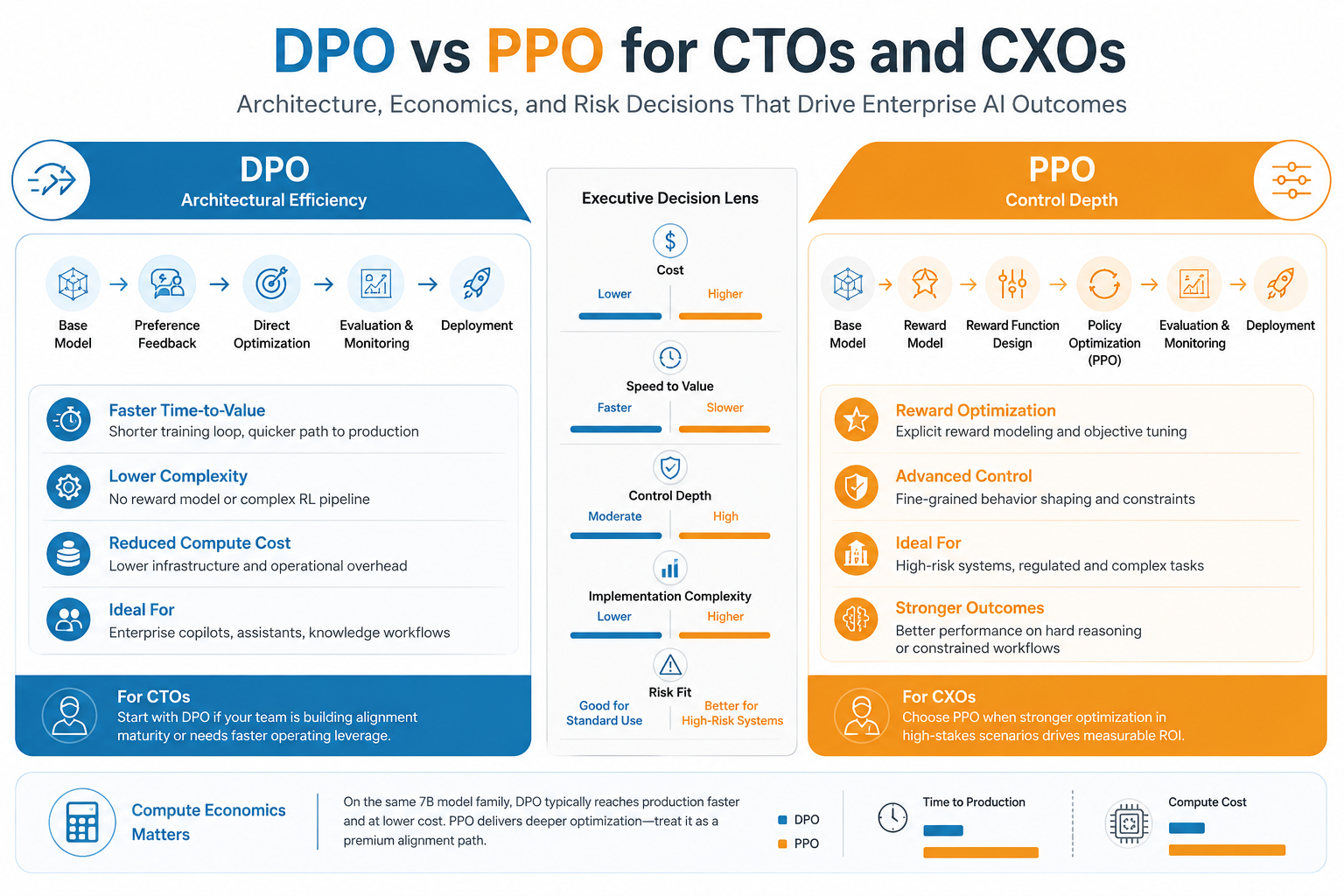
For enterprise leaders, DPO and PPO are decisions about architecture, economics, and risk.
For CTOs: Start with Architecture Readiness
CTOs should ask which stack the organization can operate reliably. DPO typically requires a base model, preference feedback, direct optimization, evaluation, and deployment monitoring. PPO adds an intermediate reward model, reward function design, and a more complex policy optimization loop. If internal ML maturity is still growing, DPO is often the more resilient path.
A useful way to frame the decision is this: DPO optimizes for architectural efficiency, while PPO optimizes for control depth. If the internal team is still building alignment maturity, DPO gives faster operating leverage. If the organization already has strong experimentation infrastructure, reward modeling capacity, and evaluation pipelines, PPO becomes more practical.
For CXOs: Focus on Business Value and Delivery Speed
CXOs should care less about algorithm branding and more about implementation outcomes. DPO reduces time-to-value and lowers the cost of aligning large language models for enterprise workflows. PPO can drive stronger optimization in high-stakes environments, but only when the additional investment translates into measurable business performance. The better method is the one that improves ROI without creating avoidable delivery drag.
This is where compute economics should be made explicit. On the same 7B model family, DPO usually reaches a production-ready state faster because it avoids the reward-model stage and shortens the training loop. PPO can still deliver better outcomes on hard reasoning or tightly constrained tasks, but leadership should treat that as a premium alignment path, not the default choice.
Enterprise Architecture Considerations
The choice of alignment method changes the technical architecture for training, evaluation, and governance.
DPO architecture: Fewer layers, Faster Motion
A DPO-centered stack usually flows from base model to supervised fine-tuning, then to preference learning, evaluation, and deployment. That makes it easier to connect fine-tuning, model parameters, model responses, and governance controls without overextending the platform. It is well-suited for enterprises that want to move quickly from pilot to production.
In implementation terms, a DPO stack often consists of the base model, supervised fine-tuning checkpoint, preference dataset pipeline, TRL-based trainer, offline evaluation, and production monitoring. That compact architecture is one reason DPO scales well for enterprise copilots and internal assistants.
PPO architecture: More layers, more precision
A PPO-centered stack includes base model preparation, supervised fine-tuning, data collection, reward model training, reward function calibration, policy optimization, and production evaluation. This creates more control points, but also more maintenance points. For regulated or highly optimized environments, that trade-off can be worthwhile. For general enterprise assistants, it is often more architecture than necessary.
A PPO stack typically adds reward model training, reward inference, rollout generation, KL control, and more involved experiment tracking. That architecture supports finer policy optimization, but it also increases GPU consumption, latency in the training cycle, and dependency on experienced ML operations teams.
Beyond DPO and PPO: What Enterprises Should Watch
New preference optimization methods are expanding the alignment landscape, but they do not replace the DPO versus PPO decision today.
Methods such as ORPO, GRPO, SimPO, and RLAIF are expanding the alignment toolkit in meaningful ways. ORPO simplifies training by folding preference optimization more directly into the supervised fine-tuning stage. SimPO reduces dependence on a reference model and is often discussed as a more compute-efficient alternative to standard DPO-style setups.
GRPO is especially important for enterprise teams tracking reasoning-heavy systems. It replaces some of PPO’s heavier components with a group-relative optimization approach, which has made it increasingly relevant in modern reasoning-model training because it can improve reasoning behavior with better memory efficiency than classic PPO loops. For a CTO evaluating reasoning-focused enterprise agents, GRPO deserves more attention than a simple name-drop.
RLAIF, or reinforcement learning from AI feedback, reduces dependence on human labeling by using AI-generated feedback to support alignment at lower annotation cost. For enterprises balancing quality and scalability, that creates a potentially useful middle ground between human-intensive RLHF and simpler pairwise preference optimization.
These approaches matter strategically, especially for enterprises building long-term AI platforms. Still, for most current implementation decisions, the main question remains whether you need DPO’s simpler preference learning path or PPO’s deeper reward control.
Where Signity Adds Enterprise Value?
Signity helps enterprises turn alignment strategy into production-ready AI systems. Signity supports organizations in choosing whether DPO training, PPO training, or a hybrid path best matches their business risk, data quality, and technical maturity. It includes architecting systems around the language model, preference dataset, reward model, and governance requirements that shape enterprise deployment.
That also includes helping clients choose the right implementation stack through libraries such as Hugging Face TRL, defining benchmark strategy using MT-Bench or AlpacaEval-style evaluations, and matching alignment choices to compute budgets, GPU planning, and governance requirements. This is where technical alignment work becomes business architecture work.
Signity also helps connect alignment choices to cost control, implementation speed, development partner selection, and long-term platform scalability. For CTOs, that means more durable architecture decisions. For CXOs, it means fewer delays between AI ambition and business value.
Conclusion
For most enterprise AI programs, DPO is the better starting point. It simplifies the fine-tuning process, removes the need for a separate reward model, and reduces cost and deployment friction. PPO remains highly valuable when enterprises need stronger policy optimization, explicit reward shaping, and tighter control over the model’s behavior in complex or high-risk systems.
So the answer to DPO vs PPO LLM is not about naming a universal winner. It is about matching the right alignment method to your architecture, your learning maturity, your training language models capabilities, and your business objectives. Enterprises that make that choice well align faster, govern better, and scale AI with more confidence.
Frequently Asked Questions
Have a question in mind? We are here to answer. If you don’t see your question here, drop us a line at our contact page.
Is DPO the same as PPO?

No. DPO uses direct optimization on preference feedback, while PPO depends on traditional reinforcement learning, a separate reward model, and policy updates based on expected reward.
Which is cheaper: DPO or PPO?
DPO is usually cheaper because it avoids reward model training, reduces compute demand, and simplifies the optimization process. PPO generally requires more VRAM, longer training cycles, and more experimentation overhead for the same base model size.
Which method is better for enterprise AI?
For most enterprise copilots and assistants, DPO is better because it reduces complexity and speeds up delivery. PPO is better when precise control, structured tasks, and stronger reward-driven optimization matter more.
Can enterprises use both DPO and PPO?
Yes. Many organizations start with DPO for fast alignment, then apply PPO for iterative refinement, more precise control, or domain-specific optimization.
What matters most in both methods?
Data quality matters most. Strong training data, relevant preference learning, clean preferred responses, and reliable human feedback drive the best alignment outcomes in both DPO and PPO.
How do enterprises measure DPO or PPO alignment quality?
Enterprises typically use evaluation frameworks such as MT-Bench, AlpacaEval, and Arena-Hard, along with internal task-based testing, to compare model responses, instruction-following quality, preference win rates, and domain-specific outcome quality after alignment.
Which library is commonly used to implement DPO and PPO?
The Hugging Face TRL library is one of the most widely used implementation paths for both DPO and PPO because it provides enterprise-ready training abstractions for preference optimization workflows.