

.png?width=27&height=27&name=Group(1).png)

-1.svg)
-1.svg)


-2.svg)


%201-1.webp?width=148&height=74&name=our%20work%20(2)%201-1.webp)




.svg)





Most teams treat vector database selection as a secondary decision. The embedding model gets debated for weeks, and the RAG pipeline gets designed carefully. The database gets chosen based on what the quickstart guide used or what was already running in the stack. That choice compounds quietly until it does not.
We have rebuilt retrieval infrastructure mid-production more than once. Every time, the root cause is the same: the initial selection was made for what the system needed on day one, not for what it would need at scale.
This is what the Pinecone vs Weaviate vs pgvector decision actually looks like when you strip away the feature comparison tables.
 Generate
Key Takeaways
Generate
Key Takeaways

- Pinecone excels at managed, high-throughput similarity search with minimal operational overhead.
- Weaviate offers the strongest hybrid search and multi-modal retrieval architecture available.
- pgvector is the right default when Postgres is already the primary data store.
- RAG retrieval quality depends on index type and configuration, not just the model.
- Match vector infrastructure to actual scale and team capacity before committing.
How Does a Vector Database Work in an AI System?
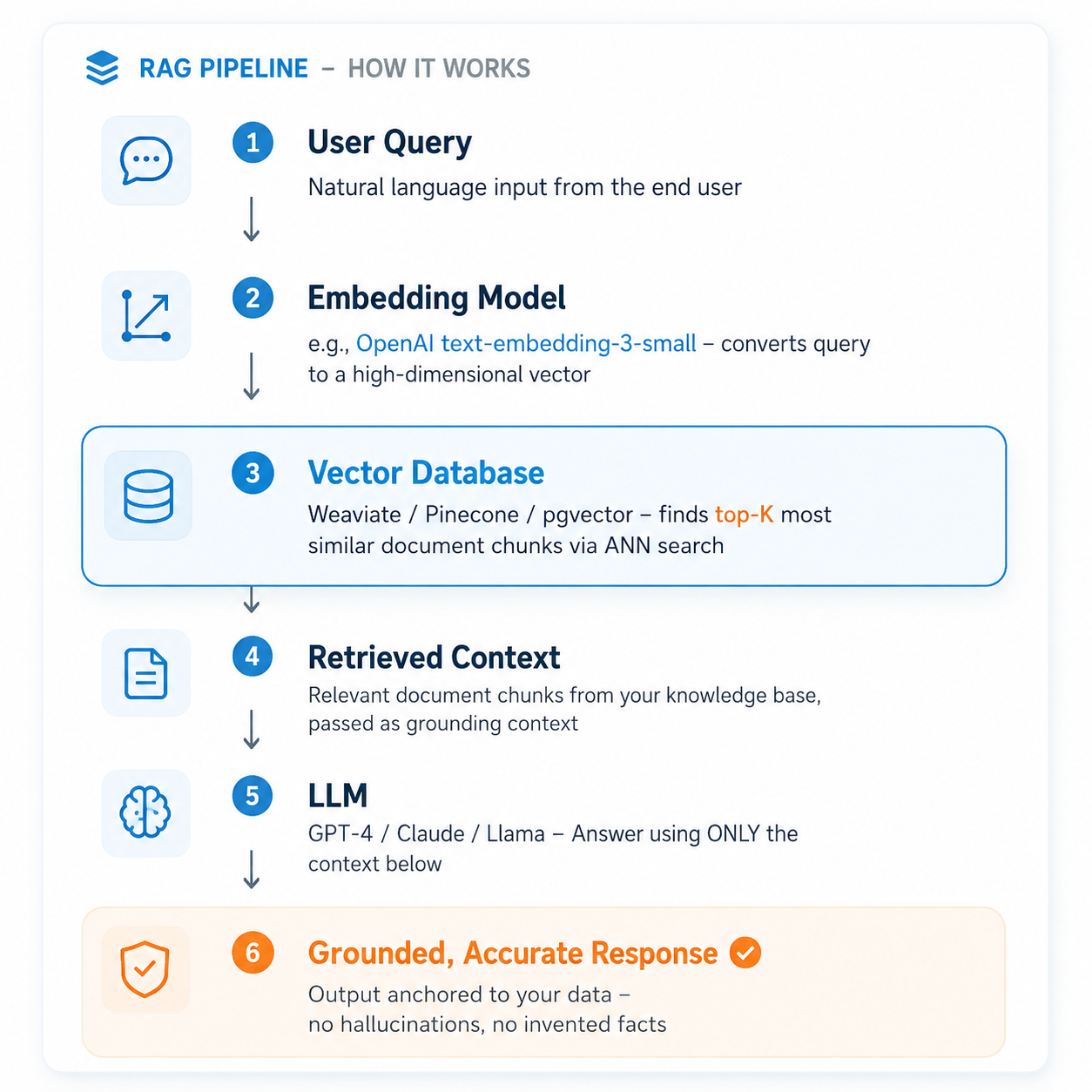
A vector database stores high-dimensional numerical representations of content, called embeddings, generated by encoder models. These representations place semantically similar items close together in geometric space. Retrieval computes the distance between a query embedding and the stored index.
Traditional relational databases retrieve exact matches. A semantic search database retrieves approximate nearest neighbors, meaning closest meaning, not closest string.
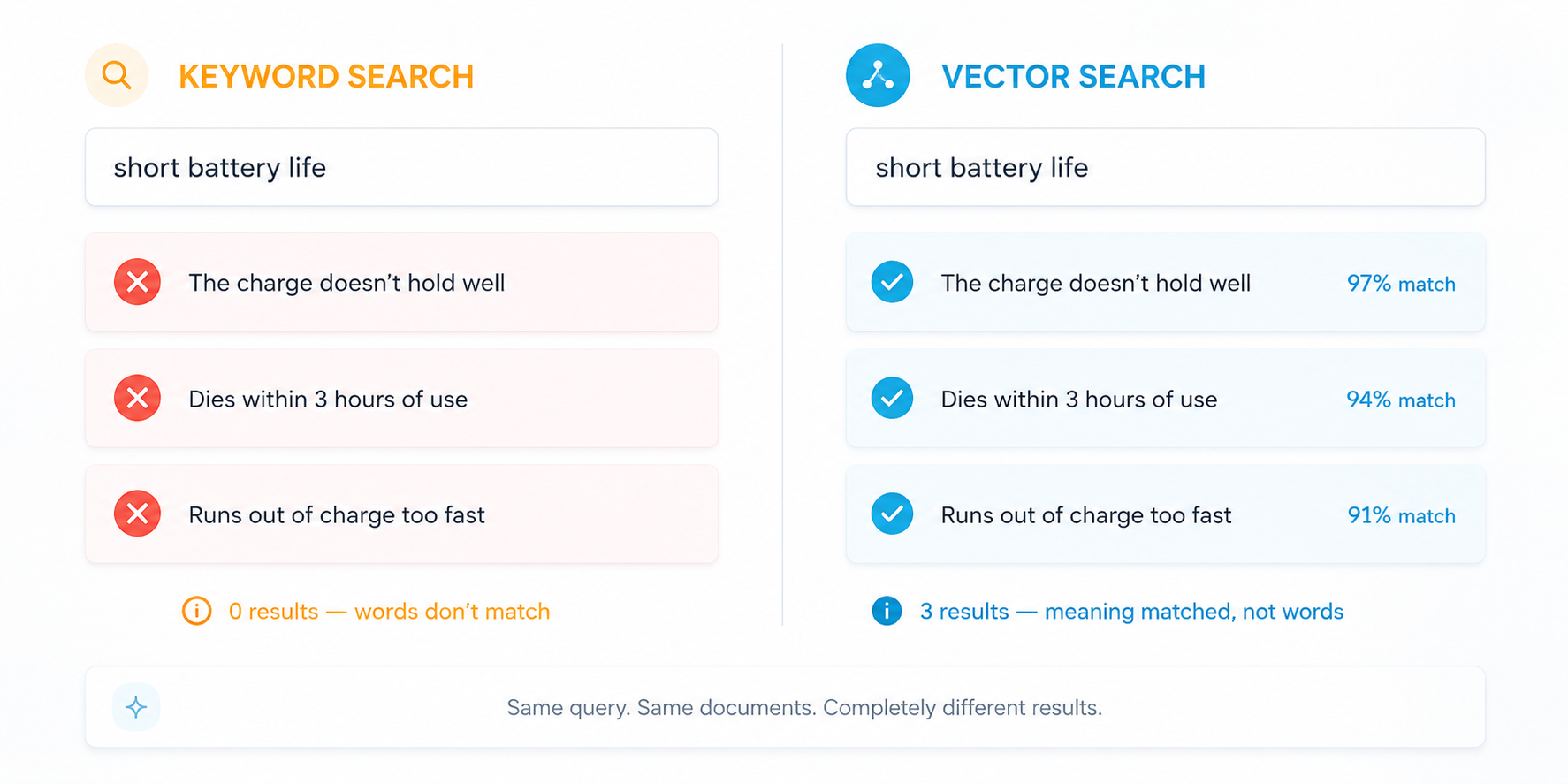
When an AI system processes a natural language query, it converts that query to an embedding and returns the most semantically proximate documents from the index, regardless of exact phrasing. This is the entire point of building on vector infrastructure over keyword indexing.
A survey of 382 enterprise executives found that retrieval-augmented generation has emerged as the connective tissue between enterprise LLM deployments and corporate data. And nearly 30 percent of organizations are already implementing RAG solutions and accelerating adoption. The retrieval layer underneath those deployments is what this decision is about.
Pinecone vs Weaviate vs pgvector: What Is the Core Difference?
Pinecone, Weaviate, and pgvector are not three versions of the same product. They represent three different bets on what matters most in a production retrieval layer. This vector database comparison is really a question about operational model, data sovereignty, and scale ceiling.
Managed simplicity
Pinecone eliminates infrastructure overhead entirely. Fast to deploy, strong under load, limited in control and portability.
Open-source flexibility
Weaviate is self-hostable, schema-aware, and built for complex hybrid retrieval pipelines where pure semantic search is not enough.
Database-native extension
Pgvector adds vector search directly to Postgres. No new infrastructure, no new failure domain, and no new operational model to learn.
What Is Pinecone and When Should You Use It?
Pinecone is purpose-built for one job: fast, scalable similarity search with minimal operational surface. It is fully managed and there is no infrastructure to operate. It doesn’t have index to tune manually, and no persistence layer to instrument
The architecture uses HNSW with proprietary optimizations and a pod-based deployment model that isolates workloads through namespaces. Hybrid search combining sparse BM25 and dense vector retrieval is available, though it was added retroactively and remains less mature than Weaviate's implementation.
Where Pinecone performs well:
- High-throughput RAG pipelines: For vector databases for RAG at production query volume, Pinecone removes the operational cost of index configuration and provisioning. It handles the infrastructure so the team does not have to.
- Speed to production: Where no configuration surface and no deployment decisions exist. For teams that need a working retrieval layer fast, this is the most direct path available.
What Makes Weaviate Different from Other Vector Databases?
In a Weaviate vs Pinecone comparison, the clearest technical differentiator is hybrid search maturity. Weaviate combines BM25 sparse retrieval with dense vector search through a configurable fusion model, with alpha weighting that adjusts the balance between keyword precision and semantic recall at query time. For retrieval pipelines where purely semantic queries miss keyword-critical results, this design is operationally significant.
Weaviate is open-source and self-hostable. The data model treats schema and vector as a unified object, not separate storage concerns. This matters when retrieval queries need to span structured metadata and semantic content within the same operation, which is common in enterprise knowledge retrieval systems.
The module system integrates natively with OpenAI, Cohere, Hugging Face, and other providers, allowing vectorization to occur at ingest time inside the database layer. That simplifies the application pipeline. It also introduces a dependency surface: when an upstream model API rate-limits or errors, ingest stalls inside the database layer rather than the application, which delays diagnosis.
Multi-modal retrieval, image and text within the same index, is natively supported. The GraphQL query interface reflects Weaviate's graph-aware internal model and is expressive but adds a translation layer that slows query iteration compared to direct vector API access.
How Does pgvector Compare to Dedicated Vector Databases?
Pgvector is a PostgreSQL extension, not a standalone database. That distinction carries more operational weight than most vector database discussions acknowledge.
- Zero new infrastructure: It has no new failure domain and no new operational model. The extension adds a vector column type and similarity search operators to an existing Postgres instance.
- Two index options: HNSW performs better on recall in most production configurations. IVFFlat builds faster and uses less memory but degrades under heavy metadata filtering. For most teams, HNSW is the right default.
- Pinecone vs pgvector for bounded workloads: When the stack is already Postgres-centric and the retrieval workload is predictable, pgvector wins on simplicity and cost. There is no additional infrastructure layer to justify until the use case outgrows it.
The pgvector's ceiling depends on hardware, but most teams hit retrieval latency issues well before dedicated vector databases do under equivalent load
What Are the Production Failure Modes of Each Vector Database?
Pinecone- Cardinality Pressure
High-cardinality metadata filtering at query time stresses the managed index model in ways that are not always visible during pre-production testing. Cold-start latency on pods after idle periods also surfaces unexpectedly under variable traffic patterns.
Weaviate- Module boundary failures
When the upstream model API stalls, ingest stops at the database layer. The failure does not always propagate visibly to the application level, which means retrieval quality can degrade silently before anyone inspects the database.
Pgvector- The quiet ceiling
HNSW index builds slow as vector count grows. Query latency increases incrementally rather than abruptly. Teams testing embedding generation throughput often miss retrieval degradation during development because the two bottlenecks appear at different stages of scale.
Which Vector Database Should You Use: Pinecone, Weaviate, or pgvector?
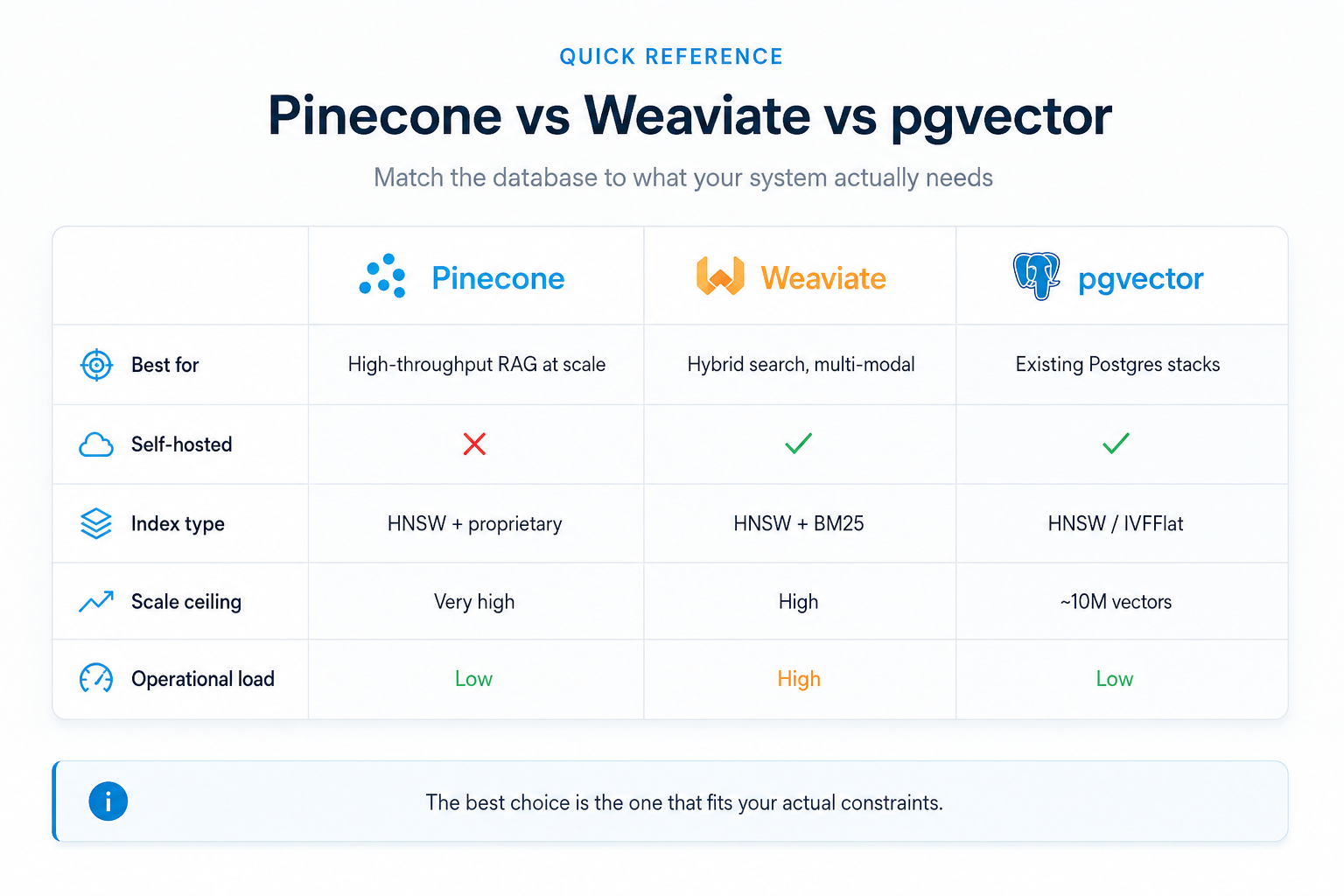
Three scenarios cover most architectural decisions. The best vector database for AI is not the one with the most features. It is the one that matches the actual scale, team capacity, and operational constraints of the system it serves.
- Greenfield, fast-scaling stack: Projected to scale past 50 million vectors within 12 months; limited infrastructure capacity: start with Pinecone.
- Complex retrieval requirements: Multi-modal pipelines, hybrid search needs, or data sovereignty constraints requiring self-hosted storage: evaluate Weaviate, despite the higher operational investment.
- Postgres is already in place: Embeddings under 1,536 dimensions, bounded and predictable workload: use pgvector. No additional infrastructure layer is necessary until the use case scales past it.
How Is the Vector Database Market Changing in 2026?
The vector database market is consolidating around three defensible positions: managed simplicity, open-source flexibility, and database-native extensions. Each has a legitimate production context. Nothing is permanent.
What is shifting is the integration layer above the retrieval database. Model Context Protocol (MCP) patterns are beginning to reshape how AI systems connect retrieval infrastructure to application logic, and the choice of vector backend directly affects how cleanly that integration can be implemented.
Teams planning 12 to 18 months ahead should factor this into the current decision. The MCP AI Integration Roadmap 2026 covers how retrieval architecture fits within the broader AI integration stack.
The retrieval layer compounds. A poor choice here affects the cost, adaptability, and production ceiling of everything built above it. Teams that need architecture-level support can work with an experienced AI development company or engage AI consulting to validate the architecture before infrastructure commitments are made.
Frequently Asked Questions
Have a question in mind? We are here to answer. If you don’t see your question here, drop us a line at our contact page.
What is the best vector database for AI?

No single answer applies to all use cases. Pinecone suits high-volume managed deployments, Weaviate fits complex pipelines, and pgvector works well for existing Postgres stacks.
Can pgvector handle production-scale RAG workloads?
Yes, within limits. pgvector handles moderate workloads reliably with HNSW indexing, but query latency climbs as vector count grows. At high scale, dedicated vector infrastructure becomes necessary.
How does Weaviate differ from Pinecone architecturally?
Pinecone is a fully managed, purpose-built vector store. Weaviate is open-source, graph-aware, and supports native hybrid search and multi-modal retrieval within a self-hosted model.
Are dedicated vector databases necessary for semantic search?
Not always. For low to mid-volume use cases on an existing Postgres stack, pgvector provides sufficient semantic search capability without additional infrastructure overhead.