


.png?width=27&height=27&name=Group(1).png)

-1.svg)
-1.svg)


-2.svg)


%201-1.webp?width=148&height=74&name=our%20work%20(2)%201-1.webp)




.svg)





Supply chain management can become complicated because businesses continue to juggle between suppliers, delivery timelines and the demand of customers. Managing all these complicated tasks simultaneously can be a task and even a small issue in supply chain delays, and makes customers unhappy.
Businesses previously used traditional methods like spreadsheets and their basic intuitions to manage all the work. It worked, until it didn’t.
However, the supply chain today moves faster and involves many moving parts, making manual methods only. That is where the role of AI comes into play. As per a McKinsey report, companies that use AI in supply chain operations can seamlessly cut logistics costs by 15% and reduce inventory levels by 35%.
AI can seamlessly predict exactly what customers need, detect patterns, spot risks early, and make quick decisions. Everything is carried seamlessly without drowning in data, making people’s jobs much easier. Supply chains are already changing fast, and what is coming in logistics AI for 2026 makes it clear this is only the start.
Here is a blog that breaks down how AI can be applied to supply chain activities, from planning and procurement to execution, and what it means for businesses trying to stay ahead.
 Generate
Key Takeaways
Generate
Key Takeaways

- AI analyzes historical data and offers an accurate demand forecast. This helps reduce waste and ensure inventory is on point.
- With real-time data analyzes, supply chain experts can leverage complete visibility across operations.
- Smart planning and route optimization helps businesses reduce fuel consumption and cut down costs.
- With human oversight, AI can boost decision-making and streamlines the delivery.
How Can AI Be Applied to Supply Chain Activities?
Artificial Intelligence is used by almost every part of the supply chain. No matter if it's demand forecasting or optimizing deliveries, check out below where the AI in supply chain helps make the actual difference.
1. AI in Demand Forecasting & Supply Chain Planning
For the demand forecasting to get right, the challenges remain critical. If too much stock is ordered, you get stuck with excess stock, and if you offer too little, you end up losing sales and important clients. AI helps businesses get the balance right.
AI Finds Patterns in Your Past Data
Machine learning systems deeply dig into the historical sales data and spot trends that humans miss. Maybe sales spike every third week of November, or a specific region orders more after a price drop. AI catches these patterns and helps supply chain planners build production schedules based on what is actually likely to happen.
It Also Looks Beyond Your Internal Numbers
Unlike traditional forecasting, AI checks for external factors too. These factors include weather, economic conditions, market trends, and more. Suppose the weather is getting windy or rainy, the AI system flags it and warns before it hits. That turns reactive planning into something far more proactive.
Fewer Forecast Errors, Faster Fixes
Every forecast can not be perfect. However, thanks to AI, which helps continuously track data in real-time and compare it against existing predictions. When the demand actually drifts from the forecast, the professionals working get the warning on a prior basis and give them time to adjust or update production plans accordingly.
2. AI in Procurement & Supplier Management
Well, procurement is not simply about placing orders on time. There are critical things that generally go wrong. A few of them are suppliers that may go silent, shift in pricing overnight, and delayed shipment without warning. AI helps businesses overcome the challenges without burning out their teams.
You can't monitor every supplier manually cost businesses work with plenty of suppliers. Keeping track of each one, their delivery records, and reliability is a full-time job and can lead to errors.
AI takes that off the plate and eases everything. It keeps a constant eye on supplier data and quietly tracks things like late deliveries, quality issues, and price changes. When something looks off, supply chain managers get flagged before it turns into a bigger problem.
Always Have a Backup Plan
Over-relying on one supplier is a risk most businesses only realise when it is too late. AI helps identify and evaluate alternative suppliers ahead of time. So if something goes wrong with your main supplier, you don’t have to begin everything from scratch. This kind of thinking separates the supply chain that bends from those that break.
Less Time on Paperwork, More Time on Real Work
Procurement teams spend plenty of time on tasks like updating their records, processing invoices, and more. AI helps manage all these repetitive tasks and cuts down errors, while giving supply chain professionals their time to make accurate decisions that matter.
3. AI in Inventory Management
Buying too much stock and not getting enough sales can be a risky affair. What if the stock gets wasted? And also having too little stock is not a good practice, because you end up losing customers. So, it becomes vital for businesses to manage inventory, and AI is actually helping manage it.
Knowing Exactly What You Have and What You Need
Businesses do struggle with inventory management because they work with data that is generally outdated by the time someone looks at it. AI uses real-time data to cross the supply chain, and this allows managers to have a clear picture of the inventory. This ultimately means a few emergency orders and less money tied up in stock.
Maintaining Optimal Stock Levels Automatically
Figuring out stocks in the past was all about guesswork. However, AI changes the game and analyzes the data, trends, sales data, and more to calculate optimal stock levels for products.
It looks at everything that could affect demand and adjusts inventory levels accordingly, without someone having to run the numbers every week.
Spotting Problems Before They Hit the Shelf
A stockout does not happen overnight. There are usually early warning signs, such as a supplier running slow, demand picking up faster than expected, or a shipment getting delayed. AI models pick up on these signals early and alert supply chain planners before the shelves actually run empty.
4. AI in Logistics & Route Optimization
Getting goods from one place to another looks simpler. But between traffic, fuel costs, delivery windows, and multiple stops across different locations, logistics planning creates chaos. AI is helping businesses cut through that complexity and move smarter.
Finding the Best Route Every Single Time
Drivers and logistics teams used to rely on experience and basic mapping tools earlier. AI algorithms analyze traffic patterns, road conditions, delivery schedules, and logistics networks in real time to find the most efficient route for every shipment. The kind that saves time, reduces fuel consumption, and gets deliveries where they need to be on time.
Cutting Costs Without Cutting Corners
Fuel is one of the highest operational costs in logistics. And a lot of it gets wasted on poorly planned routes and unnecessary stops. AI logistics planning tools look at all of these factors together and find ways to reduce fuel consumption without compromising delivery timelines. For businesses running large logistics networks, even a small improvement in route efficiency adds up to serious cost savings.
AI Agents Keeping Logistics Moving in Real Time
A road closure or a delayed pickup can throw off an entire delivery schedule if someone is not quick enough to react. AI agents monitor live conditions across logistics networks and automatically adjust routes and schedules when something changes. Supply chain managers do not have to jump in and manually reroute every time there is a hiccup.
Recommended Post: AI in Logistics: How Does It Truly Transform The Field?
How Does AI Affect Supply Chain Performance?
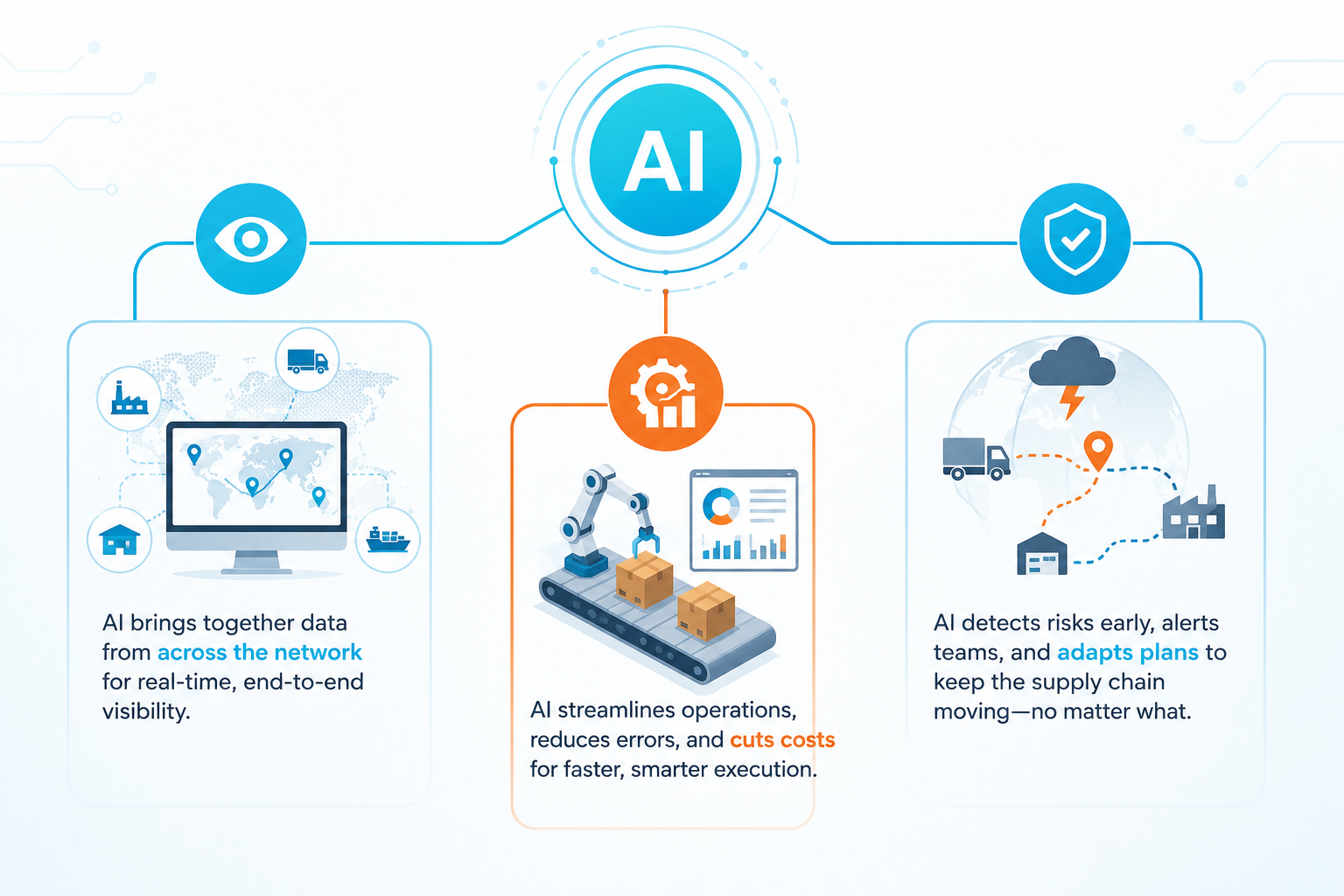
AI doesn't just speed things up. It changes how supply chains perform from the inside out, making them more visible, more efficient, and far better at handling whatever gets thrown at them.
Enhanced Supply Chain Visibility
AI brings everything together. It pulls in data from across supply chain partners, warehouses, and logistics networks and gives teams end-to-end visibility in real time. Everyone can see what is moving, where it is, and whether anything looks off.
Digital twins take this even further. They create a live virtual model of your entire supply chain, so managers can see exactly how things are running and even test out decisions before making them in the real world. That kind of enhanced supply chain visibility was simply not possible before AI.
Better Operational Efficiency and Real Cost Savings
One of the most immediate ways AI affects supply chain performance is by removing the friction that slows everything down.
With warehouse automation, the physical side, like picking and sorting stock, is streamlined. It becomes faster, and there are fewer errors than with the manual processes. On the other hand, AI helps eliminate manual entry, reduces errors, and boosts everything.
This leads to a low operational cost and faster turnaround time with supply chain processes that smoothly run on a day-to-day basis.
Supply Chain Resilience When Things Go Wrong
There may be supplier delays, demand rise, and natural disasters disruptions. These are not a matter of it, but when.
AI changes the entire scenario of how prepared the businesses actually are for such disruptions. It helps analyze relevant data and external factors so that it becomes easier to spot early warning signs and risks. Supply chain managers get notified earlier before the small issue becomes a major one. It activates alternative suppliers and adjusts production plans.
Challenges & Considerations in AI Adoption
AI actually helps bring real value to supply chains. However, there are challenges associated with businesses that need a plan for. Here is the actual breakdown of challenges and considerations.
| Challenge | What It Means | What To Do About It |
| Data Readiness | AI is only as good as the data you feed it. Messy or disconnected data leads to unreliable outcomes | Clean your data and ensure to connect it across systems before rolling out AI tools |
| Change Management | Teams that don't trust AI cause projects to stall, regardless of tool quality. | Involve teams early, communicate the why, and show quick wins. |
| Implementation Costs | Upfront investment in infrastructure and integration can be significant. | Start with high-impact pilots. Prove value before scaling. |
| Data Privacy & Security | AI processes sensitive supplier and customer data at scale. | Work with vendors who are transparent about data handling and storage. |
| AI Governance | Without oversight, models drift or produce outputs that carry hidden risk. | Define who reviews AI decisions and how models are monitored over time. |
| System Integration | AI integration into existing systems is not simple and disrupts workflows | Plan from the beginning and get the right technical support to avoid AI sitting unused on the sidelines |
| Autonomous Supply Chains | Fully trusting AI, especially for situations that the systems have not encountered previously. | Keep human oversight in place. AI should support decisions, not replace people. |
| Supply Chain Sustainability | AI can reduce fuel consumption and cut waste if sustainability is there from the start. | Set sustainability goals before configuring your AI tools, not after |
The Role of Human Expertise in AI-Powered Supply Chains
AI helps process vast amounts of critical historical data, but that does not mean human intelligence is not needed. Human oversight is one of the key components, and it becomes vital for businesses to balance AI with human expertise for better outcomes.
AI Handles the Data. Humans Handle the Judgment
AI is excellent at spotting patterns and flagging risks. What it cannot do is understand context the way a person can.
A supply chain manager who has worked with a supplier for ten years knows things no AI model will find in the data. How does that supplier behave under pressure? When to push and when to give them space. Whether a delay is a one-off or a sign of something bigger.
That kind of human oversight is not a weakness in an AI-powered supply chain. It is a key component of making it work properly.
Supply Chain Professionals Still Drive the Big Decisions
AI gives supply chain professionals better information to work with. But the decisions, especially the ones that carry real risk or involve supplier relationships, still need a human in the room.
Should the business switch to an alternative supplier? Is this the right time to increase production? AI can lay out the options and model the outcomes. But supply chain managers are the ones who weigh everything up and make the call.
Why Signity Solutions
We have worked with businesses across retail, manufacturing, and distribution to implement AI across the full supply chain, from demand forecasting and procurement automation to inventory optimization and logistics. We help you assess readiness, integrate AI into existing systems without disrupting operations, and build governance frameworks that keep outputs reliable over time.
After implementing our AI-powered warehouse management platform Velura, they could reduced inventory errors by 63%, cut order processing time by 38%, and improve night shift efficiency by 31%, all within six months.
Conclusion
No matter whether it's demand forecasting or supplier management, AI is helping businesses streamline their supply chain operations. More businesses are now embracing the technology and are dominating the supply.
Businesses that leverage the best results ensure pairing it with human expertise and support teams, not replacing them.
Are you willing to bring AI into your supply chain operations? You do not need to overhaul it at once. Just start small and get your data in order.
Ready to build a smarter supply chain? At Signity Solutions, we help businesses implement AI across their supply chain processes. Whether you are just getting started or looking to scale what you already have, we can help you get there.
Frequently Asked Questions
Have a question in mind? We are here to answer. If you don’t see your question here, drop us a line at our contact page.
Q1. How long does it take for AI to show results in a supply chain?

Q2. Is AI in supply chain only for large enterprises?
No. There are plenty of AI tools today built for mid-sized and smaller businesses, too. What matters more than company size is having clean data and knowing which supply chain processes you want to fix first.
3. What happens to supply chain data security when AI is involved?
Q4. Can AI help with autonomous supply chain sustainability goals?





.png?width=352&name=microsofts-recall-feature%20(12).png)
%20with%20OpenAI%20Language%20Models.png?width=352&name=Robotics%20Process%20Automation%20(RPA)%20with%20OpenAI%20Language%20Models.png)