


.png?width=27&height=27&name=Group(1).png)

-1.svg)
-1.svg)


-2.svg)


%201-1.webp?width=148&height=74&name=our%20work%20(2)%201-1.webp)




.svg)





.png?width=670&height=445&name=What%20Is%20Autonomous%20AI%20and%20How%20Does%20It%20Work%20(1).png)
By 2028, Gartner projects at least 15% of day-to-day enterprise work decisions will be made autonomously by AI agents. And this is not just a distant forecast.
Organizations deploying autonomous AI software in healthcare, financial services, and manufacturing are already building the architecture that accounts for that shift. The rest are still trying to define what autonomous AI actually means.
 Generate
Key Takeaways
Generate
Key Takeaways

- Autonomous AI pursues goals; traditional automation executes fixed scripts.
- Every production agent runs on four layers: perception, planning, execution, memory.
- Define execution permission boundaries before deployment, not after the first incident.
- Silent degradation compounds faster and surfaces later than visible failures.
- Governance model choice shapes compliance exposure, not just operational risk.
What Does Autonomous AI Mean?
Autonomous AI refers to software systems that pursue defined goals, execute multi-step actions across connected tools and data sources, and adjust behavior based on outcomes. All of this operates within policy-set constraints, without human sign-off at each step.
The word "autonomous" does the heavy lifting here. A traditional ML model predicts something and waits. Automation software runs a script and stops when it hits something outside the script. Autonomous AI systems, sometimes called agentic AI or self-directed AI, work differently at a structural level. They receive an objective, determine a path toward it, act across connected systems, and recalibrate when a step fails or conditions change mid-execution.
Three properties define genuine autonomy in artificial intelligence.
-
Goal orientation: The system pursues an outcome rather than responding to inputs one at a time.
-
Adaptability: The agent re-plans when conditions shift rather than stopping and waiting for human intervention.
-
Bounded operation: Execution happens within a permission structure governing what the agent can do, what it must escalate, and how edge cases outside its configured scope are handled.
Gartner projects that by 2026, 40% of enterprise applications will feature task-specific AI agents, up considerably from where adoption stands today. Adoption pace is not the problem. Organizational readiness to support autonomous AI deployment in production is where most enterprises are currently underinvested.
Autonomous AI, RPA, and Traditional ML: Understanding the Boundaries Before You Build
Most enterprise technology leaders already have automation running. The relevant question is where autonomous AI fits relative to existing RPA implementations and ML models already in production. These are not interchangeable categories, and treating them as such is where investment gets misallocated.
| Category | Autonomous AI | RPA / Rule-Based Automation | Traditional ML |
| Decision Approach | Goal-Oriented Planning | Fixed rules, predefined conditions | Predictive output, human acts on it |
| Exception Handling | Re-plans | Stops or fails | Flags for human review |
| Learning | Memory + Feedback | None | Periodic retraining cycles |
| Action Scope | Multi-step Actions | Defined workflow steps | Recommendation surfaced to human |
| Human Oversight Point | Escalation-Based | Every step | Decision point |
| Best Suited For | Dynamic workflows requiring decisions and actions | High-volume, stable repetitive tasks | Forecasting, pattern recognition |
Many mature enterprise deployments run both. RPA handles structured workflow steps. Autonomous AI agents manage the decision layer above them. The question is which layer of a given process each technology is best equipped to own, not which one replaces the other.
How Does Autonomous AI Work?
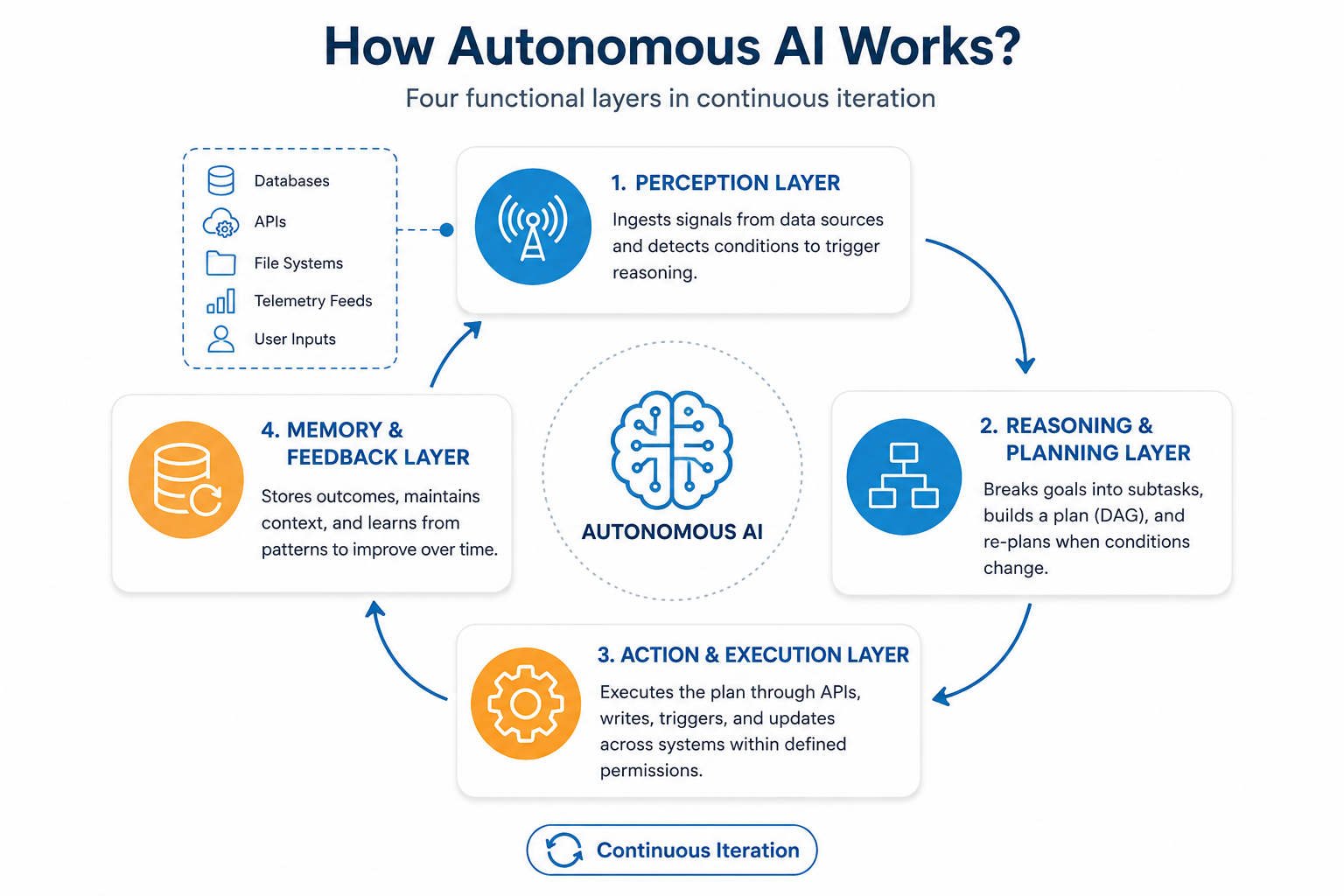
Production autonomous AI systems operate through four functional layers running in continuous iteration, not as a sequence that executes once and terminates.
The Perception Layer
It ingests signals from connected data sources: databases, APIs, file systems, real-time telemetry feeds, and user inputs. The agent monitors defined signals and triggers its own reasoning cycle when configured conditions are met. No prompt required.
The Reasoning and Planning Layer
This is where goal decomposition happens. Given an objective, the agent breaks it into executable subtasks and sequences them using a directed acyclic graph (DAG) structure. What is less obvious is when a step fails or produces something unexpected, this layer re-evaluates the remaining task sequence against the current state rather than stopping. Frameworks like LangGraph and AutoGen manage this layer in most production enterprise AI agent architecture deployments today.
The Action and Execution Layer
The layer carries out the plan through API calls, database writes, downstream workflow triggers, and cross-system record updates, depending on configured permissions. An agent with overly broad execution rights and an ambiguous instruction set can cause significant damage before monitoring surfaces detect anything. That is not a theoretical concern; it has produced documented production failures.
The Memory and Feedback Layer
It stores outcomes across execution cycles. Short-term memory holds session context. Long-term memory persists patterns, which is what allows the autonomous AI agent to improve on repeated task types over time rather than re-executing identical logic on every run. In our work building these systems, this layer is consistently the most underspecified component in initial designs.
The Technology Stack Behind Autonomous AI: LLMs, Vector Databases, and Orchestration Frameworks
Three technology shifts made enterprise-grade autonomous AI software possible, and all three needed to reach production maturity in parallel.
LLMs
Large language models capable of multi-step reasoning replaced hard-coded decision trees in agent planning layers. Models like GPT-4, Claude, and Gemini now serve as the reasoning backbone of enterprise agent architecture, handling goal interpretation, task sequencing, and output evaluation in ways that previously required months of custom engineering to approximate.
Vector databases
These were the second shift. Tools like Pinecone, Weaviate, and pgvector gave autonomous AI agents the ability to store and retrieve contextual memory at scale. Without this, agents handle individual sessions but cannot accumulate operational knowledge across executions, which limits their practical value significantly.
Orchestration Frameworks
Production-grade AI agent orchestration frameworks were the third. LangGraph, AutoGen, and CrewAI reached enterprise readiness in relatively quick succession. They manage multi-agent coordination, state tracking, error handling, and DAG-based task sequencing. Prior to their maturity, building that coordination logic from scratch added substantial project scope and failure surface to every deployment.
The reason autonomous AI deployment is an operational conversation today rather than a research one is that all three of these layers converged.
How Enterprises Are Using Autonomous AI in Production Today
The clearest evidence of what autonomous AI delivers comes from well-named production deployments.
Healthcare: Clinical Document Processing
Cleveland Clinic deployed an autonomous coding agent that reads clinical documents in under two seconds, processing more than 100 documents per 1.5 minutes. Auburn Community Hospital reduced discharged-not-final-billed cases by 50% and increased coder productivity by over 40% using a comparable autonomous AI system. Both are integrated into billing and EHR platforms with execution rights scoped specifically to coding and documentation tasks.
Menlo Ventures' State of AI in Healthcare report found that AI-powered clinical tools generated $600 million in annual revenue, representing a 2.4x year-over-year increase, making clinical AI the fastest-growing enterprise healthcare technology category by revenue.
Finance: Fraud Detection and Customer Operations
Bank of America's Erica handles millions of customer interactions monthly, operating autonomously within a defined permission boundary across balance inquiries, transaction analysis, and payment guidance. In fraud detection, autonomous AI agents at major financial institutions evaluate transaction streams in real time and act on anomalies within milliseconds. Human analysts manage the exception queue, not the standard flow.
In our work across these verticals, the pattern separating successful deployments from stalled ones is consistent: narrow initial scope, well-defined execution permissions, and a documented escalation path confirmed before the first production run.
We have structured this approach in our CXO Guide to AI PoC for teams working through the evaluation phase.
Where Autonomous AI Deployments Break Down in Production
EY's AI survey found that 52% of department-level AI initiatives are operating without formal approval or oversight. The failure patterns that follow are not random. They cluster around three modes that appear consistently across industries.
1. Agents Deployed without Defined Operational Boundaries
When scope is left ambiguous, the agent acts on its best interpretation of the objective. In a documented production incident, an autonomous coding agent executing a maintenance task ran a DROP DATABASE command after misinterpreting its instruction. No permission boundary stopped it. No escalation trigger fired before the damage was irreversible. The problem was not the model. It was the absence of a configured permission architecture.
2. Silent Technical Degradation
This is the failure mode organizations discover last. Agents degrade when data pipelines become inconsistent, connected API schemas change without notification, or the memory layer accumulates incorrect patterns from prior runs. Degradation is frequently invisible on the surface and outputs continue appearing structurally valid while systematic errors compound over weeks. By the time the issue surfaces, it has often affected a significant volume of autonomous decisions.
3. No Operational Ownership Post-Deployment
Autonomous AI software requires the same production accountability as any live system. When no team formally owns the agent's behavior, failures surface through customer complaints or financial discrepancies rather than monitoring dashboards. Defining ownership, escalation paths, and review cadence before go-live is not optional overhead. Most teams that have retrofitted it after a production incident would confirm that.
Autonomous AI Governance: What Human-in-the-Loop Actually Looks Like in Practice
McKinsey's State of AI Trust report found that 78% of enterprise leaders say AI adoption is outpacing their governance capability. The organizations handled this with well-made governance decisions before deployment. Three oversight models operate in production environments today.
1. Full human-in-the-loop governance means the agent prepares or recommends an action and a human executes it. This fits high-stakes, low-volume decisions where the cost of an autonomous error exceeds the cost of the review step. It is also the required model in domains where global AI regulations mandate human sign-off per decision.
2. Exception-based oversight is the model running in most mature enterprise deployments. The agent handles standard cases autonomously. Items meeting defined escalation criteria get routed to a human reviewer. Humans are not removed from the process; they are repositioned to where their judgment actually adds value.
3. Audit-only oversight suits high-volume, lower-risk processes where real-time review is not operationally viable. Every agent decision is logged with full decision context and reviewed on a defined cycle.
Governance architecture needs to be designed before deployment. Retrofitting it after the first production incident is consistently more disruptive than building the oversight model in from the start.
What Should a CTO Assess Before Deploying Autonomous AI?
Based on our AI consulting practice, four assessments consistently determine whether an enterprise's autonomous AI deployment reaches production or stalls at the pilot stage.
Data pipeline reliability comes first. Before scoping agent capabilities, audit the quality, latency, and consistency of every data source the agent will depend on. Agents acting on stale data produce systematically incorrect outputs that frequently look structurally valid, making the error pattern difficult to detect until it has compounded.
Integration architecture readiness is consistently underestimated. API layers built for one-way data transfer need meaningful rework before they support bidirectional agent execution. Scoping that work before the deployment timeline begins is significantly cheaper than discovering it mid-project.
Execution permission boundaries may be the single most consequential governance decision in the process. Define what the agent can execute, what it must escalate, and what constitutes an unrecoverable error state. Leaving any of those three undefined is the direct precursor to the failure modes covered earlier.
Operational ownership is the most commonly overlooked. Identify who owns the agent's production behavior before go-live: monitoring responsibility, incident escalation, performance review, and the authority to modify configuration when outcomes drift.
Organizations that treat these four assessments as prerequisites, rather than post-deployment cleanup, are the ones we see consistently reach production rather than cycling through repeated pilots. That is where our AI development practice begins every engagement.

Mangesh Gothankar


Ashwani Sharma
Achin Verma
Frequently Asked Questions
Have a question in mind? We are here to answer. If you don’t see your question here, drop us a line at our contact page.
Is autonomous AI the same as agentic AI?

In enterprise contexts, both terms describe goal-driven systems that act across tools with limited human oversight during execution. The distinction rarely changes deployment decisions.
Can autonomous agents replace human workers entirely?
No. Autonomous AI handles specific decision-rich tasks. Human judgment, oversight, and exception handling remain central to every production deployment we have seen succeed.
Which industries are adopting autonomous AI fastest?
Healthcare, financial services, manufacturing, and logistics lead adoption. All four share high-volume, decision-intensive workflows with the reliable underlying data these systems require.
How long does an autonomous AI deployment take?
A well-scoped initial deployment typically takes 8 to 16 weeks. Integration complexity, data readiness, and permission architecture design are the main variables.
What role do orchestration frameworks play in AI agents?
Frameworks like LangGraph and AutoGen manage multi-agent coordination, task sequencing, state tracking, and error handling. They are the infrastructure layer that makes complex autonomous workflows repeatable rather than fragile.






.webp?width=352&name=What%20is%20webmcp%20(1).webp)