



.png?width=27&height=27&name=Group(1).png)

-1.svg)
-1.svg)


-2.svg)


%201-1.webp?width=148&height=74&name=our%20work%20(2)%201-1.webp)




.svg)





Try asking a large language model something that spans several documents. The answer usually sounds sure of itself, right up until you actually check it.
The model doesn't actually understand how the retrieved pieces connect. It just works with whatever chunks a vector search handed it. This gap shows up most clearly in multi-hop questions. It means which clause overrides which, or how a transaction traces back through several steps.
Graph RAG closes that gap. Instead of retrieving isolated fragments, it represents real world information as a knowledge graph. In simple words, relevant entities become nodes, relationships become edges, and retrieval follows those connections instead of leaning on similarity scores alone. Microsoft Research introduced the approach to retrieval augmented generation, since then, it has made its way into standard enterprise stacks.
This guide walks through what graph RAG is and how it actually works when it comes to RAG development. From there, it gets into the enterprise data behind its ROI claims. Furthermore, it works at identifying where graph RAG delivers real value and what it takes to implement.
 Generate
Key Takeaways
Generate
Key Takeaways

- Graph RAG pairs vector search with knowledge graph traversal to preserve relationships between entities.
- It reduces hallucinations by grounding answers in traceable relationships instead of matched text chunks.
- Enterprises use it for multi-hop reasoning: fraud detection, legal research, and compliance-heavy decision support.
- Implementation success depends more on entity modeling discipline than on choosing a vector database.
What Is Graph RAG?
Graph RAG, short for graph retrieval-augmented generation, is a retrieval method that combines vector search with a knowledge graph, so an AI system retrieves not just matching text but the relationships connecting it. In a knowledge graph, facts are stored as nodes, or entities, connected by labeled edges, or relationships. For example: Albert Einstein developed the theory of relativity. Graph RAG uses that structure at query time, following edges outward from an initial match to assemble context that a plain similarity search would miss.
Traditional RAG treats unstructured data as a flat pool of chunks. It embeds each chunk, indexes it in a vector database, and at query time retrieves whichever chunks score highest on semantic search similarity. That works for direct lookups but breaks down on anything relational, because nothing in a vector index encodes how two facts connect to each other.
| Comparison Point | Vector RAG | Graph RAG |
| Retrieval basis | Semantic similarity | Similarity search plus graph traversal |
| Multi-hop questions | Struggles | Built for this |
| Explainability | Limited, black-box scoring | High, traceable relationship paths |
| Main limitation | Fragmented, incomplete answers | Requires upfront graph modeling work |
Neither approach replaces the other outright. Most production systems run both: vector search finds the entry point into the structured data, and graph traversal expands outward from there to gather connected context.
How Does Graph RAG Work?
A graph RAG pipeline runs through four stages: query processing, retrieval, organizing, and generation.
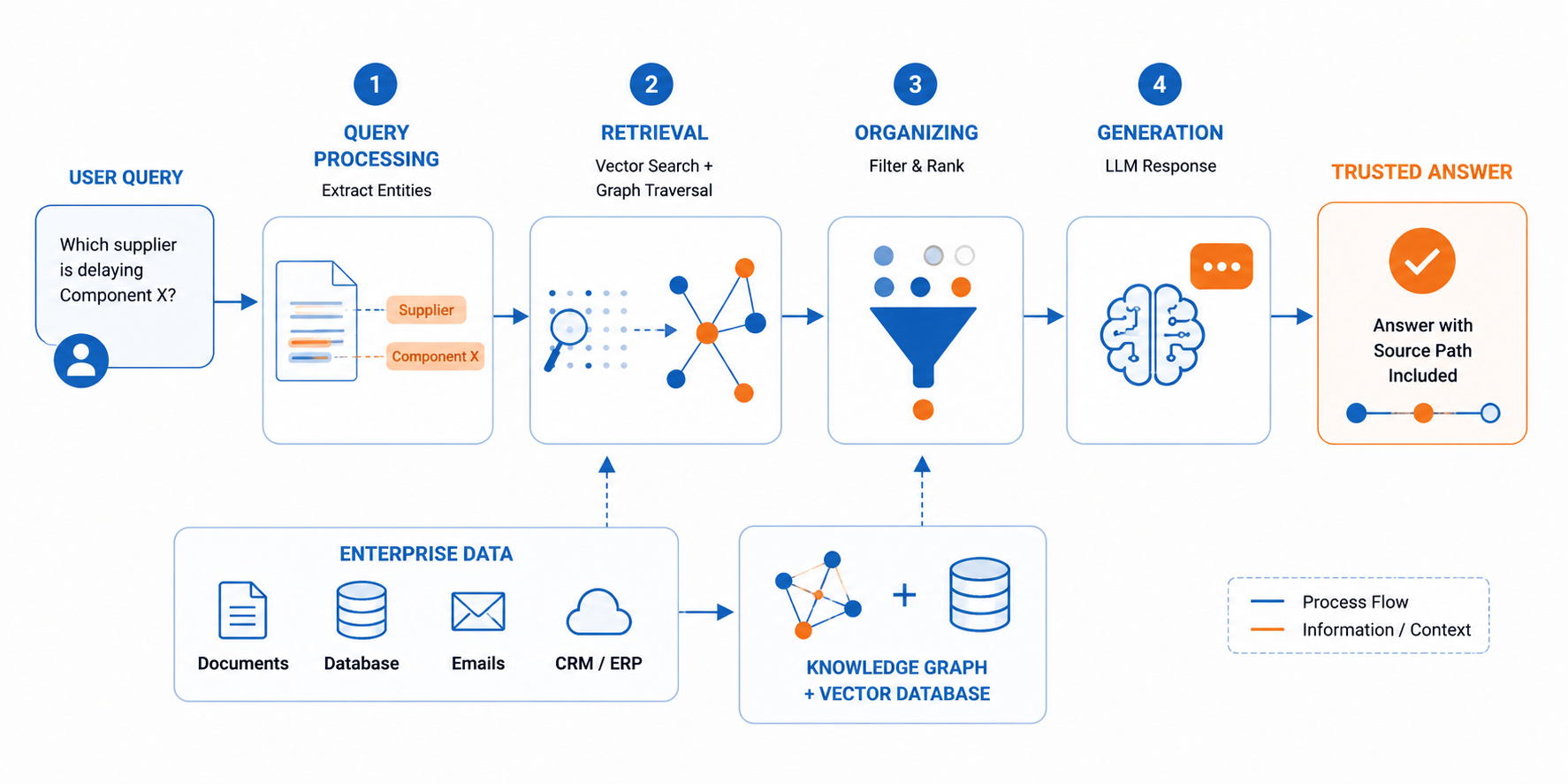
- Query processing: The system extracts key entities and relationships from the user's question, often using named-entity recognition, to identify which nodes in the graph the question actually concerns. For example, a question like “which supplier delays are affecting Component X's delivery timeline” gets tagged with “Component X” and “supplier” as target entities before retrieval even starts.
- Retrieval: Using those entities as entry points, the system finds relevant nodes through vector search, full-text search, or both, then traverses outward along relationships to pull in connected context. Common retriever patterns include neighborhood traversal, path traversal between two named entities, and global queries over pre-computed community summaries for broad, sense-making questions.
- Organizing: Raw graph output gets pruned and ranked, filtering out noisy or irrelevant nodes so only context that actually answers the question reaches the model.
- Generation: The cleaned context is passed to the LLM, which produces an answer grounded in the retrieved relationships rather than in its own training data, often with the source relationship path attached.
For technical teams, this typically means a graph database such as Neo4j or Memgraph, queried through Cypher or a comparable graph query language, paired with an embedding model for the vector portion of retrieval. For business stakeholders, that same pipeline translates into fewer manual document reviews, answers that cite their own sources, and less time spent verifying whether an AI-generated summary is actually correct.
Why Use Graph RAG Instead of Traditional Vector Search?
Vector search alone cannot explain why it retrieved a given chunk, and it cannot follow a relationship that spans more than one hop. Graph RAG addresses both, and the two most credible 2026 data points on this come from an independent research institute and a leading market research firm, not a vendor's own marketing claims.
In 2026, the National Innovation Centre for Data (NICD), a UK research institute, independently tested graph-grounded retrieval against vector-only RAG. Agents using graph RAG were 80% more truthful. They also answered 65.3% of complex questions correctly, against 28.9% for vector-only RAG, more than double the coverage.
Separately, the IDC White Paper on the Business Value of Graph Intelligence (Doc #US54319826, May 2026) measured a 230% three-year ROI and a 7.8-month payback period across surveyed enterprises. The same IDC research program found enterprises adopting graph-based context reported 44% fewer generative AI hallucinations and 53% faster queries on average.
| Metric | 2026 result | Source |
| Answer truthfulness | 80% higher; 65.3% vs. 28.9% complex-question accuracy | NICD, 2026 (independent, sponsored by Neo4j) |
| Enterprise ROI | 230% over three years, 7.8-month payback | IDC White Paper, May 2026 |
| Hallucination reduction | 44% fewer GenAI hallucinations reported | IDC research program, 2026 |
| Query performance | 53% faster queries on average | IDC research program, 2026 |
That distinction matters under the EU AI Act's explainability requirements, which are turning traceable retrieval from a nice-to-have into a compliance necessity for regulated industries, particularly finance, healthcare, and legal services. A system that can show its reasoning path through a graph is far easier to audit than one that can only report a similarity score.
Where Graph RAG Delivers Value?
The common thread across graph RAG use cases is a question that depends on relationships, not just keywords.
1. Fraud detection. Following chains of small transactions across accounts to surface patterns a single-transaction view would miss.
2. Legal and compliance research. Tracing which clause overrides which across contracts, statutes, and precedent, with a citation trail attached to every answer.
3. Healthcare and life sciences. In IDC's 2026 study, one life sciences company reduced LLM hallucination rates from 20–40% down to 2–5% after grounding its models in a connected knowledge graph of research and compliance data.
4. Manufacturing and supply chain. One manufacturer in the same IDC study cut assembly-line query wait times from up to two minutes down to real time. BMW Group has built something similar: an AI Engineering Cockpit that connects specs, tests, defects, and milestones across engineering tools that used to sit apart.
5. Enterprise operations. A telecom company in the same IDC study cut project timelines from nine months to two by resolving cross-system dependencies through a connected graph instead of manual document review.
Vector-only RAG answers "what does this document say." Graph RAG answers "how does this fact connect to everything else we know."
What Implementation Actually Takes?
Graph RAG is not a drop-in replacement for a vector database. Getting it right depends on architecture decisions made before a single query runs. It usually works through the indexing process for external knowledge that comes from specific entities like community reports.
Entity and schema modeling
The graph is only as useful as the nodes and relationships defined for it. That means deciding which entities matter for your domain. It means choosing between a property graph and an RDF model. It also means setting a chunking strategy that preserves enough context for entity extraction to actually work. A bank modeling accounts and transactions will usually favor a property graph for its flexibility. A life-sciences team mapping regulatory taxonomies may lean toward RDF instead, since it fits a standardized, ontology-driven structure.
Retrieval orchestration
Most production systems combine several retriever types: vector search for entry points, path traversal for relationship-following, and dynamic query generation for structured questions. Someone still has to write the logic that decides which one fires for a given query.
Where cost actually lands
License fees are usually the smallest line item. The real cost sits in the indexing pipeline, meaning entity extraction and relationship computation, and in ongoing graph maintenance as source data changes.
| Consideration | In-house build | Development partner |
| Entity modeling | Requires domain and graph expertise on staff | Brings established modeling patterns |
| Pipeline engineering | Built from scratch | Reusable components, faster iteration |
| Ongoing maintenance | Needs a dedicated internal team | Often bundled into the engagement |
The technology choices matter, but they rarely decide success on their own. The modeling discipline behind them, and who is doing that modeling, tends to matter more.
Where Signity Fits In
Most graph RAG rollouts fail for the same reason: teams treat it as a vector database swap instead of a modeling and pipeline engineering problem. Signity's engineering team works the opposite way, starting with entity and relationship modeling specific to a client's domain before any retrieval logic gets built, so the graph reflects how the business actually reasons about its data.
That work spans graph database integration, retrieval orchestration across vector and path-based retrievers, and the entity extraction pipelines that keep a knowledge graph accurate as source data changes. For regulated industries facing explainability requirements, this discipline is what makes a retrieval system something an auditor can actually follow.
The Bottom Line
Vector search surfaces text that sounds to have relevant context. It rarely shows how that text connects to the answer. Graph RAG does, and it can point to the path it followed to get there. The IDC data above shows this has moved past the research lab. Enterprises running it now are measuring real ROI, faster queries, and fewer hallucinations.
That matters most in finance, healthcare, and legal work, or anywhere compliance teams ask how the system knew that. In those settings, a wrong or unexplainable AI answer carries real risk. Graph RAG is becoming less of an optimization there and more of a baseline requirement.
FAQs
Is graph RAG open source?
Yes, several implementations are. Microsoft's GraphRAG library is open source, as are graph database options like Neo4j Community Edition and Memgraph, along with frameworks like LangChain and LlamaIndex that support graph retrievers.
How is knowledge graph RAG different from a regular knowledge graph?
A knowledge graph is the data structure. Knowledge graph RAG is the retrieval pattern built on top of it, using that structure at query time to pull connected context into an LLM prompt rather than just storing relationships for lookup.
Does graph RAG replace vector databases entirely?
No. Most production systems use vector search to find entry points into the graph, then traverse relationships from there. The two work together rather than competing.
How long does implementation typically take?
It depends on data readiness and domain complexity, but entity modeling and pipeline setup are usually the longest phases, well before the graph database itself becomes the bottleneck.
What data readiness is needed before starting?
A clear sense of which entities and relationships matter in your domain, and source data clean enough for reliable entity extraction. Messy, unstructured input still needs structure imposed on it somewhere in the pipeline.
How does knowledge graph construction turn unstructured text into a usable data representation?
GraphRAG extracts entities and relationships from unstructured text and source documents, building a knowledge graph data representation instead of scattered vector embeddings.
How does graph based retrieval handle complex queries better than baseline RAG?
Baseline RAG retrieves semantically similar text via vector search; graph based retrieval follows explicit relationships, handling complex queries baseline RAG misses.