











AI coding assistants can produce a working application in minutes. The difficulty begins when that application needs internal APIs, business data, employee identities, or production infrastructure. Enterprise vibe coding solves this by joining natural language prompts to the controls large enterprises already apply to software delivery.
IBM's June 2026 study of 2,000 technology executives found that 70% say teams across the business deploy technology faster than IT can track. The figure covers technology broadly, yet it describes the conditions in which unreviewed AI-generated apps multiply beyond the reach of security reviews. In short, close that visibility gap before adoption spreads.
Use this guide to choose suitable internal use cases, build a five-layer architecture with clear trust boundaries, and validate every production release. Each section gives clear steps you can apply immediately, and the guide shows when a development partner adds value so AI-assisted software development scales without losing visibility or accountability.
 Generate
Key Takeaways

- Enterprise vibe coding accelerates delivery once you set clear boundaries and name application owners.
- Give every application least-privilege service identities and protected secrets inside its own isolated environment.
- Run automated tests and require human code review before any AI-generated software reaches production.
- Track quality, security outcomes, and total cost alongside delivery speed as you scale responsibly.
What Is Enterprise Vibe Coding And Where Does It Fit?
Enterprise vibe coding is the practice of building applications from natural language prompts and large language models inside organizational controls for security, governance, and release. It keeps the speed of consumer vibe coding tools and adds identity, review, and deployment rules that protect data and production systems.
Consumer tools turn natural language instructions into a live URL with little review. By contrast, enterprise teams route every change through source control, testing, and approved environments first.
| Dimension | Consumer vibe coding | Enterprise vibe coding |
| Data access | Tool-dependent permissions | Governed identities and scoped access |
| Quality assurance | Informal checks | Automated tests and required reviews |
| Deployment | Tool-managed publishing | Controlled environments and release gates |
| Accountability | Individual builder | Assigned owner and auditable approvals |
Low-code platforms limit developers to predefined components. Vibe coding generates source code in many programming languages, which widens what teams can build and increases the review they need. Traditional development remains the right choice for complex development tasks and critical integrations.
Start with internal tools
Begin with dashboards, approval workflows, operational portals, and reporting utilities where the business context is clear. For anything that handles financial transactions, sensitive personal data, or privileged access, apply a full engineering process from the prototype.
Related Read: AI Governance Framework 2026: What You Need to Use AI Responsibly
Designing A Secure Architecture For Enterprise Vibe Coding
A secure enterprise vibe coding architecture separates AI-assisted code generation from application execution, sensitive data access, and production release authority. No model output receives credentials or deployment rights automatically. Every change passes through source control and automated validation before it reaches users.
Agentic tools raise the stakes because Gartner predicts that by 2027 more than 65% of engineering teams using agentic coding will treat IDEs as optional. That shift moves control, governance, and validation into automated platforms.
Build the reference architecture from prompt to production
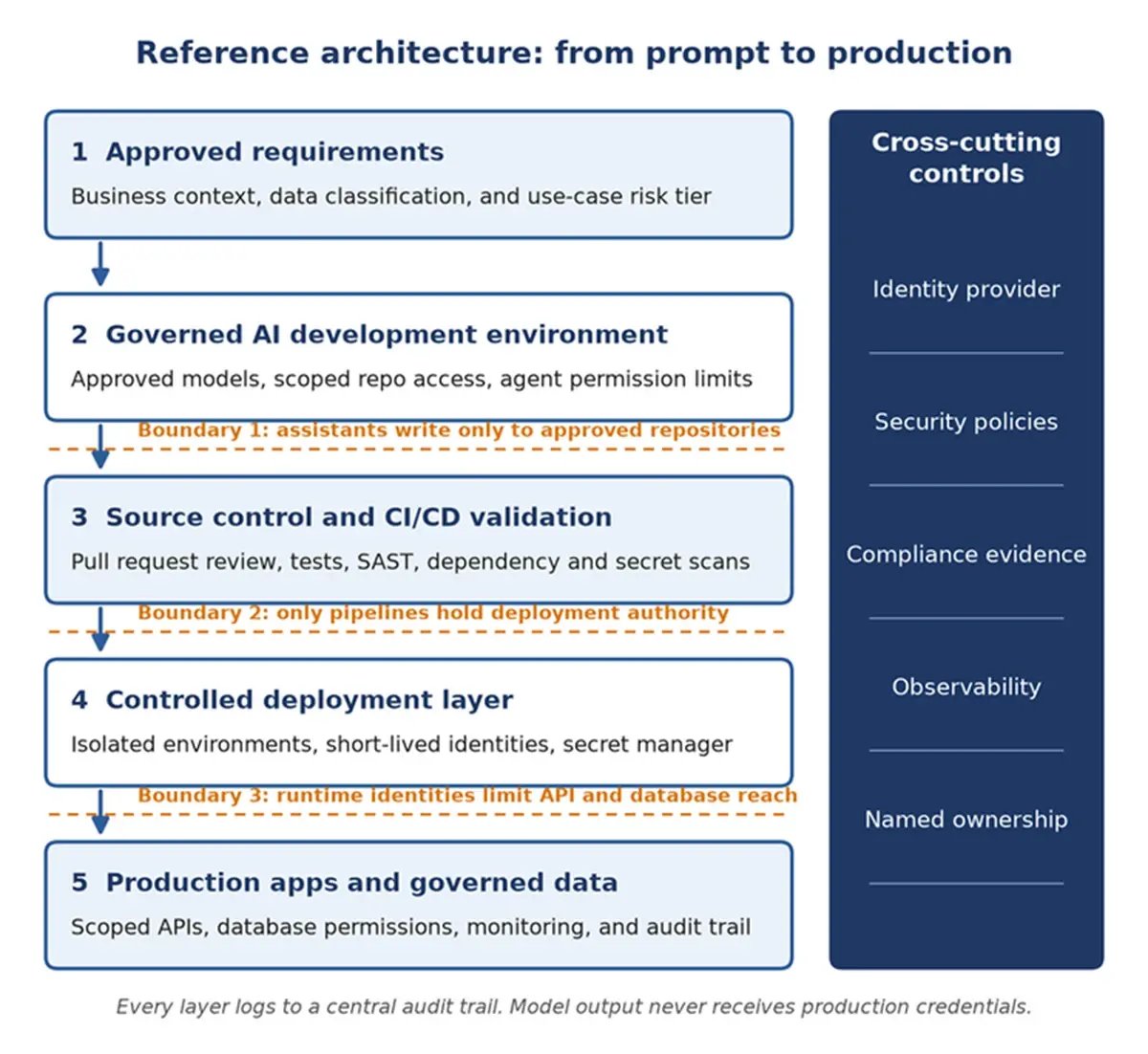
Build five layers between a prompt and production. Feed approved requirements into a governed AI environment first, and route every change through source control with CI/CD validation before a controlled deployment layer releases it. Then anchor access controls in your identity provider and scope database access through infrastructure-level control.
Enforce three trust boundaries:
- Limit assistants to approved repositories and block merges to protected branches.
- Reserve deployment authority for pipelines.
- Restrict each runtime identity to the APIs and databases its application needs.
Finally, centralize logs from all five layers to support detection and rollback.
Assign Security Controls to Each Layer
| Layer | Required controls | Verification |
| AI tools | Approve AI models, set data policies, and limit agent permissions | Configuration and access reviews |
| Source code | Scan for secrets, allow-list dependencies, and require pull request review | Repository and review evidence |
| Application | Enforce authentication, authorization, and input validation | Automated and security testing |
| Infrastructure | Use a secret manager, isolate networks, and replace shared credentials with scoped workload identities | Configuration checks and access tests |
| Production | Centralize logging, monitor continuously, and rehearse rollback | Recovery drills and operational reviews |
IBM's 2026 data points to the same weak spots: more than 20% of organizations reported a breach targeting AI models or applications, and the most common causes were compromised APIs, applications, or plug-ins (27%) and cloud misconfigurations affecting AI workloads (27%).
Test code-level flaws and deployment misconfiguration separately, because a well-written application still exposes data through an overprivileged database account, hardcoded API keys or database passwords, or a public endpoint.
Secure Vibe Coding: Validate AI-generated Code Before Production
Secure vibe coding means every AI-generated change passes risk-based validation and human review before it gains production access. The pipeline records who requested, reviewed, and approved the change. That record gives security teams evidence and engineers a repeatable path to release.
Attackers now use AI too, and IBM found that one in four malicious breaches were AI-enabled, up 56% over last year, and these breaches cost an average of $6 million. AI assistants writing code can also ship vibe-coded apps without authentication or rate limits, and they can suggest packages that do not exist, so treat any code that merely runs as unverified and add application security testing to the pipeline.
Put validation inside the delivery pipeline
- Generate code with approved tools against documented requirements.
- Open a pull request with traceable changes and an assigned reviewer.
- Run unit, integration, regression, and authorization tests.
- Scan with SAST, software composition analysis, secret detection, and infrastructure-as-code checks.
- Deploy to an isolated staging environment for risk-based security testing.
- Release through approved gates with monitoring and a tested rollback.
Use automated scans to remove repetitive review work and protect code quality as new code arrives faster, and keep people responsible for confirming that each application meets business requirements and enforces every authorization rule.
Assign human sign-off to high-risk decisions
| Decision | Accountable human |
| Architecture changes | Experienced developers review service boundaries and data flows |
| Sensitive data access | Data owner approves purpose, permissions, and retention |
| Authentication and authorization | Security team reviews identity handling |
| High-risk releases | Engineering and security leads accept residual risk |
How To Scale Vibe Coding for Enterprises: Roadmap, Metrics, and Cost
Scaling vibe coding for enterprises requires a governed operating model that standardizes tooling, clear ownership, deployment controls, and measurement across teams developing code with AI. Organizations expand by use case and risk tier, and each phase ends with documented evidence.
Start with a readiness check because IBM found that only 11% of executives feel fully ready for the scale of AI agent deployment expected in the next year. Assess tools, data sensitivity, and controls before the pilot.
Follow a four-phase adoption roadmap
| Phase | Actions | Exit criteria |
| 1. Assess | Inventory AI tools, use cases, data sensitivity, and existing controls | Approved risk assessment |
| 2. Pilot | Ship new features in low-risk internal apps with a small team | Measure quality and security baseline |
| 3. Standardize | Set templates, approved models, CI/CD gates, identity policies, and owners | Reusable delivery standards |
| 4. Scale | Expand by use case and risk tier with periodic reviews | Demonstrated operational readiness |
Track lead time to production and change failure rate, then add escaped defects and remediation time for security findings. Use review effort and rework per application to expose the hidden cost behind speed gains and to improve quality. Then standardize on custom web application development templates so these measures stay comparable across business units.
Control The Cost Of Enterprise Vibe Coding
Budget for total cost of ownership and look beyond the coding assistant's price. IBM's 2026 Cost of a Data Breach report puts the global average breach cost at $4.99 million, up 12% and a record high.
| Cost driver | How to control it |
| AI model usage | Set approved models and usage policies for each team |
| Developer and reviewer time | Reserve senior review for high-risk changes |
| Platform and security tooling | Standardize one pipeline across teams |
| Maintenance and compliance | Assign owners and retire unused apps on a schedule |
Decide whether to build, buy, or partner
Build the pipeline internally when platform teams have security capacity to spare, and buy a platform when speed matters and the vendor's constraints are acceptable. Hire a development partner when you must design architecture, integrate legacy systems, and produce compliance evidence together. Vet any partner on four points:
- Ask for secure delivery experience with AI-generated code.
- Test identity and data integration skills.
- Check familiarity with your compliance frameworks.
- Require a plan to hand pipeline ownership to your team.
How To Meet Compliance Requirements in AI-assisted Software Development?
AI governance sets enforceable rules for how AI tools generate code, access information, deploy applications, and maintain accountability. It converts policy into controls that auditors can inspect, such as access reviews and change records. Obligations depend on the sector, jurisdiction, and data involved.
| Framework | Action for AI-built apps |
| GDPR and data residency | Document lawful processing, apply data protection controls, and fix approved data locations |
| SOC 2 | Collect evidence of access control, change management, and monitoring |
| ISO/IEC 27001 and ISO/IEC 42001 | Document information security and AI management controls |
| HIPAA | Apply safeguards and sign business associate agreements for protected health information |
| NIST AI RMF | Map and measure AI risk across the system lifecycle |
Governance maturity is low: Deloitte's State of AI in the Enterprise 2026 survey of 3,235 leaders found that only one in five companies has a mature model for governing autonomous AI agents. Regulation is moving too, because EY reports that stand-alone high-risk AI systems must comply with the AI Act by 2 December 2027 and AI in regulated products by 2 August 2028. Plan around those dates and confirm the Official Journal text before you commit.
Put these controls in place:
- Classify source code and business data, and restrict sensitive inputs to approved models and environments.
- Retain audit trails of code changes, approvals, deployments, and access.
- Assess model providers and open-source dependencies as third-party risk.
- Enforce access controls through a central identity provider with periodic access reviews.
Hosting location alone does not guarantee compliance, so choose private cloud or on-premises deployment when strict data residency requirements apply.
How Signity Helps Enterprises Operationalize Secure Vibe Coding?
We move enterprises from experiments to governed delivery with 16+ years of software engineering experience, 200+ certified experts, and 1,000+ delivered projects. We start with AI governance consulting to map your AI coding tools, the data they can access, and a risk tier for each application.
Our engineers then design the target architecture around your identity provider and secret manager. We build the CI/CD pipeline through DevOps services with pull request policies, security scans, and tested rollback. Our AI development and AI cybersecurity teams validate generated code with authorization and security tests, and experienced developers review high-risk changes before release.
We also centralize your audit logs and compliance evidence for GDPR, HIPAA, SOC 2, and ISO/IEC 27001 requirements, and we deliver on AWS, Azure, and Google Cloud infrastructure.
Conclusion
Start enterprise vibe coding with one governed pilot. Pick a suitable internal application, stand up a governed environment, and validate the path from AI-generated code to production. Run it for one quarter, then review results with security and business owners before you expand.
As adoption grows, measure delivery quality and lifecycle cost alongside speed. Pair a clear architecture with enforced controls and named owners, and AI-assisted development becomes a repeatable software delivery capability that improves quality and shortens release cycles.
Frequently Asked Questions
Have a question in mind? We are here to answer. If you don’t see your question here, drop us a line at our contact page.
How is enterprise vibe coding different from low-code?

Is vibe coding safe for enterprise applications?
Does vibe coding meet SOC 2, GDPR, or HIPAA requirements?
How much does enterprise vibe coding cost?
When should an enterprise hire a development partner?