


.png?width=27&height=27&name=Group(1).png)

-1.svg)
-1.svg)


-2.svg)


%201-1.webp?width=148&height=74&name=our%20work%20(2)%201-1.webp)




.svg)






The world of business has undergone a significant facelift over the last few years. And all thanks to Artificial Intelligence and its trends. AI has changed the way we do business. Now, we can become more productive by replacing time-consuming processes and complicated choices with quick and informed decisions.
Robotic Process Automation is software-based process automation. It uses bots to carry out repetitive tasks that follow clear rules. RPA is not the same as artificial intelligence. The two technologies work well together in practice. RPA handles the structured execution of a task. AI adds judgment, prediction, and language understanding on top of that execution.
The benefits of RPA in business are spectacular. This is why it remains one of the most widely adopted automation technologies going into 2026.
The global robotic process automation market is valued at USD 35.27 billion in 2026. It is projected to reach USD 247.34 billion by 2035. This reflects a compound annual growth rate of 24.20 percent, driven largely by AI-powered automation and rising demand for operational efficiency across industries.
So, here in this blog, we will shed light on the benefits of RPA in business. But before you leverage the benefits of RPA, the first step to benefiting from RPA is identifying where the solution can be leveraged.
 Generate
Key Takeaways
Generate
Key Takeaways

- RPA reduces costs. It boosts productivity by automating repetitive manual work daily.
- The global RPA market keeps expanding. Analysts project strong growth through 2035.
- RPA lowers manual errors. It also strengthens compliance through consistent process execution.
- RPA handles structured execution. AI adds judgment and predictive decision-making capability today.
How Does RPA in Business Help?
RPA has made abrupt changes since it first came into existence. By automating mundane tasks and needing limited or no human involvement, businesses can:
- Direct their workforce to more critical tasks that require human intelligence and decision-making
- Reduce operational costs by automating repetitive, manual work
- Improve productivity as robots do more work in less time
- Significantly reduce manual errors
- Build a more productive organization overall
Related Read: Why Enterprise Leaders Are Replacing RPA with AI Workflow Optimization.
Assessing Process Usefulness for Automation
Numerous factors must be considered to evaluate processes for RPA automation. These gauging criteria consist of both enablers and prerequisites.
The prerequisites for assessing process usefulness for RPA automation are as follows:
- Rule-based - The process should be definable with clear rules, not grounded on intuition. Though many processes live up to these prerequisites, they may not be necessarily profitable from an automation perspective.
- Entirely digital - Where a robot cannot manage paper or other physical objects.
The following attributes are metrics of good processes to integrate RPA:
- Volume and Time: Either there is a high volume of cases, a large amount of time spent on every case, or both.
- Repetitiveness: A high level of repetitiveness, whether carried out on demand or in batches.
- Consistency: The minimal differentiation between each case going through the process.
- Compliance: When a high level of compliance is required for stringent control and logging.
- Quality: Concerns with quality because of human errors.
- Time: Whether there is a binding timeline or a necessity to carry out the process round the clock.
- Ho-hum: If there is a cutback in employee satisfaction from carrying out the process manually.
💡Quick Tip: The more of these attributes, the higher the probability that the processes fit RPA automation correctly..
When RPA May Not Be the Right Fit
Not every process is a good candidate for automation. RPA works best with tasks that follow fixed rules. It struggles with workflows that change often. Frequent changes to screens or applications can break rule-based bots.
RPA also struggles with tasks that depend on human judgment rather than defined steps. A process that is poorly defined or inconsistent is not ready for automation. Automating a broken process does not fix it. It only makes the process fail faster. The process should be fixed first. Automation should follow once the process is stable.
Benefits RPA Brings to Corporate Functions
1. Accelerated Productivity Gains
- A single RPA bot can typically handle the throughput of three to five full-time workers on repetitive processes, operating around the clock without fatigue.
- RPA bots cost roughly one-third the price of an offshore employee and about one-fifth the price of an onshore employee.
- Organizations pursuing well-scoped RPA projects have reported an average ROI near 250 percent with a payback period of about 14 months, and the best-planned projects have reached over 300 percent ROI in under six months.
When it's all about back office operations in corporate functions, a constantly pursued objective is productivity improvement. Here, RPA offers a new productivity lever, building on lean initiatives and offshoring.
"Robots allow a more accessible labor arbitrage as they imitate human actions on a desktop interface."
2. Improved Compliance
- Automated control steps maximize compliance
- Traceability minimizes the risk of human errors and keeps consistency safe
- Systematic documentation of audit trail
In industries with exigent regulations, RPA comes with a gimmick to manage evolving requirements for primarily two reasons.
Firstly, transactions are recorded, and steps are systematically employed, which prevents manual errors and offers complete transparency to auditors. Secondly, the risk and compliance unit can use RPA to implement reconciliation and automate daily routine controls, minimizing the workload produced by everyday tasks.
3. Enhanced Employee and Customer Satisfaction
- Time generated to focus on customer satisfaction
- Voluminous and repetitive tasks are delegated to robots
- Motivates employees to do more value-added tasks
RPA offers employees time to invest in more prudently stimulating activities since tiresome tasks like formatting or copy-pasting data files are delegated to robots. In addition, the robots can efficiently execute rule-based tasks, providing employees the time to work on value-added tasks needing cognitive and soft skills, like advising customers. Moreover, if companies keep track of the Employee Net Promoter Score, they will notice how it improves eventually.
Additional Benefits of RPA in Businesses
Ever since its debut, Robotic Process Automation has re-engineered the business wheel. Building on the productivity, compliance, and satisfaction gains above. Here are the remaining benefits of RPA in business, explained in detail.
4. Optimized Use of Resources
Eliminating the risk of errors is crucial if we want to achieve maximum efficiency in a business. However, ensuring that it becomes impossible for human resources to perform tedious jobs. They often get bored and make silly mistakes while carrying out repetitive and complex tasks like employee scheduling, payroll processing, attendance tracking, leave management, and performance reviews, etc. This leads to a great waste of time and money.
But with the help of RPA, we can prevent all this from happening. We can use RPA to automate complex tasks and assign human resources jobs that are worthy of their time and effort. This can take business productivity to a whole new level.
RPA not only optimizes how resources are used. It also increases employee satisfaction. Studies have shown that employees are more satisfied when they are assigned meaningful and worthy jobs instead of tedious tasks. This drives them to perform better and put their best efforts into their tasks. Increased employee satisfaction also reduces the likelihood that employees will switch jobs. This ultimately makes businesses more productive and helps them grow.
Related Read: How to Migrate from RPA to Agentic AI: Enterprise Transition Guide
5. Reduced Costs and Operational Risks
Since RPA lets you efficiently perform complex tasks with the minimum chance of error, it can help you reduce operational risks to a major extent. Not only that, but we also need fewer human resources to get the jobs done. This also brings the costs down and proves to be a game-changer for your business. We can aim for cost-effectiveness with the help of RPA.
6. Improved Employee Engagement & Better Customer Experience
Employee engagement and customer experience are the two most important aspects of your business. Your business certainly can't thrive without them. It's when employees are engaged that they can give their hundred percent and ensure a high-quality customer experience.
Through necessary activities like data retrieval, planning, and implementation of necessary steps, RPA solutions ensure that employees are engaged right from the beginning and pay special attention to the customer experience. Apart from RPA solutions, businesses rely on employee engagement tools to simplify the engagement process.
RPA solutions also improve the overall customer experience by enabling faster, more consistent service. This ultimately helps in offering the best services to customers and helping businesses grow.
7. Faster Services
Robotic Process Automation uses bots to handle user queries of users and artificial intelligence algorithms to handle their concerns.
Also, the automation part ensures that the tasks that human resources are going to perform in days can be performed in just a few hours without any errors. This also eliminates the need for supervising a task or making changes later. Hence, the RPA trend can help our businesses provide faster services to clients and increase customer satisfaction.
8. Analytics and Insights to Improve Business Processes
Analytics and insights play a crucial role in improving the processes of a business. Robotic Process Automation generates detailed process data as it runs. This includes logs of transactions, processing times, and exceptions. This data feeds into a company's analytics tools and shows where a process stands and how it can improve.
This way, RPA helps businesses see right through data and get actionable insights that can help them grow and become more productive, and that too with a minimal error rate. Collecting this data would've been difficult, if not impossible for humans. So, with the help of the RPA solution, we get access to insights that lead to better decision-making.
Related Read: 12 RPA Use Cases In The Real World
9. Easily Scale Up or Scale Down Processes
Another big business benefit of the RPA solution is that it lets you make changes in your business operations according to user demand.
For example, we can increase or decrease resources or the size of business processes according to user demand. This ensures optimized resource use and more productivity as we can concentrate on processes that are going to get us the maximum results.
Explore these impactful RPA use cases that are worth your attention!
Also, there is less amount of risk involved because we are not investing resources in processes where we think we are not getting a fair amount of traffic.
10. Strengthened Security and Access Control
Robotic Process Automation reduces how much sensitive data human employees need to handle directly. Fewer people manually touching credentials, files, or customer records means fewer opportunities for mistakes or misuse.
RPA also supports role-based access controls and consistent, logged execution. This can reduce the risk of unauthorized access. It also makes it easier to track exactly who, or what, touched a given piece of data and when.
11. Improve Data Accuracy and Accessibility
One major benefit of RPA is that it keeps customer and business data accurate and easy to find across systems. Manually entering or updating the same information in multiple places is slow. It is also prone to error. RPA can synchronize data across applications automatically. This reduces duplicate entries and keeps records consistent. Accurate, up-to-date information becomes far easier to pull up quickly, compared to digging through disconnected records or legacy systems.
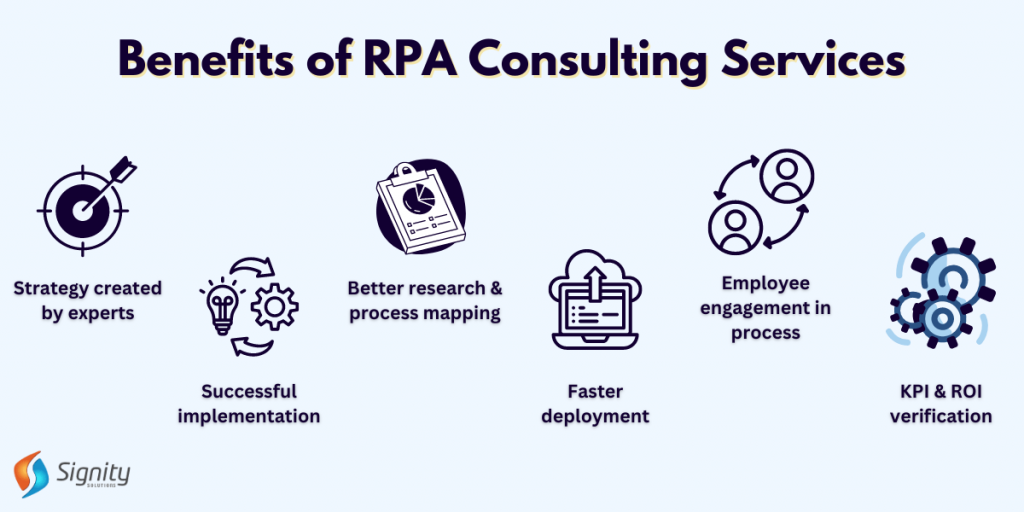
Let's Put It All Together
The benefits of RPA in business are incredible. It can revolutionize the way we do business and make it a hundred times more productive. However, implementing RPA in business is not as easy as it seems. Without proper planning, it can be difficult for businesses to achieve the results they desire.
Most of the time, businesses only focus on internal policies, processes, and business operations. They think that they can achieve more productivity just by automating these processes, and while doing so, they completely miss the bigger picture.
We just have to avoid making the same mistake and plan the RPA solutions carefully so that we can make the best possible use of the trend.

Mangesh Gothankar


Ashwani Sharma
Achin Verma
Frequently Asked Questions
Have a question in mind? We are here to answer. If you don’t see your question here, drop us a line at our contact page.
What are the main benefits of RPA in business?

Does RPA replace employees?
Does RPA replace employees?
How is RPA different from AI?
What kinds of business processes are best suited for RPA?
How do you measure the ROI of an RPA project?