

.png?width=27&height=27&name=Group(1).png)

-1.svg)
-1.svg)


-2.svg)


%201-1.webp?width=148&height=74&name=our%20work%20(2)%201-1.webp)




.svg)





According to McKinsey's Global AI Survey, 72% of enterprises now have at least one AI workload running in production. Running a workload isn't the same as running AI well.
Most of these deployments stay confined to a single department. They are never connected to the shared data or governance the rest of the organization needs in order to benefit from them.
An AI readiness assessment framework is designed to close that gap. It gives enterprises a structured way to see where they stand in terms of technology, data, and understanding in people before committing any budget to the next AI initiative.
Leadership does not have to rely on guesswork; it works instead from a scored AI readiness checklist it can act on immediately. The rest of this guide outlines what an enterprise AI readiness assessment measures and how to conduct one. It also explains why some organizations scale AI past the pilot stage while others do not.
 Generate
Key Takeaways
Generate
Key Takeaways

- An AI readiness assessment framework evaluates technology data and talent. It does this before AI spending begins.
- Data quality and governance failures are still common. They remain the main reason enterprise AI pilots stall.
- Talent readiness is the weakest pillar. Only 20% of organizations rate themselves as highly prepared.
- Strong AI readiness scores correlate with faster results. Measurable outcomes arrive nearly four times faster.
What Is an AI Readiness Assessment Framework?
An AI readiness assessment framework is a structured method for evaluating whether an organization's technology, data, governance, and talent can support successful AI implementation before it commits budget to a new initiative.
The gap between AI adoption and AI value is now the central problem in enterprise AI. Gartner reports that only 38% of CIOs and technology leaders rate their AI value-creation progress as excellent or good. Most organizations have access to AI. Few have built the foundation to make it pay off.
A comprehensive AI readiness assessment gets underneath that problem. It stops looking at the technology alone and starts asking a harder question: can the organization around it actually support what leadership wants to fund? That means checking the data foundation. It means checking the comprehensive framework. It means checking whether the people are ready.
Enterprises that skip this step tend to find out the hard way, usually mid-project. Data sitting in silos nobody has merged. Ownership nobody claimed. A workforce that was never trained on what just got built.
The output of a good assessment is not a slide deck. It is a scored AI readiness index that leadership can revisit every quarter, track against new AI opportunities, and use to defend or reject budget requests with actual evidence instead of enthusiasm. For a fast self-check, see our breakdown of the signs your business is ready for AI before commissioning a full assessment.
The Core Pillars of an Enterprise AI Readiness Assessment
A credible AI readiness assessment framework rests on five pillars. Strategic alignment sets the direction while data provides the foundation for AI use. At the same time, technology selection and architecture support the business processes, and governance helps to keep it accountable. On top of that, talent determines whether any of it actually works. All an organization needs to work is to score each pillar honestly and identify where to focus next.
| Pillar | What It Assesses | Key Question |
| Strategic Alignment | Business goals, executive sponsorship, use case prioritization | Does this map to a goal leadership already tracks, or is it AI for its own sake? |
| Data Readiness | Data quality, data governance, integration capabilities, and data silos | Is the data accurate, accessible, and connected across the systems that feed a model? |
| Technology & Architecture | Cloud infrastructure, MLOps, integration capabilities, model management | Can the architecture run this model in production, not just in a demo? |
| AI Governance & Risk | Governance framework, compliance, ethical considerations, risk management | Who owns artificial intelligence risk here, and how is it monitored after launch? |
| Talent & Culture | Skills, AI fluency, change management, stakeholder buy-in | Do the teams touching this system have the skills and the mandate to use it daily? |
| Measurement & KPIs | Key performance indicators, ROI tracking, AI readiness index | How will success get measured, and who reviews that scorecard quarterly? |
These pillars do not operate in isolation. A strong data foundation is worth little without a governance framework behind it. Also, a governance framework means nothing if key stakeholders never agreed on the business goals around an AI initiative.
Remember, the strongest assessments score all six pillars together while outranking the gaps by business impact.
Technology and Architecture Readiness
Technology and architecture readiness measures whether an enterprise's existing systems, data pipelines, and infrastructure can support AI models in production. In practice, this pillar breaks into four layers.
Data Layer
- Covers where information actually lives: a cloud data warehouse or lakehouse, plus the ETL and ELT pipelines that feed it.
- Also covers whether that data is structured well enough for a model to use in the first place.
- Gartner's data and analytics research puts a number on the problem: 70% to 90% of enterprise data remains unstructured, and most governance programs were never built to handle it.
Integration Layer
- Connects models to the systems already running the business, through APIs and event pipelines.
- Increasingly relies on the Model Context Protocol, which lets AI agents call internal tools and data sources directly instead of leaning on brittle, one-off integrations.
- For retrieval-augmented generation use cases, this layer also needs a vector database and a chunking and indexing strategy. That keeps retrieved answers grounded in an enterprise's own documents rather than a model's general training data.
Model Layer
- Covers MLOps: how models get trained, versioned, deployed, monitored, and retrained as data drifts.
Security Layer
- Wraps around all three layers above.
- Includes encryption, access controls, and audit logging that satisfy both internal risk teams and external regulators.
Enterprises that skip architecture readiness tend to pay for it later. Pipelines get rebuilt mid-project once a pilot's data assumptions collide with production reality.
Related Read: Data Engineering Solutions: Enterprise Architecture and Best Practices.
How to Run an AI Maturity Assessment: A Structured Approach
An AI maturity assessment is the process side of the framework. It's a repeatable method for scoring each pillar and prioritizing gaps; the output becomes a roadmap that actually gets used.
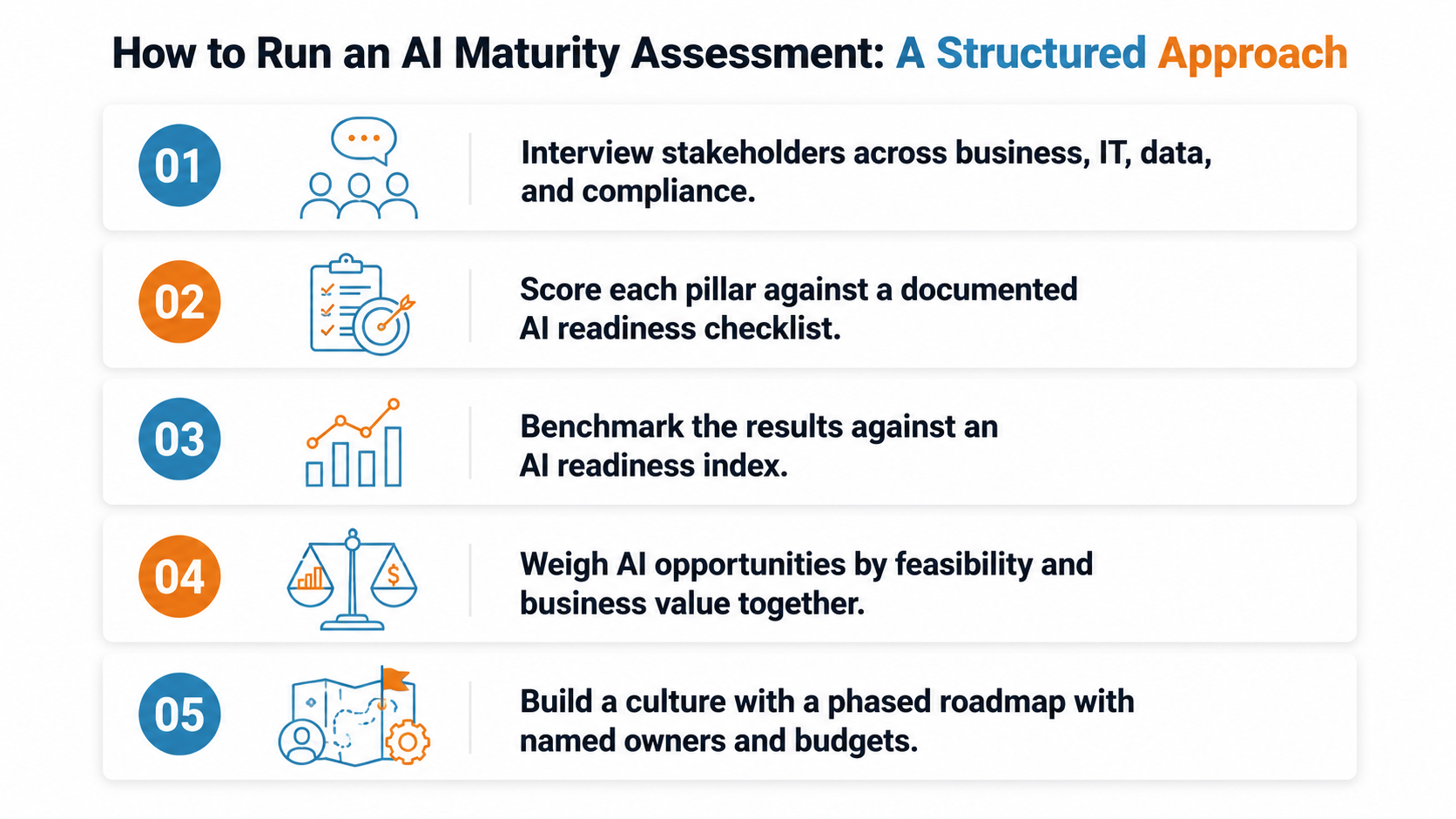
- Interview stakeholders across business, IT, data, and compliance. This is where perception and operational reality usually diverge.
- Score each pillar against a documented AI readiness checklist rather than a gut-feel rating. Ratings that shift depending on who's in the room aren't worth much.
- Benchmark the results against an AI readiness index. Leadership can then track progress and compare business units year over year.
- Weigh AI opportunities by feasibility and business value together. Internal excitement about a use case should not decide the order.
- Build a culture with a phased roadmap with named owners and budgets. Attach key performance indicators to every initiative from day one.
This should run as a continuous operating rhythm rather than a one-time audit. Regulations shift, and data volumes grow. New AI technologies show up faster than most organizations can absorb them. A readiness score from eighteen months ago rarely reflects where things stand today.
For a longer view on sequencing these steps at a mid-size organization, see our guide to building an AI roadmap for mid-market enterprises.
Compliance, Governance, and Risk Management in AI Readiness
AI governance is the set of policies, roles, and controls that keep AI systems compliant as they move to production. It is one of the least optional pillars in this framework.
Governance is no longer optional for enterprises running AI at scale. Gartner's research puts a number on why: 63% of organizations either lack solid data-management practices for AI or aren't sure whether they have them. The firm expects that shortfall to drive the abandonment of roughly 60% of AI projects lacking AI-ready data by 2026.
Regulation adds a hard deadline on top of that risk. Under the EU AI Act, Article 50 transparency obligations, covering chatbot disclosure, emotion-detection disclosure, and deepfake labeling, become enforceable on August 2, 2026.
Following the European Parliament's June 2026 vote on the Digital Omnibus amendments, Annex III high-risk system obligations for domains like employment, credit, and healthcare were pushed to December 2027. Enterprises operating in or serving the EU still need an AI inventory and a risk classification process in place now, regardless. Waiting for a final deadline is not a compliance strategy.
A practical AI governance framework assigns clear ownership for each AI system and documents how data flows into every model. Audit logging is part of that from day one. Most teams find it out the hard way. But many enterprises now anchor that framework to ISO/IEC 42001, the international standard for AI management systems.
Related Read: Understanding AI Governance: Key Strategies for Effective Oversight.
Turning AI Readiness into Measurable Business Value
AI readiness only matters if it produces business outcomes. It should reflect in terms of revenue growth, saving the expenses, or a measurable lift in customer satisfaction. In short, readiness is the input and value is the output leadership actually cares about.
The payoff for getting readiness right is significant and increasingly well documented. Grant Thornton's 2026 research found that organizations running fully integrated AI strategy are nearly four times more likely to report significant revenue growth than organizations still stuck piloting, 58% against 15%. That gap has little to do with model quality. It comes down to whether the organization solved its data, governance, and talent problems before scaling.
Talent remains the hardest part to fix quickly. Deloitte's State of AI in the Enterprise 2026 report found that talent readiness sits at just 20% highly prepared, the lowest of any dimension it tracks. Insufficient worker skills, the report says, is the single biggest barrier to deeper AI integration.
Closing that gap takes longer than buying a new platform. So it belongs in the assessment from day one rather than showing up as an afterthought once the technology is already live.
Enterprises that tie each AI initiative to a specific key performance indicator, whether that's reduced processing time or higher customer satisfaction or new revenue from an AI-enabled product, build the kind of continuous improvement loop that keeps AI investment defensible at renewal time.
This is also where competitive advantage actually gets built. Two competitors can license the same underlying AI models, yet the one with cleaner data and a trained workforce turns that access into results months earlier.
For a deeper look at where agentic AI fits into that value case, see our enterprise agentic AI strategy guide.
Conclusion
An AI readiness assessment framework is not a document you file away after one pass. It's a repeatable way to check whether technology, data, and teams are actually aligned before an enterprise commits real budget to AI.
The organizations pulling ahead in 2026 are not necessarily running more advanced models than everyone else. They took the time to fix data quality, assign governance ownership, and close the talent gap before scaling; the results reflect it.
The same principle holds whether an organization is running its first pilot or trying to move a dozen stalled projects into production. Measure readiness honestly and fix the gaps in order of business impact. Treat the assessment as a habit rather than a one-time event.
Signity Solutions has run this process with enterprises across banking, retail, and healthcare. One pattern keeps repeating: the companies that assess before they build are the ones still scaling AI a year later.