


.png?width=27&height=27&name=Group(1).png)

-1.svg)
-1.svg)


-2.svg)


%201-1.webp?width=148&height=74&name=our%20work%20(2)%201-1.webp)




.svg)





Most fintech cost articles give broad ranges without explaining the build choices behind them. That gap matters in 2026.
U.S. fintech products now operate in a market shaped by digital wallets, instant payments, stricter data expectations, and higher fraud pressure.
Federal Reserve Financial Services reported in February 2026 that 58% of consumers use digital wallets for fast, flexible payments.
Also, McKinsey estimated that the global fintech market generated about $650 billion in revenue in 2025, with North America contributing roughly $310 billion, making it the largest regional market. At the same time, risk is rising alongside adoption.
That is why the U.S. fintech app cost is not only about interface design or app feature count. It includes compliance architecture, payment infrastructure, fraud systems, vendor economics, and delivery quality.
Let us quickly aim at learning the fintech app development cost and how various factors related to regulatory compliance, multi-currency support, and everything from basic features to ongoing maintenance add to the final cost.
 Generate
Key Takeaways
Generate
Key Takeaways

- Most U.S. fintech apps cost $70,000 to $450,000+.
- Compliance and fraud controls raise costs faster than UI.
- Architecture choices shape both launch speed and ROI.
- The right partner reduces risk, delays, and rework.
How Much Does It Cost to Build a Fintech App in USA?
Fintech app development cost is the total budget required to design, build, secure, integrate, test, launch, and support a regulated financial product.
A lean U.S. fintech MVP usually starts at $70,000 to $120,000. A market-ready product typically falls between $120,000 and $250,000. An advanced platform with deeper compliance, more integrations, or broader user roles usually lands between $250,000 and $450,000+.
These numbers should be treated as 2026 planning benchmarks, not generic agency quotes. They reflect real U.S. labor economics, fintech delivery effort, infrastructure setup, QA, and security overhead.
The Bureau of Labor Statistics reported in December 2025 that private-industry employers spent 29.9% of compensation on benefits. That makes unrealistic cost assumptions especially risky for fintech solutions.
| App Scope | Typical Use Case | Estimated U.S. Build Cost | Timeline |
| Lean MVP | Budgeting app, simple wallet, narrow P2P feature | $70,000-$120,000 | 3-5 months |
| Standard product | Payments app, lending journey, personal finance platform | $120,000-$250,000 | 5-8 months |
| Advanced platform | Embedded finance, wealth app, B2B treasury, multi-rail product | $250,000-$450,000+ | 8-12+ months |
Cost by Fintech App Category
Different fintech products create different cost structures. A personal finance app usually costs less because it focuses on aggregation, reporting, and visibility. A payments app costs more because routing, settlement, fraud checks, and payout flows need stronger infrastructure and more experienced fintech app developers.
Lending apps add to app complexity as the development process demands working through KYC, underwriting logic, document handling, and repayment journeys. Investment platforms move higher again because market data, reporting, and suitability requirements create deeper backend demands.
| Fintech App Type | Estimated Cost | Main Reason Cost Changes |
| Personal finance app | $70,000-$140,000 | Aggregation, dashboards, insights |
| Digital wallet app | $100,000-$220,000 | Payments, fraud logic, and settlement |
| Lending app | $140,000-$280,000 | KYC, underwriting, repayments |
| Investment app | $180,000-$350,000 | Real-time data, reporting, and suitability |
| Embedded finance app | $220,000-$450,000+ | Ledgering, partner APIs, multi-party flows |
FinTech App Development Cost Breakdown by Phase
| Stage | Typical Budget Allocation |
| Discovery & planning | 5–10% |
| UI/UX design | 10–15% |
| Backend engineering | 25–40% |
| Frontend development | 15–25% |
| QA & testing | 10–20% |
| DevOps & deployment | 5–10% |
| Post-launch support | 15–25% annually |
What Drives Fintech App Development Cost in the USA?
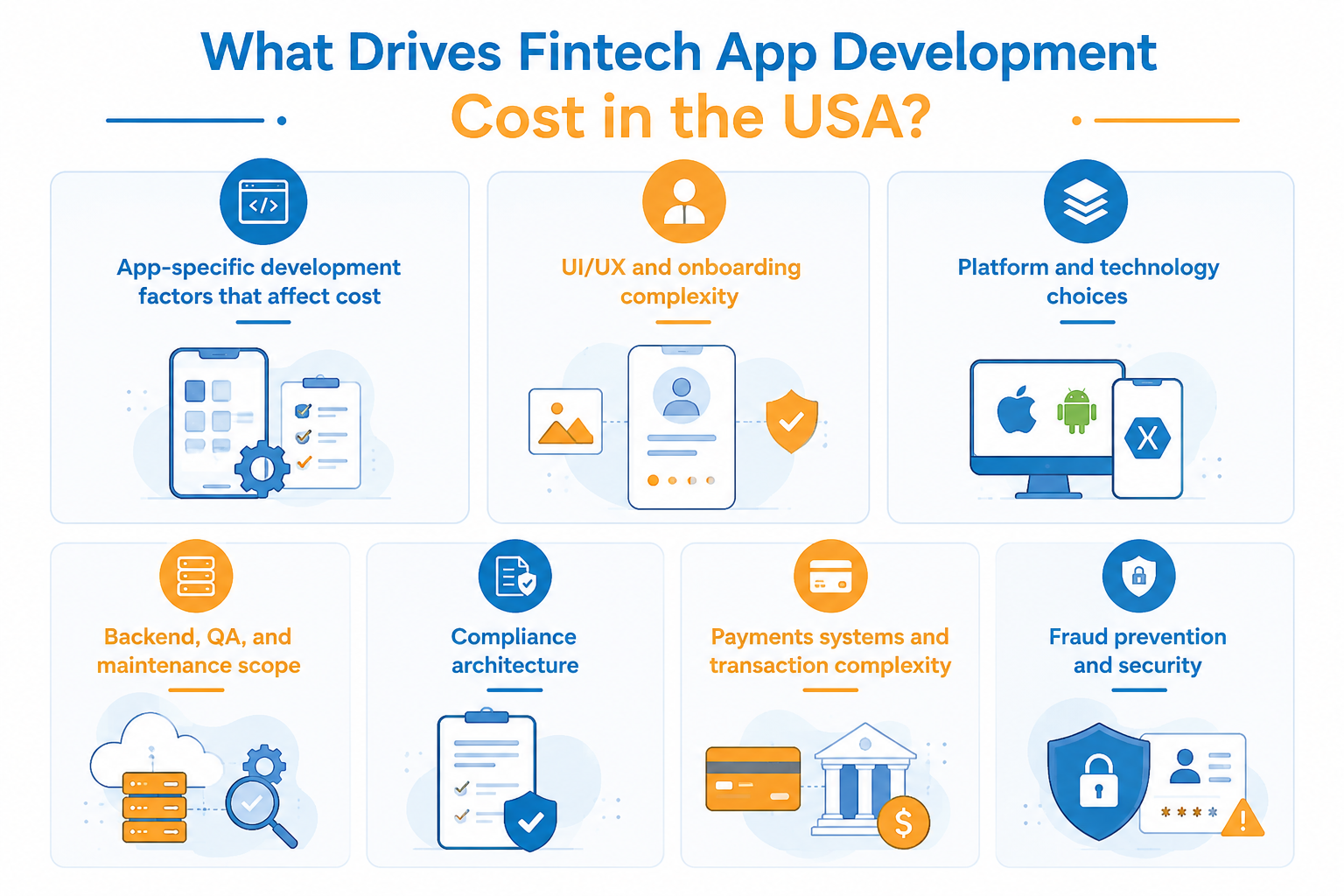
Cost drivers are the product, infrastructure, compliance, and delivery choices that expand or reduce engineering effort. The largest cost drivers usually sit behind the interface.
App-Specific Development Factors that Affect Cost
Beyond compliance and payments, fintech app development costs change with the practical build choices behind the product. UI/UX depth, platform strategy, backend architecture, integrations, QA, DevOps, and maintenance all affect the final estimate.
UI/UX and Onboarding Complexity
Fintech UX costs rise when the app needs KYC screens, guided onboarding, transaction confirmations, accessibility checks, error states, and trust-building microcopy. Better UX reduces drop-offs and support load, so it should be planned as a cost-control lever.
Platform and Technology Choices
Native iOS and Android development usually costs more than cross-platform delivery, but it can provide stronger performance and device-level control. Cross-platform development can reduce total development cost for the MVP (Minimum Viable Product) when the product does not need advanced native capabilities. Besides, the use of the technology stack and third-party integrations heavily affects the final operational costs.
Backend, QA, and Maintenance Scope
Ledger logic, APIs, admin tools, test automation, deployment pipelines, monitoring, and post-launch support all add engineering hours. These items are easy to underestimate because users rarely see them, but they determine reliability and long-term cost.
Compliance Architecture
Compliance is now part of the product foundation. For fintech apps that handle sensitive financial data or regulated user actions, the legal environment directly affects technical requirements. Be it bill payments or portfolio tracking for loan application evaluations, Fintech apps need an effective user authentication system. Even with that stay, apps should still be built around consent capture, revocation, auditability, and data minimization.
This is where budgets rise in practical ways. Teams need access controls, data-governance logic, admin review tools, audit trails, and operational visibility. These systems do not just satisfy policy expectations. They reduce implementation risk and make the product easier to scale.
Payments Systems and Transaction Complexity
The moment a fintech app moves money, the cost profile changes. A content-led or reporting-led product is one thing. A product that handles ACH, card funding, payouts, wallet balances, refunds, or reconciliation is another.
Payment economics matter early as well. Stripe’s standard U.S. card pricing starts at 2.9% + 30¢ per successful charge. Stripe Connect pricing can add $2 per active account per month and 0.25% + 25¢ per payout, depending on the implementation model. Those recurring charges influence unit economics, partner decisions, and how aggressively the product can scale.
Fraud Prevention and Security
Security has become one of the clearest reasons fintech budgets rise, and the numbers justify it. IBM found that the average breach cost in financial services was $6.08 million, above the $4.88 million global cross-industry average.
That is why strong fintech products need more than login security. They need MFA, session visibility, anomaly detection, transaction-risk rules, alerting, and internal response workflows. Identity verification also becomes a measurable operating cost at scale. Twilio Verify lists $0.05 per successful verification plus $0.0083 per U.S. SMS.
How AI affects Fintech App Cost and Value?
AI should be treated as a cost driver when it changes a financial workflow, not as a standalone trend section. It adds value in fraud detection, underwriting, document review, customer support, and personalized insights; McKinsey identifies AI as a major force in the next phase of fintech growth.
Cost Impact
AI increases effort through data-pipeline quality, model monitoring, explainability, governance controls, and human review workflows.
Best Implementation Path
Start with one high-value use case where AI reduces manual effort or improves dynamic risk assessment, then expand once the data and controls have proven reliable.
Audience and Workflow Depth
Audience changes the build more than many teams expect. Consumer apps prioritize speed and onboarding. SMB finance products introduce approvals, cash-flow workflows, reporting, and accounting sync.
Enterprise fintech platforms add SSO, permissioning, audit readiness, and partner integrations. As the audience becomes more operationally complex, the app becomes a system of financial execution rather than a simple mobile experience.
What should a 2026 Fintech App Architecture Include?
Fintech architecture is the service blueprint that supports secure transactions, compliance, performance, and future scale.
Many blogs stop at feature lists, but architecture is where fintech cost is really decided. A product may look simple on the surface while depending on a complex set of financial, operational, and compliance services underneath.
Architecture by Audience
| Audience | Primary expectation | Core services needed | Cost implication |
| Consumers | Fast signup, simple payments, and account visibility | Auth, wallet/account service, ledger, alerts, fraud checks | Speed and trust drive design |
| SMB users | Cash flow visibility, payouts, approvals | Roles, reporting, payouts, and accounting sync | Backend workflow grows quickly |
| Enterprise users | Controls, integrations, and auditability | SSO, APIs, entitlements, approval chains, reporting | Highest implementation load |
Identity Layer
This layer handles user signup, login, MFA, session control, passwordless access, and verification checkpoints. In fintech, identity is not only about convenience. It protects accounts, supports trust, and creates the access foundation needed for secure money movement.
Core Financial Layer
This is the heart of the product. It manages balances, ledger entries, transaction history, reconciliation states, and account-level financial records. If this layer is designed poorly, reporting becomes unreliable, and future payment expansion becomes expensive.
Payment Layer
This layer connects the app to ACH, cards, wallet top-ups, payouts, refunds, and settlement workflows. It determines how funds move through the system and how clearly those movements can be tracked, reversed, or audited.
Risk Layer
The risk layer supports fraud rules, anomaly detection, transaction monitoring, and checks for suspicious behavior. It enables the app to reduce fraud exposure without interrupting legitimate user activity.
Compliance Layer
This layer stores consent records, audit trails, review states, policy-aligned data controls, and internal oversight workflows. It enables the product to support governance requirements and operational transparency.
Notification Layer
This layer manages SMS, email, push alerts, OTP delivery, payment confirmations, and issue notifications. In fintech, communication is not only a user-experience feature. It is part of trust, security, and support operations.
Observability Layer
This layer includes logs, uptime monitoring, alerts, performance tracking, and incident visibility. It helps teams detect failures quickly, resolve issues faster, and maintain confidence as transaction volume grows.
Architecture Decisions that Reduce Future Cost
In most fintech builds, a modular monolith is the best starting point unless there is a clear reason to distribute services earlier.
Separating the ledger from the app-facing account experience is another high-value decision because it protects the product from rework of later transactions.
Using managed services for identity, messaging, and monitoring usually accelerates implementation and reduces engineering waste. It is also wise to include an internal operations dashboard in version one.
Remember, Fintech products without operational tooling often create avoidable support overhead after launch.
What are the Biggest Challenges in Fintech App Development?
The biggest challenges are regulatory uncertainty, fraud exposure, third-party API dependency, integration failures, and transaction reliability at scale. Each one becomes a cost issue when it is handled late.
- Regulation and risk: Compliance changes affect onboarding, consent, reporting, and audit logic.
- Integration dependency: Payment, KYC, banking, and analytics vendors add testing and support overhead.
- Scale reliability: Higher transaction volume increases demands on reconciliation, uptime, and exception handling.
How do you Control the Cost of a Fintech App without Slowing Delivery?
Cost control in fintech means reducing unnecessary complexity without weakening the systems that protect trust, revenue, and compliance.
The strongest fintech teams control cost by narrowing the first release. A product that focuses on one audience, one strong financial workflow, and one well-defined value proposition usually reaches the market faster and produces cleaner growth signals. This keeps engineering effort aligned with business outcomes instead of spreading the budget across too many features too early.
Another important move is modeling recurring vendor costs early. Payment fees, KYC services, OTP verification, data-access APIs, and payout charges all shape long-term margin. Launch costs matter, but operating costs matter just as much.
Operational readiness also deserves more attention than it usually gets. Review queues, admin tools, reporting workflows, and exception handling reduce support effort from the beginning. In fintech, these systems do not slow growth. They make growth manageable.
The last major lever is the selection of development partners. A fintech development company with regulated product experience reduces rework, improves architecture decisions, and shortens the path to launch.
All these factors matter during the fintech app development process because implementation quality in fintech affects both build efficiency and long-term commercial performance.
How do Fintech Apps make Money?
Monetization should be planned with cost because vendor fees, payment rails, and user volume determine margin.
- Consumer apps often use subscriptions, premium insights, interchange, or transaction fees.
- Payment platforms earn through processing markups or payout fees. Lending products use origination, servicing, or referral revenue.
- B2B fintech apps usually rely on SaaS pricing, usage-based billing, or premium analytics.
Why Signity for Fintech Development?
Signity should be positioned as a fintech partner that brings architecture-first execution, not just development capacity.
The right approach is to start with discovery, define service boundaries early, validate payment and compliance-sensitive flows, and narrow the MVP around one high-value financial outcome. This reduces rework, improves delivery confidence, and protects long-term ROI.
Signity’s strength should be framed around secure onboarding, transaction-aware workflows, admin visibility, integration readiness, and scalable implementation. For fintech products in the U.S., that combination matters because cost control comes from better architecture, sharper scope, and regulated-product discipline, not from cutting critical systems.
Conclusion
The cost to develop a fintech app in the USA usually falls between $70,000 and $450,000+, but the real driver is not the number of screens. It is the quality of the product foundation.
In 2026, fintech costs are shaped by compliance architecture, payment logic, fraud controls, vendor economics, and the team building the overall system experience.
For companies that want stronger ROI, the most effective path is clear: define a narrow release, architect for trust, model recurring costs early, and choose a partner that understands regulated digital products. That combination reduces rework, accelerates implementation, and creates a stronger path to scale.

Mangesh Gothankar


Ashwani Sharma
Achin Verma
Frequently Asked Questions
Have a question in mind? We are here to answer. If you don’t see your question here, drop us a line at our contact page.
Why is fintech app development more expensive than standard app development?

What is the biggest cost driver in a fintech app?
For most products, the biggest cost driver is the combination of transaction complexity, compliance requirements, and fraud protection.
How long does it take to develop a fintech app in the USA?
A lean MVP usually takes 3 to 5 months, a standard product takes 5 to 8 months, and an advanced platform can take 8 to 12+ months.
Can third-party APIs reduce fintech app development costs?
Yes. They reduce custom engineering work and speed up launch. However, they also introduce recurring fees and vendor dependencies, so they reduce upfront cost more than long-term cost.
Should I use one fintech service provider or multiple providers?
In most cases, fewer providers make version one easier to launch and easier to manage. A fragmented stack increases integration effort, support complexity, and reconciliation overhead.